Monograph
Burdock
Arctium lappa
Updated October 12, 2026
Key points
-
01
Gobo is food; tea is tradition
First-year root is a Japanese vegetable. EMA lists specified dried-root preparations as traditional for urinary flushing, appetite, and seborrheic skin—not as a cancer drug.
-
02
Root, fruit, and blends differ
Niubangzi is the fruit. Essiac is a mixture. Wrinkle creams used fruit extract. Do not cite one trial for another product.
-
03
Not cocklebur, not belladonna
Xanthium is a toxic lookalike. Atropine in “burdock tea” is contamination. Dig the right root or buy identity-tested material.
-
04
Asteraceae allergy is a hard stop
EMA contraindicates the daisy family. Anaphylaxis after boiled burdock is published. Chrysanthemum allergy is a warning.
-
05
Two weeks, then a clinician
Urinary or appetite use: see someone if symptoms last more than two weeks. Blood in the urine is not a dose increase.
Burdock (Arctium lappa) is a Eurasian daisy-family biennial whose hooked burrs hitch a ride on wool and invented a fastener. The first-year taproot is food in Japan as gobo. The same root, dried, is a European traditional herbal drug for urinary flushing, temporary loss of appetite, and seborrheic skin. The fruit is a different Chinese medicine (niubangzi). A label that only says burdock does not tell you which of these products you have.
This monograph keeps three facts in the same frame. First, the European Medicines Agency’s herbal committee lists specified oral root preparations as traditional use only. That is long-standing use, not a well-established diabetes or cancer indication. MSKCC’s About Herbs page is clear that there is no evidence to support burdock as a treatment for cancer, infections, or diabetes. Second, root, leaf, and fruit are not interchangeable chemistry. Lignans such as arctiin and arctigenin are richest in the seeds; the root is an inulin-heavy vegetable with caffeoylquinic acids. Third, commercial “burdock tea” has a contamination history. Bryson’s 1978 JAMA case was atropine poisoning from a tea that was not clean burdock. The plant does not make atropine; the cause was contamination, most likely with belladonna.
Nothing here is medical advice. A kinpira gobo side dish is dinner. A cleanse tea, an Essiac blend, or a fruit extract sold for wrinkles is not a cancer treatment. Do not confuse burdock with cocklebur (Xanthium), with rhubarb leaves, or with nightshade roots dug by mistake.
In this monograph
01 The plant
Botanical profile
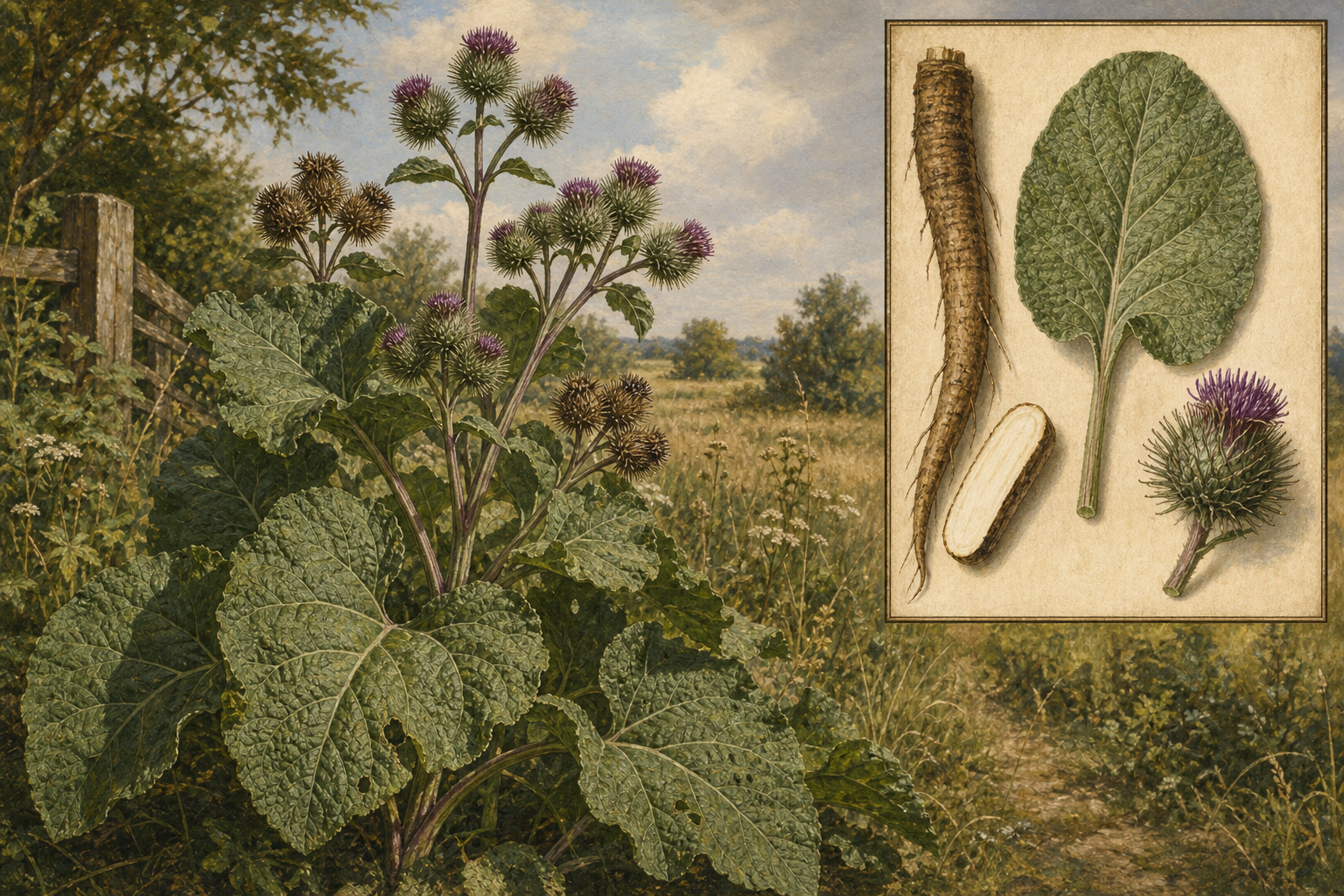
Arctium lappa L. sits in Asteraceae (the daisy family). NCBI Taxonomy treats it as taxon 4217. Linnaeus named it in Species Plantarum (1753); IPNI records the name as 178385-1. It is a robust biennial of nitrogen-rich waste ground, field edges, and riverbanks: huge cordate basal leaves, grooved often reddish stems, and globose flower heads with purple florets. The involucral bracts end in hooks. Those burrs are the plant’s seed-dispersal trick and the object George de Mestral studied before patenting hook-and-loop tape in 1955.
Native range is temperate Eurasia. European settlers carried it to North America, where it is now a familiar weed. Lesser burdock (A. minus) is smaller, with hollow petioles and more egg-shaped heads; woolly burdock (A. tomentosum) has cobwebby involucres. EMA’s herbal substance for Arctii radix is the dried root of A. lappa (including A. majus), A. minus, A. tomentosum, and related species, hybrids, or mixtures, collected in the autumn of the first year or the spring of the second. Japanese gobo is typically a cultivated A. lappa root harvested young and crisp. Wild second-year roots are woodier and more bitter.
Do not confuse this genus with cocklebur (Xanthium strumarium), a related composite whose burs look similar at a glance and whose seeds are a livestock toxicology file. Do not treat rhubarb (Rheum) leaves as burdock greens: the leaf shape can fool a forager; rhubarb leaf blades are not food. Do not dig unmarked taproots next to Atropa belladonna. That mix-up is the usual explanation for atropine in “burdock” tea, not a hidden alkaloid in Arctium.
Chemistry splits by organ. Ferracane and colleagues (2010) profiled seeds, roots, and leaves: caffeoylquinic acids (including chlorogenic acid), lignans (mainly arctiin), and flavonoids, with different emphases in each part. Root stores inulin, a fructan fiber that is food chemistry and a FODMAP, not a lignan drug. Arctigenin (the aglycone of arctiin) is the lab celebrity; it is not a standardized milligram on a gobo label. Polyacetylenes and chlorogenic acid are the usual named antibacterials in reviews (Chan 2011). Two products can share a Latin name and not share a chromatogram.
02 Lineage
History
The English name is the burr. Beggar’s buttons, lappa, bardane, and happy major are older aliases. Japanese kitchens have treated the root as a vegetable for centuries (gobo). Chinese materia medica values the fruit, Arctii Fructus (niubangzi), for wind-heat sore throat and some skin complaints—again, not the European root tea. European folk use added “blood purifier,” boils, and rheumatism to the same plant. Those traditions have not been tested in modern randomized trials.
German DAC material (Klettenwurzel, Bardanae radix) and later EU herbal law put the root on the traditional shelf. HMPC adopted the community monograph on 16 September 2010 (corrected 2011): three traditional indications, adults only, no well-established use. A 2020 addendum and a later call for scientific data have not, as of the current EMA landing page, rewritten that rank.
Twentieth-century North America added two extra stories. One is Essiac and Flor-Essence, multi-herb teas that include burdock and are marketed around cancer; Tamayo, Richardson, Diamond, and Skirvin (2000) reviewed the chemistry and found no adequate clinical proof. The other is contaminated tea: Bryson (JAMA 1978) described anticholinergic poisoning from a commercial burdock-root tea. Quality control, not folklore, is the safety headline there.
MSKCC’s monograph (updated 2023) is the clinical summary most US oncology patients will meet: lab antimicrobial and anti-inflammatory work, animal hypoglycemia and uterine stimulation, small human studies that are not confirmatory, and the atropine and allergy files. There is no NCCIH consumer page and no LiverTox chapter. A 2022 case of liver injury involved a multi-herb liver-cleanse tea that contained burdock among other plants (Niazi et al.). That case does not show that burdock alone was the cause.
03 Chemistry
Active compounds and how it works
Arctigenin is a dibenzylbutyrolactone lignan. In cell work it can damp iNOS, NO, TNF-α, and IL-6 signaling (Zhao, Wang, and Liu, 2009). That is cell-culture work, not evidence for treating rheumatoid disease with a root infusion. Arctiin is the glucoside; gut bacteria can unmask the aglycone. Seed and fruit extracts are the usual lignan-rich objects. Root tea is mostly inulin, chlorogenic acids, and a milder lignan load.
Inulin is a fructan. It ferments in the colon, which is why gobo can gas people who do not tolerate FODMAPs. It is a food fiber, not a diuretic and not an antimicrobial. EMA’s urinary indication is traditional “increase the amount of urine to achieve flushing,” which still requires extra fluid for non-tea preparations. It is not a loop diuretic and it is not a UTI antibiotic.
Polyacetylenes and caffeoylquinic acids are cited for antibacterial and skin folklore. Chan and colleagues (2011) reviewed preclinical anti-inflammatory, antimicrobial, antiulcer, hepatoprotective, and antidiabetic effects. These are promising but preclinical findings. Animal uterine stimulation is why pregnancy appears on MSKCC’s do-not-take list. EMA simply says safety in pregnancy and lactation is not established.
A cream with fruit extract is not a tea. Knott et al. (2008) studied topical A. lappa fruit extract on aging-skin signs. Maghsoumi-Norouzabad et al. (2016) studied root tea inflammatory markers in knee osteoarthritis. Wang 2004 studied a compound fructus arctii mixture in diabetic nephropathy. Those are three different products, and each result applies only to its own product.
04 In practice
Common uses
EMA traditional indications for specified oral root preparations, in adults: (1) increase urine output as an adjuvant in minor urinary-tract complaints; (2) temporary loss of appetite; (3) seborrheic skin conditions. If urinary symptoms last more than two weeks, or skin more than four, see a clinician. Fever, painful urination, spasms, or blood in the urine are a medical visit, not a stronger infusion. This is not a treatment for pyelonephritis or nephrotic syndrome.
Food: first-year root, julienned and soaked to blunt the muddy polyphenol taste, then cooked—kinpira, tonjiru, takikomi gohan. Young leaves and immature stalks appear in forager kitchens. Culinary gobo is not a labeled lignan extract and is not a cancer adjunct. It is still an Asteraceae exposure.
MSKCC: no evidence for cancer, AIDS, eczema, or psoriasis as treatments. A small osteoarthritis tea study improved some inflammatory markers, not a replacement for indicated joint care. Diabetic-nephropathy and H. pylori papers that MSKCC flags used combination products (compound fruit mixture; “burdock complex”), not a single-herb root capsule. Topical fruit extract has an encouraging wrinkle trial; confirmatory work would help. Do not delay cancer care, insulin, or an ulcer work-up in favor of burdock.
Essiac and “blood purification” claims have not been tested in clinical trials. Tamayo’s 2000 review of Essiac/Flor-Essence chemistry found interesting plants but inadequate clinical evidence. Burdock is one ingredient in those blends, and a blend does not inherit evidence from any single ingredient.
Do not use burdock to skip a urine culture or to treat acne as if it were isotretinoin. “Detox” claims for burdock are not supported by research, so it is not a daily cleanse. Indicated antibiotics, glucose-lowering drugs, and dermatology remain the foundation of care for the conditions people hope this plant will cover.
05 The apothecary
Preparations and traditional use
EMA traditional oral products (adults and elderly): comminuted root as infusion, 2–6 g, three times daily; powdered root 350 mg, three to five times daily; liquid extract DER 1:1 (ethanol 25% V/V), 2–8 ml three times daily; aqueous soft extract 0.2 g per dose, 1–2 g daily; tincture 1:10 (ethanol 45%) or 1:5 (ethanol 25%), 8–12 ml three times daily. Non-tea forms need adequate fluid if the aim is urinary flushing. No established use under 18. Concomitant synthetic diuretics are not recommended.
Food: fresh gobo root from a grocer, not a roadside biennial of unknown spray history. Soak cut root in water to reduce harshness. This is kitchen use.
Dietary supplements: dried root, teas, tinctures, capsules, fruit extracts, and “liver cleanse” blends. Look for Arctium lappa root if you want the EMA object. Fruit (Arctii Fructus) is the TCM file. Leaf is a third. Essiac-type mixtures add sheep sorrel, slippery elm, and rhubarb species; they are not burdock monotherapy. Quality varies. Atropine contamination is the reason to buy from a maker that tests identity rather than from an unlabeled bulk bin.
Topical fruit creams for skin aging rest on one small cosmetic trial (Knott 2008). Do not put unidentified leaf poultices on broken skin to treat boils. Contact dermatitis is published (Rodriguez 1995).
Safety
Before you use burdock
06 Caution
Side effects
EMA lists anaphylactic shock as a reported undesirable effect, frequency not known. Sasaki and colleagues (2003) described a 53-year-old man who developed whole-body redness and dyspnea an hour after eating boiled burdock; he recovered with treatment. That is food-as-allergen, not only capsules.
Allergic contact dermatitis from handling or applying the plant is documented (Rodriguez et al., 1995). People who react to chrysanthemums and other Asteraceae may cross-react (MSKCC; EMA contraindication is the whole family). Oral itching after eating gobo is an allergy warning sign.
Gastrointestinal: inulin can cause bloating, gas, and loose stool, especially in people who already struggle with fructans. Bitters can bother an empty stomach.
Anticholinergic poisoning (dry mouth, dilated pupils, urinary retention, delirium) after “burdock tea” is the contamination story (Bryson 1978). Treat it as atropine until proven otherwise, and keep the package for identification. A 2022 liver-injury case involved a multi-herb liver-cleanse tea containing burdock (Niazi et al.). Stop the blend; burdock may not have been the only cause.
07 Caution
Contraindications
Do not use medicinal burdock if you are hypersensitive to Arctium or to other Asteraceae (ragweed, chrysanthemum, chamomile, echinacea, marigold). EMA’s contraindication is the family, not a single species.
EMA: safety in pregnancy and lactation is not established; use is not recommended. MSKCC is stricter on pregnancy because animal data show uterine stimulation and a theoretical risk of premature delivery. Culinary gobo in ordinary food amounts is a different exposure from gram-level extracts; still tell the obstetric clinician.
Do not use under 18 as a traditional herbal medicine (EMA). Do not use as a homemade diuretic if you already take a prescription water pill. If you have fever, dysuria, spasms, or hematuria, see a doctor—those can be infection or stones, not “more flushing.”
MSKCC: skip it as a cancer, AIDS, or diabetes treatment. Do not replace indicated glucose-lowering drugs with root tea because an animal study lowered blood sugar. People with significant kidney or heart disease who cannot freely increase fluid intake are a poor match for a flushing herb.
08 Caution
Drug and herb interactions
EMA’s traditional monograph lists no reported drug interactions for the specified oral root preparations. That does not rule interactions out, so still tell your pharmacist.
Synthetic diuretics: EMA advises against combining them with the urinary-flushing use; doubling up on urine output is not a safe plan. Lithium and other narrow-index drugs that care about fluid balance belong in the same conversation.
Diabetes medicines: preclinical hypoglycemia and small combination-product human papers are a reason to monitor, not to stack. Fruit-mixture trials are not root-tea pharmacokinetics.
Avoid unlabeled “liver cleanse” teas (burdock plus dandelion plus unidentified yellow dock); if liver enzymes rise, it is hard to tell which plant was responsible. Niazi’s case involved a blend, and Essiac is a blend. Keep track of every ingredient.
09 Questions
Frequently Asked Questions
Gobo is the Japanese culinary name for the first-year taproot, usually cultivated Arctium lappa. That is food. Dried root tea, TCM fruit, and Essiac blends are other products. A supermarket gobo stir-fry is not an EMA herbal medicine and not a cancer adjunct.
No meaningful clinical evidence. MSKCC says evidence is lacking. Essiac and Flor-Essence contain burdock among other herbs and are promoted as alternative cancer treatments; Tamayo’s 2000 review found the chemistry interesting and the human proof inadequate. Another bark tea sold for cancer, pau d’arco, shows the same gap between laboratory results and patients. Please do not delay cancer care for burdock tea.
Animal work shows lower blood sugar; that is not a reason to stop metformin. The diabetic-nephropathy paper MSKCC cites is a compound fruit mixture. A small root-tea study improved some inflammatory markers in knee osteoarthritis. Neither is a disease-modifying plan. Confirmatory trials are still wanted.
Bryson’s 1978 JAMA case was anticholinergic poisoning from a commercial tea labeled burdock. Arctium does not make atropine. The usual explanation is contamination with belladonna or another tropane plant. Buy identity-tested products. If you get dry mouth, dilated pupils, and confusion after a tea, get emergency care.
No. European traditional use and gobo are the root. Chinese niubangzi is the fruit, richer in lignans such as arctiin. Topical wrinkle research used a fruit extract. Check the plant part on the label.
Only with confident ID, unsprayed ground, and the right organ. Hooked burs and huge leaves mark Arctium. Cocklebur is a different, toxic genus. Rhubarb leaves are a different poison. Nightshade roots have been mixed into teas. A grocer’s gobo is the safer food. Medicinal extracts are a different exposure than a stir-fry.
Anyone with daisy-family allergy; pregnant or breastfeeding people using medicinal doses; children as a traditional herbal medicine; people already on prescription diuretics who want a flushing tea; and anyone treating cancer, a UTI with fever, or diabetes with a capsule instead of indicated care.
The hooks on the burr inspired George de Mestral’s hook-and-loop fastener, patented in 1955. That is industrial history, not a medical claim. The burs still stick to dogs.
10 References
Sources
These references support the history, clinical, and safety claims on this page. They are not an endorsement of any product.
-
Burdock
Memorial Sloan Kettering Cancer Center, About Herbs, 2023
Clinical summary: no evidence for cancer, diabetes, or infection treatment; atropine-contaminated tea; Asteraceae cross-reactivity; pregnancy uterine-stimulation caution; Essiac context.
-
Arctii radix — herbal medicinal product
European Medicines Agency, Committee on Herbal Medicinal Products, 2011
HMPC landing page for burdock root: traditional use in loss of appetite, seborrheic skin, and minor urinary complaints.
-
Community herbal monograph on Arctium lappa L., radix
European Medicines Agency (EMA/HMPC/246763/2009 Corr.1), 2010
Adopted 16 September 2010: traditional indications, adult posology for tea, powder, extracts, and tinctures; Asteraceae contraindication; anaphylaxis listed; diuretic caution; pregnancy not recommended.
-
Burdock root tea poisoning. Case report involving a commercial preparation
JAMA (PubMed 642161), 1978
Bryson: anticholinergic poisoning from a commercial tea labeled burdock—the atropine-contamination file, not an Arctium alkaloid.
-
Effects of Arctium lappa L. (Burdock) root tea on inflammatory status and oxidative stress in patients with knee osteoarthritis
International Journal of Rheumatic Diseases (PubMed 25350500), 2016
Maghsoumi-Norouzabad et al.: small root-tea study on inflammatory markers in knee OA; not a disease-modifying arthritis trial.
-
Natural Arctium lappa fruit extract improves the clinical signs of aging skin
Journal of Cosmetic Dermatology (PubMed 19146605), 2008
Knott et al.: topical fruit extract, not oral root tea—the wrinkle study MSKCC cites.
-
In vitro anti-inflammatory effects of arctigenin, a lignan from Arctium lappa L., through inhibition on iNOS pathway
Journal of Ethnopharmacology (PubMed 19429312), 2009
Zhao, Wang, and Liu: cell-level iNOS/NO mechanism for arctigenin, not a human anti-inflammatory trial.
-
Metabolic profile of the bioactive compounds of burdock (Arctium lappa) seeds, roots and leaves
Journal of Pharmaceutical and Biomedical Analysis (PubMed 19375261), 2010
Ferracane et al.: organ-specific caffeoylquinic acids, lignans (mainly arctiin), and flavonoids.
-
A review of the pharmacological effects of Arctium lappa (burdock)
Inflammopharmacology (PubMed 20981575), 2011
Chan et al.: preclinical anti-inflammatory, antimicrobial, antiulcer, hepatoprotective, and antidiabetic survey.
-
Anaphylaxis due to burdock
International Journal of Dermatology (PubMed 12786879), 2003
Sasaki et al.: systemic reaction after boiled burdock—the food-anaphylaxis case behind EMA’s listed shock.
-
Allergic contact dermatitis due to burdock (Arctium lappa)
Contact Dermatitis (PubMed 8549139), 1995
Rodriguez et al.: handling/topical allergy to the plant.
-
The chemistry and biological activity of herbs used in Flor-Essence herbal tonic and Essiac
Phytotherapy Research (PubMed 10641040), 2000
Tamayo, Richardson, Diamond, and Skirvin: burdock as one ingredient in cancer-marketed teas without adequate clinical proof.
-
Drug-induced liver injury from herbal liver detoxification tea
Case Reports in Gastroenterology (PubMed 36636365), 2022
Niazi et al.: acute liver injury after a multi-herb liver-cleanse tea that included burdock—not a LiverTox burdock chapter.
-
Clinical observation on treatment of diabetic nephropathy with compound fructus arctii mixture
Zhongguo Zhong Xi Yi Jie He Za Zhi (PubMed 15307694), 2004
Wang and Chen: compound fruit mixture in diabetic nephropathy—the combination study MSKCC cites, not root monotherapy.
-
Taxonomy browser: Arctium lappa
NCBI Taxonomy (NIH), 2024
NCBI taxon 4217 for greater burdock in Asteraceae.
-
Arctium lappa L.
International Plant Names Index, 1753
Linnaean name, Sp. Pl. 2: 816 (1753); LSID urn:lsid:ipni.org:names:178385-1.
-
Arctigenin
PubChem, National Library of Medicine (NIH), 2024
Dibenzylbutyrolactone lignan aglycone discussed for anti-inflammatory cell work; CID 64981, C21H24O6.
-
Arctiin
PubChem, National Library of Medicine (NIH), 2024
Principal seed lignan glycoside of burdock; CID 100528, C27H34O11.
-
Chlorogenic acid
PubChem, National Library of Medicine (NIH), 2024
Caffeoylquinic acid abundant in burdock organs; CID 1794427, C16H18O9.