Monograph
Butcher's Broom
Ruscus aculeatus
Updated October 12, 2026
Key points
-
01
Cladodes, not holly, not Scotch broom
Ruscus aculeatus is an asparagus-family shrub with spine-tipped false leaves. Cytisus scoparius is a different plant with sparteine. The drug is the rhizome.
-
02
Traditional, not well-established
EMA lists minor venous heaviness and hemorrhoid itch on long-standing use. Horse-chestnut seed extract sits higher on the same shelf. Vanscheidt 2002 was not enough to change the rank.
-
03
Combination trials are not Ruscus alone
Cyclo 3 Fort mixes Ruscus with hesperidin methylchalcone and vitamin C. Kakkos 2017 is that mix. Read the label before you cite the meta-analysis.
-
04
Two weeks, then a clinician
EMA: if symptoms last more than two weeks, get examined. Sudden one-leg swelling, ulcers, or rectal bleeding are not a dose increase.
-
05
Diabetes and allergy cautions
A ketoacidosis case report sits on MSKCC’s do-not-take list. Ruscogenin creams have a contact-dermatitis literature. Pregnancy is not recommended.
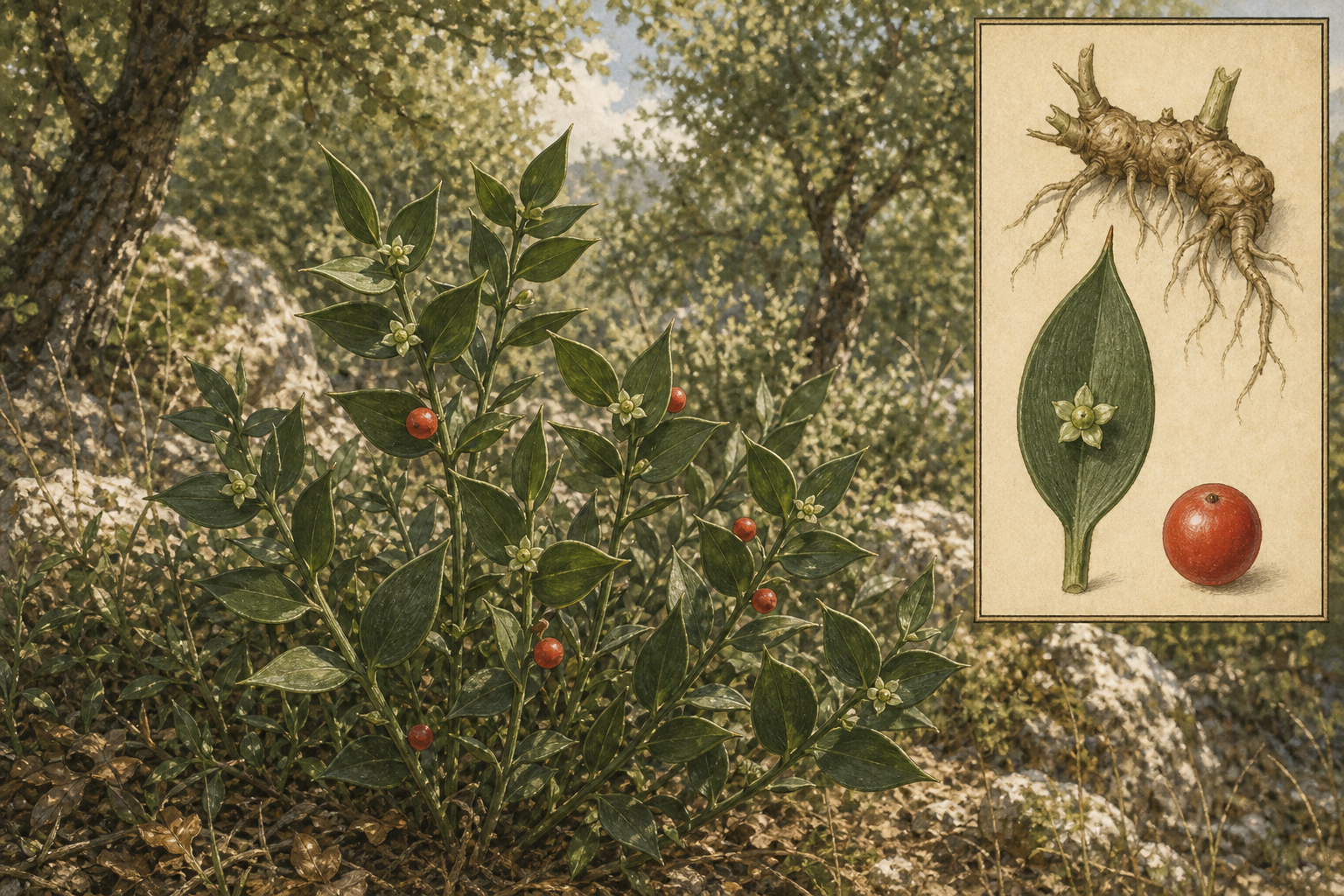
Butcher's broom (Ruscus aculeatus) is a low evergreen Mediterranean shrub whose “leaves” are not leaves. They are flattened stems—cladodes—with a spine at the tip and, in season, a small flower sitting in the middle of the green blade. The medicinal part in European pharmacy is the dried rhizome and root, Rusci rhizoma, not the red berries and not a bouquet of florist greens.
This monograph keeps three facts in the same frame. First, the European Medicines Agency’s herbal committee lists specified oral rhizome preparations as traditional use only: heaviness of the legs from minor venous circulatory disturbances, and itching or burning of hemorrhoids after a doctor has ruled out serious disease. That is a lower evidence rank than horse-chestnut seed extract, which EMA treats as well-established for chronic venous insufficiency (CVI). Second, a 2002 randomized trial of a Ruscus-only extract in women with CVI (Vanscheidt) found less leg volume and some symptom relief versus placebo; EMA still judged the overall benefit not convincing enough to leave the traditional shelf. Third, much of the modern “Ruscus works” literature is not Ruscus alone. Cyclo 3 Fort and kin mix Ruscus extract with hesperidin methylchalcone and vitamin C. Those combination meta-analyses are a different file.
Nothing here is medical advice. Sudden swelling of one leg, ulcers, rectal bleeding, or skin that looks infected is a clinic or emergency problem, not a capsule. Do not confuse this plant with Scotch broom (Cytisus scoparius), which is a different shrub with a different chemistry. Do not treat a clot, heart failure, or kidney failure with a Mediterranean understory herb.
In this monograph
01 The plant
Botanical profile
Ruscus aculeatus L. sits in Asparagaceae, subfamily Nolinoideae (older books file it in Liliaceae or Ruscaceae). NCBI Taxonomy treats it as taxon 59067. Linnaeus named it in Species Plantarum (1753); IPNI records the name as 540443-1. It is a dioecious, clump-forming evergreen: stiff, striated shoots bear ovate, spine-tipped cladodes that look like holly leaves and are not. True leaves are reduced to scales. Small greenish-white flowers sit in the center of the cladode; female plants may carry a round red berry. The underground organ is a knobby rhizome with fibrous roots—the Ph. Eur. drug (monograph 1847).
Native range is western and southern Europe, the Mediterranean, and east toward the Black Sea and Iran. It tolerates deep woodland shade and also grows on coastal cliffs and in hedgerows. Garden plantings have escaped in places outside that range. Culinary footnote: young spring shoots are eaten in parts of the Mediterranean like slender asparagus. That is food. It is not a ruscogenin tablet.
Do not confuse butcher's broom with Scotch broom (Cytisus scoparius, Fabaceae), a yellow-flowered shrub whose quinolizidine alkaloids include sparteine, or with Spanish broom (Spartium junceum). Those are different genera. Ruscus hypoglossum is a gentler Ruscus with larger, softer cladodes and showy bracts; it is not the Ph. Eur. rhizome monograph. Florist “Ruscus” greens are decorative cladodes, not a standardized extract.
The chemistry that labels care about is steroidal saponins. Intact glycosides include ruscin, ruscoside, and deglucoruscin. Acid or enzymatic hydrolysis yields the sapogenins ruscogenin and neoruscogenin, which are used to standardize extracts. Rhizomes also carry sterols, flavonoids, and the coumarin glucoside esculin—the same coumarin name that shows up in raw horse-chestnut seed, in a different plant. Barbič and colleagues (2013) found that saponins plus esculin reduced thrombin-induced leakiness of cultured endothelial cells. That is encouraging cell-culture work, not a replacement for compression stockings.
02 Lineage
History
The English name is a workshop story. Stiff, evergreen shoots were tied into bunches and used to sweep butchers’ chopping blocks. Italian pungitopo and German Mausedorn—“mouse-stinger”—record another use: spiny branches stacked around stored food to keep pests off. Dioscorides-era Mediterranean pharmacy already knew the plant, long before any modern venous trial.
Nineteenth-century European herbals treated the rhizome as a diuretic and mild laxative and, later, as a vein herb. The chemical turn is mid-twentieth century: spirostanol saponins based on ruscogenin and neoruscogenin were isolated from the underground parts, and French and German phytomedicine built oral extracts for heavy legs and hemorrhoids. German Commission E approved the rhizome in 1991 as supportive therapy for CVI discomfort and hemorrhoid complaints, with a daily target of 7–11 mg total ruscogenin after hydrolysis.
EU herbal law put the same plant on the traditional-use shelf. HMPC adopted a first community monograph in 2008 and revision 1 on 20 November 2018 (published 2019). The indications stayed traditional: minor venous heaviness, and hemorrhoid itch or burn after serious conditions are excluded. The 166-woman Vanscheidt trial was read and not promoted to well-established use. Combination products—Ruscus plus hesperidin methylchalcone plus ascorbic acid—ran a parallel commercial life (Cyclo 3 Fort, Fabroven). Boyle’s 2003 meta-analysis and Kakkos and Allaert’s 2017 review speak to that mix, not to a single-herb capsule.
In the United States the same rhizome is a dietary supplement. MSKCC’s About Herbs page (updated 2023) records small CVI studies, a combination lymphedema trial, diarrhea with Cyclo 3, contact allergy to ruscogenins, and a diabetic ketoacidosis case report. There is no NCCIH consumer monograph and no LiverTox chapter. It remains a traditional vein herb that has not reached horse chestnut’s well-established rank.
03 Chemistry
Active compounds and how it works
Ruscogenin and neoruscogenin are steroidal sapogenins, not a single tablet molecule. Experimental work points to venoconstriction with an α-adrenergic flavor: isolated-vein models contract more when Ruscus extract is applied, and α-blockers blunt the response in older pharmacology. That is why people talk about “vein tone.” It is also why combining it at home with other products said to constrict vessels is not advised. EMA does not require a clinical mechanism for traditional use and does not claim one.
Anti-inflammatory stories are better sourced in cells and animals than in people. Huang, Kou, Ma and colleagues (J Pharmacol Sci 2008) reported that ruscogenin cut TNF-α-driven ICAM-1 and NF-κB signaling. Facino and colleagues (1995) found saponins and sapogenins from Ruscus, ivy, and horse chestnut inhibited elastase and hyaluronidase—the enzymes blamed for chewing perivascular matrix in venous disease. Barbič 2013 added endothelial barrier effects for rhizome saponins and esculin. Lymphatic-flow claims exist in combination-product literature; they are not a confirmed human Ruscus-only mechanism (MSKCC).
Standardization is hydrolysis arithmetic. Labels often quote milligrams of ruscogenins (neoruscogenin plus ruscogenin after acid or fermentation). Commission E’s 7–11 mg/day is that sum. EMA’s traditional posology is instead listed as milligrams of powdered rhizome or of named dry extracts, not as a ruscogenin milligram on every pack. Two bottles can share a plant and not share an assay.
04 In practice
Common uses
Heavy legs and minor venous complaints are the traditional indication. EMA: oral rhizome preparations to relieve discomfort and heaviness related to minor venous circulatory disturbances, in adults, and only after the usual red flags are not present. Vanscheidt et al. (Arzneimittelforschung 2002) randomized 166 women with Widmer I–II / CEAP 3–4 CVI to a methanol dry extract (Fagorutin Ruscus) or placebo for twelve weeks. Intent-to-treat analysis (148 women) found a significant drop in the area-under-baseline of leg-volume change, plus ankle and calf circumference and some symptoms (heavy tired legs, tension) versus placebo. EMA’s public summary still called the overall benefit not convincing: women only, short duration, and not enough to leave traditional use. A positive RCT and a traditional-use rank can sit together.
Combination products are a larger, messier evidence pile. Boyle, Diehm, and Robertson (Int Angiol 2003) meta-analyzed Cyclo 3 Fort trials in CVI. Kakkos and Allaert (Int Angiol 2017, PMID 28225220) pooled ten mostly low-bias RCTs (719 people) of Ruscus extract plus hesperidin methylchalcone plus vitamin C and reported improvements in pain, heaviness, fatigue, swelling sensation, paresthesia, ankle circumference, and leg volume versus placebo. That is a three-ingredient drug. It is not proof that an unlabeled “butcher’s broom” capsule will do the same. Cappelli, Nicora, and Di Perri (1988) is an older Ruscus-extract venous-disease study still cited in clinical summaries; it is small and not a modern CVI program.
Hemorrhoids: EMA traditional use for itching and burning after a doctor has excluded serious disease. MSKCC says evidence is lacking. There is no Ruscus-only hemorrhoid RCT in the HMPC file. Rectal bleeding is a medical visit, not a dose increase.
Lymphedema after breast-cancer treatment: Cluzan et al. (Lymphology 1996) studied Cyclo 3 Fort for secondary upper-limb lymphedema. Combination product, one trial, not a Ruscus-alone protocol, and not a reason to skip compression or oncology follow-up. Constipation, “diuretic,” atherosclerosis, and general “circulation cleanses” are folk uses that have not been studied in meaningful trials (MSKCC).
Do not use butcher's broom to skip a vascular work-up, to treat a DVT, or as a food-like daily tonic. Compression, walking, weight, and indicated procedures remain the foundation of CVI care. Horse chestnut is a different saponin story with a stronger EMA rank; combining both in an unlabeled “vein complex” makes it hard to tell which plant did what.
05 The apothecary
Preparations and traditional use
EMA traditional oral products (adults), Ph. Eur. rhizome: powdered herbal substance 350 mg three times daily; aqueous dry extract DER 2.5–6.5:1, 150–200 mg per dose, maximum 450 mg/day; ethanolic dry extract DER 5–8.5:1 (ethanol 80% V/V), 86 mg once or twice daily; ethanolic dry extract DER 6–9:1 (ethanol 96% V/V), 45 mg twice daily (leg-heaviness indication). Hemorrhoid traditional posology covers the powder, the water extract, and the 80% ethanol extract on the same milligram schedule; the 96% ethanol extract is listed for indication 1. If symptoms last more than two weeks, see a clinician. No established use under 18.
Dietary supplements: capsules standardized to ruscogenins (Commission E’s 7–11 mg/day is the older German target), tinctures, and “vein blends” with horse chestnut, gotu kola, or citrus bioflavonoids. Quality varies. Look for Ruscus aculeatus rhizome, not “broom herb” and not Cytisus. Combination tablets with hesperidin methylchalcone and vitamin C are a different product class; match the trial if a clinician still wants that mix.
Food: young shoots cooked like asparagus in Mediterranean kitchens. That exposure is not a CVI dose. Florist cladodes and red berries are not tea material. Do not decoct garden plants of unknown identity.
Topical hemorrhoid creams and “vein” gels with ruscogenin exist in some markets. They are not the oral EMA monograph, and they have a small contact-allergy file. Do not apply them to broken skin.
Safety
Before you use butcher's broom
06 Caution
Side effects
EMA’s 2018 monograph listed no known undesirable effects for the specified traditional oral preparations, with the usual “tell a doctor if something happens” line. Commission E already noted rare gastric disorders or nausea. Real-world products vary more than that.
Gastrointestinal: nausea and stomach upset with some extracts. Chronic diarrhea is a documented problem with Cyclo 3 Fort (Thomas-Anterion et al., 1993, and later case series). MSKCC says diarrhea is frequent with that combination and less common with other butcher's-broom formulations. A combination pill’s diarrhea is not automatically a Ruscus-only effect, but it is a reason to read the label.
Skin: allergic contact dermatitis to ruscogenins is published. Ramírez-Hernández and colleagues (Contact Dermatitis 2006) described lesions from a hemorrhoid cream, then a generalized flare after an anti-cellulite product that also contained ruscogenin. A pregnant woman developed a spreading papulo-erythematous eruption and eyelid edema from a vasoconstrictor cream containing butcher's-broom extract (Landa 1990, cited by MSKCC). If a rash appears, stop the cream rather than applying more.
Metabolic: Sadarmin and Timperley (J Emerg Med 2013) reported diabetic ketoacidosis in a 39-year-old woman five days after taking butcher's broom for mild ankle swelling. MSKCC lists diabetes as a do-not-take. That is a case report, not a trial, and it is still a reason for people with diabetes to talk with a clinician before using this herb.
07 Caution
Contraindications
Do not use if you are allergic to Ruscus preparations or to ruscogenins. Do not use Scotch broom or Spanish broom as a substitute. Do not use oral traditional products in children or adolescents; EMA says the use has not been established under 18.
EMA: safety in pregnancy and lactation is not established; use is not recommended. The topical-cream pregnancy case is a separate warning against assuming “natural vein cream” is fine in pregnancy. No fertility data.
See a doctor before any vein herb if there is skin inflammation, hard subcutaneous patches, ulcers, sudden swelling of one or both legs, or known cardiac or renal insufficiency (EMA indication-1 warnings). Those can be clots, ulcers, or organ failure. If rectal bleeding occurs, see a doctor (indication 2); bleeding needs examination before any herbal treatment.
MSKCC: skip butcher's broom if you have diabetes, given the ketoacidosis report. CVI still needs a diagnosis. This plant is not a treatment for arterial claudication, unworked-up edema, or post-thrombotic ulcers. Compression, wound care, and indicated procedures remain first.
08 Caution
Drug and herb interactions
EMA’s traditional monograph lists no reported drug interactions for the specified oral rhizome preparations. That does not rule interactions out, so still tell your pharmacist.
α-adrenergic pharmacology is the theoretical overlap: other stimulants, decongestants, and some blood-pressure regimens. This is not a documented EMA interaction table. It is a reason not to build a homemade “circulation stack.”
Anticoagulants: unlike raw horse-chestnut esculin folklore, butcher's broom does not have a clean bleeding-trial file. Esculin is still present in the rhizome chemistry. If you take warfarin, DOACs, or dual antiplatelet therapy, this is a clinician conversation.
Do not mix unlabeled “circulation” blends (horse chestnut plus butcher's broom plus unidentified citrus bioflavonoids); if the gut or the liver reacts, it is hard to tell which plant was responsible. Combination products already confound diarrhea reports and some older vein-tablet hepatotoxicity stories on the horse-chestnut side. Keep track of every ingredient.
09 Questions
Frequently Asked Questions
No. Butcher's broom is Ruscus aculeatus, an evergreen with cladodes and a saponin rhizome. Scotch broom is Cytisus scoparius, a yellow-flowered pea-family shrub with quinolizidine alkaloids including sparteine. Spanish broom (Spartium junceum) is another different plant. Do not brew a plant labeled only “broom.”
EMA allows traditional use for heaviness of the legs from minor venous disturbances, not a well-established CVI indication. Vanscheidt’s 2002 trial of a Ruscus-only extract reduced some swelling and symptoms in women versus placebo; the HMPC still did not promote it. Combination Ruscus–hesperidin–vitamin C products have a larger trial pile. None of that replaces compression or a clot work-up.
They often pool Cyclo 3 Fort, which is Ruscus extract plus hesperidin methylchalcone plus ascorbic acid. Boyle 2003 and Kakkos 2017 are that combination. A single-herb capsule is not automatically the same medicine.
Young Mediterranean shoots are a traditional vegetable, like slender asparagus. That is not a medicinal dose. The red berries should not be eaten, and florist greens are not tea material. The evidence and the EMA posology are for dried rhizome preparations.
EMA does not recommend medicinal use in pregnancy or while breastfeeding. MSKCC flags a diabetic ketoacidosis case report and lists diabetes as a reason not to take it. Those cautions mean avoiding it, not just taking less.
Traditional European use for itching and burning after a doctor has excluded serious disease. MSKCC calls the evidence lacking. Rectal bleeding needs examination, not a ruscogenin cream as the only plan. Topical ruscogenin products can cause contact dermatitis.
Different plant, different saponins (ruscogenins versus escin), different EMA rank. Horse-chestnut seed extract is well-established for CVI symptoms. Butcher's broom is traditional for minor venous heaviness. Avoid unlabeled vein blends that mix the two.
Anyone allergic to Ruscus or ruscogenins; children; pregnant or breastfeeding people using medicinal doses; people with diabetes unless a clinician agrees; and anyone with sudden one-leg swelling, ulcers, heart or kidney failure, or rectal bleeding. CVI still needs a diagnosis before an extract is a plan.
10 References
Sources
These references support the history, clinical, and safety claims on this page. They are not an endorsement of any product.
-
Butcher's broom
Memorial Sloan Kettering Cancer Center, About Herbs, 2023
Clinical summary: small CVI studies, Cyclo 3 Fort lymphedema trial, diarrhea with the combination, ruscogenin contact allergy, and the diabetic ketoacidosis case as a do-not-take.
-
Rusci rhizoma — herbal medicinal product
European Medicines Agency, Committee on Herbal Medicinal Products, 2019
HMPC landing page: traditional use only for minor venous heaviness and hemorrhoid itch/burn; public summary of the Vanscheidt trial’s limited weight.
-
European Union herbal monograph on Ruscus aculeatus L., rhizoma (revision 1)
European Medicines Agency (EMA/HMPC/188804/2017), 2018
Adopted 20 November 2018: traditional indications, adult posology for powder and named dry extracts, two-week review, pregnancy not recommended, no known interactions or listed adverse effects.
-
Efficacy and safety of a Butcher's broom preparation (Ruscus aculeatus L. extract) compared to placebo in patients suffering from chronic venous insufficiency
Arzneimittel-Forschung (PubMed 12040966), 2002
Vanscheidt et al.: 12-week multicenter RCT of a Ruscus-only extract in women with CVI; reduced leg volume and some symptoms versus placebo.
-
Efficacy of Ruscus extract, HMC and vitamin C, constituents of Cyclo 3 fort, on improving individual venous symptoms and edema: a systematic review and meta-analysis of randomized double-blind placebo-controlled trials
International Angiology (PubMed 28225220), 2017
Kakkos and Allaert: 10 RCTs of the three-ingredient combination, not Ruscus monotherapy; symptom and edema improvements versus placebo.
-
Meta-analysis of clinical trials of Cyclo 3 Fort in the treatment of chronic venous insufficiency
International Angiology (PubMed 14612852), 2003
Boyle, Diehm, and Robertson: earlier pooling of the Ruscus–hesperidin methylchalcone–ascorbic acid product in CVI.
-
Use of extract of Ruscus aculeatus in venous disease in the lower limbs
Drugs under Experimental and Clinical Research (PubMed 3048951), 1988
Cappelli, Nicora, and Di Perri: older clinical study of Ruscus extract in lower-limb venous disease, still cited in MSKCC’s CVI stack.
-
Treatment of secondary lymphedema of the upper limb with CYCLO 3 FORT
Lymphology (PubMed 8721977), 1996
Cluzan et al.: combination-product trial for post-breast-cancer upper-limb lymphedema—not a Ruscus-alone protocol.
-
Possible mechanism of the anti-inflammatory activity of ruscogenin: role of intercellular adhesion molecule-1 and nuclear factor-kappaB
Journal of Pharmacological Sciences (PubMed 18946195), 2008
Huang, Kou, Ma et al.: ruscogenin reduced TNF-α-driven ICAM-1 and NF-κB signaling in experimental inflammation.
-
Anti-elastase and anti-hyaluronidase activities of saponins and sapogenins from Hedera helix, Aesculus hippocastanum, and Ruscus aculeatus
Archiv der Pharmazie (PubMed 8554461), 1995
Facino et al.: in-vitro enzyme inhibition proposed as a contributor to venous-insufficiency phytotherapy.
-
Spirostanol saponins and esculin from Rusci rhizoma reduce the thrombin-induced hyperpermeability of endothelial cells
Phytochemistry (PubMed 23499166), 2013
Barbič et al.: rhizome saponins plus the coumarin esculin reduced endothelial leakiness in vitro.
-
Novel steroidal components from the underground parts of Ruscus aculeatus L.
Molecules (PubMed 23183890), 2012
De Marino et al.: steroidal saponin chemistry of the rhizome, the material behind ruscogenin assays.
-
An unusual case of Butcher's Broom precipitating diabetic ketoacidosis
The Journal of Emergency Medicine (PubMed 23849361), 2013
Sadarmin and Timperley: DKA five days after butcher's broom for ankle swelling—the case behind MSKCC’s diabetes caution.
-
Allergic contact dermatitis to ruscogenins
Contact Dermatitis (PubMed 16426297), 2006
Ramírez-Hernández et al.: topical ruscogenin allergy from a hemorrhoid cream, with later generalized flare from another ruscogenin product.
-
Unexplained chronic diarrhea, apropos of 4 new cases under Cyclo 3 fort and review of the literature
La Revue de Médecine Interne (PubMed 8378650), 1993
Thomas-Anterion et al.: chronic diarrhea attributed to the Ruscus–hesperidin–vitamin C combination product.
-
Taxonomy browser: Ruscus aculeatus
NCBI Taxonomy (NIH), 2024
NCBI taxon 59067 for butcher's broom in Asparagaceae, Nolinoideae.
-
Ruscus aculeatus L.
International Plant Names Index, 1753
Linnaean name, Sp. Pl. 2: 1041 (1753); LSID urn:lsid:ipni.org:names:540443-1.
-
Ruscogenin
PubChem, National Library of Medicine (NIH), 2024
Steroidal sapogenin used with neoruscogenin to standardize Ruscus extracts; CID 441893, C27H42O4.
-
Neoruscogenin
PubChem, National Library of Medicine (NIH), 2024
Companion sapogenin in hydrolyzed Ruscus saponins; CID 9910474, C27H40O4.
-
Butcher's Broom (Commission E)
American Botanical Council, Complete German Commission E Monographs, 1991
Approved 12 July 1991: supportive CVI and hemorrhoid use; 7–11 mg total ruscogenin daily; rare gastric upset.