Monograph
Elderberry
Sambucus nigra
Updated October 10, 2026
Key points
-
01
Cook ripe berries first
Raw or unripe berries, leaves, stems, and bark contain cyanide-releasing compounds and can cause vomiting and diarrhea. Cooking ripe fruit removes the risk; never crush in stems.
-
02
Mixed evidence for flu and colds
Small early trials suggested faster recovery, but a 2020 trial in 87 people with laboratory-confirmed influenza found no benefit. Preventing colds is unproven.
-
03
Elderflower and elderberry differ
EMA accepts elderflower tea as a traditional remedy for early cold symptoms but could not establish a monograph for the berry. Evidence for one does not cover the other.
-
04
No COVID or cytokine-storm evidence
There is no good evidence that elderberry prevents or treats COVID-19, and a 2021 systematic review found no evidence that it overstimulates the immune system.
-
05
Check first in pregnancy and with immunosuppressants
Medicinal doses are not recommended in pregnancy or breastfeeding, and EMA does not recommend berry products under 18. Ask your specialist first if you take immunosuppressants.
Elderberry is the small, purple-black fruit of the elder tree, Sambucus nigra, a hedgerow shrub or small tree also known as black elder, European elder, or common elder. It is both a food and an herb. Cooks turn the fully ripe, cooked berries into jams, syrups, pies, and wine, and herbalists use the berries and the flat clusters of creamy flowers, sold as elderflower, for colds and flu. Kew’s Plants of the World Online gives the plant’s native range as the Azores and Europe to western Iran, and it is now grown and naturalized far beyond that. The name has nothing to do with age, whatever autocorrect does to “elderly berry”: elder comes from the Anglo-Saxon aeld, fire, because the hollow young stems were used to blow up a fire. Other names include sambucus, Holunder in German, sureau in French, soc in Romanian, and sambuk shachor (סמבוק שחור) in Hebrew. Today elderberry is one of the best-selling herbal supplements in the United States, taken as syrups, gummies, lozenges, and capsules at the first sign of a cold or flu.
The evidence for colds and flu is genuinely mixed. Small trials of a commercial syrup in Israel and Norway reported influenza symptoms clearing two to four days sooner, a 2016 trial in 312 air travelers found shorter, milder colds but not fewer of them, and a 2019 meta-analysis of 180 participants reported a large benefit. Then a 2020 placebo-controlled trial in which all 87 participants had influenza confirmed by laboratory test found no benefit at all, and a post hoc analysis suggested that people taking elderberry without the antiviral oseltamivir did about two days worse than those taking placebo alone. A 2021 systematic review rated the evidence very uncertain: elderberry may not prevent colds, might shorten colds and flu, and showed no sign of overstimulating the immune system. Regulators draw a similar line. The European Medicines Agency (EMA) accepts elderflower teas and tinctures as traditional herbal medicines for early cold symptoms, based on long use rather than trials, but in 2014 its herbal committee concluded that a monograph for the berry could not be established. The National Center for Complementary and Integrative Health (NCCIH) says preliminary research suggests elderberry may relieve cold and flu symptoms and that there is no good evidence for COVID-19.
Safety depends on preparation. NCCIH warns that raw or unripe elderberries and other parts of the plant, such as the leaves and stems, contain cyanide-producing substances that can cause nausea, vomiting, and severe diarrhea, and that cooking eliminates the toxin. In 1983, eight people in California were flown by helicopter to hospital after drinking juice pressed from wild elderberries crushed together with their leaves and branches. Cooked, ripe berry products have been well tolerated in trials, but safety in pregnancy and breastfeeding has not been established, EMA does not recommend berry preparations under 18 or elderflower medicines under 12, and people taking immunosuppressant drugs should check with their prescriber first. Quality is a further problem: a 2023 bulletin from the nonprofit Botanical Adulterants Prevention Program found that extracts sold as elderberry were often partly or wholly replaced with cheaper black rice extract. Nothing here is medical advice. Elderberry is not a flu vaccine or an antiviral, and anyone at high risk of flu complications, or with shortness of breath, a fever, or symptoms that are getting worse, should contact a clinician promptly rather than rely on a syrup.
Featured in
Herbs for Colds, Flu and ImmunityIngredient in
Sinupret (BNO 1016)In this monograph
01 The plant
Botanical profile
Sambucus nigra L. was named by Linnaeus in Species Plantarum in 1753, and Kew’s Plants of the World Online (POWO) accepts it in the family Viburnaceae, order Dipsacales. Other references give other family names for the same plant. Mrs Grieve’s A Modern Herbal (1931) and the USDA PLANTS Database place it in the honeysuckle family, Caprifoliaceae, while the Woodland Trust and the European Food Safety Authority compendium quoted by EMA use the moschatel family, Adoxaceae. The plant has not changed; botanists have redrawn the family boundaries around it. POWO lists it as native from Portugal, Spain, Ireland, and Great Britain across Europe to Türkiye, the Caucasus, Lebanon and Syria, Iraq, and Iran, and as introduced in places as far apart as Argentina, Brazil, Chile, Australia, New Zealand, Pakistan, and parts of eastern North America. POWO records it as used for food, animal food, and medicine, and as a poison, a fair summary of the plant’s double life. The Woodland Trust notes that it grows in woodland, scrub, wasteland, and hedgerows, and often appears near rabbit warrens and badger setts, where animals spread the seeds in their droppings.
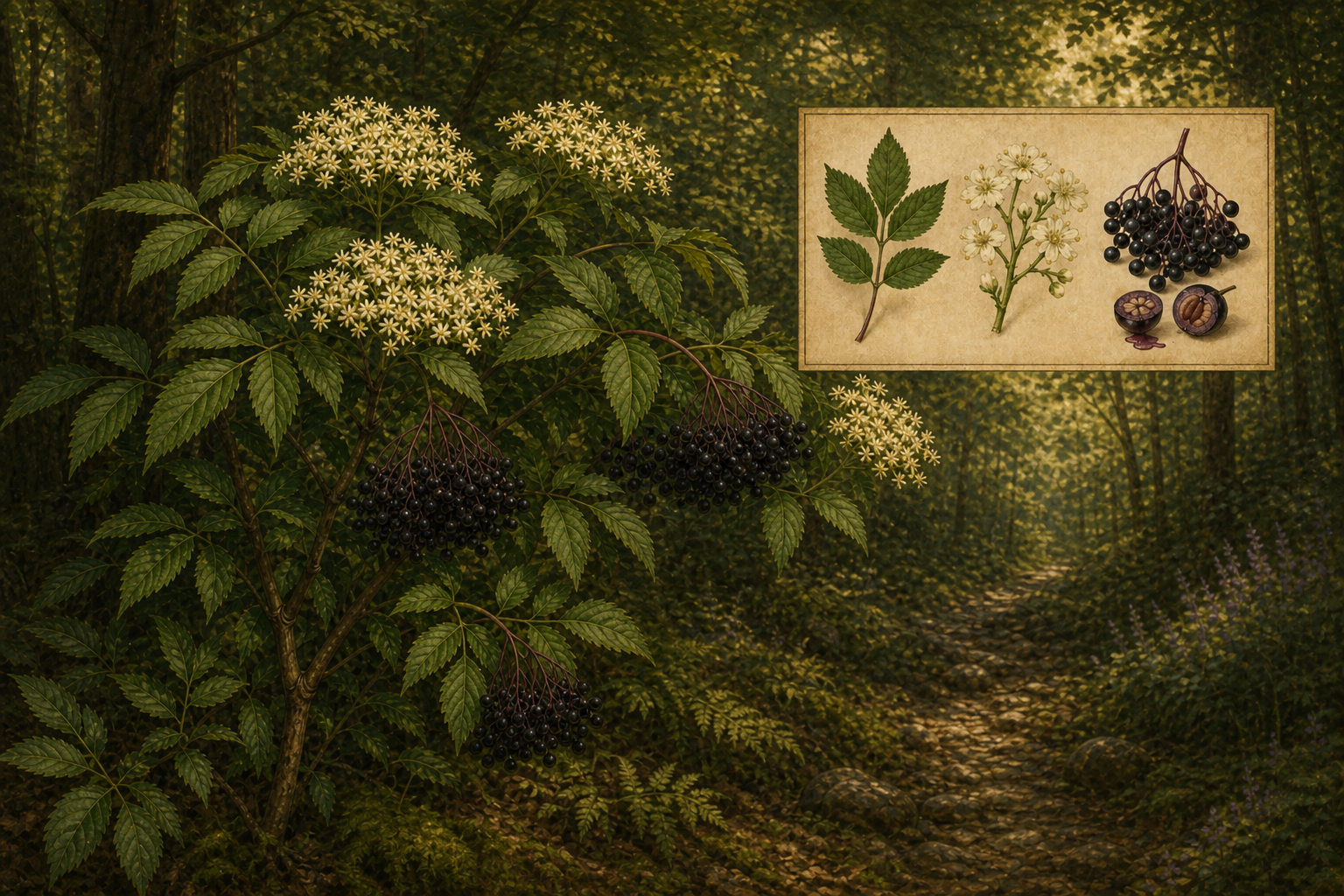
Elder is usually seen as a large shrub, but the Woodland Trust says mature trees can reach about 15 meters and live for around 60 years. It has a short trunk, grey-brown, corky, furrowed bark, and relatively few branches, and its twigs are hollow or filled with soft white pith, which is why the stems were once made into pipes and pop-guns (Grieve). The leaves are opposite and pinnate, with five to seven oval, toothed leaflets that smell unpleasant when bruised. From late May the plant carries flat flower heads 10 to 30 cm across, made of many tiny, creamy, highly scented five-petaled flowers; Grieve noted that in England the flowering season lasts only about three weeks in June. Each pollinated flower becomes a small, sour, purple-black berry that ripens from late summer into autumn, in heavy, drooping bunches. EMA’s assessment report describes the dried fruit as a wrinkled, roughly spherical drupe about 0.5 cm across that usually holds three small stones, each containing a seed. Birds and mammals eat the berries, dormice and bank voles eat both flowers and fruit, and many moth caterpillars feed on the leaves (Woodland Trust).
The berries’ color comes from anthocyanins. EMA’s 2014 assessment report, drawing on older analyses, gives 1 to 8 mg of anthocyanins per gram of fresh fruit, rising with ripeness, with two pigments dominating: cyanidin-3-glucoside, about two-thirds of the total, and cyanidin-3-sambubioside, about one-third. The fruit also contains flavonols such as rutin, isoquercitrin, and hyperoside, about 0.01% essential oil, up to 7.5% glucose and fructose, organic acids, pectin, potassium, and 18 to 26 mg of vitamin C per 100 g. Less welcome are the plant’s defensive compounds. Elder leaves contain cyanogenic glycosides, including sambunigrin, prunasin, zierin, and holocalin, which can release hydrogen cyanide; the EFSA compendium cited by EMA gives about 3 to 17 mg of hydrogen cyanide per 100 g of fresh leaf and about 3 mg per 100 g of fruit. Seeds and fresh berries contain lectins, proteins that bind to sugars on cell surfaces, and the bark contains a lectin called nigrin b that resembles ricin in structure and activity, although it is less toxic. The dried flowers are a separate herbal drug with their own European Pharmacopoeia monograph.
Elderberry labels hide a tangle of related plants. The USDA PLANTS Database treats American elder as a subspecies, Sambucus nigra subsp. canadensis, the American black elderberry, which is why US sources sometimes describe black elderberry as native to North America; Kew’s POWO instead keeps Sambucus canadensis as a separate species, native from North America to Venezuela and Bolivia. The 2023 adulterants bulletin lists the elder berries found in commerce as European elder, American elder, blue elder (S. cerulea, also called S. nigra subsp. cerulea), and dwarf elder (S. ebulus). Memorial Sloan Kettering Cancer Center (MSKCC) notes that American and blue elder berries have similar chemistry, but European elder is the type most studied and used in supplements, and almost every clinical trial described on this page used S. nigra extracts. The native western US elder involved in the 1983 California poisoning, which the CDC report called Sambucus mexicana, has berries that the report describes as edible when mature and commonly cooked into pies and jams, while its fresh leaves, flowers, bark, young buds, and roots contain a bitter alkaloid and a glucoside that can produce hydrocyanic acid. Correct identification, full ripeness, and removing every stem matter whichever elder ends up in the basket.
02 Lineage
History
Elder is one of Europe’s most storied plants, and Grieve’s A Modern Herbal (1931) gathers much of its lore. The English name traces to the Anglo-Saxon aeld, fire, because the soft pith pushes out of young stems to leave tubes for blowing up a fire, which also gave the old names pipe tree and bore tree. The genus name Sambucus appears in Pliny and may come from the sambuca, an ancient musical instrument, although Grieve doubted the link because the sambuca was a stringed instrument and elder wood would make a wind instrument. In Denmark a dryad called Hylde-Moer, the Elder-tree Mother, was said to live in the tree; permission had to be asked before cutting it, and she was believed to haunt the owners of furniture made from its wood. A medieval belief held that Judas hanged himself on an elder, a story echoed in Shakespeare’s Love’s Labour’s Lost, and the tree became an emblem of sorrow and death. Yet elders were also planted near English cottages for protection against witches, and the Woodland Trust records the belief that an elder planted by the house kept the Devil away. Gypsy custom, Grieve wrote, forbade burning its wood on camp fires.
Medicinal use is just as old. Grieve records that the Romans used elder and dwarf elder in medicine, as Pliny noted, that both were employed by early English and Welsh healers and at the medieval medical school of Salerno, and that the use of the bark as a purgative went back to Hippocrates. The seventeenth century was elder’s high point. In 1644 an English translation appeared of The Anatomie of the Elder by the physician Martin Blockwich, a treatise of some 230 pages that prescribed elder in every form from rob and syrup to tincture, oil, vinegar, and poultice for some seventy diseases or groups of diseases. The diarist John Evelyn wrote that if the medicinal properties of its leaves, bark, and berries were fully known, he could not tell what a countryman could ail for which he might not fetch a remedy from every hedge. Elder was called “the medicine chest of the country people,” and the great physician Boerhaave was said never to pass one without raising his hat. Grieve also makes clear which parts were harsh: the bark was a strong purgative and, in large doses, an emetic, and juice of the root caused vomiting, while the flowers and ripe berries were the gentler medicines.
Kitchen and pharmacy overlapped. Grieve describes elderberry rob, five pounds of ripe crushed berries simmered with a pound of sugar to the thickness of honey, taken a tablespoon or two in hot water at night to promote sweating and soothe the chest. It was official in the British Pharmacopoeia, renamed Succus Sambuci spissatus in 1788, and dropped in 1809. EMA’s assessment report adds that elderberry syrup was used against colds in parts of Europe including England and Holland, that a decoction of dried berries was used as a laxative in Germany, and that elderberry juice in port wine was taken to induce sweating. Elderberry wine, drunk hot at bedtime, was a country cold remedy, and Kent had whole orchards of elder grown for wine-makers. The juice was also used to fake port, a practice so widespread that Portugal banned it in 1747, along with growing the trees. Elderflower water was an official British preparation, used mainly as a base for eye and skin lotions, and Grieve recommended a strong, hot infusion of elderflower and peppermint, drunk in bed, at the first sign of influenza, a claim no one has tested in a trial.
The modern supplement story began in Israel. In the 1990s Zakay-Rones and colleagues reported that a standardized extract, Sambucol, inhibited many influenza strains in the laboratory and, in a small trial during a 1993 influenza B outbreak on a kibbutz, appeared to speed recovery. More trials followed, and so did demand. Macknin and colleagues noted that US elderberry sales more than doubled from 2017 to 2018, to over 100 million dollars, and the 2023 adulterants bulletin, citing the American Botanical Council’s market data, reported that elderberry was the top-selling herbal supplement ingredient in the US mass market in 2021, with combined sales of about 305 million dollars, before a 10% decline in 2022. Marketing claims drew regulators’ attention. MSKCC notes that the US Food and Drug Administration (FDA) has halted unsubstantiated claims that elderberry prevents or treats AIDS, diabetes, flu, and COVID-19, and NCCIH reports that the FDA and the Federal Trade Commission took action against companies marketing elderberry for COVID-19. In Europe, EMA’s herbal committee adopted a monograph on elderflower in 2008, revised it in 2018, and in 2014 issued a public statement, rather than a monograph, on the berry.
03 Chemistry
Active compounds and how it works
Most of elderberry’s plausible mechanisms come from laboratory work. In the 1995 Zakay-Rones study, Sambucol reduced hemagglutination, the clumping of red blood cells that influenza virus causes, and inhibited replication of several human influenza A (H1N1 and H3N2) and influenza B strains, as well as swine and turkey strains, in cultured dog kidney cells. MSKCC summarizes later work in which elderberry flavonoids bound to H1N1 virus particles and blocked their recognition of and entry into host cells. EMA’s assessment adds that methylated and esterified flavonoids may contribute, and mentions a small experiment in four chimpanzees in which flu-like symptoms were reduced after elderberry syrup. How much of this applies in people is unclear. EMA’s review of absorption studies found that elderberry anthocyanins can be absorbed intact, as glycosides, but at low rates, with most of the absorbed compounds excreted in urine within about four hours. Antiviral activity in a dish shows that an effect is plausible; it does not establish a dose, prove that enough reaches the airways, or show that elderberry beats rest and fluids, which is what clinical trials have to answer.
Elderberry’s effect on the immune system is where the COVID-era worry came from. In a 2001 laboratory study, Barak and colleagues exposed monocytes, a type of white blood cell, from 12 healthy donors to Sambucol products and found large increases in the inflammatory messengers IL-1β, TNF-α, IL-6, and IL-8, up to about 45-fold for TNF-α, which they presented as immune activation. During the pandemic, findings like this prompted concern that elderberry might tip infected people into a cytokine storm, an overwhelming inflammatory response. Wieland and colleagues looked for such harm in their 2021 systematic review and found no studies linking elderberry to clinical inflammatory outcomes. Three studies had measured cytokines in people after they took elderberry: a randomized trial in 52 postmenopausal women found no difference from placebo in CRP, TNF-α, or IL-6 after 12 weeks; 22 volunteers drinking dwarf elder (Sambucus ebulus) tea for 30 days had lower CRP and IL-1β; and in a small, poorly described study a single dose of elderberry tincture lowered IL-1 and, briefly, TNF-α, as did the painkiller diclofenac. EMA’s 2014 assessment judged the evidence for any immune-modulating effect insufficient. Test-tube stimulation has not translated into documented harm, and “immune support” on a label is a marketing phrase, not a measured outcome.
The plant’s toxicity has a clearer mechanism. Cyanogenic glycosides are harmless while intact, but when plant tissue is crushed, or when the glycosides meet the enzyme β-glucosidase in the gut, they break down and release hydrogen cyanide (EMA). Because hydrogen cyanide is volatile, heating berries or juice drives it off, which is why EMA concluded that heat treatment removes the small amount the seeds can release and that ripe fruit is safe to eat cooked or dried. Lectins in seeds, unripe berries, and branches are linked to stomach upset, and the CDC report on the 1983 outbreak also pointed to a bitter alkaloid in the leaves and bark. The eight people taken to hospital in that outbreak had normal serum cyanide levels, a reminder that cyanide may not be the whole story. Elderberry’s other reported effects are mostly laboratory findings. MSKCC lists blood-sugar-lowering activity, including activation of the PPAR-γ receptor by compounds from elderflowers, a diuretic effect in rats, and laxative effects in clinical studies of a multi-herb product. None of these has been tested well enough in people to guide treatment.
04 In practice
Common uses
Elderflower is the part with official European recognition. EMA’s herbal committee concluded that dried elderflower, taken as a tea, and two alcoholic preparations can be used to relieve early symptoms of the common cold, on the basis of long-standing use: at least 30 years of safe use, including 15 years within the EU, with plausible effectiveness. The committee also noted the lack of clinical studies with elderflower, so this is a traditional-use listing, not proof from trials. It applies to adults and adolescents over 12, and EMA advises seeing a doctor if symptoms worsen or last longer than a week, or if shortness of breath, fever, or purulent sputum develops. This matches centuries of practice. Grieve described hot elderflower tea at bedtime as a good old-fashioned remedy for colds and throat troubles, valued for inducing free perspiration. No modern trial has tested elderflower tea on its own, so the berry studies below should not be borrowed to support the flower, or the other way round. Elderflower cordials and fritters, made from the same blossoms, are food traditions rather than remedies.
For influenza, the first trials were small and positive. Zakay-Rones and colleagues (1995) tested Sambucol during an influenza B outbreak on an Israeli kibbutz in 1993: 93.3% of the elderberry group had a significant improvement in symptoms, including fever, within two days, while 91.7% of the placebo group improved within six days, and nearly 90% of the elderberry group felt completely cured within two to three days. The 2021 systematic review counted only 27 participants analyzed and rated the trial at unclear risk of bias because randomization was not described. In the 2004 follow-up, 60 adults aged 18 to 54 in Norway who had flu-like symptoms for 48 hours or less took 15 ml of elderberry or placebo syrup four times a day for five days; symptoms were relieved on average four days earlier with elderberry, rescue medicines were used less, and the authors asked for a larger study to confirm the result. A 2009 trial in China gave 64 adults lozenges with 175 mg of elderberry extract or placebo four times a day for two days, but did not report overall illness duration. Pooling the two Sambucol trials, the 2021 review found recovery nearly three days faster, with very low certainty and very inconsistent results.
The best-designed influenza trial so far was negative. Macknin and colleagues (Journal of General Internal Medicine 2020), in a registered, placebo-controlled trial, enrolled 87 patients aged 5 and older at three Midwestern emergency departments between January 2018 and April 2019, all with influenza confirmed by PCR test and at least two moderate symptoms for less than 48 hours. They took elderberry extract, 15 ml (5.7 g) twice a day for children aged 5 to 12 and four times a day for older patients, or placebo, for five days, and could also choose the antiviral oseltamivir (Tamiflu). Symptoms became mild after an average of 5.3 days with elderberry and 4.9 days with placebo, and resolved completely after 8.6 and 8.7 days, no meaningful difference, even though the trial was large enough to detect a two-day benefit. In a post hoc analysis, people taking elderberry without oseltamivir did about two days worse than those taking placebo alone. The authors noted that their results contradicted earlier studies. In a separate trial of 420 people, summarized in the 2021 review, a hot drink combining echinacea and elderberry performed about as well as oseltamivir by day five, but that tested a combination product, not elderberry on its own.
Evidence for colds is thinner. Tiralongo and colleagues (Nutrients 2016) randomized 312 economy-class passengers flying from Australia to overseas destinations to capsules of a membrane-filtered Sambucus nigra extract or placebo: 600 mg a day for ten days before travel, then 900 mg a day until four or five days after arrival. Slightly fewer people in the elderberry group caught a cold (12 versus 17), a difference that was not statistically significant, but the colds that did occur were shorter (57 versus 117 total cold-episode days) and less severe. The extract’s maker sponsored the study, and the 2021 review rated these results very low certainty, concluding that elderberry may not reduce the risk of catching a cold. Pooled analyses that combine cold and flu trials look more favorable. Hawkins and colleagues (2019) analyzed 180 participants and reported a large effect on upper respiratory symptoms, and Harnett and colleagues (2020), across five studies with 936 adults, concluded that berry preparations taken within 48 hours of onset may shorten and soften cold and flu symptoms, with most participants’ symptoms falling by an average of 50% within two to four days. Neither review included the negative 2020 emergency-room trial, and the trials they pool are small and use different products.
Beyond colds and flu, the evidence is sparse. NCCIH says there is not enough information to show whether elderberry helps with any other health purpose, and that there is no good evidence for preventing or treating COVID-19. MSKCC notes that randomized trials found elderberry ineffective for improving cardiovascular risk markers and for lowering cholesterol, and EMA found no clinical studies of the traditional laxative use, despite its long history. Small studies cited by MSKCC tested elderberry within products for chronic constipation and recurrent tonsillitis in children, which says little about elderberry alone. Blending elderberry with echinacea, zinc, or vitamin C is common in cold products, and it makes each ingredient’s contribution impossible to judge. A fair summary: elderberry might modestly shorten colds and flu when started early, based on small trials, several of them sponsored by product makers; the one carefully controlled trial in laboratory-confirmed influenza found no benefit; and prevention is unproven. That makes elderberry a reasonable comfort measure for some adults, not a treatment to rely on, and not a substitute for vaccination or for antivirals when a clinician recommends them.
05 The apothecary
Preparations and traditional use
Most elderberry supplements are made from the fruit and sold as syrups, gummies, tablets, capsules, and lozenges, under brand names such as Sambucol, according to MSKCC. Trial doses give the only evidence-based reference points, and they apply strictly to the products tested. The Sambucol trials used 15 ml of syrup four times a day for five days, started within 48 hours of flu symptoms; the 2004 syrup contained 38% elderberry extract. The 2020 emergency-room trial used 15 ml of extract (5.7 g) four times a day for people over 12 and twice a day for children aged 5 to 12, also for five days, without benefit. The air-travel trial used 300 mg capsules of an extract standardized to 15% anthocyanins and 22% polyphenols, two a day before travel and three a day during and after it. The Chinese lozenge trial used 175 mg of extract four times a day for two days. Harnett’s review notes that the studies tested short courses of commercial products, for up to 16 days. Extracts differ in strength, sugar, and added ingredients, so a dose on one label cannot be converted into a trial dose, and results from one product may not apply to another.
Traditional preparations always involve heat or drying. EMA’s assessment concludes that ripe fruit is safe to eat cooked or dried, that heat treatment drives off the small amount of hydrogen cyanide that seeds can release, and that leaves and stems should not be crushed into preparations at all. In practice that means picking only fully ripe, dark berries, stripping them from every stem, and simmering them before making juice, syrup, or jam. An 1837 recipe quoted by EMA, the Elder Rob, used five parts ripe berries to one part sugar, boiled gently to the consistency of thick honey; handbooks cited by EMA describe a tea of about 10 g of dried berries put into cold water, heated slowly to boiling, then steeped for 5 to 10 minutes. For elderflower, EMA’s 2018 monograph gives 2 to 5 g of dried flowers in 150 ml of boiling water three times a day, or 3 to 6 g as a decoction in 200 ml of water divided into two doses; a 1:1 liquid extract is taken at 2 to 5 ml, and a 1:5 tincture at 10 to 25 ml, three times a day. These amounts are for adults and adolescents, as elderflower medicines are not recommended under age 12.
Buying a supplement raises a different question: is it really elderberry? The 2023 Botanical Adulterants Prevention Bulletin, written by Stefan Gafner and Josef Brinckmann for the nonprofit ABC-AHP-NCNPR program, reviewed seven reports and publications on elderberry extracts and products, and roughly one in six of the samples analyzed failed identity specifications. The most common fraud was partial or complete substitution with black rice extract, which can cost up to 30 times less than genuine elderberry extract; other anthocyanin-rich plant extracts and blue or purple food colors were also found, and some products had a chemical fingerprint with no anthocyanins at all. Black rice is not dangerous, but it may not deliver elderberry’s effects, and undeclared dyes carry their own risks. Look for products that name Sambucus nigra fruit or berry, state the extract and its strength, and show independent quality testing, and be wary of unusually cheap extracts. Check syrups and gummies for added sugar, especially for children or anyone managing diabetes.
Safety
Before you use elderberry
06 Caution
Side effects
Cooked, ripe elderberry products have been well tolerated in clinical trials. Harnett’s rapid review found adverse events rare, with none serious, and in the two studies that reported them they were more common in the comparison groups than with elderberry. The 2021 systematic review found that most trials described side effects only briefly, without saying how they were collected, and that an echinacea and elderberry hot drink may have caused fewer adverse events than oseltamivir, with low certainty. In the air-travel trial, five of 312 participants reported problems such as an itchy throat, fatigue, or kidney pain; unblinding showed that some had taken placebo, and no causal link to elderberry could be established. The review concluded that elderberry may be a safe option for treating viral respiratory illness, while stressing that the evidence on harms, like the evidence on benefits, is uncertain. EMA’s elderflower monograph lists no known undesirable effects and no reported overdoses. MSKCC lists gastrointestinal upset and type 1, or immediate, allergy as infrequent reactions to elderberry. Trials have mostly lasted days to a few weeks, so daily use over months is the least studied pattern.
Poisoning comes from the wrong parts of the plant or from skipping the cooking. On August 26, 1983, 25 members of a religious group gathered in a remote part of Monterey County, California, where juice made from wild elderberries was served. Staff had crushed bunches of berries together with their leaves and branches in a press, added apple juice, water, and sugar, and stored the drink overnight. Within 15 minutes of drinking it, 11 people began to have nausea and vomiting. The eight most ill also had abdominal cramps and weakness, some with dizziness and numbness, and were flown by helicopter to hospital in Monterey; one, who had drunk five glasses, was stuporous and kept overnight. All recovered quickly, and those who drank only tea stayed well. The CDC report advised that the berries may be safe, particularly if cooked, though uncooked berries may cause nausea, and that leaves and stems should not be crushed into juice. NCCIH describes the same pattern: nausea, vomiting, and severe diarrhea from raw or unripe berries and other plant parts, and serious illness with large quantities.
A handful of case reports describe rarer problems, although none proves that elderberry was the cause. MSKCC lists acute pancreatitis in a 51-year-old man after he used black elderberry, which resolved with steroid treatment, and autoimmune hepatitis in a 60-year-old woman with Hashimoto’s thyroiditis who had taken elderberry-containing supplements long term; her liver tests returned to normal after she stopped the supplements and received immunosuppressive therapy. Pharmacovigilance reports gathered by EMA include abdominal pain after elderberry syrup in a 48-year-old Canadian woman, a change in blood-clotting test results (INR) in a 75-year-old Norwegian woman taking an elderberry supplement, and 22 allergic reactions among 26 Australian reports for a combination product containing andrographis, white willow, and elderberry; andrographis is a known cause of anaphylaxis, and in September 2026 Australia removed it from the ingredients permitted in new low-risk medicines. Combination products make it hard to know which ingredient was responsible, and spontaneous reports cannot show how common a reaction is. Tell a clinician about any unexpected symptom while taking elderberry, and mention every supplement you use, including gummies.
Long-term safety is the biggest gap. EMA found no studies of acute or repeated-dose toxicity, reproductive toxicity, or genotoxicity for elderberry, but concluded that neither its chemistry nor its long, widespread use as food suggests a high risk from preparations made from ripe fruit that has been cooked or heat-treated. That reasoning covers ordinary food amounts better than months of concentrated extract. Elderberry supplements, like all US dietary supplements, are not approved by the FDA before they are sold, as NCCIH explains, so their safety and labeling rest with the manufacturer, and the adulteration findings show that labels are not always accurate. Sugar is a practical side effect of many syrups and gummies, since traditional robs and syrups are built on sugar. Finally, the safety concern most discussed online, that elderberry might trigger a cytokine storm, is not supported by the clinical evidence so far: Wieland and colleagues found no evidence that it overstimulates the immune system, although with so few studies they described the evidence on harms as uncertain.
07 Caution
Contraindications
Never eat raw or unripe elderberries, or elder leaves, stems, bark, or roots. EMA’s assessment states that plant parts other than the flowers and ripe berries are reported to be poisonous and should not be eaten or included in elderberry preparations, that leaves and stems should not be crushed, and that bark lectins are toxic; MSKCC adds that eating elder bark, leaves, and raw berries has caused poisoning. Homemade juices, “immune shots,” and smoothies made from raw berries are the riskiest products, and foraged batches carry identification risks, since several Sambucus species grow wild and the 1983 outbreak involved a native western elder. The CDC report also recalls older anecdotal poisonings in children from American elder, so keep foraged berries and plants out of children’s reach. Anyone who becomes ill after eating an elder product, especially with vomiting, weakness, dizziness, numbness, or drowsiness, should call a poison control center or seek medical care. Do not try to make tea from elder leaves or bark: the bark was historically used as a drastic purgative and emetic, and it has no place in modern self-care.
Pregnancy and breastfeeding: avoid medicinal elderberry products unless a clinician advises otherwise. NCCIH says little is known about whether elderberry is safe for health purposes during pregnancy or breastfeeding. EMA does not recommend either the berry or the flower preparations during pregnancy or lactation, because safety has not been established, and MSKCC advises avoiding elderberry during both because of the risk of toxicity and stomach upset. Harnett’s review likewise found no reliable evidence to support use in pregnant or breastfeeding women, and no trial described on this page tested elderberry in pregnancy. These cautions concern concentrated supplements and homemade medicinal preparations. Fully ripe, cooked berries in ordinary foods such as jam or pie are a long-standing part of European diets, and EMA notes that the fruit is safe to eat when ripe and cooked or dried. Raw berries and green, unripe fruit remain off the menu for everyone. A pregnant person who develops flu-like symptoms should contact a clinician rather than self-treat with a syrup, because treatment decisions in pregnancy need professional input.
Children: EMA does not recommend elderberry fruit preparations for anyone under 18, or elderflower medicines for children under 12, because data on safety and efficacy are lacking. A few trials have included children: the 1995 Sambucol study enrolled both children and adults, and the 2020 emergency-room trial gave children aged 5 to 12 15 ml of extract twice a day, with no benefit over placebo. Children’s syrups and gummies are widely sold, but no trial has established a pediatric dose or shown that these products work in children. Never give children homemade preparations from raw or unripe berries, and supervise foraging closely. Gummies that look like candy should be stored like medicines, out of reach, and counted as part of the child’s daily intake if several products are used. A child with flu who is very unwell, breathing fast or with difficulty, or not drinking should see a clinician promptly, and a syrup is no reason to wait.
Autoimmune disease, transplants, and immunosuppressant drugs: EMA’s assessment notes that elderberry might, in theory, interfere with immunosuppressant therapy and corticosteroids because of possible immunostimulating activity, citing the laboratory cytokine work. There is no clinical evidence of harm, and the 2021 systematic review found no evidence of immune overstimulation, but the one case of autoimmune hepatitis listed by MSKCC occurred in a woman with an existing autoimmune thyroid disease. People with autoimmune conditions or organ transplants, or who take immunosuppressants, should discuss elderberry with their specialist before using it, and should never stop prescribed treatment in favor of a supplement. Allergy: EMA contraindicates elderflower medicines in anyone hypersensitive to them, and anyone who has reacted to elder flowers, berries, or pollen should avoid elder products. Finally, elderberry is never a reason to delay care: EMA advises seeing a doctor if cold symptoms worsen, last beyond a week, or come with shortness of breath, fever, or purulent sputum. Elderberry does not replace flu vaccination or antivirals prescribed by a clinician.
08 Caution
Drug and herb interactions
Immunosuppressants and corticosteroids are the main theoretical concern. EMA’s 2014 assessment states that elderberry might interfere with immunosuppressant therapy because of possible immunostimulating activity, noting that it may stimulate cytokine production by human monocytes, a finding that still needs confirmation in better studies, and it names corticosteroids in the same context. No clinical interaction has been documented, but drugs used after organ transplants and for autoimmune diseases are carefully dosed, and changes in immune activity can matter. People taking them should ask their transplant team, rheumatologist, or pharmacist before using elderberry, and should be especially cautious with multi-ingredient “immune” products whose other herbs may carry their own warnings. EMA’s elderflower monograph, by contrast, reports no known interactions for elderflower preparations, although it notes that tinctures and extracts containing alcohol must carry ethanol labeling, which matters for people taking medicines that interact with alcohol or avoiding alcohol for other reasons. NCCIH’s general advice applies: anyone taking prescription medicines should talk with a health care provider before using elderberry, because some herbs and medicines interact in harmful ways.
MSKCC lists three possible additive interactions. Elderberry showed blood-sugar-lowering activity in laboratory studies and might add to the effects of diabetes medicines; it promotes urination in animal studies and might add to diuretics; and laxative effects reported in clinical studies of a combination product could add to laxatives. For the first two, MSKCC says clinical relevance has yet to be determined. People taking insulin or other glucose-lowering drugs who notice symptoms of low blood sugar, or who take diuretics for heart failure or high blood pressure, should mention elderberry to their prescriber, and the sugar in many syrups pulls in the opposite direction for diabetes control. Separately, a Norwegian pharmacovigilance report summarized by EMA describes a change in INR, a measure of blood clotting, in a 75-year-old woman taking an elderberry supplement. A single report proves nothing, but people taking warfarin should tell their anticoagulation clinic about any new supplement, elderberry included, and have their INR checked if they start or stop one regularly.
Effects on drug metabolism are uncertain. A laboratory study listed in MSKCC’s references reported inhibition of CYP3A4, a liver enzyme that processes many medicines, by a multi-herb product called Sambucus Force and by its main constituents, echinacea and elderberry; whether this matters in people is unknown. With oseltamivir, the 2020 emergency-room trial allowed patients to take both. The trial found no overall benefit from elderberry, and a post hoc analysis suggested that those taking elderberry alone did worse than those on placebo alone, so there is no evidence-based reason to swap a prescribed antiviral for a syrup or to add elderberry expecting extra benefit. Stacking several cold products, for example an elderberry syrup, an elderberry gummy with zinc and echinacea, and an over-the-counter cold tablet, risks duplicate dosing and makes it impossible to tell which product caused a reaction. Keep a written list of everything you take, including gummies and teas, and show it to your pharmacist when you collect a prescription or buy a cold remedy.
09 Questions
Frequently Asked Questions
Elderberry is the dark purple-black fruit of the elder tree, Sambucus nigra, also called black elder or European elder. It is both a food and an herb: ripe, cooked berries go into jams, syrups, and wine, and the berries and the flowers, known as elderflower, have a long history in European folk medicine for colds and flu. Botanically, elder is a large shrub or small tree rather than a soft-stemmed herbaceous plant, but in the everyday sense of a medicinal plant it is very much an herb. Today it is sold mainly as syrups, gummies, lozenges, and capsules, often alongside echinacea in cold-season products.
They come from the same tree at different times of year. Elderflowers are the flat, creamy, scented flower heads of late spring and early summer, used for teas, cordials, and fritters; elderberries are the purple-black fruit that ripens from late summer. EMA accepts elderflower teas and tinctures as traditional herbal medicines for early cold symptoms, but it could not establish a monograph for the berry, while most clinical trials have tested berry extracts. The Woodland Trust notes that the flowers and cooked berries are edible, but uncooked berries and other parts of the plant are poisonous.
They are close cousins that botanists classify differently. Black or European elderberry is Sambucus nigra. The USDA treats American elder as a subspecies, Sambucus nigra subsp. canadensis, while Kew’s Plants of the World Online lists it as a separate species, Sambucus canadensis, native from North America to Venezuela and Bolivia. MSKCC notes that American and blue elder berries have similar chemistry, but European black elderberry is the most studied and the type used in most supplements, so trial results apply most directly to it. Both need full ripeness and cooking, and a good label names the species and the plant part.
No. NCCIH warns that raw or unripe elderberries, and the leaves and stems, contain cyanide-producing substances that can cause nausea, vomiting, and severe diarrhea, and that cooking eliminates the toxin. In 1983, eight people in California were flown to hospital after drinking juice pressed from wild elderberries crushed together with their leaves and branches. Pick only fully ripe berries, remove every stem, and cook the fruit before making juice, syrup, or jam. If someone becomes ill after eating a raw elder product, contact a poison control center.
Possibly a little, but the evidence is mixed. Small trials of commercial extracts reported flu symptoms clearing two to four days sooner, and a 2016 trial in air travelers found shorter, milder colds. But a 2020 placebo-controlled trial in 87 people with laboratory-confirmed influenza found no benefit, and a 2021 systematic review rated the evidence very uncertain and concluded that elderberry may not prevent colds. If you try it, the trials started within 48 hours of symptoms, and it should never replace a flu vaccine or a prescribed antiviral. For other options, see our guides to herbs for colds, flu and immunity and for coughs, or the monograph on pelargonium.
Safety has not been established. EMA does not recommend elderberry fruit preparations under 18 or elderflower medicines under 12, and does not recommend either during pregnancy or breastfeeding, because data are lacking. NCCIH says little is known about elderberry in pregnancy and breastfeeding, and MSKCC advises avoiding it then. A 2020 flu trial that included children aged 5 to 12 found no benefit. Ripe, cooked berries in ordinary foods such as jam are a different matter from concentrated supplements. Children and pregnant people with flu symptoms should be seen by a clinician rather than treated with syrup at home.
Talk to your specialist rather than deciding alone. There is no clinical evidence that elderberry worsens autoimmune disease, and a 2021 systematic review found no evidence that it overstimulates the immune system. But laboratory studies show elderberry products can raise inflammatory cytokines, EMA notes that it might in theory interfere with immunosuppressants and corticosteroids, and MSKCC lists a case of autoimmune hepatitis in a woman with Hashimoto’s thyroiditis who took elderberry-containing supplements long term. If you take immunosuppressants or have had a transplant, check before starting. Other immune-active herbs such as echinacea and astragalus raise similar questions.
Neither claim is supported. The cytokine-storm worry came from laboratory studies in which elderberry products sharply raised inflammatory messengers in white blood cells. A 2021 systematic review found no studies linking elderberry to clinical inflammatory harm, and studies in people found little or no rise in cytokines, with some markers falling. On the other side, NCCIH says there is no good evidence that elderberry prevents or treats COVID-19, and the FDA and Federal Trade Commission have acted against companies marketing elderberry for it. Anyone seriously ill with a respiratory infection needs medical care, not a supplement.
10 References
Sources
These references support the history, clinical, and safety claims on this page. They are not an endorsement of any product.
-
Elderberry
National Center for Complementary and Integrative Health (NIH), 2024
Consumer evidence summary (updated November 2024): preliminary research suggests elderberry may relieve flu and cold symptoms; no good evidence for COVID-19 and FDA/FTC action on such claims; raw or unripe berries, leaves, and stems contain cyanide-producing substances removed by cooking; little known about pregnancy and breastfeeding.
-
Elderberry
Memorial Sloan Kettering Cancer Center, About Herbs, 2023
Clinical summary (updated March 2023): European elder most studied; antiviral and immunomodulatory lab data; ineffective for cholesterol and cardiovascular markers; FDA halted unsubstantiated claims; avoid in pregnancy and lactation; pancreatitis and autoimmune hepatitis case reports; diabetes drug, diuretic, and laxative interactions.
-
European Union herbal monograph on Sambucus nigra L., flos
European Medicines Agency (EMA/HMPC/611512/2016), 2018
Revision adopted 27 March 2018: traditional use of elderflower for relief of early symptoms of the common cold; infusion, decoction, liquid extract, and tincture posology; not under 12; not recommended in pregnancy or lactation; see a doctor after one week or with dyspnoea, fever, or purulent sputum.
-
Assessment report on Sambucus nigra L., fructus
European Medicines Agency (EMA/HMPC/44208/2012), 2014
Anthocyanin, lectin, and cyanogenic glycoside content; traditional robs and syrups; HCN removed by heat; plant parts other than flowers and ripe berries poisonous; not recommended in pregnancy, lactation, or under 18; possible interference with immunosuppressants; concluded a monograph on the fruit cannot be established.
-
Sambucus nigra L.
Plants of the World Online, Royal Botanic Gardens, Kew, 2026
Accepted species in Viburnaceae, published by Linnaeus in 1753; native range Azores and Europe to western Iran; introduced range; Sambucus canadensis accepted separately as native from North America to Venezuela and Bolivia.
-
Sambucus nigra L. (black elderberry)
USDA Natural Resources Conservation Service, PLANTS Database, 2026
Federal plant profile placing black elderberry in Caprifoliaceae and treating American black elderberry as Sambucus nigra subsp. canadensis.
-
Elder (A Modern Herbal)
Mrs M. Grieve, A Modern Herbal, via Botanical.com, 1931
Name from Anglo-Saxon aeld; Hylde-Moer and Judas lore; Roman, Salernitan, and seventeenth-century use; Anatomie of the Elder (1644); elderberry rob dropped from the pharmacopoeia in 1809; elder wine and port adulteration; elderflower tea for colds.
-
Elder (Sambucus nigra)
Woodland Trust, 2026
Identification: up to about 15 m, corky bark, pinnate leaves with 5–7 toothed leaflets, flat flower heads 10–30 cm across from late May, berries ripening late summer to autumn; habitats, wildlife value, folklore, and edible versus poisonous parts.
-
Poisoning from Elderberry Juice — California
Centers for Disease Control and Prevention, Morbidity and Mortality Weekly Report 33(13), 1984
August 1983 outbreak: juice from wild berries crushed with leaves and branches; 11 of 25 people ill, eight flown to hospital, one hospitalized overnight; all recovered; serum cyanide normal; leaves and stems should not be crushed into juice.
-
Inhibition of several strains of influenza virus in vitro and reduction of symptoms by an elderberry extract (Sambucus nigra L.) during an outbreak of influenza B Panama
Journal of Alternative and Complementary Medicine (PubMed 9395631), 1995
Zakay-Rones et al.: Sambucol inhibited human and animal influenza strains in cell culture; in a 1993 kibbutz outbreak, 93.3% improved within two days versus six days with placebo.
-
Randomized study of the efficacy and safety of oral elderberry extract in the treatment of influenza A and B virus infections
Journal of International Medical Research (PubMed 15080016), 2004
Zakay-Rones et al.: 60 Norwegian adults with flu-like symptoms for 48 hours or less; 15 ml syrup four times daily for five days; symptoms relieved about four days earlier than placebo; larger study requested.
-
Elderberry Supplementation Reduces Cold Duration and Symptoms in Air-Travellers: A Randomized, Double-Blind Placebo-Controlled Clinical Trial
Nutrients (PubMed 27023596), 2016
Tiralongo et al.: 312 air travelers; 600–900 mg/day extract; cold episodes 12 versus 17 (not significant); cold days 57 versus 117 and lower symptom scores with elderberry.
-
Black elderberry (Sambucus nigra) supplementation effectively treats upper respiratory symptoms: A meta-analysis of randomized, controlled clinical trials
Complementary Therapies in Medicine (PubMed 30670267), 2019
Hawkins et al.: 180 participants; reported a large mean effect of elderberry on upper respiratory symptoms.
-
Elderberry Extract Outpatient Influenza Treatment for Emergency Room Patients Ages 5 and Above: a Randomized, Double-Blind, Placebo-Controlled Trial
Journal of General Internal Medicine (PubMed 32929634), 2020
Macknin et al.: 87 patients with PCR-confirmed influenza; no difference in time to mild symptoms (5.3 versus 4.9 days) or resolution; post hoc, elderberry alone about two days worse than placebo alone; US sales above $100 million in 2018.
-
Elderberry for prevention and treatment of viral respiratory illnesses: a systematic review
BMC Complementary Medicine and Therapies (PubMed 33827515), 2021
Wieland et al.: five trials; may not prevent colds; may shorten colds and influenza, with very low certainty; no studies linking elderberry to clinical inflammatory outcomes; no evidence of immune overstimulation.
-
The effects of Sambucus nigra berry on acute respiratory viral infections: A rapid review of clinical studies
Advances in Integrative Medicine (PubMed 32864330), 2020
Harnett et al.: five studies, 936 adults; berry preparations within 48 hours may reduce duration and severity of cold and flu symptoms; adverse events rare; no evidence for COVID-19 or for use in pregnancy and lactation.
-
The effect of Sambucol, a black elderberry-based, natural product, on the production of human cytokines: I. Inflammatory cytokines
European Cytokine Network (PubMed 11399518), 2001
Barak et al.: monocytes from 12 healthy donors; Sambucol products increased IL-1β, TNF-α, IL-6, and IL-8, with TNF-α up 44.9-fold.
-
Adulteration of European Elder (Sambucus nigra) Berries and Berry Extracts
ABC-AHP-NCNPR Botanical Adulterants Prevention Program (Gafner and Brinckmann), 2023
Seven reports reviewed; about 17% of samples failed identity tests; black rice extract the most common adulterant, up to 30 times cheaper; other anthocyanin extracts and food dyes; elder species in commerce; US sales about $305 million in 2021.
-
High-moderate risk changes to permissible ingredients - Andrographis paniculata 2026
Therapeutic Goods Administration (Australia), 2026
Andrographis, found in some elderberry cold combinations, removed from Australia’s low-risk listed medicines from 17 September 2026 after continued anaphylaxis reports, including a death reported in 2024.