Monograph
Ginger
Zingiber officinale
Updated October 12, 2026
Key points
-
01
Rhizome, not a root
Zingiber officinale is a cultivated tropical stem. Fresh gingerols and dried shogaols are related, not identical, chemistries.
-
02
Nausea is the main use
EMA well-established use is motion-sickness prevention, though NCCIH says most motion-sickness studies show no clear benefit. Pregnancy and chemotherapy data are encouraging but mixed in quality—not a substitute for indicated antiemetics.
-
03
Food is not a capsule
Tea and cooking are low intensity. Trial and EMA doses are often 0.5–2 g of powder. Heartburn scales with the concentrate.
-
04
Pregnancy is a split decision
NVP trials exist. NCCIH is cautiously open. EMA still prefers to avoid licensed ginger medicines in pregnancy. Ask the obstetric clinician.
-
05
Not galangal, not turmeric
Same family, different plants. A yellow curry rhizome or a Thai galangal slice is not Zingiber officinale.
Ginger (Zingiber officinale) is a tropical rhizome that is food first. The kitchen uses the knobby underground stem fresh, dried, pickled, or candied. Pharmacy uses the same organ as powder, capsules, and tincture. Those are not one dose. A slice in tea is not two grams of dry powder an hour before a ferry, and neither is a chemotherapy-nausea capsule stacked on ondansetron.
This monograph keeps three facts in the same frame. First, nausea is the evidence core: EMA treats powdered rhizome as well-established for preventing motion sickness, although NCCIH notes that most motion-sickness studies have not shown clear benefit; pregnancy trials and meta-analyses often show less nausea than placebo, with mixed vomiting results and modest study quality; a large cooperative-group trial found ginger reduced acute chemotherapy-induced nausea as an add-on to standard antiemetics. Small trials also suggest ginger supplements may ease period pain. Second, the most common side effect is heartburn and reflux—EMA lists dyspepsia and heartburn as common. Third, regulators split on pregnancy: NCCIH says supplement use may be safe and to ask a clinician; EMA, looking at licensed herbal medicines, still prefers to avoid use in pregnancy as a precaution even while recording hundreds of pregnancy outcomes without a malformation signal. Severe, persistent vomiting in pregnancy (hyperemesis gravidarum) needs medical care, and ginger cannot take the place of that care.
Nothing here is medical advice. Vomiting that prevents keeping fluids down, blood in vomit, or pregnancy with weight loss needs a clinician. Do not stop prescribed antiemetics for a capsule. Do not confuse ginger with galangal, turmeric, or cardamom just because they share a family.
Featured in
Herbs for Digestion and Bloating Herbs for Joint Pain and Arthritis Herbs for Inflammation Herbs for Period Pain and PMS Herbs for NauseaEvidence reviews
Ginger for Nausea →In this monograph
01 The plant
Botanical profile
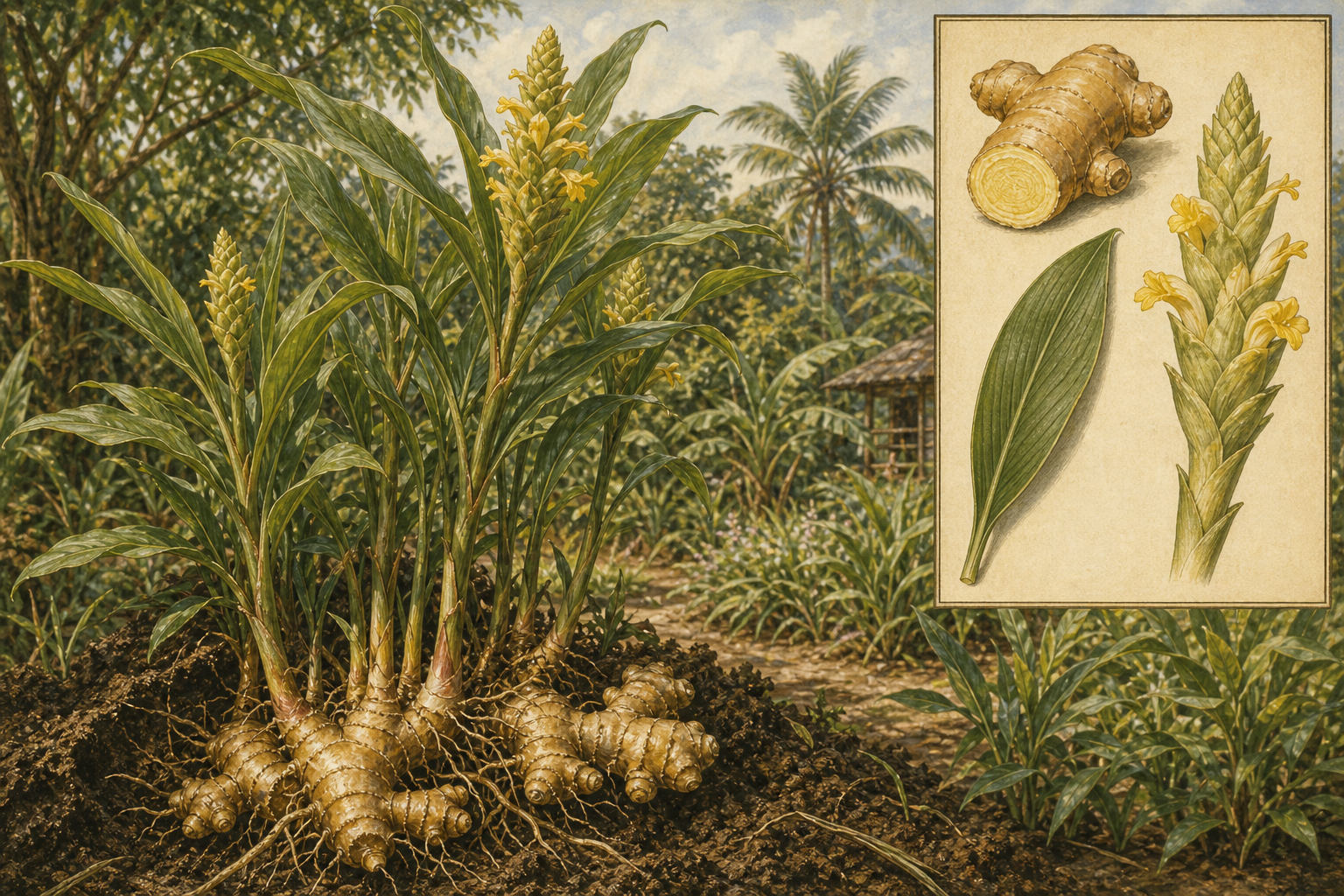
Zingiber officinale Roscoe (Zingiberaceae) is a sterile, cultivated perennial. NCBI Taxonomy files it as taxon 94328. It does not set reliable seed in cultivation; farmers plant rhizome pieces. Shoots are reed-like, with two-ranked lanceolate leaves and a ligule. The inflorescence is a cone of overlapping bracts; flowers are small, yellowish, and often scarce in commercial plots. The medicinal and culinary part is Zingiberis rhizoma: a branched, palmately knobby rhizome with a corky tan skin, a pale-yellow fibrous interior, and a sharp aroma. It is a stem, not a root. Ph. Eur. monograph 1522 is the quality frame for the dried drug.
Native as a cultigen in tropical Asia; now grown across South and Southeast Asia, the Caribbean, Africa, and Australia. Young “spring” ginger is juicier and milder; mature rhizome is hotter and more fibrous. Drying and heating convert gingerols toward shogaols. Chinese pharmacy splits shēng jiāng (fresh) from gān jiāng (dried)—same species, different process, different traditional indications. Japanese and Korean kitchens pickle young rhizome; that is food chemistry, not a motion-sickness monograph.
The hot principles are phenolic ketones: 6-gingerol in fresh rhizome, 6-shogaol enriched by drying, and zingerone from further degradation. Essential oil (zingiberene and kin) carries the scent. Related spices are not substitutes: turmeric (Curcuma longa) is curcuminoids; greater galangal (Alpinia galanga) is a different ginger-family rhizome; grains of paradise and cardamom are still other genera. Ornamental torch ginger (Etlingera) is not Z. officinale.
02 Lineage
History
Sanskrit, Chinese, and Greco-Roman sources already treat ginger as spice and stomach medicine. The spice trade made dried rhizome a shipboard antiemetic long before capsules. Fresh versus dried splits in Chinese materia medica are centuries old. British herbal books kept ginger for cold, wind, and nausea. None of that is a randomized trial.
German Commission E (1990) listed powdered rhizome for dyspepsia and motion-sickness prevention. EMA’s HMPC wrote a well-established-use monograph for powdered ginger to prevent motion sickness (first adopted 2012; revision 1, 7 May 2025) and a longer traditional-use list: symptomatic motion sickness, mild spasmodic gut complaints, temporary loss of appetite, minor articular pain, and common-cold symptoms. The 2025 revision is the current EU herbal law object—not a license for every candy or shot.
Late-twentieth-century trials moved ginger into pregnancy nausea, postoperative nausea, and chemotherapy. Ryan and colleagues’ URCC CCOP study (2012) randomized 744 patients, 576 of whom provided analyzable data. Viljoen’s 2014 Nutrition Journal meta-analysis and Matthews’s Cochrane review of NVP interventions are the pregnancy evidence pile NCCIH still leans on. History here is a spice that picked up a trial file, not a new plant.
03 Chemistry
Active compounds and how it works
Gingerols and shogaols act on the gut more than on a single brain receptor. Proposed mechanisms include 5-HT3 receptor antagonism (the same family as ondansetron, at a much milder, non-drug level), slowed or regularized gastric motility, and TRPV1 warmth that people read as “settling.” EMA’s motion-sickness note is candid: the way it works is not fully known; some studies point at gastrointestinal motility. That is enough to explain a peripheral antiemetic and not enough to call ginger a serotonin drug.
Anti-inflammatory work for osteoarthritis is mostly gingerol/shogaol effects on eicosanoids and cytokines in experimental systems. Bartels’s 2015 meta-analysis of OA RCTs is the human summary, not a replacement for NSAIDs. Antiplatelet effects show up in vitro and in older volunteer work; EMA’s 2025 monograph lists no known drug interactions for the specified powders and tinctures. US clinical pages still flag anticoagulants. Both sentences can be true: licensed EU powders have no proven warfarin interaction, and high-dose extracts still warrant a conversation about bleeding risk.
Fresh and dry are not interchangeable chemotypes. Heat and storage raise shogaols. A candied slice, a tea bag, and a standardized capsule will not share a milligram of 6-gingerol.
04 In practice
Common uses
Motion sickness is EMA’s well-established indication for powdered rhizome in adults: 1–2 g about an hour before travel, single use. Traditional-use powder can be 500–750 mg half an hour before, with a pediatric traditional rung from age six. It is meant to prevent nausea rather than to treat it once it has started. Results vary: EMA’s bibliographic review supports prevention, while NCCIH notes that most studies of ginger for motion sickness haven’t shown it to be helpful. Prescription motion-sickness medicines such as scopolamine are better studied.
Nausea and vomiting of pregnancy: NCCIH says ginger may help, mostly as supplements rather than food, and to talk to a clinician. Viljoen et al. (Nutrition Journal 2014; PMC3995184) reviewed twelve RCTs (1,278 women); in the two placebo trials that could be pooled for nausea, ginger improved it, while the fall in vomiting episodes was not significant (p = 0.06); an apparent edge for daily doses under about 1.5 g came only from comparisons with vitamin B6, not placebo. Hu et al. (2022) pooled ginger against B6 and placebo. Matthews’s Cochrane review of NVP interventions (2015, CD007575) said ginger products may help but evidence was limited and inconsistent. ACOG’s public morning-sickness FAQ discusses ginger among non-drug options. EMA still prefers to avoid licensed ginger medicines in pregnancy as a precaution. Food amounts in cooking are not those capsules. Hyperemesis gravidarum, severe pregnancy vomiting with dehydration or weight loss, needs medical treatment; ginger alone is not enough.
Chemotherapy-induced nausea: Ryan et al. (Supportive Care in Cancer 2012; PMC3361530) randomized 744 patients (576 analyzable), all on a 5-HT3 receptor antagonist antiemetic; 0.5–1.0 g ginger daily reduced acute nausea. A smaller trial by Zick et al. (Supportive Care in Cancer 2009) found no benefit, and worse acute nausea, when ginger was added to aprepitant. Choi et al. (Nutrients 2022; PMC9739555) reviewed later CINV RCTs—signals exist, products and timing vary. Ginger is an adjunct, not a replacement for guideline antiemetics. MSKCC files it in that cautious oncology frame.
Postoperative nausea: Tóth et al. (Phytomedicine 2018) meta-analyzed prevention and found a possible alternative or add-on. Heterogeneity is real. Do not skip prescribed PONV prophylaxis for a lozenge.
Period pain (dysmenorrhea): NCCIH says research suggests ginger dietary supplements might help reduce the severity of menstrual cramps. The 2016 Cochrane review of dietary supplements for dysmenorrhea (Pattanittum et al., CD002124; 27 trials, 3,101 women) found very limited evidence that ginger eased pain compared with placebo (three trials, 266 women), and rated all the evidence in the review low or very low quality. A 2024 meta-analysis (Moshfeghinia et al., Journal of Integrative and Complementary Medicine) pooled 12 trials and found ginger better than placebo for pain intensity and duration, with no difference from NSAIDs for pain intensity; the authors noted risk of bias and sparse safety reporting. Ginger may be worth trying for ordinary cramps. Periods that are very painful, worsening, or heavy deserve a gynecology check, because conditions such as endometriosis need a diagnosis.
Osteoarthritis and “cold” folklore: Bartels 2015 (PMID 25300574) reported modest OA symptom benefit versus placebo. EMA traditional use covers minor articular pain and common-cold symptoms. Neither is a disease-modifying arthritis drug. Dyspepsia and bloating are traditional GI indications; concentrated ginger can also cause the heartburn you were treating.
05 The apothecary
Preparations and traditional use
Food: fresh rhizome sliced or grated in tea, stir-fry, or broth. Young ginger is milder. This is the lowest-intensity exposure.
Dried powdered rhizome: the EMA well-established object for motion sickness (1–2 g before travel). Traditional GI doses run roughly 0.18–1 g three times daily. Most pregnancy trials in Viljoen’s review gave 1,000–1,950 mg/day in divided doses, and ACOG lists 250 mg capsules four times daily; the chemotherapy benefit was clearest at 0.5–1 g/day of extract. More is not clearly better, but Viljoen’s hint that lower doses did better came only from comparisons with vitamin B6, not placebo.
Tinctures (EMA traditional: 1:10 or 1:2 in 90% ethanol) and syrups exist. Candied ginger and ale are food, with sugar as the other active. Extracts standardized to gingerols are a different, hotter product than kitchen powder.
If someone and a clinician use ginger for nausea, match the trial form: dry powder or a labeled capsule in the 0.5–1 g/day band, not an unnamed “gut shot.” Stop if reflux becomes the new problem. Hold high-dose capsules before surgery if a surgeon is already holding other antiplatelet herbs.
Safety
Before you use ginger
06 Caution
Side effects
Common (EMA, ≥1/100): stomach upset, belching, dyspepsia, heartburn; traditional-use listings also include nausea. That last item is why using ginger for nausea can fail in people with reflux. NCCIH also lists abdominal discomfort and diarrhea. Mouth and throat irritation happen with raw slices and strong tea.
Allergy and contact dermatitis occur, including in people who react to other Zingiberaceae. Hypersensitivity is the only EMA contraindication.
Bleeding is a theoretical and case-level US caution (antiplatelet in vitro; MSKCC flags warfarin), not an EMA-listed interaction. Treat high-dose extracts like other herbs that might add to anticoagulants, and treat food ginger as food unless intake is huge.
Gallbladder folklore: ginger is sometimes called a cholagogue. Biliary colic and obstructing stones are a reason to skip concentrated rhizome, not a reason to “flush bile.” MSKCC notes gall-related caution. Hypoglycemia theoreticals sit next to insulin on the same page—monitor if you use both.
07 Caution
Contraindications
Do not use if you are allergic to ginger or other ginger-family spices. Do not use concentrated products to treat unexplained abdominal pain, jaundice, or vomiting of blood.
Pregnancy: cooking with ginger is not the same as a licensed herbal medicine. EMA prefers to avoid medicinal use in pregnancy as a precaution despite moderate human outcome data without a malformation signal, and does not recommend lactation use. NCCIH: supplements may be safe; ask the obstetric clinician. Do not treat hyperemesis with rhizome alone.
Children: EMA well-established motion-sickness powder is not recommended under 18. Traditional motion-sickness powder allows 6–12 years at a lower dose; under six is not established. Capsules are not candy.
Osteoarthritis with hot, swollen joints or fever needs a diagnosis, not a traditional “articular pain” tea (EMA warning).
08 Caution
Drug and herb interactions
EMA’s 2025 monograph lists no known interactions for the specified powdered rhizome and tinctures. That is a regulatory sentence about those preparations, not a permission to hide gram-level extracts from a pharmacist.
Anticoagulants and antiplatelets: MSKCC and consumer herb databases still flag bleeding risk with warfarin and similar drugs. Evidence in people is more limited than the laboratory findings. If you take a blood thinner, this is a clinician conversation before capsules, not before ginger in soup.
Diabetes drugs and insulin: MSKCC warns ginger can affect how insulin works. Check glucose if you add a high-dose product.
Combining ginger shots, turmeric products, and NSAIDs for a sore knee can add up to more bleeding or gallbladder risk than any one of them alone. If you use several, review the combination with a pharmacist or clinician.
09 Questions
Frequently Asked Questions
It can help some kinds. Powdered rhizome is EMA well-established for preventing motion sickness, although NCCIH notes that most motion-sickness studies have not shown clear benefit. Pregnancy and chemotherapy studies often show less nausea, with smaller or mixed effects on vomiting. It is not a replacement for prescribed antiemetics such as ondansetron, and vomiting that dehydrates you needs medical care.
Food amounts are widely used. Supplement trials for morning sickness generally look reassuring on miscarriage signals, with modest benefit for nausea. EMA still says it is preferable to avoid licensed ginger medicines in pregnancy. Talk to the obstetric clinician before capsules; do not self-treat hyperemesis.
Yes. Fresh rhizome is richer in gingerols. Drying and heat raise shogaols. EMA’s motion-sickness indication is powdered dried rhizome. A soda or candy is mostly sugar plus a little spice.
Only as an adjunct your oncology or surgical team knows about. Ryan 2012 found 0.5–1 g/day reduced acute chemo nausea on top of standard antiemetics. Do not drop prescribed drugs for ginger. Tell the team before high-dose capsules if bleeding is a concern.
It is a known side effect. EMA lists heartburn, dyspepsia, and belching as common. People with reflux often do worse on strong tea or gram-level powder. That is a reason to cut the dose or stop, not to “push through.” Peppermint can do the same, because it relaxes the valve at the top of the stomach.
In vitro and in some older volunteer work, gingerols affect platelets. EMA lists no documented interactions for specified powders. MSKCC still flags warfarin. Soup is not the same as a 2 g extract. If you are anticoagulated, ask before capsules.
EMA traditional use covers minor joint pain and cold symptoms. A 2015 osteoarthritis meta-analysis found modest benefit versus placebo. Neither replaces disease-modifying arthritis care or indicated cold evaluation if you are short of breath or febrile with a swollen joint.
It may. NCCIH says ginger supplements might help reduce the severity of menstrual cramps. A 2024 meta-analysis found ginger eased pain more than placebo and about as well as NSAIDs, though the trials were small and had risk of bias, and a 2016 Cochrane review rated the evidence low quality. Very painful, worsening, or heavy periods deserve a medical check for causes such as endometriosis.
Anyone allergic to ginger-family plants; people using high-dose products with unexplained abdominal pain or active ulcers/reflux that ginger worsens; and anyone pregnant, breastfeeding, anticoagulated, or on insulin who has not cleared capsules with a clinician. Cooking with ginger is a different exposure.
10 References
Sources
These references support the history, clinical, and safety claims on this page. They are not an endorsement of any product.
-
Ginger: usefulness and safety
National Center for Complementary and Integrative Health (NIH), 2025
Consumer evidence (updated February 2025): possible help for pregnancy nausea; most motion-sickness studies not helpful; uncertain for chemotherapy and postoperative nausea; supplements might reduce menstrual cramp severity; oral supplements used safely in many trials; ask a clinician in pregnancy; little known on breastfeeding.
-
Ginger
Memorial Sloan Kettering Cancer Center, About Herbs, 2022
Clinical summary: nausea uses, heartburn, warfarin/bleeding, insulin, and gallbladder cautions in an oncology context.
-
Zingiberis rhizoma — herbal medicinal product
European Medicines Agency, Committee on Herbal Medicinal Products, 2025
HMPC landing page: well-established powdered rhizome for preventing motion sickness; traditional uses for gut complaints, appetite, minor joint pain, and cold symptoms.
-
European Union herbal monograph on Zingiber officinale Roscoe, rhizoma (final — revision 1)
European Medicines Agency (EMA/HMPC/885789/2022), 2025
Adopted 7 May 2025: 1–2 g powder before travel (WEU); common heartburn; no listed interactions; pregnancy precaution despite moderate outcome data; lactation not recommended.
-
Ginger (Zingiber officinale) reduces acute chemotherapy-induced nausea: a URCC CCOP study of 576 patients
Supportive Care in Cancer (PMC3361530), 2012
Ryan et al.: 744 randomized, 576 analyzed; 0.5–1.0 g/day ginger reduced acute CINV as an adjunct to 5-HT3 receptor antagonist antiemetics.
-
Effects of ginger intake on chemotherapy-induced nausea and vomiting: a systematic review of randomized clinical trials
Nutrients (PMC9739555), 2022
Choi et al.: later CINV RCT synthesis; benefit signals with heterogeneous products and regimens.
-
A systematic review and meta-analysis of the effect and safety of ginger in the treatment of pregnancy-associated nausea and vomiting
Nutrition Journal (PMC3995184), 2014
Viljoen et al.: twelve RCTs, 1,278 women; nausea improved versus placebo in two pooled trials; vomiting reduction not significant (p = 0.06); lower-dose (<1.5 g) advantage seen only versus vitamin B6; most trials used 1,000–1,950 mg/day.
-
Interventions for nausea and vomiting in early pregnancy
Cochrane Database of Systematic Reviews (PubMed 26348534), 2015
Matthews et al. CD007575: ginger products may help NVP; evidence limited and not consistent across trials.
-
Effect of ginger in the treatment of nausea and vomiting compared with vitamin B6 and placebo during pregnancy: a meta-analysis
Journal of Maternal-Fetal & Neonatal Medicine (PubMed 31937153), 2022
Hu et al.: pooled comparison of ginger with B6 and placebo for NVP.
-
Morning sickness: nausea and vomiting of pregnancy
American College of Obstetricians and Gynecologists, 2024
Public ACOG FAQ discussing ginger among non-drug options for NVP; not a license to skip obstetric care.
-
Ginger (Zingiber officinale): an alternative for the prevention of postoperative nausea and vomiting. A meta-analysis
Phytomedicine (PubMed 30466995), 2018
Tóth et al.: PONV prevention meta-analysis of ginger versus control.
-
Efficacy and safety of ginger in osteoarthritis patients: a meta-analysis of randomized placebo-controlled trials
Osteoarthritis and Cartilage (PubMed 25300574), 2015
Bartels et al.: modest OA symptom benefit versus placebo; not a disease-modifying therapy.
-
Dietary supplements for dysmenorrhoea
Cochrane Database of Systematic Reviews (PubMed 27000311), 2016
Pattanittum et al. CD002124: 27 RCTs, 3,101 women; very limited evidence that ginger reduced pain versus placebo (three RCTs, 266 women); all evidence low or very low quality.
-
Ginger for pain management in primary dysmenorrhea: a systematic review and meta-analysis
Journal of Integrative and Complementary Medicine (PubMed 38770631), 2024
Moshfeghinia et al.: 12 studies pooled; ginger beat placebo for pain intensity and duration; no difference from NSAIDs; risk of bias and limited safety data.
-
The effectiveness of ginger in the prevention of nausea and vomiting during pregnancy and chemotherapy
Integrative Medicine Insights (PMC4818021), 2016
Open-access review of NVP and CINV preparations and the gap between food ginger and trial products.
-
Taxonomy browser: Zingiber officinale
NCBI Taxonomy (NIH), 2024
NCBI taxon 94328 for culinary ginger in Zingiberaceae.
-
(6)-Gingerol
PubChem, National Library of Medicine (NIH), 2024
Principal pungent phenolic of fresh ginger rhizome; CID 442793.
-
Shogaol
PubChem, National Library of Medicine (NIH), 2024
6-Shogaol, the dehydration product that rises when ginger is dried or heated; CID 5281794.
-
Zingerone
PubChem, National Library of Medicine (NIH), 2024
Degradation ketone of gingerol/shogaol pathways in cooked ginger; CID 31211.