Monograph
Goldenseal
Hydrastis canadensis
Updated October 4, 2026
Key points
-
01
No proven health use
NCCIH says no rigorous studies have tested goldenseal for any condition in people, including colds and urinary infections. Laboratory antimicrobial effects have not been confirmed in trials.
-
02
Strong drug interactions
In volunteers, goldenseal inhibited CYP3A4 and CYP2D6, raising midazolam levels 40 to 60%, and lowered metformin levels by about a quarter. Ask a pharmacist first.
-
03
Short courses only
Two-year rodent studies found liver tumors at high doses, and IARC lists goldenseal root powder as possibly carcinogenic. MSKCC advises against long-term use.
-
04
Avoid in pregnancy and infancy
Berberine can displace bilirubin, raising concern about newborn jaundice. NCCIH advises against goldenseal in pregnancy, while breastfeeding, and for infants.
-
05
At-risk woodland plant
Overharvest and habitat loss have depleted wild goldenseal, listed on CITES Appendix II since 1997. Choose cultivated, documented root.
Goldenseal (Hydrastis canadensis) is a small woodland perennial in the buttercup family whose knotted, bright-yellow root, strictly a rhizome or underground stem, is dried and sold as a herbal supplement. It is used mainly for colds and other upper respiratory infections, very often in combination with echinacea, and is also promoted for hay fever, diarrhea, and constipation (NCCIH); historically it was a bitter digestive tonic and a wash for skin and eye complaints (MSKCC). Many people also ask whether goldenseal extract treats urinary tract infections; no study has tested that in people. Its reputation rests on berberine, a yellow alkaloid in the root that kills bacteria and other microbes in laboratory tests. The plant is native to rich hardwood forests from Ontario through the eastern and central United States. Indigenous nations, including the Cherokee and Iroquois, used it as a medicine and its yellow juice as a dye, nineteenth-century Eclectic physicians made it one of their signature remedies, and heavy digging for the herb trade is why it has been listed under CITES Appendix II since 1997.
The evidence in people is thin. The National Center for Complementary and Integrative Health (NCCIH) says no rigorous studies have evaluated goldenseal for any health condition, and Memorial Sloan Kettering Cancer Center (MSKCC) finds no evidence for its use against the common cold. Isolated berberine has more research of its own, including a 1987 trial in which a single 400 mg dose reduced diarrhea caused by toxin-producing E. coli, and studies on blood sugar and cholesterol, but NCCIH notes that very little berberine may be absorbed when people swallow goldenseal, so those results do not transfer to the root. What is well documented is goldenseal’s effect on medicines. In healthy volunteers it inhibited CYP3A4 and CYP2D6, two liver and gut enzymes that clear a large share of prescription drugs, raising blood levels of the sedative midazolam by roughly 40 to 60 percent. In another study it lowered levels of the diabetes drug metformin by about a quarter.
Long-term safety is uncertain. In two-year feeding studies by the US National Toxicology Program, goldenseal root powder caused liver tumors in rats and male mice at high doses, and the International Agency for Research on Cancer (IARC) classifies it as possibly carcinogenic to humans (Group 2B). Berberine can push bilirubin off the blood protein that carries it, which is why NCCIH advises against goldenseal in pregnancy, while breastfeeding, and for infants. Goldenseal does not reliably hide drugs on a urine test; that idea traces back to a novel published in 1900. Nothing here is medical advice. A suspected urinary or kidney infection, a sore throat with fever, or an inflamed eye needs proper diagnosis and often prescription treatment, and anyone taking prescription medicines should check with a pharmacist before trying goldenseal.
Featured in
Herbs for Colds, Flu and ImmunityEvidence reviews
Goldenseal for UTIs →In this monograph
01 The plant
Botanical profile
Hydrastis canadensis L. was published by Linnaeus in 1759, in the tenth edition of Systema Naturae (Kew’s Plants of the World Online). It belongs to Ranunculaceae, the buttercup family, although a US Forest Service review notes that several studies have suggested the genus deserves a family of its own. Kew gives its native range as southeastern Canada to the north-central and eastern United States: Ontario and 25 states from Vermont and Connecticut west to Minnesota and Iowa and south to Georgia, Alabama, Mississippi, and Arkansas. NatureServe places the core of the range in Indiana, Kentucky, Ohio, and West Virginia, around the Ohio River valley. King’s American Dispensatory (1898) calls the genus name, from Greek words linked to water, a misnomer based on the mistaken belief that the plant grew in bogs; it actually prefers rich, open woodland hillsides strewn with leaf mold. Common names recorded by King’s and the Forest Service include yellow root, orange root, yellow puccoon, eye root, eye balm, Indian paint, Indian dye, jaundice root, wild curcuma, and Indian turmeric. MSKCC warns that goldenseal is sometimes called turmeric root but should not be confused with turmeric (Curcuma longa).
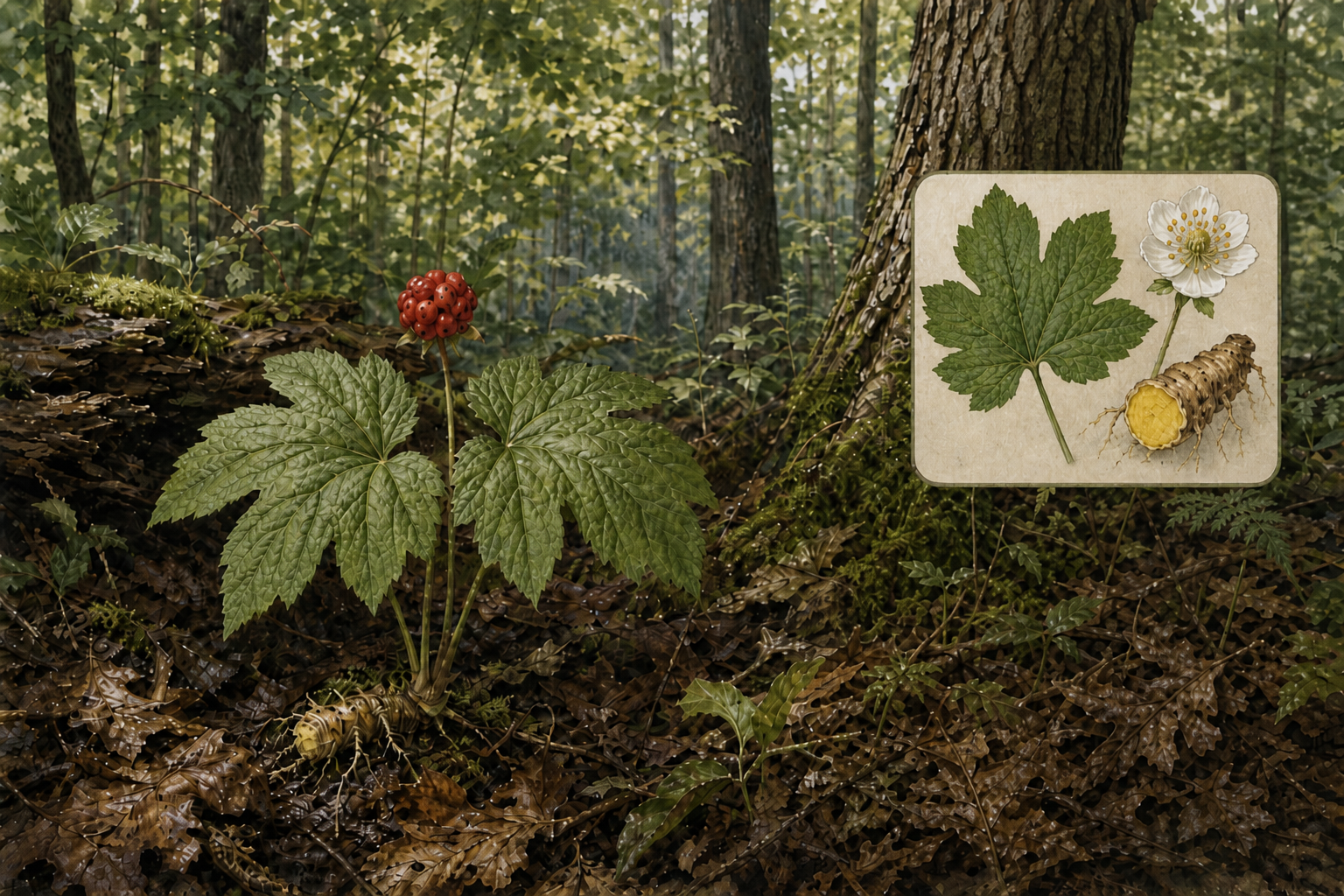
Mature plants send up a single hairy stem up to about 12 inches (30 cm) tall, yellow below ground and purplish above, which forks into two palmate leaves, each with five to seven toothed lobes (US Forest Service). The leaves are only partly open at flowering and keep growing afterwards, reaching 3 to 12 inches across, one usually larger than the other. Young or weak plants produce one leaf and no flower. The single flower appears in April or May, is about half an inch across, and lasts only five or six days; its three small, petal-like sepals fall as it opens, so what you see is a tuft of white stamens around a cluster of small pistils. By midsummer the flower becomes a red, raspberry-like cluster of small fleshy fruits, each holding one or two shiny black seeds (King’s). Seeds that fall in late summer germinate the following spring, a seedling spends its second year with a single leaf, and plants usually first flower in their third or fourth year (Forest Service, citing Bowers 1891).
The medicinal part is the rhizome, a horizontal, knotty underground stem about half to three-quarters of an inch thick with many fibrous rootlets. Fresh, it is vivid yellow inside and out; it dries to a dull brown with a lemon-yellow break and loses about two-thirds of its weight in drying (King’s). The name goldenseal combines that color with the round scars that each year’s dead stem leaves on the rhizome, which reminded people of the imprint of a wax seal; King’s credits the Thomsonian botanical healers with introducing the name. Rhizomes mature after four to five years, then die back at one end as they grow at the other. Wild plants spread mostly by budding from rhizomes and rootlets, forming dense clonal patches. Goldenseal grows under a shady canopy of sugar maple, beech, red oak, basswood, or black walnut, alongside American ginseng, black cohosh, bloodroot, and mayapple, and it does not return to land that has been cleared or plowed (Forest Service). NatureServe found that 62% of Ohio populations had fewer than 200 stems.
King’s American Dispensatory described three alkaloids in the root: yellow berberine and the colorless hydrastine and canadine. IARC adds a group of flavonoids, including sideroxylin, and notes that the United States Pharmacopeia (USP) requires a dry goldenseal extract to contain at least 2% hydrastine and 2.5% berberine. Berberine is not unique to goldenseal. It also occurs in goldthread (Coptis), barberry and Oregon grape (Berberis), and other plants, and IARC records Coptis, Berberis, yellowroot (Xanthorhiza simplicissima), and Rumex species being used to adulterate goldenseal, because genuine root is expensive and some commercial products contain little or none of it. When Wallace and colleagues (Food and Chemical Toxicology 2018) analyzed 35 commercial goldenseal products, several turned out to come from another species or a mixture of plants. NCCIH likewise notes that some goldenseal products contain herbs not listed on the label. Because berberine occurs in so many plants, a yellow color or a berberine content figure alone does not prove that a product is goldenseal.
02 Lineage
History
Goldenseal’s medical history begins with Indigenous nations of eastern North America. Ethnobotanical records compiled in a US Forest Service bibliography (Predny and Chamberlain 2005) describe Cherokee use of the root as a wash for inflammations and a treatment for indigestion, cancer, poor appetite, and general debility, and Cherokee people also mixed it with bear grease as an insect repellent. The same records list Iroquois uses for whooping cough, diarrhea, tuberculosis, liver disease, fever, earache, stomachache, flatulence, pneumonia, and heart trouble. King’s American Dispensatory (1898) adds that the yellow juice was used to color clothing and to stain the face, which explains names such as Indian paint and Indian dye. NCCIH summarizes Native American use for digestive disorders, wounds, skin and eye conditions, and cancer. European physicians learned of it through these traditions: King’s records that Benjamin Smith Barton, in his 1798 Collections for an Essay Toward a Materia Medica of the United States, mentioned the Cherokee use of the root against cancer, and later described it as a bitter tonic and a wash for inflamed eyes.
The root’s professional career came through the Eclectics, nineteenth-century American physicians who favored botanical medicines. According to King’s, goldenseal figured among their leading drugs from about 1847, and especially after John King’s American Dispensatory of 1852, in which King gave it a careful review while judging earlier claims to be greatly overdrawn. By the 1898 edition the Eclectics regarded it as specifically indicated for “catarrhal states of the mucous membranes”: chronic gastritis and indigestion, sore throat and nasal catarrh, and conjunctivitis, for which a colorless preparation was diluted 1 part in 10 or 20 of water. It was a favored local treatment for gonorrhea, and King’s describes it given by mouth and, heavily diluted, as a bladder wash for cystitis. Mainstream pharmacy adopted it too. A USP history by Brinckmann and colleagues (HerbalGram 2020) records goldenseal entering the US Pharmacopeia in 1860, leaving the USP in 1930 and the National Formulary in 1960, and returning to the USP in 2003. King’s adds that E. M. Hale introduced it into homeopathy.
Demand outran the plant early. King’s American Dispensatory (1898) observed that goldenseal disappeared as soon as settlers disturbed the ground, that once-plentiful stands along the Ohio River survived only in isolated spots, and that only Ohio, Indiana, Kentucky, and West Virginia still produced enough for commercial gathering. The Forest Service bibliography cites estimates of 140,000 to 150,000 pounds of root consumed a year in the late 1800s, prices rising from 8 to 12 cents a pound before 1880 to 58 cents by 1890, about 200,000 to 300,000 pounds a year by 1931, and more than 250,000 pounds around 2000; a pound of dried root takes roughly 200 to 250 rhizomes. Concern about supply prompted early cultivation manuals, including a 1908 US Department of Agriculture bulletin on growing goldenseal. The National Toxicology Program later chose goldenseal for long-term testing partly because it was one of the most widely used herbs in the United States.
Two modern episodes shaped how goldenseal is sold. The first is a myth: the idea that goldenseal can hide drugs on a urine test. The Forest Service bibliography traces it to John Uri Lloyd, a pharmacist and Eclectic author, and his 1900 novel Stringtown on the Pike, in which goldenseal in a dead man’s tonic is mistaken for strychnine by an expert witness, a false positive rather than a false negative. Laboratory studies have since failed to support the masking claim, but it persisted and added to demand. The second is conservation. On 18 September 1997, goldenseal was listed on Appendix II of the Convention on International Trade in Endangered Species of Wild Fauna and Flora (CITES), which requires permits for international trade in its roots, and United Plant Savers keeps it on its At-Risk list of North American medicinal plants. In 2010 the National Toxicology Program published the two-year studies that led IARC to classify goldenseal root powder as possibly carcinogenic to humans.
03 Chemistry
Active compounds and how it works
Most proposed effects of goldenseal are attributed to its alkaloids, chiefly berberine and hydrastine (MSKCC). In laboratory studies berberine and goldenseal extracts are active against a range of bacteria, fungi, and parasites; MSKCC cites a comparison in which goldenseal extract was the most active of several herbs at inhibiting the stomach bacterium Helicobacter pylori. Laboratory work also shows that goldenseal relaxes smooth muscle like that of the gut, and that berberine stops cancer cells dividing in culture. None of these findings has been confirmed in clinical studies of goldenseal, and MSKCC states that clinical studies are lacking. Isolated berberine does have one well-known clinical effect in the gut. Rabbani and colleagues (Journal of Infectious Diseases 1987) found that it reduced the secretion of fluid into the intestine in diarrhea caused by toxin-producing E. coli, an effect that does not depend on absorbing the alkaloid into the blood. Laboratory studies cited by MSKCC also point to phototoxicity, which MSKCC suggests is more likely with preparations applied to the skin than with capsules.
Absorption is the central problem for any internal use. Berberine passes poorly from the gut into the blood: in rats, Chen and colleagues (AAPS PharmSciTech 2011) measured an absolute oral bioavailability of 0.68%, and NCCIH notes that very little berberine may be absorbed when people take goldenseal by mouth. Hydrastine behaves differently. Gupta and colleagues (Drug Metabolism and Disposition 2015) gave 11 healthy volunteers a single 2.7 g dose of goldenseal containing 78 mg of hydrastine and found it in the blood within about 1.5 hours, at a peak of 225 ng/ml, with a half-life of about 4.8 hours, followed by extensive breakdown into many metabolites. This matters for the most common questions about goldenseal. An antimicrobial that stays largely in the gut is unlikely to reach a throat infection, a sinus, or the bladder at useful concentrations, and whether swallowed goldenseal delivers enough berberine to the urine to affect bacteria has not been shown in people.
The best-characterized human effect of goldenseal is on drug-metabolizing enzymes. Both berberine and hydrastine are time-dependent inhibitors of CYP3A in laboratory tests, meaning they progressively disable the enzyme. Nguyen and colleagues (Journal of Pharmacology and Experimental Therapeutics 2023) gave healthy adults a single 3 g dose of goldenseal or 1 g three times a day for six days; either way, blood levels of midazolam, a sedative cleared by CYP3A, rose by 40 to 60%, and modeling pointed to hydrastine acting mainly on CYP3A in the gut wall. Goldenseal also inhibits CYP2D6 in people, and laboratory studies cited by MSKCC show inhibition of CYP2C9 and CYP3A5. Separately, goldenseal reduced the absorption of metformin from the gut without changing how fast the kidneys removed it. The toxicology has its own mechanism: berberine and its metabolite berberrubine inhibit topoisomerases, enzymes that manage DNA during cell division, which the National Toxicology Program and IARC suggest may explain the liver tumors in rodents, even though goldenseal powder and berberine were not mutagenic in standard bacterial tests.
04 In practice
Common uses
Colds and immune support are the main modern uses. NCCIH lists goldenseal among supplements promoted for the common cold and other upper respiratory tract infections, and MSKCC notes that it is often combined with echinacea in products sold to support immune function; the Forest Service bibliography describes it as a so-called carrier herb used to boost other herbs, particularly echinacea. None of this has been tested properly. NCCIH states that there is not enough evidence to determine whether goldenseal is useful for any health condition and that no rigorous studies have evaluated it in people, and MSKCC finds no evidence for its use against the common cold. Most colds are caused by viruses, so laboratory activity against bacteria would not be expected to help them in any case. The combination with echinacea is a marketing tradition rather than a tested formula, and it brings goldenseal’s drug interactions along with it. Anyone who takes prescription medicines and wants an herbal cold product is better served by one without goldenseal.
Urinary tract infections are a frequent question, and the answer is short: there are no clinical trials of goldenseal for UTIs and no established dose. The idea has historical roots. King’s American Dispensatory (1898) described goldenseal given by mouth for cystitis and, heavily diluted, used to wash out the bladder, and Eclectic physicians used it locally for gonorrhea. Today’s reasoning relies on berberine’s antibacterial effect in the laboratory, but berberine is poorly absorbed, and no study has shown that goldenseal clears or prevents a bladder infection. A small 2021 case series by Pannek and Pannek-Rademacher (Spinal Cord Series and Cases) reported fewer catheter blockages in three of four people with spinal cord injury given homeopathic Hydrastis, a 30C dilution that contains essentially none of the plant; it says nothing about herbal goldenseal or infection. Because untreated bladder infections can spread to the kidneys, using goldenseal instead of testing and antibiotics risks delay. For preventing repeat infections, cranberry has the most research among herbs.
Digestive complaints were central to traditional use. King’s American Dispensatory recommended small doses of goldenseal as a bitter before meals for indigestion and chronic gastritis, and NCCIH notes that goldenseal is still promoted for diarrhea and constipation. The best human evidence comes from isolated berberine, not the herb. Rabbani and colleagues (Journal of Infectious Diseases 1987) tested berberine sulfate in randomized controlled trials involving 165 adults with acute diarrhea; in diarrhea caused by toxin-producing E. coli, a single 400 mg dose reduced stool volume, and 42% of treated patients had stopped having diarrhea at 24 hours compared with 20% of controls. In cholera the effect was slight and added nothing to the antibiotic tetracycline. That trial used a measured dose of a purified salt, and its results cannot be assumed for goldenseal capsules of unknown berberine content. Laboratory activity against H. pylori, the bacterium behind many stomach ulcers, has not been tested in people with goldenseal, and ulcers need proper diagnosis and treatment.
Eyes, mouth, and skin are the oldest local uses. Barton, writing from 1798 onward, described goldenseal as a wash for inflamed eyes, and King’s recommended a colorless goldenseal preparation diluted 1 part in 10 or 20 of water for conjunctivitis and inflamed eyelids, and as a local application for sore throats and ulcerated tonsils. The Forest Service bibliography notes that goldenseal was an ingredient of many commercial eyewashes until the 1980s, IARC notes berberine salts in some commercial eyewash formulations, and goldenseal itself appears in ear drops and feminine cleansing products. These uses have not been tested in modern trials. Home-made eye washes from powdered root or tea are not sterile and can introduce infection, and a red, painful eye, especially with blurred vision or sensitivity to light, needs an eye examination rather than an herbal rinse. MSKCC adds that laboratory studies point to possible sun sensitivity with goldenseal applied to the skin.
Blood sugar, cholesterol, and weight belong to berberine, not goldenseal. NCCIH explains that berberine has been studied for its effects on blood sugar, cholesterol levels, body weight, and other outcomes, but that study results on berberine may not apply to goldenseal because so little berberine is absorbed from the root. Whole goldenseal has not been tested as a diabetes treatment. In a pharmacology study of adults with type 2 diabetes already taking metformin, Nguyen and colleagues (Clinical and Translational Science 2025) recorded HbA1c falling on average from 6.8% to 6.5% over the study period whether or not goldenseal had lowered metformin levels; the study was designed to measure drug levels, not to test goldenseal as a treatment. Finally, two popular uses are simply myths: goldenseal is not a reliable way to mask drug use on a urine test, and it is not an antibiotic substitute for strep throat, pneumonia, Lyme disease, or any diagnosed infection.
05 The apothecary
Preparations and traditional use
Goldenseal is sold as dried, cut, or powdered rhizome and root, capsules, tablets, tinctures and liquid extracts, teas, and combination products, especially with echinacea; IARC also lists ear drops, cold and flu remedies, allergy products, laxatives, and digestive aids containing it. There is no established clinical dose for any condition. NCCIH reports that small research studies have given about 3 g a day for short periods without serious harm, and the drug interaction studies used similar amounts: 3,210 mg a day for 14 days in Gurley and colleagues’ digoxin study, and either a single 3 g dose or 1 g three times a day for six days in Nguyen and colleagues’ midazolam study. King’s American Dispensatory (1898) gave doses of 10 to 30 grains of powdered root, roughly 0.65 to 2 g, and 10 to 60 minims of fluid extract. Those figures describe what has been used, not what has been shown to work. Interaction studies found measurable effects within days, so even a short course can affect medicines.
Quality varies widely. The USP standard for dry goldenseal extract requires at least 2% hydrastine and 2.5% berberine, which gives buyers a benchmark to look for on the label. Because genuine goldenseal is expensive, IARC reports products containing little or no goldenseal, and substitution with cheaper berberine plants such as Coptis, Berberis, and yellowroot. In the Wallace analysis of 35 commercial products, several were identified as another species or a mixture, and NCCIH notes products with herbs not listed on the label. A yellow color and a bitter taste are not proof of identity. Products that name Hydrastis canadensis root and rhizome, state their hydrastine and berberine content, and carry an independent quality seal are more likely to contain what the label says, though a seal is not a guarantee of safety or benefit. Taste is a useful warning in its own right: King’s describes the root as intensely bitter with a lingering acridity, which capsules hide.
Sourcing matters because wild goldenseal is under pressure. NCCIH notes that wild goldenseal has been overharvested and that the plant is grown commercially but is expensive to cultivate. The Forest Service bibliography explains why: plants take three to five years to reach harvest from rhizome divisions and five to seven years from seed, need 60 to 75% shade, and suffer from slugs, nematodes, and fungal diseases; an industry survey counted only 140 acres under cultivation in 1998. United Plant Savers recommends using At-Risk plants such as goldenseal in cultivated forms whenever possible and keeping any wild harvest very limited. CITES controls international trade in whole, cut, and powdered roots, but its annotation for goldenseal excludes finished products such as capsules, tinctures, and ointments, so a CITES listing does not tell you whether the root in a bottle was farmed or dug. Ask suppliers whether their root is cultivated, and treat “wildcrafted” on a goldenseal label as a conservation question rather than a mark of quality.
Safety
Before you use goldenseal
06 Caution
Side effects
Short-term use appears to be reasonably well tolerated. NCCIH reports that small studies giving about 3 g a day for short periods found no serious harmful effects, while noting that the safety of longer use is uncertain. Older toxicology summarized by the Forest Service lists nausea, vomiting, diarrhea, nervousness, and depression after large doses, and the root’s intense bitterness can itself cause stomach upset. In Rabbani’s trial of purified berberine sulfate, no side effects were noted after single doses. MSKCC records two case reports: severe hypernatremia, a dangerously high blood sodium level, in a pre-teen with diabetic ketoacidosis who had taken goldenseal for two weeks, which did not recur during a later episode without goldenseal; and a sun sensitivity reaction in a woman using a supplement that combined ginseng, goldenseal, bee pollen, and other ingredients, in which the authors suspected the combination rather than any single herb. Single case reports cannot prove cause, and many goldenseal products contain other herbs that could be responsible.
The main long-term concern comes from animal studies. In the National Toxicology Program’s two-year feeding studies (Technical Report 562, 2010), groups of 50 rats and 50 mice of each sex ate feed containing 0, 3,000, 9,000, or 25,000 ppm goldenseal root powder, equivalent to about 135 to 1,340 mg per kg of body weight a day in rats. At the highest dose, benign liver tumors (hepatocellular adenomas) appeared in 10 of 50 male rats, compared with 1 of 50 controls, and 8 of 50 female rats, compared with none; male mice developed more multiple adenomas and hepatoblastomas, while female mice showed no effect. The program judged this clear evidence of carcinogenic activity in rats. Non-cancerous liver changes, such as enlarged and degenerating liver cells, appeared even at the lowest dose. IARC concluded that the evidence in animals was sufficient and in humans inadequate, and classified goldenseal root powder as possibly carcinogenic to humans (Group 2B).
How that translates to people is uncertain. MSKCC notes that the doses at which liver tumors appeared are unlikely to be reached in humans, but still advises against long-term use because of the toxicity seen in animals, and it cites laboratory work in which commercial goldenseal products damaged DNA in liver cells in proportion to their berberine content. For comparison, 3 g a day is roughly 43 mg per kg for a 70 kg adult, about a third of the lowest dose given to the rats on a simple weight basis. Goldenseal root powder was not mutagenic in standard bacterial tests and did not increase micronuclei, a marker of chromosome damage, in mice (National Toxicology Program). Clinical liver injury in people has not been a prominent signal: LiverTox, the NIH database on drug-induced liver injury, reports that berberine has not been linked to raised liver enzymes or to clinically apparent liver injury. That reassurance concerns short-term use; nobody has studied people taking goldenseal for years, so the animal findings are a good reason to keep courses short.
Berberine’s effect on bilirubin is the reason for caution around newborns. In laboratory work, Chan (Biology of the Neonate 1993) found that berberine displaced bilirubin from albumin, its carrier protein in the blood, about ten times more strongly than phenylbutazone, a drug known for this effect, and that repeated injections raised free and total bilirubin in rats. Free bilirubin can enter a newborn’s brain and cause damage called kernicterus. Chan wrote that the Chinese herb huanglian (Coptis), rich in berberine, had been reported to pose a risk of kernicterus in jaundiced newborns, and advised avoiding high-berberine herbs in jaundiced newborns and pregnant women. LactMed, the NIH database on medicines and breastfeeding, notes that no data exist on whether goldenseal’s components pass into breast milk, and that most sources recommend avoiding any exposure of newborns. Applied to the skin, goldenseal preparations may cause sun sensitivity (MSKCC), and concentrated or non-sterile preparations can irritate the eyes and other mucous membranes.
07 Caution
Contraindications
Pregnancy, breastfeeding, and newborns: NCCIH says women who are pregnant or breastfeeding should not use goldenseal and that it should not be given to infants, because the berberine in goldenseal can be harmful to newborns. MSKCC explains that berberine may cause or worsen jaundice in newborns, and Chan’s bilirubin research is the basis for that concern. Older herbal sources cited in the Forest Service bibliography also claimed that goldenseal stimulates the uterus, but that claim is less well documented than the bilirubin risk. LactMed records that goldenseal has been applied to sore nipples by nursing mothers, a practice that exposes the baby directly, so it should be avoided along with oral use. No benefit of goldenseal in pregnancy has been shown that could offset these risks. Because safety in pregnancy has not been established, it is sensible to stop goldenseal when trying to conceive. If a baby develops yellow skin or eyes, particularly in the first days of life, contact a doctor or midwife promptly, and mention any herbs taken during pregnancy or while breastfeeding.
Children: goldenseal should not be given to infants (NCCIH), and there is no established use or safety data in older children. The MSKCC case of severe hypernatremia in a pre-teen with diabetic ketoacidosis is a reminder that children with serious illness are especially vulnerable to unexpected effects. Liver disease and jaundice: although LiverTox reports no clinical liver injury linked to berberine, the liver was the target organ in two-year animal studies, and berberine raises free bilirubin in experiments. People with chronic liver disease, a history of unexplained jaundice, or a known bilirubin disorder should avoid goldenseal or use it only with their specialist’s agreement. Long-term use: MSKCC advises against using goldenseal long term because of the toxicity seen in animals, and NCCIH says the safety of longer use is uncertain. Daily goldenseal for months, for example as a general immune tonic, is the pattern of use with the least safety information and the most theoretical risk.
Prescription medicines: MSKCC advises against goldenseal for people taking drugs metabolized by CYP450 enzymes, especially CYP3A4 and CYP2D6, people taking metformin, and people taking the leukemia drug bosutinib. Together those enzymes handle a very large share of commonly prescribed medicines, so anyone on regular prescriptions should ask a pharmacist before taking goldenseal, and people on medicines where small changes in blood levels matter, such as some heart rhythm, transplant, cancer, psychiatric, and seizure drugs, should not take it without their prescriber’s agreement. Surgery and procedures: midazolam, the drug whose levels goldenseal raised by 40 to 60% in human studies, is a widely used sedative for procedures and anesthesia. Stop goldenseal well before planned surgery or sedation, and tell the anesthesia team about any recent use, including combination cold products that may list goldenseal among several ingredients.
Infections: goldenseal should not be used in place of medical assessment for a suspected bacterial infection. Urinary symptoms with fever, chills, back or side pain, vomiting, or blood in the urine can mean a kidney infection, and urinary symptoms in pregnancy, in men, or in children always need assessment. A sore throat with high fever and no cough, spreading redness of the skin, an eye that is painful or losing vision, or diarrhea with blood or signs of dehydration likewise need prompt care. If a clinician has prescribed an antibiotic, antiviral, or antifungal, do not add goldenseal as extra insurance without telling them, because no study has tested the combination and some of these drugs are cleared by CYP3A4. Diabetes: people with type 2 diabetes who take metformin should not start or stop goldenseal without checking with their care team and monitoring their blood sugar, given the measured fall in metformin levels.
08 Caution
Drug and herb interactions
CYP3A4 and CYP2D6: goldenseal’s effects on these enzymes have been measured repeatedly in healthy volunteers. Gurley and colleagues (Clinical Pharmacology and Therapeutics 2005) gave 12 volunteers goldenseal, black cohosh, kava, and valerian for 28 days each and found that goldenseal reduced the activity of both CYP2D6 and CYP3A4/5 by about 40%, the only herb with a large effect on either. In a 2008 study by the same group, 14 days of goldenseal raised exposure to oral midazolam, a probe drug cleared by CYP3A, from an average of 108 to 175 ng·h/ml and lengthened its half-life from 2.0 to 3.2 hours, while kava had no effect. A third study (Molecular Nutrition and Food Research 2008) found that goldenseal cut CYP2D6 activity by about 50% in 16 volunteers, whereas milk thistle, black cohosh, kava, St. John’s wort, and echinacea did not; the authors note that CYP2D6 metabolizes about 30% of all medications. Later work by Nguyen and colleagues confirmed 40 to 60% rises in midazolam exposure after either a single 3 g dose or six days of use.
Metformin and transporters: in 16 healthy volunteers, Nguyen and colleagues (Clinical Pharmacology and Therapeutics 2021) found that goldenseal lowered metformin exposure by 23%, which NCCIH describes as about 25 percent and potentially enough to hinder blood sugar control. Half-life and kidney clearance did not change, pointing to reduced absorption from the gut. Goldenseal did not affect rosuvastatin or furosemide, drugs that test other transporters. In adults with type 2 diabetes already taking metformin, the same group (Clinical and Translational Science 2025) found no clinically meaningful change overall, but exposure fell about 20% at daily metformin doses of 500 to 750 mg, 14% at 1,000 to 1,500 mg, and not at all at 2,000 mg or more; the authors still suggest caution. Gurley and colleagues (Drug Metabolism and Disposition 2007) found that 3,210 mg of goldenseal a day for 14 days did not meaningfully change levels of digoxin, apart from a 14% higher peak. For the leukemia drug bosutinib, computer modeling cited by MSKCC predicts about a doubling of exposure.
Other herbs and practical steps: combining goldenseal with berberine supplements or other berberine plants such as Oregon grape, barberry, or goldthread adds to alkaloid exposure in ways no one has studied. Echinacea, goldenseal’s usual partner, did not inhibit CYP2D6 in Gurley’s study, so the interaction risk in a combination product comes mainly from the goldenseal. St. John’s wort pulls in the opposite direction, weakening the effects of many medicines according to NCCIH, so taking the two together makes drug levels harder to predict. Because interaction studies found effects within days and after a single 3 g dose, the safest approach for anyone on regular medicines is to check with a pharmacist before taking any goldenseal product, including cold and immune blends where it is one of several ingredients. Tell every prescriber and pharmacist that you use it, stop it before surgery or sedation, and if you take metformin, monitor your blood sugar when starting or stopping goldenseal.
09 Questions
Frequently Asked Questions
Goldenseal root is mainly taken for colds and other upper respiratory infections, often combined with echinacea, and is also promoted for hay fever, diarrhea, constipation, sore throats, and skin and eye complaints. Traditionally it was a bitter digestive tonic and a wash for inflamed eyes and mucous membranes. NCCIH says no rigorous studies have evaluated goldenseal for any of these uses in people, and MSKCC finds no evidence that it helps colds. Its best-documented effect is on prescription drug levels, so check with a pharmacist before using it.
There is no good evidence that it does, and there is no established dose for a urinary infection. Berberine, goldenseal’s best-known alkaloid, kills bacteria in laboratory tests, but NCCIH notes that no rigorous studies have tested goldenseal for any health condition in people, and very little berberine may be absorbed when it is taken by mouth. A UTI usually needs a urine test and often antibiotics, and fever, chills, or back or side pain can mean a kidney infection that needs prompt care. For preventing repeat infections, cranberry is the best-studied herb; our urinary health guide compares the options. Goldenseal should not be used in pregnancy or while breastfeeding.
No. Berberine is one of several alkaloids in goldenseal, alongside hydrastine and canadine, and it also comes from barberry, Oregon grape, and goldthread; most berberine capsules contain no goldenseal at all. Trials of purified berberine for diarrhea, blood sugar, or cholesterol do not apply to goldenseal root, because NCCIH notes that very little berberine may be absorbed from it. The two also differ in interactions: hydrastine appears to drive much of goldenseal’s effect on CYP3A, the enzyme that clears many drugs. Neither should be used in pregnancy, while breastfeeding, or in infants.
No. The idea traces to John Uri Lloyd’s 1900 novel Stringtown on the Pike, in which goldenseal is mistaken for strychnine in a poisoning case. LactMed states that goldenseal appears ineffective at masking drugs with modern laboratory methods. In a 1988 laboratory study, goldenseal tea added directly to urine samples made them unusually dark, the kind of appearance that testing laboratories check for. Taking goldenseal for this purpose exposes you to its drug interactions and adds to demand for a plant that is at risk in the wild.
Goldenseal and echinacea are often sold together for colds, but the pairing is a tradition rather than a tested formula. Some echinacea products have trial evidence of their own, while NCCIH says goldenseal has not been rigorously studied in people. In one human study, goldenseal strongly inhibited the drug-metabolizing enzyme CYP2D6 and echinacea did not, so the interaction risk of a combination comes mainly from the goldenseal. If you take prescription medicines, an echinacea-only product avoids that issue. Our immunity guide compares the evidence for cold remedies.
Goldenseal inhibits CYP3A4 and CYP2D6, enzymes that clear a large share of prescription drugs; in human studies it raised levels of the sedative midazolam by 40 to 60%. It also lowered levels of the diabetes drug metformin by about 25% in healthy adults, and MSKCC warns against combining it with the leukemia drug bosutinib. Ask a pharmacist before using it with any regular medicine, and stop it before surgery or sedation. St. John’s wort causes the opposite problem, weakening the effects of many medicines.
It is not on the US endangered species list, but it is considered at risk. NatureServe ranks it globally vulnerable to apparently secure, vulnerable in the United States, and imperiled in Canada, where wild collection is prohibited, and several states rank it critically imperiled. It has been on CITES Appendix II since 1997, which controls international trade in its roots, and United Plant Savers lists it as At-Risk. Plants take three to five years or more to reach harvest, so choose cultivated, well-documented root and avoid wild-dug goldenseal.
That has not been established. NCCIH says about 3 g a day has been used for short periods without serious harm, but the safety of longer use is uncertain. In two-year studies, high doses of goldenseal root powder caused liver tumors in rats and male mice, IARC classifies it as possibly carcinogenic to humans, and MSKCC advises against long-term use. Goldenseal should not be used in pregnancy, while breastfeeding, or by infants, and people with liver disease or on prescription medicines should check with a clinician first. Short, occasional courses are the pattern with the most safety information.
10 References
Sources
These references support the history, clinical, and safety claims on this page. They are not an endorsement of any product.
-
Goldenseal
National Center for Complementary and Integrative Health (NIH), 2025
Consumer evidence summary (updated February 2025): promoted for colds, hay fever, diarrhea, and constipation; no rigorous studies in people; little berberine absorbed orally; about 3 g a day used short term without serious harm; adulterated products; metformin levels fell about 25%; avoid in pregnancy, breastfeeding, and infants.
-
Goldenseal
Memorial Sloan Kettering Cancer Center, About Herbs, 2022
Clinical summary (updated March 2022): traditional uses and pairing with echinacea; no evidence for colds; avoid long-term use after animal toxicity; CYP3A4, CYP2D6, metformin, and bosutinib interactions; avoid in pregnancy and nursing because of newborn jaundice; hypernatremia and photosensitivity case reports.
-
In vivo effects of goldenseal, kava kava, black cohosh, and valerian on human cytochrome P450 1A2, 2D6, 2E1, and 3A4/5 phenotypes
Clinical Pharmacology and Therapeutics (PubMed 15900287), 2005
Gurley et al.: 12 healthy volunteers, each herb for 28 days; goldenseal inhibited CYP2D6 and CYP3A4/5 activity by about 40%; kava affected CYP2E1 and black cohosh weakly affected CYP2D6.
-
Supplementation with goldenseal (Hydrastis canadensis), but not kava kava (Piper methysticum), inhibits human CYP3A activity in vivo
Clinical Pharmacology and Therapeutics (PubMed 17495878), 2008
Gurley et al.: 16 volunteers, 14 days; midazolam AUC rose from 107.9 to 175.3 ng·h/ml and half-life from 2.01 to 3.15 hours with goldenseal; kava had no effect.
-
Clinical assessment of CYP2D6-mediated herb-drug interactions in humans: effects of milk thistle, black cohosh, goldenseal, kava kava, St. John’s wort, and Echinacea
Molecular Nutrition and Food Research (PubMed 18214849), 2008
Gurley et al.: 16 volunteers per study, 14 days of each extract; goldenseal inhibited CYP2D6 by about 50%, the other five herbs did not; CYP2D6 metabolizes about 30% of medications.
-
Assessing Transporter-Mediated Natural Product-Drug Interactions Via In vitro-In Vivo Extrapolation: Clinical Evaluation With a Probe Cocktail
Clinical Pharmacology and Therapeutics (PubMed 33174626), 2021
Nguyen et al.: 16 healthy volunteers; goldenseal raised midazolam AUC 1.43-fold and lowered metformin AUC to 0.77 without changing half-life or renal clearance; no effect on rosuvastatin or furosemide.
-
The Pharmacokinetic Interaction Between Metformin and the Natural Product Goldenseal Is Metformin Dose-Dependent: A Three-Arm Crossover Study in Adults With Type 2 Diabetes
Clinical and Translational Science (PubMed 39943692), 2025
Nguyen et al.: no clinically meaningful interaction overall (AUC ratio 0.93), but metformin exposure fell about 20%, 14%, and 0% at low, moderate, and high metformin doses; authors advise caution.
-
An Integrative Approach to Elucidate Mechanisms Underlying the Pharmacokinetic Goldenseal-Midazolam Interaction: Application of In Vitro Assays and Physiologically Based Pharmacokinetic Models to Understand Clinical Observations
Journal of Pharmacology and Experimental Therapeutics (PubMed 37541764), 2023
Nguyen et al.: midazolam AUC and peak rose 40–60% after a single 3 g dose or 1 g three times daily for six days; hydrastine implicated as the main inhibitor, acting mostly on intestinal CYP3A.
-
Toxicology and Carcinogenesis Studies of Goldenseal Root Powder in F344/N Rats and B6C3F1 Mice (Feed studies) (TR-562)
National Toxicology Program, NIEHS, 2010
Two-year feed studies at 3,000–25,000 ppm: clear evidence of liver carcinogenicity in male and female rats, some evidence in male mice, none in female mice; not mutagenic in bacterial or micronucleus tests.
-
Some Drugs and Herbal Products (IARC Monographs Volume 108)
International Agency for Research on Cancer (WHO), 2016
Goldenseal root powder classified as possibly carcinogenic to humans (Group 2B): inadequate evidence in humans, sufficient in animals; USP alkaloid standards; adulteration with Coptis, Berberis, and other berberine plants.
-
Goldenseal
Drugs and Lactation Database (LactMed), National Institute of Child Health and Human Development (PubMed 30000926), 2006
No data on excretion into breast milk; berberine displaces bilirubin from albumin; most sources advise avoiding neonatal exposure; topical use on sore nipples; drug-test masking appears ineffective with modern methods.
-
Displacement of bilirubin from albumin by berberine
Biology of the Neonate (PubMed 8513024), 1993
Chan: berberine displaced bilirubin about tenfold more strongly than phenylbutazone and raised free and total bilirubin in rats; high-berberine herbs best avoided in jaundiced newborns and pregnant women.
-
Adulterants causing false negatives in illicit drug testing
Clinical Chemistry (PubMed 3052928), 1988
Mikkelsen and Ash: eight household additives, including goldenseal tea, added to 222 drug-positive urine specimens; goldenseal tea gave the urine a dark appearance that laboratories can detect.
-
Goldenseal (Hydrastis canadensis): an annotated bibliography
US Forest Service, Southern Research Station (Gen. Tech. Rep. SRS-88), 2005
Predny and Chamberlain: botany and habitat; Cherokee and Iroquois uses; trade volumes and prices since the 1880s; drug-test myth traced to Lloyd’s 1900 novel; cultivation times and shade needs; CITES Appendix II since 1997.
-
Hydrastis (U. S. P.)—Hydrastis. (King’s American Dispensatory)
Felter and Lloyd, King’s American Dispensatory, via Henriette’s Herbal Homepage, 1898
Botany, common names, and alkaloids; Barton’s 1798 report of Cherokee use; Eclectic adoption from 1847 and 1852; mucous membrane, eye, throat, gastric, and bladder uses; historical doses; decline of wild stands.
-
Plant Annotations in the CITES Appendices: Implementation Manual
CITES Secretariat (Schippmann, Federal Agency for Nature Conservation, Germany), 2016
Annotation #8, used only for Hydrastis canadensis on Appendix II: whole, cut, and powdered roots and rhizomes are controlled; capsules, tinctures, and ointments are not.
-
Species At-Risk List
United Plant Savers, 2026
Goldenseal listed as At-Risk; At-Risk plants should be used in cultivated forms whenever possible, with very limited, monitored wild harvest.
-
Hydrastis canadensis (Goldenseal)
NatureServe Explorer, 2012
Global rank G3G4 (reviewed 2012), N3 in the United States and N2 in Canada; core range in the Ohio River valley; threats from habitat loss, wild collection, and deer browsing; wild collection prohibited in Canada.