Monograph
Kava
Piper methysticum
Updated October 4, 2026
Key points
-
01
A Pacific drink, then a pill
Ceremonial water-root kava and solvent extract capsules share a plant, not a risk file or a dose.
-
02
Liver injury is rare and real
FDA (2002) and CDC documented hepatitis and failure, including transplant. Jaundice is an emergency.
-
03
Anxiety data are mixed
Older extract trials look helpful; a 2020 GAD RCT did not beat placebo. Not a benzodiazepine substitute.
-
04
Root, not stems
Peeled noble rhizome in water is the traditional object. Peelings, tudei cultivars, and harsh solvents are quality red flags.
-
05
Not with alcohol or a car
Kava is a CNS depressant. Mixing drinks or driving after a session is how people meet the case reports.
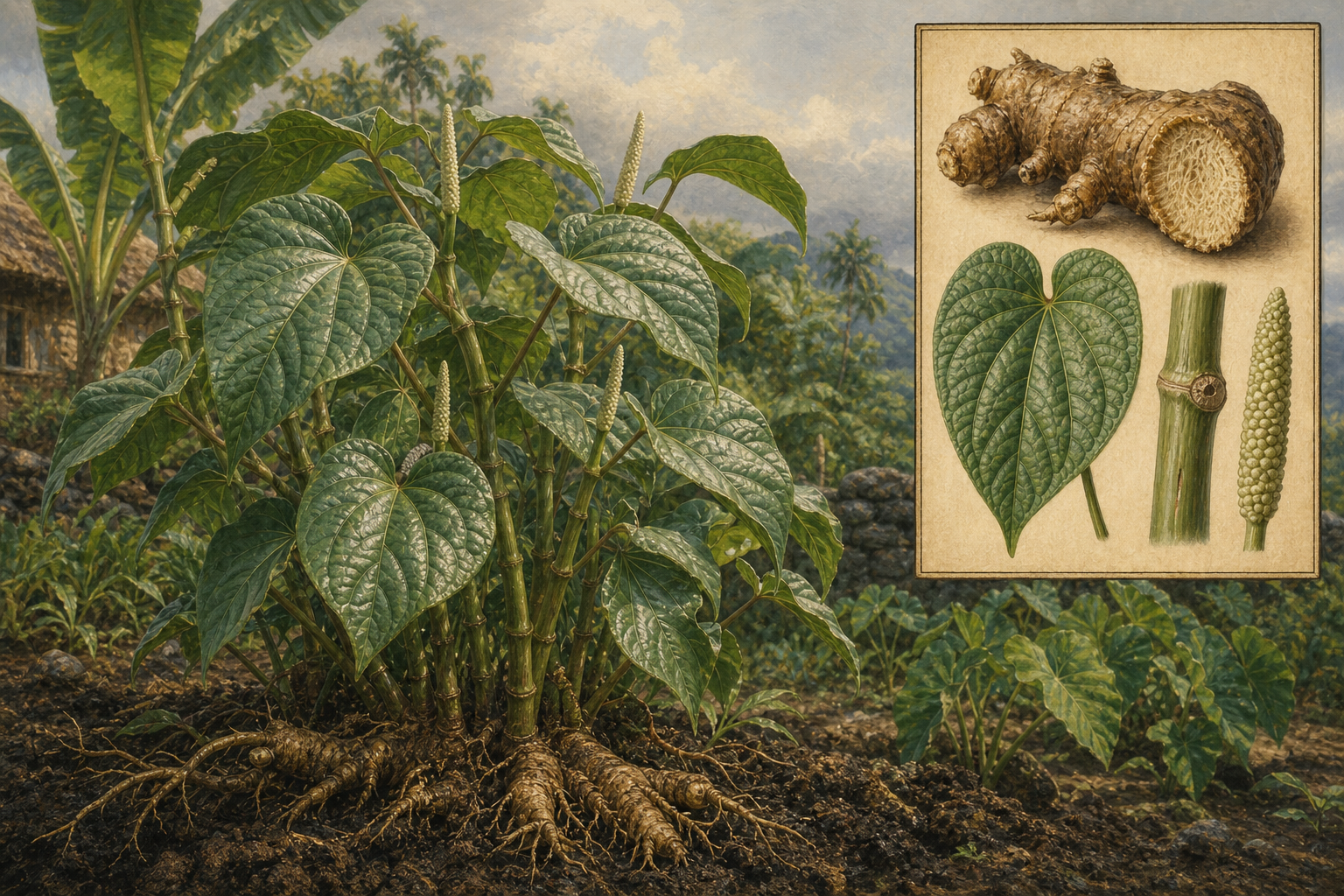
Kava (Piper methysticum) is a sterile, cultivated pepper of Oceania. The name is Polynesian for bitter. The drink is made from peeled root and rhizome, traditionally chewed or pounded, mixed with water, and strained. In village and urban nakamal, it is social and ceremonial: talk, calm, heavy limbs, a numb mouth. Export culture turned the same plant into acetone and ethanol extracts in German phytomedicine, then into US dietary-supplement capsules and kava bars. Those are not one object.
This monograph keeps three facts in the same frame. First, kavalactones can ease some anxiety in short trials of certain extracts. Second, a 2020 randomized trial in generalized anxiety disorder did not beat placebo. Third, kava products have been linked to rare, sometimes catastrophic liver injury—hepatitis, failure, transplant. The FDA said so in 2002. The CDC mapped cases in the United States, Germany, and Switzerland. Several European regulators pulled products. A long Pacific drinking tradition does not rule out liver risk, and a capsule is a different product from a shared bowl in a kava circle.
Nothing here is medical advice. Anxiety that wrecks sleep or work needs a clinician. Jaundice, dark urine, or right-upper-quadrant pain after kava is an emergency, not a reason to switch brands. Do not mix kava with alcohol or benzodiazepines, and do not drive after using it.
Featured in
Herbs for Anxiety and StressIn this monograph
01 The plant
Botanical profile
Piper methysticum G. Forst. (Piperaceae) is a perennial shrub, vegetatively propagated, not a wild-seeding crop. It is native as a cultivated complex across Melanesia, Polynesia, and Micronesia—Vanuatu is a diversity center—and was carried with voyaging. Stems are jointed and succulent, like a green cane. Leaves are large, cordate, with palmate venation. Inflorescences are pale spikes. Flowers are functionally limited; the plant is a clone garden. The medicinal and ceremonial part is the peeled rootstock: rhizome and roots (Piperis methystici rhizoma in older pharmacy language). Aerial stems and peelings are a different, alkaloid-richer material.
Cultivar chemistry is not a footnote. “Noble” kavas, the drinking cultivars, are relatively high in kavain among the six major kavalactones (kavain, dihydrokavain, methysticin, dihydromethysticin, yangonin, desmethoxyyangonin). “Tudei” or two-day kavas hang over longer, taste harsher, and are widely treated as unsuitable for daily drink and for export extracts. Flavokavains and the leaf/stem alkaloid pipermethystine show up in quality arguments about hepatotoxicity: wrong plant part, wrong cultivar, wrong solvent. Those hypotheses are real research. They are not a completed acquittal of every water extract.
Preparation splits the modern safety story. Traditional beverage is an aqueous suspension of root. German-style anxiolytic products were often acetone or ethanol extracts standardized to 30–70% kavalactones. Capsules, tinctures, and bar drinks in the United States mix those histories. FAO/WHO’s 2016 beverage review treats ceremonial/recreational water drinks as a separate exposure from solvent medicinal extracts—and still does not call either risk-free.
Kava is not black pepper (P. nigrum), not kawa-kawa (some unrelated bitter plants), and not kratom. The numb tongue is kavalactones, not a proof of dose.
02 Lineage
History
Archaeology and oral history put kava at the center of Pacific social life for many centuries: chiefly ceremony, reconciliation, welcome, evening talk. Preparation—chewing or pounding, water, hibiscus or coconut-fiber strain—is skilled work. The pharmacology (heavy legs, calm, a clear-enough head at modest dose) is why missionaries, traders, and later ethnographers wrote it down. Heavy daily use also wrote down kava dermopathy: dry, scaly, ichthyosiform skin that recedes when drinking stops.
Nineteenth- and twentieth-century pharmacy isolated kavain and kin and filed the rhizome as a sedative and urinary antispasmodic. Late-century German phytotherapy made WS 1490 and similar acetonic extracts a researched anxiolytic. That is when kava left the nakamal and entered tablet bottles in Europe and North America.
The break is 1998–2002. Case reports of hepatitis and liver failure accumulated in Germany, Switzerland, and then the United States. In March 2002 the FDA issued a consumer advisory: kava-containing supplements may be associated with severe liver injury, including a US transplant in a previously healthy young woman. In November 2002 the CDC’s MMWR summarized hepatic toxicity possibly associated with kava products in the United States, Germany, and Switzerland. Several countries restricted or banned medicinal kava. Germany’s ban was later litigated and, in a 2015 court story often cited by kava advocates, lifted on quality-and-identity grounds. A court ruling is not the same as a finding of safety. The US still sells kava as a supplement; FDA’s 2020 literature memorandum did not treat it as GRAS for conventional food.
Meanwhile kava bars spread in the United States, and Pacific producers argued that noble, peeled, water-extracted root had been blamed for solvent extracts and stem peelings. Teschke and others named a “Pacific kava paradox”: widespread traditional use, few documented island epidemics of fulminant hepatitis. NCCIH’s current consumer page records both the paradox hypotheses (cultivar, plant part, alcohol co-use, contamination, genetics, dose/duration) and the fact that water-prepared drinks have also appeared in injury reports. Both the cultural history and the safety record matter.
03 Chemistry
Active compounds and how it works
The six major kavalactones are lipid-soluble pyrones. Kavain, in experimental systems, potentiates GABAA receptors. Other proposed actions—sodium-channel effects, MAO-B inhibition, monoamine reuptake changes—are reviewed, not settled as a single clinical mechanism. The mouth-numbing is local anesthetic activity of the lactones. The heavy limbs are central muscle-relaxant effects. This is why kava is a driving and perioperative problem, not only a liver problem.
Hepatotoxicity mechanisms are plural and unfinished: idiosyncratic immune injury, CYP inhibition plus co-medication, glutathione depletion, mitochondrial stress, flavokavains, pipermethystine from aerial parts, and solvent residues have all been nominated. Gurley’s human phenotyping work found kava inhibited CYP2E1 in vivo (and had mixed 1A2 signals), unlike a blank CYP slate. Acetaminophen plus kava is a laboratory warning about glutathione, not a license to stack Tylenol and kava for a hangover.
Anxiety effects, when they appear, take days to weeks in extract trials, not one sip. NCCIH’s 2025 consumer summary: supplements may help some anxiety with delayed onset; they do not appear helpful for diagnosed generalized anxiety disorder—the 2020 Sarris 16-week GAD trial is the study behind that sentence. Earlier, smaller GAD work (including Sarris 2013 aqueous extract) had looked more favorable. Product chemistry was not identical across trials. That is a methods lesson, not a loophole.
04 In practice
Common uses
Traditional use is the drink: peeled root, water, social setting, evening. Dose in a village is not a milligram label. Recreational kava bars imitate that form with variable root quality.
Anxiety is the Western indication. Pittler and Ernst’s systematic reviews and Cochrane work on kava extract found short-term anxiolytic effects versus placebo in mixed anxiety samples, with the usual small-trial caveats. German acetonic extract WS 1490 has a cluster of older RCTs. Aqueous extracts in Australian work (KADSS 2009; 2013 GAD) reported benefit in some designs. The 2020 multicenter 16-week GAD trial did not. MSKCC’s clinical summary describes the data as mixed and judges that liver risk outweighs using kava as an anxiety treatment.
Sleep use follows from the calming effect. Evidence for kava as a primary sleep aid is limited, and it should not be used like a prescription sleeping pill.
Kava is sometimes pitched against benzodiazepines as “natural and non-addictive.” Sarris’s secondary analyses did not show a classic withdrawal syndrome in trial doses; that is not a reason to stop a prescribed benzodiazepine in favor of a root product of uncertain quality and liver safety. Almeida 1996 remains the textbook kava-plus-alprazolam coma case.
Do not use kava to “detox,” to drink through hepatitis, or as a hangover buffer. Alcohol plus kava is a documented bad idea: additive CNS depression and a plausible extra liver load.
05 The apothecary
Preparations and traditional use
Traditional: dried or fresh peeled rhizome/root, pounded, mixed with water, strained. Fresh green kava and dried chips are not interchangeable in strength.
Dietary supplements: capsules and tablets standardized to kavalactones, tinctures, and instant powders. Labels rarely certify noble cultivar, peeled root only, or solvent. FAO/WHO treat solvent medicinal extracts as a different product class from the beverage.
If someone and a clinician still consider a short, labeled course, the conservative pattern from trials is aqueous noble-root extracts in the ballpark of 120–240 mg kavalactones per day for weeks—not months of undocumented bar sessions, not unlabeled solvent extracts, and not “kava plus kratom.” Stop for surgery. Stop for any hint of liver injury. There is no dose that makes fulminant hepatitis impossible.
Do not make tea from leaves or peelings to “use the whole plant.” Alkaloids in the aerial parts are among the suspected contributors to liver injury, so leaves and peelings are best avoided.
Safety
Before you use kava
06 Caution
Side effects
Common: numbness of mouth, dizziness, headache, GI upset, drowsiness, “hangover,” restlessness. Visual and reflex changes happen. Impaired driving is documented, including forensic cases with kavalactones in urine and no other drugs.
Kava dermopathy: dry, scaly, flaky skin, reddened eyes, sometimes yellow tint of skin, hair, and nails after heavy chronic use. It is a known occupational look of very heavy drinkers in the Pacific and it usually recedes with abstinence.
Hematologic and other heavy-use reports: low platelets or white cells, photosensitivity, sebotropic rashes. Overdose: ataxia and altered mental status.
Liver: the rare, serious end. LiverTox catalogs clinically apparent acute liver injury that can progress to failure. CDC and FDA files include transplants. Latency is often weeks. Co-medication, alcohol, pre-existing liver disease, and product quality show up in case series; some injuries occurred without obvious overdose. Elevated GGT in regular drinkers is a field finding, not a curiosity. Any jaundice, itching, pale stools, or unusual fatigue is a stop-and-get-labs event.
07 Caution
Contraindications
Do not use kava if you have liver disease, unexplained enzyme elevations, or heavy alcohol use. Do not use it in pregnancy or while breastfeeding (kavalactones; NCCIH flags pyrone constituents). Do not give it to children.
Do not combine with benzodiazepines, barbiturates, other sedatives, or alcohol. Do not take it before driving or operating machinery. Stop before elective anesthesia.
Parkinson disease and acute dystonic reactions have case-level signals; skip kava if you have a movement disorder unless a neurologist agrees.
Anxiety disorders still need standard care. Kava is not a replacement for indicated SSRI, SNRI, CBT, or emergency psychiatric treatment.
08 Caution
Drug and herb interactions
CNS depressants: additive sedation with alcohol, benzodiazepines (alprazolam coma case), barbiturates, opioids, and some antihistamines. This is the interaction that shows up in ERs and traffic stops.
Hepatotoxic drugs and acetaminophen: theoretical and in-vitro potentiation. Do not stack kava with high-dose acetaminophen, isoniazid, high-dose methotrexate, or a hangover of drinks.
CYP: Gurley 2005 found in-vivo CYP2E1 inhibition with kava kava; 1A2 data conflict; 3A4 was not clearly inhibited in that protocol (unlike goldenseal). Treat “kava doesn’t do CYP” as false. Tell a pharmacist about anything with a narrow liver path.
Do not mix kava into unregulated “chill” blends with kratom, phenibut, or undeclared benzos. Unidentified ingredients make reactions both more likely and harder to treat.
09 Questions
Frequently Asked Questions
It is a different product: peeled root and water versus concentrated solvent extracts. FAO/WHO treat them separately. Water drinks have still appeared in liver-injury discussions. “Traditional” is not a shield against alcohol co-use, huge daily sessions, or bad cultivars.
Some short trials of standardized extracts reduced anxiety scores. NCCIH’s current reading is that supplements may help some anxiety after weeks, but not diagnosed GAD—the 2020 16-week trial was negative. Liver risk is why this is not a first-line plan.
Because of hepatitis and liver-failure reports around 2000–2002, in parallel with the FDA advisory and CDC MMWR. Germany later saw court challenges over product identity and quality. A lifted ban is not the same as “safe for everyone.”
Dry, scaly, ichthyosiform skin (and often red eyes) after heavy chronic drinking. It usually improves when kava stops. It is a known Pacific heavy-use sign, not a vitamin deficiency to treat with more kava.
No. Kava impairs coordination and has shown up in impaired-driving case series with kavalactones in urine. Treat it like other sedatives.
No. Alcohol and benzodiazepines add sedation; alcohol also loads the liver. A published coma case combined kava with alprazolam.
Stop it. If you have jaundice, dark urine, pale stools, severe fatigue, or belly pain, get emergency care and say you used kava. Report the product to your clinician and to FDA MedWatch.
People with liver disease, heavy drinkers, pregnant or breastfeeding people, children, anyone who must drive or face surgery soon, and anyone on sedatives. If anxiety is taking over your life, a clinician can help with treatments that have stronger evidence.
10 References
Sources
These references support the history, clinical, and safety claims on this page. They are not an endorsement of any product.
-
Kava: usefulness and safety
National Center for Complementary and Integrative Health (NIH), 2025
Consumer evidence and safety: possible help for some anxiety, not for GAD; liver injury including water-prepared drinks; alcohol/sedative and pregnancy cautions.
-
Kava
Memorial Sloan Kettering Cancer Center, About Herbs, 2022
Clinical summary: mixed anxiety data, 2020 GAD trial without benefit, hepatotoxicity, driving impairment, and CNS-depressant interactions.
-
Kava kava
LiverTox, National Institute of Diabetes and Digestive and Kidney Diseases (NIH), 2018
Hepatotoxicity monograph: clinically apparent acute liver injury that can be severe or fatal; regulatory bans and disputed causality reviewed.
-
Kava
NIH Office of Dietary Supplements (FDA advisory hub), 2002 / 2020
ODS index of the 25 March 2002 FDA consumer advisory, the 2020 FDA safety memorandum, and the CDC MMWR on hepatic toxicity.
-
Review of the published literature pertaining to the safety of kava for use in conventional foods
U.S. Food and Drug Administration, 2020
FDA memorandum reviewing kava safety for conventional food use; does not treat kava as GRAS given toxicity and interaction concerns.
-
Hepatic toxicity possibly associated with kava-containing products — United States, Germany, and Switzerland, 1999–2002
CDC MMWR, 2002
Public-health case summary of severe hepatic injury and transplants prompting the FDA advisory.
-
Kava: a review of the safety of traditional and recreational beverage consumption
FAO / World Health Organization, 2016
Joint FAO/WHO technical report distinguishing traditional water beverages from solvent medicinal extracts; chemistry of noble kava and kavalactones.
-
Efficacy of kava extract for treating anxiety: systematic review and meta-analysis
Journal of Clinical Psychopharmacology / NCBI DARE, 2000
Pittler and Ernst meta-analysis of kava extract versus placebo for anxiety—the older efficacy core later updated in Cochrane CD003383.
-
Kava extract for treating anxiety
Cochrane Database of Systematic Reviews (PubMed 12076477), 2003
Cochrane review CD003383: kava extract as a short-term anxiolytic option with the evidence-base and adverse-event limits of the included RCTs.
-
Kava in the treatment of generalized anxiety disorder
Journal of Clinical Psychopharmacology, 2013
Sarris et al. 6-week aqueous-extract GAD RCT with a moderate HAMA effect versus placebo; later contrasted with the 2020 16-week trial.
-
Kava for generalised anxiety disorder: a 16-week double-blind, randomised, placebo-controlled study
Australian & New Zealand Journal of Psychiatry, 2020
Sarris et al. multicenter GAD trial that did not demonstrate benefit over placebo—the study NCCIH cites when saying kava does not appear helpful for GAD.
-
Kava as a clinical nutrient: promises and challenges
Nutrients (PMC7600512), 2020
Open-access review of kavalactone chemotypes, flavokavains, and why different Sarris trial products are not interchangeable.
-
Toxicity of kava kava
Journal of Environmental Science and Health, Part C (PMC5868963), 2018
Mechanistic toxicity review covering the 2002 FDA advisory, CDC MMWR, metabolism, and proposed hepatotoxicity pathways.
-
In vivo effects of goldenseal, kava kava, black cohosh, and valerian on human cytochrome P450 1A2, 2D6, 2E1, and 3A4/5 phenotypes
Clinical Pharmacology & Therapeutics (PubMed 15900287), 2005
Gurley et al.: kava inhibited CYP2E1 in healthy volunteers—human interaction data, not only in-vitro conjecture.
-
Coma from the health food store: interaction between kava and alprazolam
Annals of Internal Medicine (PubMed 8967670), 1996
Almeida and Grimsley case report of profound sedation from kava plus a benzodiazepine.
-
Kava dermopathy
Journal of the American Academy of Dermatology (PubMed 8021358), 1994
Norton and Ruze clinical description of the reversible ichthyosiform eruption of heavy chronic kava use.
-
Taxonomy browser: Piper methysticum
NCBI Taxonomy (NIH), 2024
NCBI taxon 130404 for kava (Piper methysticum G. Forst.).
-
Piper methysticum G. Forst.
Integrated Taxonomic Information System (ITIS), 2024
Accepted ITIS record (TSN 18313) for kava in the pepper family Piperaceae.
-
Kavain
PubChem, National Library of Medicine (NIH), 2024
Chemical identity for a principal kavalactone of noble kava, used in GABA-A experimental work.