
Monograph
Rosemary
Salvia rosmarinus
Updated October 12, 2026
Key points
-
01
Kitchen first
Most real-world use is culinary. A sprig in the pan is not an essential oil, a hair protocol, or a memory drug.
-
02
Two names, one shrub
Salvia rosmarinus is the accepted name; Rosmarinus officinalis is the synonym still on bottles and in EMA titles.
-
03
Leaf is not oil
Tea and food use the leaf. Distilled oil is camphor- and cineole-rich and is not for drinking.
-
04
Remembrance is literature
Ophelia’s line and a few aroma studies are not evidence that rosemary treats dementia.
-
05
Hair: one trial
A 2015 comparison with 2% minoxidil is interesting and limited—not a replacement for indicated care.
Rosemary is a woody Mediterranean evergreen in the mint family whose needle-like leaves have seasoned lamb, marked graves, and scented sickrooms for two millennia. The Latin ros marinus—“dew of the sea”—is a habitat name, not a chemical one: the plant hugs limestone and salt wind. Botanists now treat it as Salvia rosmarinus; jars, pharmacopeias, and older papers still say Rosmarinus officinalis. Same shrub. Different filing cabinet.
This monograph keeps three objects from collapsing into one wellness product: the culinary leaf, the traditional herbal tea and bath, and the steam-distilled essential oil. Europe still lists the leaf for dyspepsia and the oil for minor muscle pain and sluggish leg circulation—as tradition, not as a pile of randomized trials. Interest in rosemary for memory draws on Shakespeare and a handful of intriguing aroma studies; interest for hair draws on one promising comparative trial against 2% minoxidil. Neither makes the oil safe to drink.
Nothing here is medical advice. A sprig in potatoes is food. A labeled bath additive is a medicinal-strength use. Persistent indigestion, sudden leg swelling, seizures, or hair loss that worries you needs a clinician, not a stronger steam.
Featured in
Herbs for Memory and Focus Herbs for Digestion and Bloating Herbs for Back and Muscle PainIn this monograph
01 The plant
Botanical profile
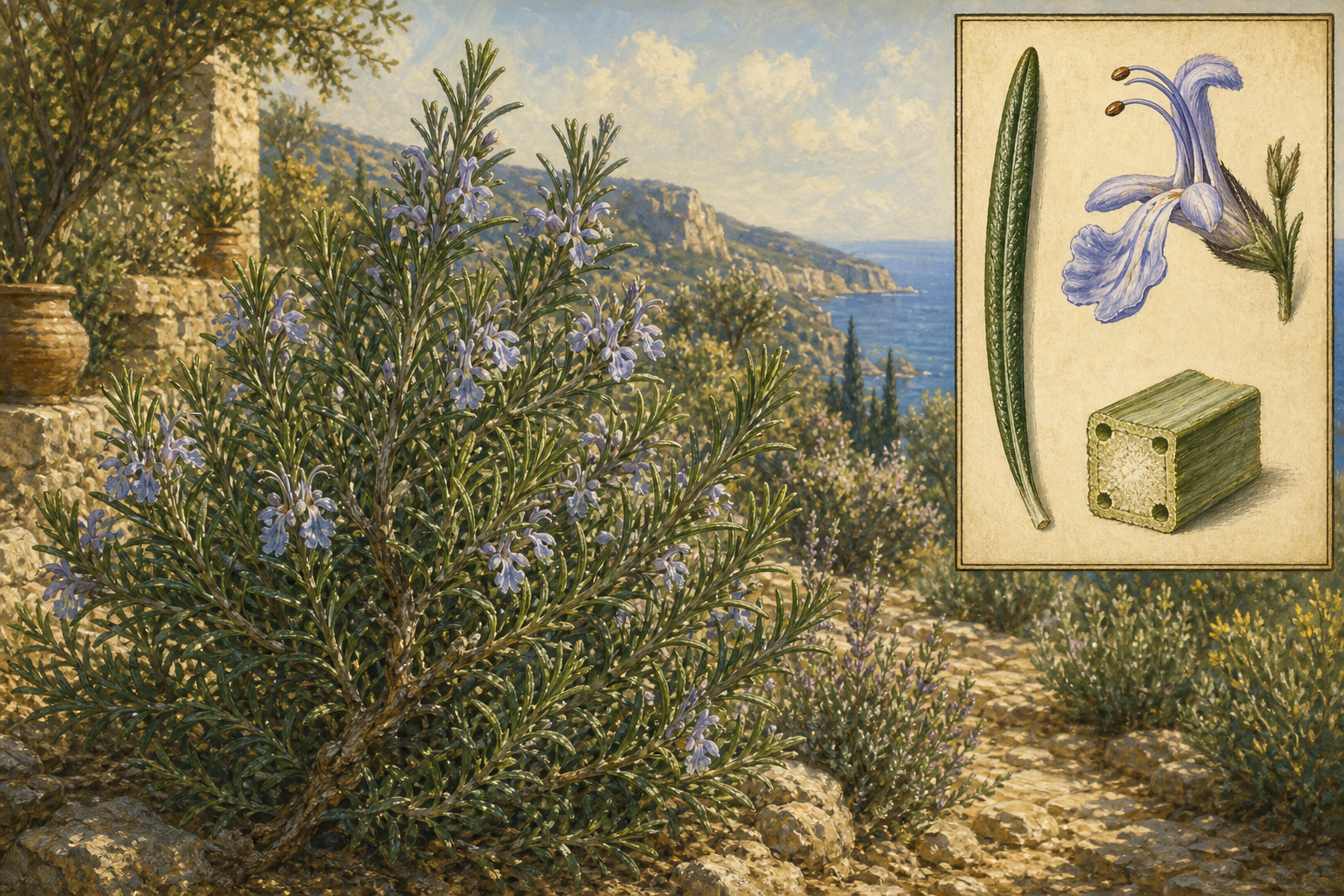
Salvia rosmarinus (synonym Rosmarinus officinalis) is an evergreen shrub native to the Mediterranean basin—coasts and hills of Iberia, the Maghreb, Italy, the Balkans, and adjacent islands—and now planted worldwide in dry gardens. It prefers full sun, sharp drainage, and a winter that does not stay wet. Stems become woody; young growth is square in cross-section, as in other Lamiaceae. Leaves are opposite, linear, needle-like, dark green above and paler beneath, with rolled margins and dense glandular hairs that hold the camphoraceous-cineole scent. Flowers are two-lipped, typically pale blue to lilac (sometimes pink or white), with two long-exserted stamens—one of the morphological rhymes that helped phylogenists fold Rosmarinus into Salvia.
The 2017 recircumscription in Taxon (Drew and colleagues) placed rosemary inside a broadly defined Salvia because the old genus Rosmarinus sat nested among sages. Kew’s Plants of the World Online accepts Salvia rosmarinus Spenn. Labels did not all follow. If a bottle says R. officinalis, it is still this plant unless the seller has mixed in another salvia. It is not garden sage (Salvia officinalis), not white sage (S. apiana), and not “rosemary” as a perfume accord without the leaf.
Chemotypes matter for the oil. Distillations are often grouped by dominant volatiles: 1,8-cineole (eucalyptol), camphor, or verbenone/borneol patterns, plus α-pinene. Spanish, Moroccan, and Tunisian commercial oils are not interchangeable drop for drop. The dried leaf (Rosmarini folium) is a different pharmacognostic object from the essential oil (Rosmarini aetheroleum). Leaf also carries phenolic diterpenes—carnosic acid and carnosol—and the caffeic ester rosmarinic acid, which food chemists prize as antioxidants. Those phenolics are why rosemary extract, not the perfume oil, became an EU food additive.
The part used in the kitchen and in most traditional teas is the leaf, fresh or dried. Flowering tops go into some distillations. Do not assume a hedge clipping matches a Ph. Eur. leaf with a minimum essential-oil content.
02 Lineage
History
The written Mediterranean trail is old and overlapping: a seaside shrub used as food, fumigant, wreath, and bitter digestive. Greek and Roman authors treated rosemary as a plant of memory and of the dead—sprigs in graves, scent in rooms, a student folklore that wearing the herb helped one remember. How much of that is S. rosmarinus in the modern sense versus a cluster of aromatic Lamiaceae is a historian’s problem; the cultural payload is not. The plant traveled with monks, markets, and later with colonial gardens far beyond the limestone it prefers.
The English-language image that still sells tinctures is Shakespeare’s. In Hamlet, Act 4, scene 5, Ophelia—distracted, handing out herbs with moral labels—says, “There’s rosemary, that’s for remembrance. Pray you, love, remember.” That is a stage emblem, not a protocol. It tells you early modern England already coded the plant as memory and fidelity. It does not tell you an essential-oil diffuser treats dementia.
Medieval and Renaissance Europe distilled “Hungary water” (eau de la reine de Hongrie) from rosemary in spirit—an early alcoholic perfume and household tonic whose recipes wander. Herbals kept the leaf for the stomach, the bath, and the hair. Culinary use never needed a monograph: lamb, beans, bread, and later roast potatoes made the pine-camphor taste ordinary. Charlemagne’s agricultural instructions and monastic garden lists helped keep it in northern plots that freeze harder than a Dalmatian hillside.
Nineteenth- and twentieth-century pharmacy separated the oil from the leaf. Camphor and cineole made the distillate a liniment and a bath scent—and, in overdose, a convulsant story. Food science later isolated why the leaf resists rancidity: carnosic acid and carnosol scavenge the chemistry of fat oxidation. In 2008 EFSA assessed rosemary extracts as antioxidants; the EU now lists them as E 392. That is a manufacturing use, not a “take this capsule for longevity” result.
The name change is recent history with a long fuse. Linnaeus published Rosmarinus officinalis in 1753. Spenner’s Salvia rosmarinus (1835) sat unused until molecular work made a broad Salvia the less-bad map. Pharmacopeias and EMA documents still title the herbal substance Rosmarinus officinalis L. because that is how the European tradition filed it. Readers should treat the two binomials as one species unless a label is doing something sloppy.
03 Chemistry
Active compounds and how it works
Rosemary is a mixed aromatic, not a single-molecule drug. The volatile fraction—cineole, camphor, pinene, camphene, borneol, verbenone depending on chemotype—explains the scent, the traditional “warming” bath, and the neurologic risk of the oil. Camphor is a known convulsant at sufficient dose; cineole is the same oxide famous in eucalyptus. Inhaled aroma is a small exposure. A teaspoon of undiluted oil is not.
Non-volatile phenolics do different work. Carnosic acid and carnosol are abietane diterpenes concentrated in the leaf; they are the backbone of rosemary’s food-antioxidant extracts. Rosmarinic acid is a caffeic ester shared with sage, lemon balm, and other mints—often cited in antioxidant and astringent talk. A roast sprig delivers some of both worlds. A steam-distilled oil is mostly the volatiles and is a poor source of carnosic acid. That is why “rosemary oil for antioxidants” is usually a category error.
Traditional digestive use maps onto bitter-aromatic carminative folklore: scent, saliva, and a strong flavor that people historically reached for after heavy meals. Mechanisms are not a single receptor story. Traditional cutaneous and bath use for “circulation” and sore muscle is likewise tradition-plus-counterirritant scent, not a proven vasodilator protocol for claudication.
Cognition studies that exist are mostly aroma or small extract trials in healthy adults: modest shifts on lab memory tasks, mixed speed-accuracy tradeoffs, not Alzheimer’s disease outcomes. Hair folklore now cites a 2015 randomized comparison of rosemary oil versus 2% minoxidil in androgenetic alopecia. That trial is real, limited, and not FDA approval of a hair drug.
04 In practice
Common uses
Today the dominant use is culinary. Fresh sprigs or crumbled dried leaf season lamb, pork, chicken, beans, focaccia, and roasted roots. Fat carries the aroma; late addition keeps it from turning medicinal. That is food. The dose is a few needles, not a cup of oil.
European traditional herbal indications split by preparation. Dried leaf as tea (and related oral forms) is framed for symptomatic relief of dyspepsia and mild spasmodic gut complaints. The same leaf as a bath additive, and the essential oil in semi-solid cutaneous preparations, are framed for minor muscular or joint aches and for minor peripheral circulatory complaints (the heavy-legs folklore). EMA HMPC listings are traditional-use, not well-established-use: long practice, plausible, with limited modern trials. Night sweats from infection, inflammatory arthritis with fever, or a cold white painful foot are diagnostic problems.
Memory and “brain fog” claims run ahead of the data, though the early findings are intriguing. Moss and colleagues (2003) found rosemary aroma associated with better scores on some memory factors in healthy adults versus a no-odor control, with a cost to speed, while lavender went the other way on several tasks. That is a lab scent study, not a treatment for dementia, ADHD, or exam season. Do not delay a memory clinic for a diffuser.
Hair growth is the newest area of interest, with one encouraging trial. Panahi and colleagues (2015) randomized adults with androgenetic alopecia to rosemary oil or 2% minoxidil for six months and reported similar hair-count gains at six months, with more scalp itch in the minoxidil arm. It is one comparative trial, not a head-to-head against 5% minoxidil, oral therapies, or a dermatologist’s full workup. Rosemary oil on the scalp can irritate. It is not a substitute for indicated medical treatment when that is the right treatment.
Food preservation is the quiet industrial success. Rosemary extracts standardized to carnosic acid/carnosol are used to slow oxidation in oils, meats, and packaged foods (E 392 in the EU). Eating those foods is not the same as taking a “detox” capsule of the same extract, and the extract is not the essential oil.
Aromatherapy and liniments remain popular. Inhaled culinary-level scent is not the same as ingesting oil or using it on broken skin. Do not put rosemary oil in the eyes, on mucosa, or in a child’s bath.
05 The apothecary
Preparations and traditional use
Kitchen use is fresh sprigs (stripped or whole in a roast) or dried leaf, which is stronger and more camphoraceous. Crushing releases oil glands. A little goes a long way.
Traditional medicinal tea is comminuted dried leaf in hot water, in labeled amounts, for short courses. EMA-style posology is time-limited: seek care if dyspepsia lasts more than about two weeks on the product, or if bath use for aches is not helping by about four weeks. Follow the pack, not a social-media handful.
Bath additives using leaf or specified oil dilutions are a separate route from tea. Do not use on broken or irritated skin. Oil in semi-solid cutaneous bases (6–10% in the EU traditional listing for the oil monograph) is a liniment-style use, not a salad dressing.
Hair recipes online often mix undiluted essential oil with a carrier. If someone tries a dilute topical, patch-test and keep it out of eyes. The 2015 trial is not a recipe blog.
Do not ingest rosemary essential oil. Distillation concentrates camphor and cineole. Capsules of leaf or antioxidant extract are still supplements with variable quality—not a reason to skip a clinician if you have gallbladder disease, liver disease, or a seizure history.
Safety
Before you use rosemary
06 Caution
Side effects
Culinary amounts are well tolerated for most people. Large bitter infusions can upset the stomach. Contact dermatitis to Lamiaceae and to the oil happens. Dried herb dust can bother sensitive noses. Baths can irritate skin.
Essential oil and high-camphor preparations can cause redness, burning, and—if swallowed or used in large quantity—vomiting, agitation, and seizures. That is a documented pattern for camphoraceous oils, not a tea anecdote. Children are at greatest risk in essential-oil poisonings; keep bottles capped and out of reach.
EMA consumer language flags hypersensitivity (including contact dermatitis and, for the oil, breathing difficulty in susceptible people). Frequency is often “not known” because reporting is incomplete.
Hair-oil use can itch. That does not prove it is “working.” Minoxidil itch in the 2015 trial was more common, not absent on the rosemary side.
07 Caution
Contraindications
Do not ingest the essential oil. EMA traditional listings contraindicate rosemary leaf medicines in children under 12, and rosemary oil medicines in anyone under 18; both leaf and oil traditional products are listed as not for pregnancy or breastfeeding. Culinary seasoning in food is a different exposure. Concentrated teas, extracts, baths-as-medicine, and oils are the objects of those cautions.
Skip medicinal-dose rosemary if you have bile-duct obstruction, gallbladder inflammation, gallstones, or liver disease (leaf monograph). Skip the oil if you have known heart or kidney disease as listed in the EU oil summary, and do not apply it around the eyes or mucous membranes.
Seizure disorders and a history of camphor or essential-oil toxicity are reasons to avoid the oil and perhaps high-dose extracts unless a clinician agrees. Allergy to rosemary or other mints is a stop.
Do not use bath or cutaneous rosemary on broken skin, ulcers, or a suddenly swollen, hot, painful leg—that is a medical evaluation, not a circulatory herb.
08 Caution
Drug and herb interactions
EMA assessment at the time of the herbal monographs did not describe well-documented drug–drug interactions for traditional leaf and oil uses. That is not the same as “no interactions exist.” Concentrated extracts plus anticoagulants, anticonvulsants, or diabetes medicines belong in the “tell the pharmacist” bucket because evidence is incomplete and camphor is neurologically active in principle.
Do not stack camphoraceous oils (rosemary, some sages, eucalyptus, wintergreen-adjacent liniments) for a stronger “circulation ritual.” Combining them raises the risk of seizures.
If a clinician has prescribed minoxidil, finasteride, or another hair-loss regimen, adding rosemary oil is an experiment, not a proven upgrade. Mention it so scalp irritation is not blamed on the wrong product.
Rosemary is not St. John’s wort. Dramatic CYP induction is not its reputation. Disclosure still beats stacking “antioxidant” capsules on a narrow-therapeutic-index drug without asking.
09 Questions
Frequently Asked Questions
On many labels, yes. Botanists and Kew now treat Salvia rosmarinus as the accepted name after rosemary was folded into a broad Salvia. EMA herbal documents still title the plant Rosmarinus officinalis L. They are the same species. It is not garden sage (S. officinalis).
Shakespeare made it an emblem of remembrance. A 2003 healthy-adult aroma study found some memory-task gains with rosemary scent (and slower responses). That is not a treatment for dementia, exam performance, or “brain fog.” See a clinician for real cognitive change.
One 2015 randomized trial reported similar hair-count increases for rosemary oil and 2% minoxidil after six months, with less itch than minoxidil in that sample. It is a single comparative study, not proof it matches stronger medical regimens. Ask a dermatologist before swapping treatments.
No. Tea is an aqueous infusion of leaf, with some volatiles and the phenolic diterpenes that food chemists care about. Essential oil is a steam distillate concentrated in cineole and camphor and is not a beverage. EU traditional use of the oil is cutaneous, not oral.
Leaf extracts rich in carnosic acid and carnosol slow fat oxidation. EFSA assessed that use; the EU additive number is E 392. That is a preservative function, not evidence that antioxidant capsules prevent disease.
No. Camphoraceous oils can cause serious neurologic toxicity if ingested. Keep them away from children. Culinary leaf in cooking is a different, much smaller exposure.
Pregnant or breastfeeding people should avoid concentrated products (food seasoning is a different question). Skip medicinal leaf if you have gallbladder or liver disease as listed in the EU monograph. Skip the oil in children and if you have the heart or kidney cautions on the oil summary. Seizure history and essential-oil allergy are further reasons to stop.
Smoke is an airway irritant, not a monograph indication. This page is about S. rosmarinus as food and traditional herbal leaf or labeled topical oil—not a how-to for fumigation.
10 References
Sources
These references support the history, clinical, and safety claims on this page. They are not an endorsement of any product.
-
Rosmarini folium — rosemary leaf (EU herbal summary)
European Medicines Agency, 2024
Traditional-use summary for dried leaf: dyspepsia and mild spasmodic GI complaints (oral tea); baths for minor muscular/articular pain and minor peripheral circulatory complaints; age, pregnancy, and gallbladder/liver cautions.
-
Rosmarini aetheroleum — rosemary oil (EU herbal summary)
European Medicines Agency, 2024
Traditional-use summary for essential oil in cutaneous semi-solid forms: minor muscular/articular pain and minor circulatory complaints in the legs; not for under-18s, pregnancy, or internal use.
-
Assessment report on Rosmarinus officinalis L., aetheroleum and Rosmarinus officinalis L., folium (Revision 1)
European Medicines Agency (HMPC), 2024
HMPC assessment covering leaf versus oil, Ph. Eur. definitions, chemistry (including chemotypes), traditional indications, and safety. Notes the Salvia rosmarinus synonymy.
-
European Union herbal monograph on Rosmarinus officinalis L., folium (Revision 1)
European Medicines Agency (HMPC), 2024
Binding-style EU monograph text for rosemary leaf preparations, posology, and contraindications.
-
Salvia rosmarinus Spenn.
Plants of the World Online (Royal Botanic Gardens, Kew), 2024
Accepted botanical name, Mediterranean native range, and current Kew classification for rosemary.
-
Salvia rosmarinus Spenn.
International Plant Names Index (IPNI), 2024
Nomenclatural record for the accepted combination Salvia rosmarinus (the name Kew treats as current).
-
Taxonomy browser: Salvia rosmarinus
NCBI Taxonomy (NIH), 2024
NCBI taxon 39367 for rosemary, including the Rosmarinus officinalis synonymy used in biomedical databases.
-
Rosmarinus officinalis L.
Plants of the World Online (Royal Botanic Gardens, Kew), 2024
Linnaean name treated as a synonym of Salvia rosmarinus, with Drew et al. 2017 cited among the authorities.
-
Salvia united: The greatest good for the greatest number
Taxon, 2017
Phylogenetic paper that recircumscribed Salvia to include Rosmarinus; the nomenclatural reason labels now disagree with Kew.
-
Use of rosemary extracts as a food additive
EFSA Journal (Panel on Food Additives, Flavourings, Processing Aids and Materials in Contact with Food), 2008
Scientific opinion on rosemary extracts (carnosic acid/carnosol) as antioxidants—the basis for EU additive E 392, distinct from essential-oil use.
-
Aromas of rosemary and lavender essential oils differentially affect cognition and mood in healthy adults
International Journal of Neuroscience (PubMed 12690999), 2003
Healthy-volunteer aroma study often cited for rosemary and memory-task performance; not a dementia trial.
-
Rosemary oil vs minoxidil 2% for the treatment of androgenetic alopecia: a randomized comparative trial
Skinmed (PubMed 25842469), 2015
The comparative hair-count trial behind most “rosemary oil equals minoxidil” headlines; one study, 2% minoxidil comparator.
-
Rosemary (Rosmarinus officinalis L., syn Salvia rosmarinus Spenn.) and its topical applications: a review
Plants (Basel) / PMC7284349, 2020
Open-access review of topical rosemary chemistry and dermatologic folklore, including nomenclature after the Salvia merger.
-
Hamlet, Act 4, scene 5
Folger Shakespeare Library, c. 1600 (modern Folger text)
Primary text of Ophelia’s “There’s rosemary, that’s for remembrance”—literature, not a clinical citation.
-
Carnosic acid
PubChem, National Library of Medicine (NIH), 2024
Chemical identity for a principal phenolic diterpene of rosemary leaf extracts used as food antioxidants.
-
Camphor
PubChem, National Library of Medicine (NIH), 2024
Chemical identity for a major monoterpene ketone of many rosemary oils, relevant to neurologic toxicity if the oil is ingested.
-
Rosmarinic acid
PubChem, National Library of Medicine (NIH), 2024
Phenolic ester shared with other Lamiaceae, often cited in rosemary’s antioxidant chemistry alongside the diterpenes.
-
1,8-Cineole
PubChem, National Library of Medicine (NIH), 2024
Volatile oxide (eucalyptol) that dominates some rosemary chemotypes and is concentrated by steam distillation.