Monograph
Ashwagandha
Withania somnifera
Updated October 4, 2026
Key points
-
01
A rasayana that became a lifestyle aisle
People now buy it for stress, sleep, and gym testosterone. Those are the boom uses. They are not a cortisol diagnosis and not Panax ginseng.
-
02
Some stress and sleep signal; anxiety is messier
NCCIH: some preparations may help insomnia and stress; anxiety evidence is unclear. Small RCTs and metas exist. They do not replace indicated care.
-
03
Root is not leaf is not a gummy
Trial extracts are usually standardized root. Leaf is richer in withaferin A. India has told domestic makers to keep leaves out. Match the product.
-
04
Short-term, not forever
NCCIH: possibly safe up to about three months. Long-term safety is not established. Denmark could not set a food-supplement safe dose.
-
05
Rare liver injury is documented
LiverTox likelihood B. Jaundice weeks in is an emergency. Skip it if you already have liver disease. Pregnancy and prostate cancer are also firm reasons to avoid it.
Ashwagandha (Withania somnifera) is a Solanaceae shrub whose Sanskrit name means horse smell. Ayurveda used the root as a rasayana tonic for centuries. The object on a 2020s shelf is something else: a branded withanolide extract in a gummy, a latte powder, a stress-relief capsule, or a gym stack next to creatine. People now reach for it mainly to feel less stressed, sleep through the night, and—especially men—nudge testosterone, recovery, and “drive.” Those are the claims that made it the Western face of Ayurveda. They are not one chemistry and not one trial.
This monograph keeps four facts in the same frame. First, NCCIH’s consumer page (March 2023) says some preparations may help insomnia and stress; the anxiety signal is unclear; limited data suggest two to four months of use may raise testosterone and sperm quality in some men; evidence is not enough for athletic performance, cognition, diabetes, menopause, or COVID-19. Second, the products are not interchangeable. Root-only extracts (KSM-66 is the famous one), root-plus-leaf extracts (Sensoril and kin), leaf powders, and candy-aisle gummies do not share a withanolide profile. India’s food regulator has told domestic manufacturers to keep leaves out of supplements; withaferin A is higher in leaf. Third, EMA’s herbal committee looked at the root and did not adopt a European Union monograph—only a 2013 public statement. Fourth, LiverTox (updated December 2024) now rates ashwagandha a likely cause of clinically apparent liver injury (likelihood B): usually cholestatic or mixed jaundice two to twelve weeks in, rarely failure or transplant, especially with preexisting liver disease. Denmark banned it in food supplements in 2023. Australia’s TGA keeps warning that liver injury is very rare and real.
Nothing here is medical advice. Panic, insomnia, or low mood that disrupts work still belongs with a clinician. Jaundice after any ashwagandha product is an emergency: stop it and get medical care rather than switching brands. This plant is not Panax ginseng, not a benzodiazepine, and not a thyroid drug.
Featured in
Herbs for Sleep Herbs for Anxiety and Stress Herbs for Energy and Fatigue Herbs for Low Mood and Depression Herbs for Libido and Sexual HealthEvidence reviews
Ashwagandha for Anxiety →In this monograph
01 The plant
Botanical profile
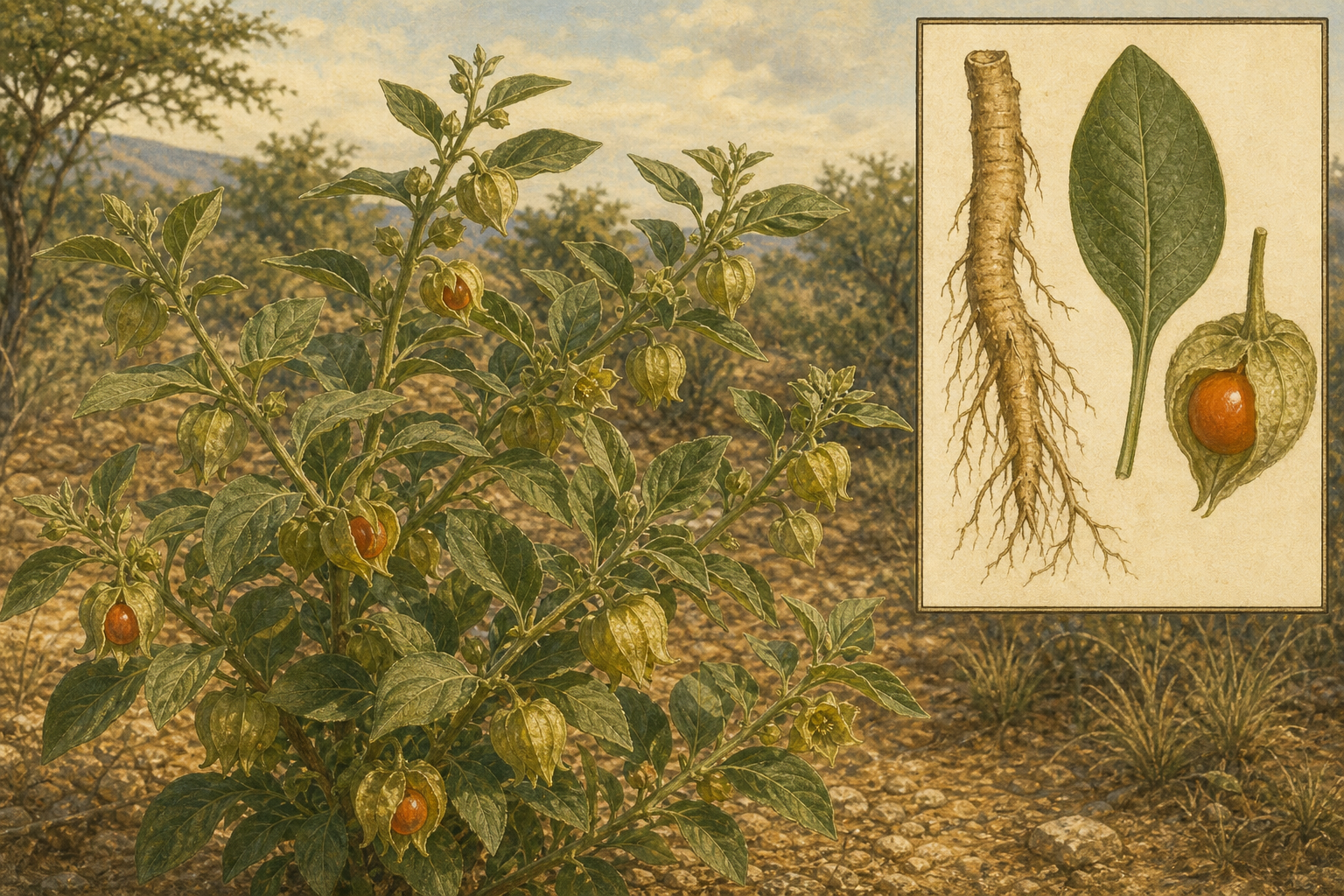
Withania somnifera (L.) Dunal sits in Solanaceae, the nightshade family, with tomato, potato, and ashwagandha’s lookalike cousin Physalis. NCBI Taxonomy treats it as taxon 126910. Linnaeus named it Physalis somnifera in Species Plantarum (1753); Dunal moved it to Withania in de Candolle’s Prodromus (1852). IPNI records that combination as 821709-1. It is a drought-tolerant shrub of India, the Middle East, and parts of Africa: dull ovate leaves, small greenish-yellow bells, and inflated papery calyces that lantern around orange-red berries—winter cherry, poison gooseberry. The Ayurvedic drug, and the extract most trials use, is the root. Leaves are a different, more withaferin-A-rich organ.
Do not confuse it with Panax ginseng because some labels say “Indian ginseng.” Different family, different saponins, different trials. Do not treat the lantern fruit like tomatillo or Cape gooseberry; the medicinal research is on the root, not the berries. Withania coagulans is another species sold in some markets; it is not W. somnifera.
The chemistry that labels advertise is steroidal lactones: withanolides. Withaferin A (PubChem CID 265237) and withanolide A (CID 11294368) are the named markers. Alkaloids, saponins, and iron also sit in the root. More than a hundred constituents have been counted; the molecule responsible for stress scores—or for hepatitis—is not proven. LiverTox suspects withanolides. Leaf extracts skew toward reactive withanolides; that is the quality argument behind root-only branding and behind India’s leaf restriction. Two capsules can share a Sanskrit name and not share a chromatogram.
02 Lineage
History
In Ayurveda the root is a rasayana: a rejuvenative for strength, sleep, and “vitality,” classically for vata complaints and as a tonic after illness. Somnifera nods at sleep in the Latin. Horse smell, horse strength—the folk etymology made for easy branding. Traditional preparations were powders (churna), milk decoctions, and compound formulas, not 600 mg KSM-66 twice daily in a gummy mold. Abortifacient folklore in some herbals is why pregnancy stays on modern do-not-take lists; it is not a clinical trial of miscarriage, and NCCIH still says avoid it in pregnancy and lactation.
Twentieth-century Indian pharmacy standardized root powders. The Western boom is twenty-first century. Chandrasekhar, Kapoor, and Anishetty’s 2012 Indian Journal of Psychological Medicine RCT of a high-concentration full-spectrum root extract (the KSM-66 material) in stressed adults became the paper every stress bottle cites: lower perceived stress and cortisol versus placebo. Sleep RCTs followed (Langade and colleagues). Gym culture picked up Wankhede’s 2015 muscle-strength trial. By the late 2010s the plant had left the Ayurvedic dispensary and entered the same aisle as magnesium glycinate and “adrenal” blends.
The 2020s made it ambient. Stress and sleep were already the use-case; the pandemic, then a social-media cortisol panic, then flavored gummies and coffee creamers, turned a bitter root into a lifestyle ingredient. LiverTox now calls it the most frequently used Ayurvedic medication and a popular Western herbal. Australia listed hundreds of Withania-containing medicines. Parallel to the boom: case series of jaundice (Björnsson, Iceland and the US DILIN, 2020), a Danish food-supplement ban in 2023 after a DTU risk assessment that could not set a safe dose, Dutch pharmacovigilance updates into 2025, TGA safety alerts, and an Indian enforcement line that leaves should not go into domestic supplements. EMA never gave the root a well-established or traditional EU monograph. Its modern story is an old tonic finding a new, global market.
03 Chemistry
Active compounds and how it works
“Adaptogen” describes a hoped-for effect rather than a specific receptor. Proposed actions that show up in reviews include HPA-axis effects (lower circulating cortisol in some RCTs), GABAergic calming in animals, modest thyroid-hormone nudges, and anti-inflammatory cell work attributed to withanolides. Speers and colleagues (2021) reviewed stress, anxiety, depression, and insomnia together and found a plausible but still mixed body of neuropsychiatric evidence. None of that makes ashwagandha an SSRI, a Z-drug, or a replacement for treating sleep apnea.
Withaferin A is cytotoxic in cancer-cell models and is more associated with leaf. That is interesting oncology pharmacology and a reason not to treat leaf powder as a gentler tea. Root extracts used in stress trials are standardized to withanolides, often in the 5% range, at capsule doses of a few hundred milligrams once or twice daily. Gummies rarely match those trial products. Sensoril-type root-and-leaf extracts are a third profile. Match the trial if you and a clinician still want a course—and do not assume a latte does.
Testosterone and sperm changes, when they appear, are modest and come from weeks of extract in men, not from one scoop. Thyroid: van der Hooft (2005) described thyrotoxicosis after ashwagandha; NCCIH says people with thyroid disorders should skip it. GABA-flavored sedation is why stacking it with benzodiazepines, alcohol, or “sleep gummies” that already contain melatonin and botanicals is a drowsiness experiment. MSKCC notes no significant CYP3A4 or CYP2D6 interaction in one microsome study, and in-vitro CYP2B6 inhibition plus CYP3A4 induction in another; clinical relevance is unsettled. Tell a pharmacist anyway.
04 In practice
Common uses
Stress is why the bottle is next to the checkout. Chandrasekhar 2012 is the ancestor RCT: high-concentration root extract versus placebo in stressed adults, with drops in perceived-stress scores and serum cortisol. Lopresti 2019 is a later randomized pharmacological look at a standardized extract. Akhgarjand and colleagues (Phytotherapy Research 2022) meta-analyzed anxiety and stress trials and reported benefit versus placebo. NCCIH still separates the claims: some preparations may help stress; evidence on anxiety is unclear. Read both. A significant meta-analysis of small, heterogeneous, often industry-adjacent trials is not a diagnosis of generalized anxiety disorder and not a reason to stop an SSRI.
Sleep is the other mass-market use—night gummies, “wind-down” powders, insomnia TikTok. Cheah, Norhayati, Husniati Yaacob, and Abdul Rahman (PLoS One 2021) systematically reviewed and meta-analyzed ashwagandha extract for sleep and found improvements, larger in people who already had insomnia and with treatment past eight weeks. Langade’s RCTs in healthy volunteers and insomnia patients are the usual primary studies. NCCIH accepts a sleep signal for some preparations. This is still adjunct territory: not a Z-drug, not CPAP, not a fix for shift work or alcohol. Drowsiness is also an adverse effect. Do not treat next-day fog as proof it “worked.”
The gym file is testosterone, recovery, and “natural TRT energy.” Wankhede, Langade, Joshi, Sinha, and Bhattacharyya (Journal of the International Society of Sports Nutrition 2015) randomized men in resistance training to ashwagandha or placebo and reported better muscle strength and recovery. Smith, Lopresti, Teo, and Fairchild (Advances in Nutrition 2021) reviewed herbs and testosterone and included ashwagandha among botanicals with limited supportive data. NCCIH: limited evidence that two to four months may increase testosterone and sperm quality; not enough to say it helps athletic performance as a category. Durg, Shivarum, and Bavage (Phytomedicine 2018) meta-analyzed male-infertility studies. None of this is a substitute for indicated testosterone therapy, a fertility work-up, or a training program. People with hormone-sensitive prostate cancer should avoid it (NCCIH, MSKCC).
What people also buy it for, with less evidence: “adrenal fatigue” (not a medical diagnosis), thyroid “support” (the opposite of what you want if you already have hyperthyroidism), menopause (NCCIH: not enough evidence; there is a perimenopause RCT in the MSKCC stack, not a guideline), cognition and COVID-19 (NCCIH: insufficient), diabetes and blood pressure (possible additive effects with medicines—caution, not a protocol). Cancer-cell papers and chemo-fatigue pilots are not a reason to self-treat a tumor; ashwagandha is not a cancer treatment.
Do not use ashwagandha to skip therapy, to “biohack” cortisol readings, or as an open-ended daily tonic. NCCIH’s safety window is short-term, up to about three months; long-term safety is not established. If stress or insomnia lasts, the plant is not the diagnosis.
05 The apothecary
Preparations and traditional use
Traditional: dried root powder in milk or ghee, or in compound Ayurvedic formulas. It is bitter and horse-scented, quite unlike today’s flavored gummies.
Branded trial extracts: KSM-66 is a root-only full-spectrum extract used in the 2012 stress RCT (often 300 mg twice daily in that design). Sensoril and similar products include leaf. Withanolide percentages on labels are not a clinical potency SI unit. If someone and a clinician still consider a course, match a studied root extract and a studied duration (weeks, not years), not an unquantified blend.
US dietary supplements: capsules, tablets, tinctures, gummies, drink mixes, coffee creamers, and “stress complex” stacks with L-theanine, magnesium, and mushrooms. They are not bioequivalent. Leaf-containing products are the quality fight India’s FSSAI/Ayush line is about. Multi-herb liver or testosterone blends hide the dose. LiverTox notes commercial products are often mixtures; some injury cases still tested as ashwagandha without other contaminants.
EMA did not set an EU herbal-medicine posology. There is no licensed well-established indication in that system. Food use of the plant as a spice is a different exposure from gram-level extract. Do not give medicinal extracts to children as a calm-down plan.
Safety
Before you use ashwagandha
06 Caution
Side effects
Common in trials and labels: drowsiness, stomach upset, diarrhea, vomiting, headache (NCCIH, MSKCC). Large doses irritate the gut. Next-day sedation happens. That is why stacking sleep herbs is a bad idea even when the liver is fine.
Thyroid: thyrotoxicosis case reports after ashwagandha (van der Hooft 2005 and later). Palpitations, weight loss, tremor, suppressed TSH—stop the herb and get labs. NCCIH: not recommended in thyroid disorders.
Liver: the modern serious file. LiverTox: clinically apparent injury, typically 2–12 weeks, cholestatic or mixed, jaundice and itch, sometimes a hepatocellular start then a long jaundice. Most cases resolve in one to four months after stopping. Rare death or transplant, especially with cirrhosis. Likelihood B. Björnsson et al. (Liver International 2020) reported Icelandic and US DILIN cases; some products were chemically confirmed as ashwagandha. TGA and Lareb have kept adding post-marketing reports. Jaundice, dark urine, pale stools, or unusual itching is stop-and-get-labs, not a different gummy.
Other case-level signals in MSKCC’s list include autoimmune flares, a kidney-transplant rejection temporally associated with use, HPA-axis suppression after prolonged use, and dystonia. Lead-contaminated herbomineral pills are a separate, serious quality problem. Digoxin immunoassays can read falsely high (Dasgupta). None of these make the average capsule a poison, but they are a reminder that natural does not mean inert.
07 Caution
Contraindications
Do not use in pregnancy (miscarriage concern; NCCIH, MSKCC) or while breastfeeding. Do not use if you have hormone-sensitive prostate cancer. Do not use if you have autoimmune disease that a clinician has told you not to stimulate (NCCIH; MSKCC notes possible triggering or exacerbation). Do not use if you have a thyroid disorder unless that clinician agrees. Do not use if you have cirrhosis, unexplained enzyme elevations, or prior ashwagandha-related hepatitis (LiverTox, TGA).
NCCIH: not recommended if you are about to have surgery. Sedative stacking with anesthesia is the worry. Stop and tell the team.
Medicinal extracts, including gummies, are not for children. Anxiety and insomnia in kids need pediatric care, not a rasayana capsule.
Stress and poor sleep still need a diagnosis when they persist. Ashwagandha is not a treatment for major depression, PTSD, or obstructive sleep apnea.
08 Caution
Drug and herb interactions
Sedatives: possible additive drowsiness with benzodiazepines, barbiturates, anticonvulsants, alcohol, and other calming herbs (NCCIH, MSKCC). Clinical GABAergic potency in people is not fully mapped; the stacking risk is still real.
Thyroid hormone: ashwagandha can raise thyroxine in some reports. Combining it with levothyroxine needs your clinician and thyroid labs; do not use it as a do-it-yourself thyroid treatment.
Diabetes and blood-pressure medicines: NCCIH flags possible interactions. Monitor; do not freelance a substitution.
Immunosuppressants: theoretical opposition because of immune-modulating folklore and a transplant-rejection case report. If you are on anti-rejection drugs, this is a hard conversation with the transplant team, not a wellness add-on.
Multi-herb “cortisol” blends (ashwagandha plus rhodiola plus holy basil plus undeclared caffeine) make it hard to tell which ingredient caused a sleepless night or a rise in ALT. Count the ingredients.
09 Questions
Frequently Asked Questions
Because stress, sleep, and “natural testosterone” are huge consumer categories, and a few encouraging RCTs of branded root extracts gave those claims early research support. Gummies and lattes made a bitter Ayurvedic root palatable. LiverTox now calls it the most used Ayurvedic medicine and a popular Western herbal. Popularity is not the same as a well-established drug indication—EMA never issued an EU herbal monograph.
Some randomized trials of specific root extracts, including Chandrasekhar 2012, reported lower perceived stress and cortisol versus placebo. Later metas (Akhgarjand 2022) pool anxiety and stress scores. NCCIH says some preparations may help stress. That is a short-term extract signal, not a treatment for an anxiety disorder; research does not support the idea of a “cortisol detox.”
Cheah’s 2021 meta-analysis found improvements in sleep measures, more so in people with insomnia and with longer than eight weeks of extract. NCCIH accepts a possible insomnia benefit for some products. It can also make you drowsy. It is not a substitute for treating sleep apnea, alcohol, or a chaotic schedule.
Limited evidence: Wankhede 2015 reported strength and recovery benefits in training men; Smith’s 2021 herb-and-testosterone review included ashwagandha among botanicals with some supportive data. NCCIH: two to four months may increase testosterone and sperm quality in some men; athletic-performance evidence overall is insufficient. Not TRT. Avoid it in hormone-sensitive prostate cancer.
No. KSM-66 is a branded root-only extract used in several trials. Sensoril-type products include leaf. Gummies and drink mixes often under-specify plant part and withanolide dose. India’s food regulator has restricted leaves in domestic supplements because leaf chemistry (including withaferin A) is not the traditional root drug.
Rarely, yes. LiverTox rates it a likely cause of clinically apparent injury, usually jaundice two to twelve weeks after starting. Most cases recover after stopping; failure and transplant have occurred, especially with preexisting liver disease. TGA calls the risk very rare. Jaundice, dark urine, or itch means stop and get labs—not a different brand.
NCCIH and MSKCC say avoid in pregnancy (miscarriage concern) and while breastfeeding. Thyroid disorders are on NCCIH’s not-recommended list; thyrotoxicosis case reports exist. Do not use it as homemade thyroid support.
Pregnant or breastfeeding people; anyone with hormone-sensitive prostate cancer; people with autoimmune or thyroid disease unless a clinician agrees; anyone with liver disease or prior herb-related hepatitis; people facing surgery; and anyone replacing indicated mental-health, sleep, or endocrine care with a supplement. A short course of extract under medical advice is a different decision from open-ended daily use.
10 References
Sources
These references support the history, clinical, and safety claims on this page. They are not an endorsement of any product.
-
Ashwagandha: usefulness and safety
National Center for Complementary and Integrative Health (NIH), 2023
Consumer evidence: possible insomnia and stress benefit; unclear anxiety; limited testosterone/sperm data; insufficient for athletic performance and COVID-19; short-term safety up to ~3 months; pregnancy, thyroid, autoimmune, surgery, and rare liver injury cautions.
-
Ashwagandha
Memorial Sloan Kettering Cancer Center, About Herbs, 2026
Clinical summary: stress/sleep/anxiety trial stack, testosterone and prostate-cancer caution, sedation, thyroid case reports, and liver-injury literature.
-
Ashwagandha
LiverTox, National Institute of Diabetes and Digestive and Kidney Diseases (NIH), 2024
Updated 3 December 2024: likelihood B for clinically apparent liver injury; typical 2–12 week cholestatic/mixed jaundice; rare failure/transplant; avoid in advanced liver disease.
-
Withaniae somniferae radix — herbal medicinal product
European Medicines Agency, Committee on Herbal Medicinal Products, 2013
HMPC did not adopt an EU herbal monograph; outcome is a public statement on winter-cherry root, not a well-established or traditional-use indication.
-
Withania somnifera (Ashwagandha) and very rare risk of liver injury
Therapeutic Goods Administration (Australia), 2026
Regulator update (published 7 July 2026): continuing Australian and international liver-injury reports, including liver failure and fatalities overseas; avoid in existing liver disorders; root versus leaf withanolide differences; most Australian cases resolved after stopping.
-
A prospective, randomized double-blind, placebo-controlled study of safety and efficacy of a high-concentration full-spectrum extract of ashwagandha root in reducing stress and anxiety in adults
Indian Journal of Psychological Medicine (PubMed 23439798), 2012
Chandrasekhar, Kapoor, and Anishetty: the KSM-66-era stress/cortisol RCT most modern “stress” labels still cite.
-
An investigation into the stress-relieving and pharmacological actions of an ashwagandha (Withania somnifera) extract: a randomized, double-blind, placebo-controlled study
Medicine (Baltimore) (PubMed 31517876), 2019
Lopresti et al.: later standardized-extract RCT on stress-related outcomes.
-
Does Ashwagandha supplementation have a beneficial effect on the management of anxiety and stress? A systematic review and meta-analysis
Phytotherapy Research (PubMed 36017529), 2022
Akhgarjand et al.: pooled RCTs on anxiety and stress scores versus placebo; still limited by trial size and product heterogeneity.
-
Effect of Ashwagandha (Withania somnifera) extract on sleep: a systematic review and meta-analysis
PLoS One (PubMed 34559859), 2021
Cheah et al.: sleep quantity/quality improvements versus placebo, larger with insomnia and >8 weeks—the paper behind NCCIH’s sleep sentence.
-
Efficacy and safety of Ashwagandha (Withania somnifera) root extract in insomnia and anxiety: a double-blind, randomized placebo-controlled study
Cureus (PubMed 31728244), 2019
Langade et al.: root-extract RCT in insomnia and anxiety, one of the primary sleep trials.
-
Examining the effect of Withania somnifera supplementation on muscle strength and recovery: a randomized controlled trial
Journal of the International Society of Sports Nutrition (PubMed 26609282), 2015
Wankhede et al.: resistance-training RCT often cited for gym and recovery claims.
-
Examining the effects of herbs on testosterone concentrations in men: a systematic review
Advances in Nutrition (PubMed 33150931), 2021
Smith, Lopresti, Teo, and Fairchild: ashwagandha among botanicals with limited testosterone data in men.
-
Withania somnifera (Indian ginseng) in male infertility: an evidence-based systematic review and meta-analysis
Phytomedicine (PubMed 30466985), 2018
Durg, Shivarum, and Bavage: pooled male-infertility outcomes; the limited sperm-quality file NCCIH cites.
-
Effects of Withania somnifera (ashwagandha) on stress and the stress-related neuropsychiatric disorders anxiety, depression, and insomnia
Current Neuropharmacology (PubMed 34254920), 2021
Speers, Cabey, Soumyanath, and Gray: narrative review of the stress-related psychiatry stack.
-
Ashwagandha-induced liver injury: a case series from Iceland and the US Drug-Induced Liver Injury Network
Liver International (PubMed 31991029), 2020
Björnsson et al.: DILIN/Iceland series that put ashwagandha hepatitis on the Western map; some products chemically confirmed.
-
Thyrotoxicosis following the use of ashwagandha
Nederlands Tijdschrift voor Geneeskunde (PubMed 16355578), 2005
van der Hooft et al.: thyrotoxicosis after ashwagandha that resolved on stopping—the thyroid caution’s index case.
-
Safety and clinical effectiveness of Withania somnifera (Linn.) Dunal root in human ailments
Journal of Ethnopharmacology (PubMed 32201301), 2020
Tandon and Yadav: clinical safety/effectiveness review of the root, the organ most trials actually use.
-
Taxonomy browser: Withania somnifera
NCBI Taxonomy (NIH), 2024
NCBI taxon 126910 for ashwagandha in Solanaceae.
-
Withania somnifera (L.) Dunal
International Plant Names Index, 1852
Dunal combination, Prodr. 13(1): 453 (1852); basionym Physalis somnifera L. (1753); LSID urn:lsid:ipni.org:names:821709-1.
-
Withaferin A
PubChem, National Library of Medicine (NIH), 2024
Reactive withanolide more abundant in leaf than root; CID 265237, C28H38O6.
-
Withanolide A
PubChem, National Library of Medicine (NIH), 2024
Steroidal lactone marker in Withania root extracts; CID 11294368, C28H38O6.