
Monograph
Calendula
Calendula officinalis
Updated October 12, 2026
Key points
-
01
Pot marigold is not Tagetes
Calendula officinalis is the medicinal pot marigold. The garland, bedding, and lutein-supplement marigolds are Tagetes, a different genus.
-
02
Traditional use only in the EU
EMA allows minor skin inflammation, minor wounds, and mouth or throat rinses on long-standing use. Trials were judged not yet strong enough for well-established use.
-
03
Radiation-skin trials are split
Pommier 2004 beat trolamine with an aerial-parts ointment; Sharp 2013 found no edge over plain aqueous cream. A 2023 meta-analysis found no significant effect.
-
04
The drug is the ray floret
The pharmacopeia specifies florets of double-flowered cultivars. Faradiol esters are the lead anti-inflammatory markers; many products never say what part they used.
-
05
Daisy allergy and pregnancy caution
Asteraceae allergy is a contraindication and sensitization is reported. EMA does not recommend use in pregnancy, lactation, or young children.
Calendula is the pot marigold of European cottage gardens: an easy annual with orange or yellow flower heads that open in the sun and close at dusk. It is the “marigold” in a baby balm, a lip salve, or a tube of skin cream. It is not the marigold of Indian festival garlands, American bedding displays, or lutein eye capsules; those are Tagetes, a different genus. Calendula reaches people as petals in a salad, a flower infusion used as a rinse, an oil or ointment, and a homeopathic tube that may contain the plant at a measurable dose or not at all. The pharmacopeial drug is narrower still: the detached florets of cultivated double-flowered varieties. A label that only says marigold has not told you which plant, which part, or which kind of product you hold.
This monograph keeps three facts in the same frame. First, the European Medicines Agency’s herbal committee (HMPC) classes calendula flower as traditional use only: minor inflammation of the skin such as sunburn, an aid in healing minor wounds, and minor inflammation of the mouth or throat. The committee looked at trials in leg ulcers, burns, and dermatitis and could not draw firm conclusions because of design problems. Second, the famous radiotherapy result is split. Pommier and colleagues (Journal of Clinical Oncology 2004) found less grade 2 or higher dermatitis with a calendula ointment than with trolamine in 254 women, but EMA notes that ointment was made from whole aerial parts, not flowers alone. Sharp and colleagues (European Journal of Oncology Nursing 2013) randomized 420 women to a calendula cream or a plain aqueous cream and found no difference. A 2023 meta-analysis did not find a significant calendula effect. Third, calendula is a daisy-family plant. Skin sensitization is reported, frequency unknown, and Asteraceae allergy is a contraindication.
Nothing here is medical advice. A deep, dirty, or infected wound, an extensive burn, a venous or diabetic leg ulcer, and skin breaking down during radiotherapy need clinical care rather than a salve; EMA explicitly judged leg ulcers unsuitable for unsupervised traditional use. Do not swap a prescribed radiation skin protocol for a jar from the market. Do not take medicinal calendula by mouth in pregnancy. If you react to ragweed, chamomile, arnica, or chrysanthemums, treat a calendula cream as a patch-test question, not a soothing default.
Featured in
Herbs for Skin and Wound CareIn this monograph
01 The plant
Botanical profile
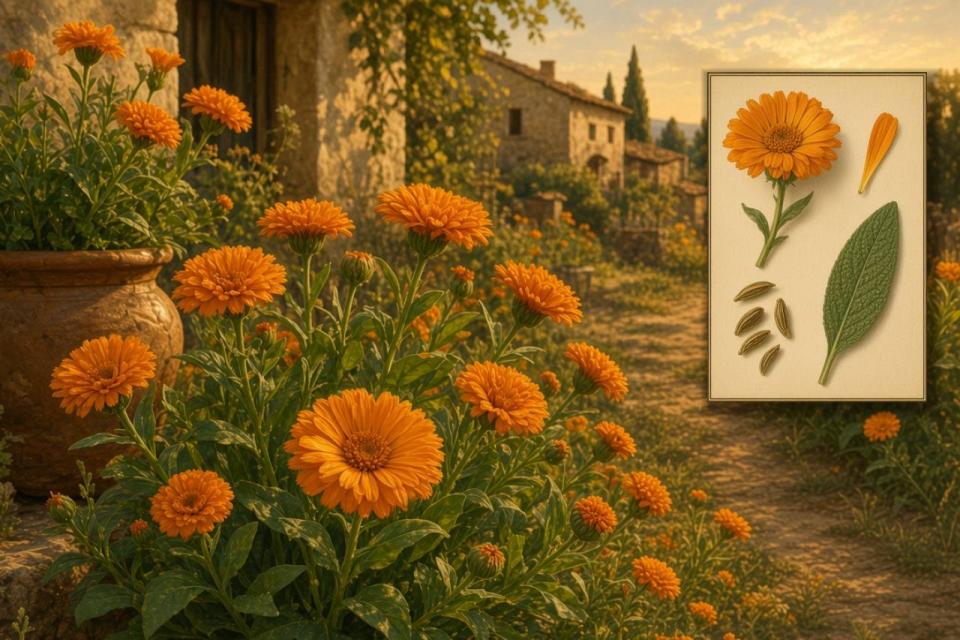
Calendula officinalis L. belongs to Asteraceae, the daisy family. Linnaeus published the name in Species Plantarum in 1753; IPNI records it as 187894-1. NCBI Taxonomy files it as taxon 41496 with the common name pot marigold. It is usually grown as a hardy annual: a branching plant with soft, slightly sticky, aromatic, simple oblong leaves and solitary flower heads in shades from pale yellow to deep orange. Each head is a disc of small tubular florets ringed by strap-shaped ray florets. The fruits are curved, ridged achenes that curl like hooks or rings, a quick field mark among daisy lookalikes. The heads open in daylight and close in the evening and in dull weather. Its wild origin is uncertain and probably Mediterranean; it has been a garden plant for so long that it is known chiefly from cultivation. Field marigold, C. arvensis, is a smaller wild relative, not the pharmacopeial plant.
Tagetes is the source of most “marigold” confusion. Tagetes erecta (African or Aztec marigold) is indigenous to Mexico and Guatemala; T. patula is the French marigold of bedding schemes. Both have pinnately divided, strongly scented leaves rather than calendula’s simple ones. Tagetes erecta is the garland flower grown on a huge scale in India and the commercial source of lutein: FAO/WHO’s food-additive committee (JECFA) writes its specification as lutein from Tagetes erecta, made from hexane extracts of the flowers. A lutein capsule that says marigold almost always means Tagetes. A calendula ointment means Calendula. Same family, different genus, different chemistry, and only Calendula has an EMA herbal monograph.
Which part counts matters. The European Pharmacopoeia defines Calendulae flos as whole or cut, dried, fully opened flowers detached from the receptacle, of the cultivated double-flowered varieties of Calendula officinalis, with at least 0.4% flavonoids calculated as hyperoside. Double-flowered cultivars carry many more ray florets, so in practice the drug is mostly the orange rays; EMA assessors repeatedly speak of preparations from ligulate or ray florets only. The Czech pharmaceutical codex keeps a separate article for whole flower heads with the calyx (Calendulae flos cum calyce). Single-flowered garden plants, whole heads, and leaf-and-stem preparations are therefore not the same herbal substance. That distinction is not pedantry: EMA discounts several clinical studies, including the best-known radiotherapy trial, because their products were made from leaves and stems as well as flowers.
Chemistry, from EMA’s assessment report: triterpene saponins at 2–10%, oleanolic acid glycosides with glucuronic acid; triterpene alcohols, with about 0.8% monols (α- and β-amyrin, lupeol, taraxasterol, ψ-taraxasterol) and about 4% diols, mostly as fatty-acid monoesters of faradiol and arnidiol. Faradiol-3-O-myristate (PubChem CID 11763698) and faradiol-3-O-palmitate are the principal anti-inflammatory esters; Hamburger and colleagues (Fitoterapia 2003) also purified the laurate. Carotenoids reach up to 4.7%, predominantly lutein and zeaxanthin. Flavonoids run 0.3–0.8%, glycosides of isorhamnetin and quercetin. Coumarins (scopoletin, umbelliferone, aesculetin), 0.2–0.3% volatile oil, and up to 15% water-soluble polysaccharides complete the profile. The “sesquiterpene lactone calendin” of older literature is not a genuine constituent; EMA identifies it as loliolide, a carotenoid breakdown product. Calendula flowers largely lack the sesquiterpene lactones that make arnica a stronger skin sensitizer.
02 Lineage
History
The genus name comes from Latin kalendae, the first day of the Roman month, because the plant was said to be in flower at the start of almost every month. Officinalis marks a plant of the apothecary’s workroom. EMA’s assessors trace documented therapeutic use of calendula flowers and ointments back at least to Hildegard von Bingen in the twelfth century. The kitchen history is as long. Calendula was “poor man’s saffron,” used to color and flavor soups, rice, custards, butter, and cheese, and John Lindley wrote in 1838 that it was chiefly used to adulterate saffron. William Turner’s 1551 herbal recorded the flowers as a yellow hair dye and their fumes as a way to “bring down” the afterbirth, the kind of uterine lore that still shadows the plant’s pregnancy cautions.
Professional medicine formalized the skin and mouth uses. Germany’s Commission E published a Calendulae flos monograph on 13 March 1986: internal and topical use for inflammation of the oral and pharyngeal mucosa, and external use for wounds, including slow-healing wounds and leg ulcers. Its dose was 1–2 g of dried flowers infused in 150 ml of water, 2–4 ml of tincture in a quarter to half liter of water, or ointments equivalent to 2–5 g of flowers per 100 g. The British Herbal Pharmacopoeia of 1976 reached further, to enlarged lymph nodes, sebaceous cysts, and duodenal ulcer; those claims never acquired trial support. Popular herb books also repeat stories of marigold wound dressings on battlefields, including the American Civil War. This monograph could not trace the Civil War version to primary medical records, so treat it as lore.
The modern regulatory file is cautious. The HMPC adopted its first calendula monograph and an EU list entry in 2008, then a revised monograph on 27 March 2018, both on the traditional-use tier. During that revision the committee reviewed newer trials, including Brazilian studies of a standardized calendula extract in leg and pressure ulcers and the Swedish radiotherapy trial, and still judged the evidence insufficient for well-established use. A further call for scientific data ran in 2024. Homeopathy runs on a parallel track: the Cochrane review of homeopathic medicines for cancer-treatment side effects (Kassab and colleagues, 2009) counted the Pommier ointment, made by the homeopathic manufacturer Boiron, as a homeopathic medicine. In the United States calendula is sold as a cosmetic ingredient, a dietary supplement, and a homeopathic product, three regulatory categories with three different standards.
03 Chemistry
Active compounds and how it works
EMA does not require pharmacology for a traditional registration, and no mechanism is established in people. The laboratory story centers on triterpenoids. Della Loggia, Tubaro, Sosa, Becker, Saar, and Isaac (Planta Medica 1994) fractionated a supercritical CO2 extract of calendula flowers in the croton-oil mouse-ear edema model and found the triterpenoids were the main anti-inflammatory principles. The faradiol monoester mattered most because it is the most abundant. Free faradiol, which was not present in the extract, was the most active compound and matched indomethacin. The anti-inflammatory activity of different CO2 extracts tracked their faradiol monoester content, which the authors proposed as a quality-control marker. Zitterl-Eglseer and colleagues (Journal of Ethnopharmacology 1997) isolated faradiol-3-myristate and -palmitate, found similar dose-dependent anti-edema activity for both with no synergy, and again found free faradiol equal to an equimolar dose of indomethacin.
Those esters are fat-soluble waxes recovered with CO2. A watery infusion, an olive-oil macerate, a petroleum-jelly ointment, and a hydroalcoholic tincture are therefore not chemically interchangeable, and a mouse ear swelling after croton oil is not a human wound closing. Other threads are more preliminary: flavonoid and carotenoid antioxidant activity, polysaccharides, and antimicrobial and cytotoxic effects in dishes (MSKCC’s summary). Animal wound studies, pooled by Givol and colleagues (Wound Repair and Regeneration 2019), point to faster resolution of the inflammatory phase and more granulation tissue. That is a plausible basis for traditional skin use, not proof that a given cream works.
The allergy biology runs the other way. Strong Compositae sensitizers such as arnica owe much of their reputation to sesquiterpene lactones. Calendula flowers contain little of them, which is the likeliest reason Paulsen’s review (Contact Dermatitis 2002) judged calendula only weakly sensitizing experimentally and found the human evidence anecdotal. A low risk is still not zero. Cross-reactivity with other daisy-family plants cannot be excluded, and EMA keeps the family-wide contraindication.
04 In practice
Common uses
The EMA indications are short. Traditional use, on the basis of long-standing safe use rather than trial proof: symptomatic treatment of minor skin inflammation such as sunburn, an aid in healing minor wounds, and symptomatic treatment of minor inflammation in the mouth or throat as a rinse or gargle. Skin use is for age six and up; mouth and throat use is for age twelve and up; symptoms lasting more than a week, worsening, or signs of infection go to a clinician. There is no EMA indication for swallowing calendula. MSKCC’s patient summary lands in the same place: small cuts and burns, irritated or inflamed skin, with other uses unstudied, and food and tea amounts generally safe.
Radiation dermatitis is the headline trial area, and it is split. Pommier, Gomez, Sunyach, D’Hombres, Carrie, and Montbarbon (J Clin Oncol 2004) randomized 254 women after breast-cancer surgery to calendula ointment or trolamine (Biafine) on irradiated skin. Grade 2 or higher dermatitis fell from 63% to 41%, with less pain and fewer treatment interruptions; the ointment was harder to apply. EMA’s assessors note the product was 20% fresh aerial parts in petroleum jelly and declined to treat it as evidence for the flower drug. Sharp and colleagues (Eur J Oncol Nurs 2013) randomized 420 Swedish women (411 analyzed) to a calendula cream or an ordinary aqueous cream: severe reactions were 23% versus 19%, with no difference at any point. Kassab’s 2009 Cochrane review called the calendula data preliminary and in need of replication. Robijns and colleagues’ 2023 meta-analysis in Supportive Care in Cancer found no significant calendula effect on grade 2 or higher dermatitis. Doing better than trolamine is not the same as doing better than a plain moisturizer.
Other topical trials are small and mostly unblinded. Duran and colleagues (2005) treated 21 people with venous leg ulcers with a calendula ointment and 13 with saline dressings: ulcer area fell about 42% versus 15% in three weeks. Buzzi and colleagues (J Wound Care 2016) reported faster venous-ulcer healing with a standardized hydroglycolic extract in 38 treated versus 19 control patients; the abstract does not describe randomization, and the second author’s listed affiliation is Phytoplenus Bioativos, a Brazilian company, although the paper declares no conflict of interest. Givol’s 2019 systematic review found two positive venous-ulcer studies but no benefit in a diabetic-ulcer trial or a burn trial. Panahi and colleagues (2012) found fewer diaper-rash sites with calendula ointment than with aloe cream in 66 infants, with no placebo arm. De Angelis and colleagues (2022) reported less episiotomy pain with calendula ointment than standard care in 100 women. Encouraging, uneven, and not enough for EMA’s well-established tier.
Less-supported or misattributed uses: calendula capsules for stomach ulcers, menstrual problems, or immunity have no meaningful human trial base. Cytotoxic and antitumor results are cell-culture and rodent findings. The often-cited ear-pain trial (Sarrell and colleagues, Archives of Pediatrics and Adolescent Medicine 2001, 103 children) used Otikon, olive-oil drops of garlic, mullein, calendula, and St. John’s wort; a four-herb blend that matched anesthetic drops says nothing about calendula alone. Eye-health lutein comes from Tagetes, not calendula. Homeopathic calendula pellets are a separate question from an ointment containing the plant.
05 The apothecary
Preparations and traditional use
The EMA monograph lists six herbal preparations: the dried, comminuted flower for infusion; liquid extracts 1:1 and 1:1.8–2.2 in 40–50% ethanol; a 1:5 tincture in 70–90% ethanol; a 1:10 extract in fatty vegetable oil such as olive oil; and a 1:5–1:25 extract in hardened vegetable fat or petroleum jelly. Skin posology: an infusion of 1–2 g of flowers in 150 ml of water, used still warm to soak dressings two to four times a day, with dressings removed after 30–60 minutes; the tincture diluted at least 1:3 with freshly boiled water for dressings; and semi-solid products containing the equivalent of roughly 2–20% flower depending on the extract type, applied as a light layer two to four times a day.
Mouth and throat posology, for adolescents and adults: 1–2 g of flowers infused in 150 ml of water and used warm as a rinse or gargle two to four times a day, or the tincture as a 2% solution in water for gargling at the same frequency. The use is oromucosal; the rinse is spat out, not drunk as a treatment. Commission E’s older dosing was similar: 1–2 g per cup, 2–4 ml of tincture in a quarter to half liter of water, or 2–5 g of flowers per 100 g of ointment. If symptoms last longer than a week, EMA directs people to a doctor or qualified practitioner.
Shop products rarely say which of these they are. Infused oils, salves, creams, baby balms, and soaps often list calendula without a strength or plant part, and some are made from whole heads or aerial parts. Homeopathic labels are a separate category. A “mother tincture” cream contains the plant at material strength; EMA’s report describes a burn hydrogel with 10% homeopathic mother tincture. Pellets or creams labeled 6C or 30C are serial dilutions; beyond about 12C, it is unlikely a single molecule of the original extract remains. If you want the EMA object, look for Calendula officinalis flower, a stated extract type, and a stated percentage.
In the kitchen, fresh ray florets go into salads and dried petals color soups, rice, and butter; MSKCC regards food and tea amounts as generally safe. Those are culinary quantities, not the EMA wound protocol. Tagetes petals are not a substitute for calendula in a skin preparation, and garden flowers sprayed with pesticides belong in neither a salad nor a salve. Home-made oils are fine for intact, mildly irritated skin in people without daisy allergy; they are not dressings for deep, infected, or burned tissue.
Safety
Before you use calendula
06 Caution
Side effects
EMA’s monograph lists one undesirable effect: skin sensitization has been reported, frequency not known. MSKCC lists allergic reactions. That short list reflects how calendula is used, on skin and in rinses at modest strengths, and the limited systematic safety data, not proof that nothing happens. Calendula has no entry in the NIH LiverTox database, which reflects the absence of a liver-injury signal rather than a body of oral safety studies. Oral capsules and concentrated extracts are the least-studied way to use the plant.
The best patch-test number comes from Reider, Komericki, Hausen, Fritsch, and Aberer (Contact Dermatitis 2001). Of 443 consecutive patients tested in Innsbruck, nine (about 2%) reacted to marigold and five (about 1%) to arnica. Only four of the nine marigold reactors were picked up by the standard Compositae mix, so routine screening can miss calendula allergy. Reactors often also reacted to nickel, balsam of Peru, fragrance mix, propolis, and colophony. EMA’s assessors counter that the test material was whole aerial parts, not ray florets, and rate the paper of limited value for the monograph preparations. Paulsen’s 2002 review found epidemiological data for arnica and German chamomile only; for calendula the evidence was anecdotal.
The product can be the allergen as well as the plant. Paulsen, Christensen, and Andersen (Contact Dermatitis 2008) patch tested Compositae-allergic patients with ingredients of their cosmetics and herbal remedies and found reactions to fragrances, emulsifiers, and preservatives, not only to plant extracts. A rash under a calendula cream may be the perfume, the lanolin, or the plant, and only patch testing tells them apart. People with eczema and multiple contact allergies are the group most likely to react.
Systemic toxicity data are limited and reassuring as far as they go. EMA reports no overdose cases, no genotoxicity concern from a 60% ethanol liquid extract, and negative carcinogenicity studies in rats over 22 months and hamsters over 18 months at an oral dose of 0.15 g/kg daily. Adequate reproductive-toxicity tests have not been done. In the trials discussed here, adverse events were few: Panahi and Buzzi reported none, and the main complaint in Pommier’s trial was that the ointment was harder to apply.
07 Caution
Contraindications
Do not use calendula if you are allergic to it or to other Asteraceae (Compositae): ragweed, chamomile, arnica, chrysanthemum, echinacea, daisies. This is the EMA monograph’s only formal contraindication. People with a known positive Compositae patch test, or with eczema that flares under botanical cosmetics, should ask a dermatologist before applying calendula products, particularly to broken or radiated skin.
Children: EMA does not recommend calendula skin products under age six or calendula mouth and throat preparations under age twelve because adequate data are lacking. That includes the reflex of putting calendula balm on every infant rash. Panahi’s diaper-dermatitis trial is a small comparison with aloe, not a safety file for newborns. A rash with fever, blistering, oozing, or spreading redness needs a pediatrician.
Pregnancy and lactation: EMA says safety has not been established and use is not recommended. The reasons are partly lore and partly data. Turner’s sixteenth-century herbal used the flowers to expel the afterbirth; an aqueous infusion was uterotonic on isolated rabbit and guinea-pig uterus; and an ethanolic extract caused maternal toxicity in rats when given late in pregnancy, though that preparation was poorly characterized. MSKCC also advises against calendula supplements while pregnant or breastfeeding. Culinary petals are a different exposure from medicinal oral doses, which should be avoided.
Some wounds are outside traditional self-care. EMA judged venous leg ulcers unsuitable for unsupervised traditional use and tells people to see a clinician if skin infection appears or symptoms worsen. Deep, contaminated, or bite wounds, extensive burns, diabetic foot ulcers, and skin breaking down during radiotherapy need professional care. Radiotherapy units often have their own rules about what goes on treated skin and when; follow the center’s protocol rather than a trial headline.
08 Caution
Drug and herb interactions
EMA’s monograph states that no interactions have been reported, and the assessment report adds that no interaction data are available. Those two sentences mean the same thing: an absence of reports for products used mainly on skin and as rinses, not a demonstrated absence of effect. MSKCC lists no specific drug interactions for calendula.
The interaction most consumer databases repeat is with sedatives. It rests on rodent work: calendula extracts and saponin fractions prolonged barbiturate-induced sleep and reduced spontaneous movement in mice and rats. Some databases rate the combination moderate and advise stopping before surgery; others rate it minor and unlikely, noting decades of use without reports of human sedation. No human pharmacokinetic study or case report backs the warning. For topical calendula it is implausible. For oral calendula alongside benzodiazepines, barbiturates, or sleep drugs, it remains a theoretical footnote worth mentioning to a pharmacist, not an established interaction.
Blends carry their own interactions. The Otikon ear drops studied in children contained St. John’s wort, an herb with real enzyme-induction interactions when swallowed. Calendula creams may also contain arnica, chamomile, or essential oils that bring their own allergy profiles, and homeopathic complexes list several remedies at once. On radiated skin, any added product can interfere with the unit’s skin-care plan. Read the full ingredient list before blaming, or crediting, the calendula.
Do not confuse calendula with lutein supplements. Lutein capsules labeled marigold extract are Tagetes-derived carotenoids taken by mouth for eye health; they do not supply calendula’s triterpene esters and are not covered by the calendula monograph. Tagetes is also a daisy-family plant, so the allergy caution travels with it, but its safety and interaction questions belong to the lutein file, not this one. Check the Latin name on the label before applying anything you read here.
09 Questions
Frequently Asked Questions
Only sometimes. Calendula officinalis is called pot marigold, and older European texts simply say marigold. The marigolds of Indian garlands, summer bedding, and lutein supplements are Tagetes, mainly Tagetes erecta and T. patula, a different genus with divided, pungent leaves and different chemistry. Only Calendula has an EMA herbal monograph. Read the Latin name.
The evidence is split. Pommier’s 2004 trial in 254 women found less grade 2 or higher dermatitis with a calendula ointment than with trolamine, but that ointment was made from whole aerial parts. Sharp’s 2013 trial in 420 women found no difference between a calendula cream and a plain aqueous cream, and a 2023 meta-analysis found no significant calendula effect. Use whatever your radiotherapy team recommends; do not substitute a shop cream.
Traditional use only: symptomatic treatment of minor skin inflammation such as sunburn, an aid in healing minor wounds, and minor inflammation of the mouth or throat as a rinse or gargle. Skin use is from age six, mouth and throat use from age twelve, and symptoms lasting more than a week need a clinician. There is no EMA indication for swallowing calendula.
EMA does not recommend calendula skin products under age six because data are lacking. One Iranian trial in 66 infants found calendula ointment reduced rash sites more than aloe cream, but it had no placebo arm and is not a safety file for newborns. Ask a pediatrician, especially if the rash blisters, oozes, spreads, or comes with fever, or if there is daisy-family allergy in the family.
Not necessarily. Some homeopathic calendula creams are made with mother tincture and contain the plant at material strength. Pellets or creams labeled 6C or 30C are serial dilutions, and beyond about 12C it is unlikely any molecule of the original extract remains. The label category tells you little; the stated concentration tells you more.
Yes. EMA lists skin sensitization with unknown frequency and contraindicates use in Asteraceae allergy. In Reider’s 2001 patch-test series, about 2% of 443 patients reacted to marigold, and the standard Compositae mix missed more than half of them. Fragrances, preservatives, and emulsifiers in the cream base can also be the culprit.
EMA does not recommend calendula during pregnancy or breastfeeding because safety has not been established, an infusion was uterotonic in isolated animal tissue, and an extract caused maternal toxicity in rats late in pregnancy. MSKCC gives the same advice. Petals in a salad are a different exposure from medicinal oral doses, which should be avoided.
No interactions are reported in the EMA monograph, and there are essentially no interaction data. Some consumer databases warn about sedatives based on rodent studies showing longer barbiturate sleep, but no human case or pharmacokinetic study supports it. Blends are a different matter: calendula products that also contain St. John’s wort or other herbs bring those herbs’ interactions.
10 References
Sources
These references support the history, clinical, and safety claims on this page. They are not an endorsement of any product.
-
Calendulae flos — herbal medicinal product
European Medicines Agency, Committee on Herbal Medicinal Products, 2018
HMPC landing page: traditional use for minor skin inflammation, minor wounds, and minor mouth or throat inflammation; age limits of 6 and 12; skin sensitization; 2024 call for data for periodic review.
-
European Union herbal monograph on Calendula officinalis L., flos (Revision 1)
European Medicines Agency (EMA/HMPC/437450/2017), 2018
Adopted 27 March 2018: six herbal preparations, 1–2 g infusion in 150 ml for dressings or gargles, 2–20% semi-solid strengths, Asteraceae contraindication, no interactions reported, not recommended in pregnancy.
-
Assessment report on Calendula officinalis L., flos (Revision 1)
European Medicines Agency (EMA/HMPC/603409/2017), 2018
Ph. Eur. definition (double-flowered varieties), constituent ranges, Commission E 1986 history, Hildegard citation, critique of Pommier and Reider for using aerial parts, reproductive-toxicity data.
-
Calendula
Memorial Sloan Kettering Cancer Center, About Herbs, 2023
Clinical summary: topical wound use, preliminary radiation-dermatitis and ulcer data, triterpenoid mechanism, allergic reactions, avoid in pregnancy and lactation.
-
Phase III randomized trial of Calendula officinalis compared with trolamine for the prevention of acute dermatitis during irradiation for breast cancer
Journal of Clinical Oncology (PubMed 15084618), 2004
Pommier et al.: 254 women; grade 2+ dermatitis 41% with calendula versus 63% with trolamine; less pain and fewer interruptions.
-
No differences between Calendula cream and aqueous cream in the prevention of acute radiation skin reactions — results from a randomised blinded trial
European Journal of Oncology Nursing (PubMed 23245940), 2013
Sharp et al.: 420 randomized, 411 analyzed; severe reactions 23% calendula versus 19% aqueous cream; no difference at any assessment.
-
Homeopathic medicines for adverse effects of cancer treatments
Cochrane Database of Systematic Reviews (PubMed 19370613), 2009
Kassab et al. CD004845: counted the Pommier calendula ointment as a homeopathic medicine; preliminary support that needs replication.
-
Natural and miscellaneous agents for the prevention of acute radiation dermatitis: a systematic review and meta-analysis
Supportive Care in Cancer (PubMed 36859690), 2023
Robijns et al.: of aloe vera, oral enzymes, olive oil, calendula, and curcumin, only oral enzymes and olive oil significantly reduced grade 2+ dermatitis.
-
A systematic review of Calendula officinalis extract for wound healing
Wound Repair and Regeneration (PubMed 31145533), 2019
Givol et al.: 7 animal and 7 clinical studies; positive venous-ulcer data, no benefit in diabetic-ulcer and burn RCTs, split radiation results.
-
The role of triterpenoids in the topical anti-inflammatory activity of Calendula officinalis flowers
Planta Medica (PubMed 7809203), 1994
Della Loggia et al.: triterpenoids as main anti-inflammatory principles of the CO2 extract; faradiol monoester proposed as quality-control marker.
-
The seamy side of natural medicines: contact sensitization to arnica (Arnica montana L.) and marigold (Calendula officinalis L.)
Contact Dermatitis (PubMed 11722485), 2001
Reider et al.: 9 of 443 patch-tested patients reacted to marigold; only 4 of the 9 were detected by Compositae mix.
-
Contact sensitization from Compositae-containing herbal remedies and cosmetics
Contact Dermatitis (PubMed 12492516), 2002
Paulsen review: calendula among suspected Compositae sensitizers; epidemiological data only for arnica and chamomile; sesquiterpene lactones as main allergens.
-
Lutein from Tagetes erecta (JECFA specification)
Food and Agriculture Organization of the United Nations, FAO JECFA Monographs 22, 2018
Food-additive specification showing commercial marigold lutein is extracted from Tagetes erecta flowers, not Calendula.
-
Taxonomy browser: Calendula officinalis
NCBI Taxonomy (NIH), 2024
NCBI taxon 41496, pot marigold, in Asteraceae.
-
Calendula officinalis L.
International Plant Names Index, 1753
Linnaeus, Species Plantarum 2: 921 (1753); LSID urn:lsid:ipni.org:names:187894-1.
-
Faradiol-3-O-myristate
PubChem, National Library of Medicine (NIH), 2024
Principal anti-inflammatory triterpenoid ester of calendula flowers; CID 11763698, C44H76O3.