Monograph
Comfrey
Symphytum officinale
Updated October 4, 2026
Key points
-
01
Never drink it
Unsaturated pyrrolizidine alkaloids can cause hepatic veno-occlusive disease; no safe oral dose is established.
-
02
Knitbone is a name
Topical trials suggest comfrey root ointment may ease sprain, back, and knee osteoarthritis pain; it does not replace orthopedic care for fractures.
-
03
Intact skin only
Even topical use is framed as short-course on unbroken skin; wounds absorb more alkaloids.
-
04
Species differ
Russian comfrey hybrids in gardens are not the same chemotype as a PA-reduced licensed ointment.
-
05
Injury is cumulative
Months of “ulcer tea” is the classic case-report pattern—feeling well at first is not clearance.
Comfrey (Symphytum officinale) is a moisture-loving borage-family perennial whose common name “knitbone” still advertises an old promise: that poultices of leaf or root could help bruises, sprains, and even broken bones knit. The plant is rich in allantoin and rosmarinic acid—constituents that make a topical anti-inflammatory story plausible—and also in unsaturated pyrrolizidine alkaloids (PAs), which the liver can convert into reactive pyrroles that damage hepatic blood vessels. That second chemistry is not folklore. It is why internal comfrey is treated as a hepatotoxin, not as a rustic tea.
This monograph goes further than a two-paragraph warning label. It covers how European herbalism used root and leaf, how Russian comfrey (Symphytum × uplandicum) complicated the alkaloid picture, what modern trials of PA-reduced topical comfrey root products have found for sprains, back pain, and knee osteoarthritis, how veno-occlusive disease (hepatic sinusoidal obstruction) presents after oral or excessive use, and why “PA-free” on a salve is not a license for open wounds, pregnancy, or months of daily use. The key split is simple to state and easy to forget in a garden: tea and other internal use is the dangerous form; a short course of ointment on unbroken skin is the use European regulators recognize, and the one with encouraging trial results.
Nothing here is medical advice. A swollen joint after a fall can be a fracture, a clot, or an infection. Comfrey poultice is not imaging, not a cast, and not a reason to delay care. Do not drink comfrey, do not give it to children, and do not assume a homegrown leaf is “PA-free” because it grew in your yard.
Featured in
Herbs for Skin and Wound Care Herbs for Joint Pain and Arthritis Herbs for Back and Muscle PainIn this monograph
01 The plant
Botanical profile
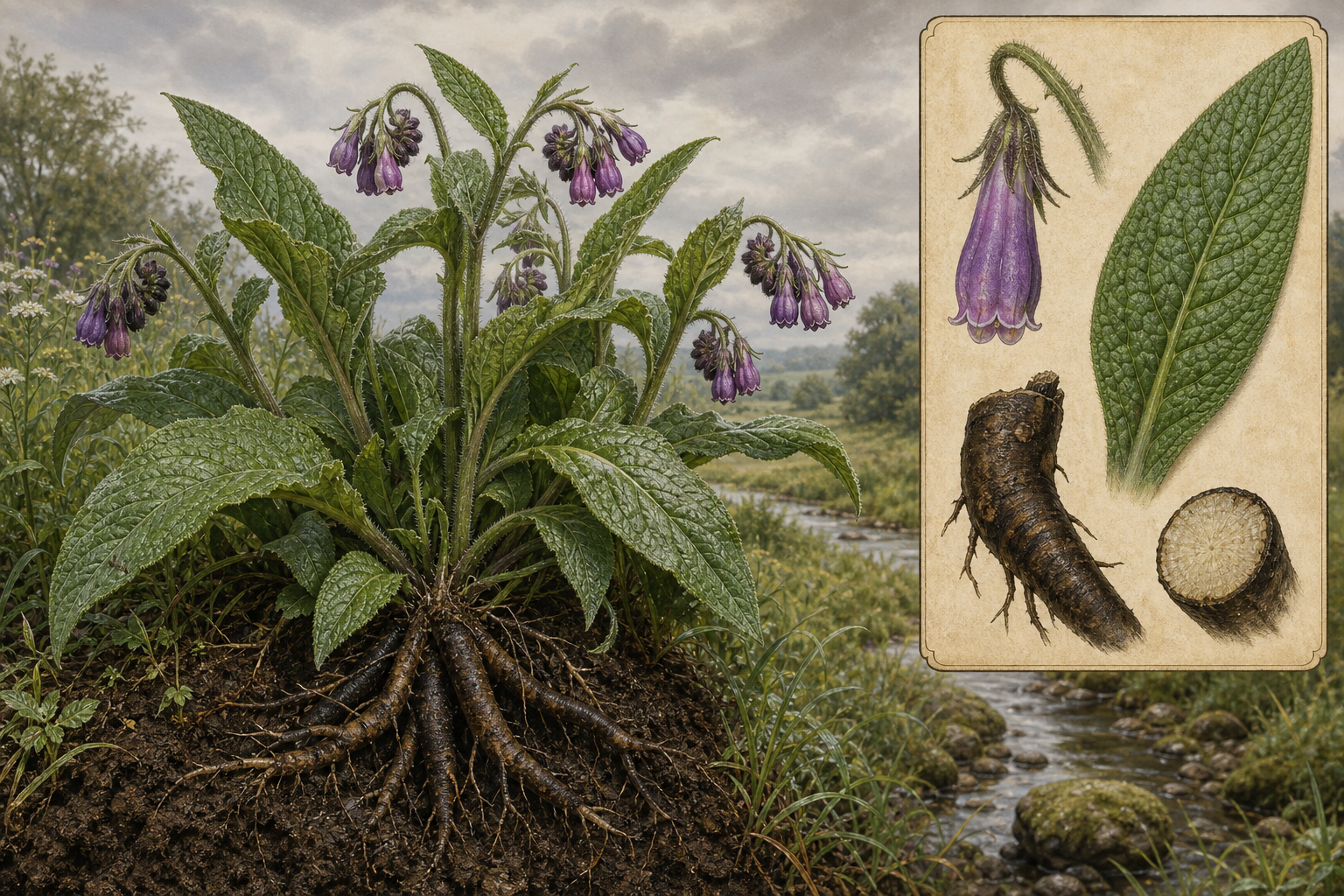
Symphytum officinale is a robust perennial in the Boraginaceae, native to Europe and western Asia and naturalized in parts of North America. It favors damp ground: riverbanks, ditches, wet meadows, and garden edges with rich soil. Plants form clumps from a thick, dark, fleshy taproot that snaps with a cucumber-like scent when fresh. Stems are winged and bristly. Leaves are large, lance-shaped to ovate, roughly hairy, and distinctly veined; basal leaves can be a foot long. Flowers hang in coiled cymes (scorpioid), typically dull purple, mauve, or creamy white, each a small drooping bell with a closed throat of scales—classic borage-family architecture.
Identity matters because “comfrey” in commerce is not one chemotype. Common comfrey (S. officinale) is the pharmacopeial species in older European texts. Prickly comfrey (S. asperum) and, especially, Russian comfrey (S. × uplandicum, the hybrid of S. officinale and S. asperum) are widely grown as fodder and compost plants. The hybrid is vigorous, often taller, and frequently higher in certain PAs such as echimidine. Gardeners who grow “bocking” clones for fertilizer tea are often growing the hybrid, not official common comfrey. A leaf from the compost pile is not a characterized drug.
Look-alikes include other bristly Boraginaceae and, in name only, boneset (Eupatorium perfoliatum), an unrelated aster that has caused its own confusion in English herbals. True comfrey has succulent, mucilaginous roots and nodding tubular flowers, not the perfoliate leaves of boneset.
The parts historically used are dried root (Symphyti radix) and aerial herb (leaf and flowering tops). Roots tend to be richer in allantoin and also carry PAs; young leaves were the folk poultice. PA concentration varies by species, plant part, age, season, and drying. Roots and young leaves can be particularly problematic. There is no kitchen assay for “how much lycopsamine is in this clump.”
Allantoin is a hydantoin derivative also found in other plants and in some cosmetic urea-related pathways; it is associated with keratolytic and cell-proliferation folklore. Rosmarinic acid is a phenolic that appears in anti-inflammatory models. Mucilage soothes. None of those constituents cancel the PA problem. They explain why people wanted the plant on skin. They do not make the liver safe.
02 Lineage
History
Comfrey’s European trail is long and orthopedic in spirit. Dioscorides and later medieval authors discussed Symphytum-type plants for knitting wounds and closing tissues—the Greek root of the genus name is often linked to “grow together.” Country practice wrapped mashed leaf around sprains and used root decoctions internally for ulcers, “blood in the spit,” and bowel complaints. The English knitbone and consound names advertise that mechanical metaphor: a plant that glues what is broken.
Nineteenth- and early twentieth-century pharmacy still listed comfrey root. Then toxicology caught up. Unsaturated PAs were characterized across the Boraginaceae, Asteraceae, and Fabaceae. Case reports of hepatic veno-occlusive disease after comfrey tea and tablets accumulated from the 1970s onward—some in people who thought they were taking a gentle ulcer remedy. The lesions resemble those from other PA plants (for example, certain Crotalaria and Senecio exposures): occlusion of small hepatic veins, hepatomegaly, ascites, and, in severe cases, liver failure.
Regulatory history is unusually clear for an herb. In 2001 the U.S. FDA advised dietary-supplement firms to remove comfrey products intended for internal use because of PA hepatotoxicity and the lack of a demonstrated safe oral dose. Several European authorities restricted or removed oral comfrey medicines. Germany’s Commission E had already limited official use to external application for bruises, strains, and sprains. The European Medicines Agency’s herbal assessment later framed traditional topical use on intact skin, with duration limits, exclusion of broken skin, and exclusion of pregnancy, lactation, and children in the conservative documents.
Meanwhile, manufacturers developed PA-reduced or “PA-free” topical extracts—often from S. × uplandicum clones selected and processed to strip alkaloids—used in ointments studied for back pain and ankle sprain. Those products are not equivalent to a mashed garden leaf. They are also not proof that unlimited DIY poultice is safe, because skin is not a perfect barrier and broken skin is a worse one.
Comfrey never left the permaculture garden. Dynamic-accumulator folklore (mining potassium and silica for compost) is a horticultural story, not a dietary one. “Comfrey fertilizer tea” for tomatoes is not a beverage. That distinction still gets lost when the same plant is discussed as medicine.
03 Chemistry
Active compounds and how it works
Two pharmacologies run in parallel, and only one of them is the reason comfrey is famous. Allantoin can promote epithelial proliferation and a moist wound environment in experimental and cosmetic contexts. Rosmarinic acid and other phenolics show anti-inflammatory and analgesic signals in models and in some topical human studies. Mucilage is demulcent. Together they make a coherent story for rubbing a PA-reduced ointment onto a bruise or strained muscle: less soreness, perhaps faster comfort, without claiming that a bone has “knitted” because of a leaf.
The other pharmacology is PA toxicity. Unsaturated pyrrolizidine alkaloids such as lycopsamine, intermedine, symphytine, and—especially in some Russian comfrey material—echimidine are absorbed and oxidized, largely via CYP3A4, to pyrrolic esters. Those electrophiles bind proteins and DNA in hepatocytes and sinusoidal endothelial cells. Repeated exposure is cumulative. The clinical picture of hepatic sinusoidal obstruction syndrome (older term: veno-occlusive disease) includes abdominal pain, hepatomegaly, ascites, and abnormal liver tests. Pulmonary hypertension and other endothelial injuries appear in the broader PA literature. Carcinogenicity in animals is part of why regulators refuse a “safe daily tea.”
Absorption from intact skin is lower than from the gut, which is the rationale for allowing short topical courses. Absorption from damaged skin, mucous membranes, or large areas is higher. Occlusive wraps, heat, and daily use for weeks all push exposure up. Children have smaller bodies and developing livers. There is no established oral NOAEL for garden comfrey that would make a folk tea acceptable.
PA-reduced extracts used in European trials are not “the whole plant minus the bad part” in a folk sense. They are processed drugs with specified residual alkaloid limits. A homegrown poultice has unspecified PAs, unspecified allantoin, and possible soil contamination.
Comfrey does not set fractures. Imaging, reduction, and immobilization set fractures. At best, a studied ointment may ease periarticular soreness after a sprain already evaluated as not needing surgery. Using a poultice to “wait and see” on a possible break is how malunion happens.
04 In practice
Common uses
Traditional external uses are bruises, contusions, strains, and sprains. Germany’s Commission E approved external use for bruises, strains, and sprains, and the European Medicines Agency’s traditional-use monograph for comfrey root words the indication as “symptomatic relief of minor sprains and bruises.” Randomized trials of specific PA-reduced comfrey ointments (including products studied for acute ankle sprain and upper or lower back pain) have reported greater pain reduction and functional improvement versus placebo over days to a couple of weeks.
Knee osteoarthritis has the largest trial. Grube and colleagues (Phytomedicine 2007) randomized 220 adults with painful knee osteoarthritis to a comfrey root extract ointment or placebo, applied three times a day for three weeks. Pain scores fell by about 55% with comfrey and about 11% with placebo, with improvements in function, knee mobility, and quality of life, and adverse events were no more common than with placebo. The trial was run by the product’s manufacturer. A 2013 Cochrane review of topical herbal therapies for osteoarthritis (Cameron and Chrubasik) rated this single study as moderate-quality evidence that comfrey extract probably improves pain, and called for larger confirmatory trials. These results apply to specified, tested products. They do not validate every cottage salve, every species, or any internal use.
Traditional internal uses—gastric and duodenal ulcer folklore, lung complaints, diarrhea, heavy menstrual bleeding—are historically real and clinically obsolete. Oral comfrey is not an evidence-based ulcer therapy. It is a documented cause of liver injury. Do not treat dyspepsia with comfrey tea because a Victorian herbal said so.
Bone healing is the most stubborn myth. The knitbone name and allantoin’s cell-proliferation story got collapsed into “comfrey mends fractures.” There is no good clinical evidence that topical or oral comfrey replaces orthopedic care. Reducing swelling around a sprain is not the same as osteogenesis.
Cosmetic creams sometimes include comfrey or allantoin for dry or irritated skin. Concentration and PA specification vary. A face cream is still a dermal exposure; it is not a reason to use root poultice on dermatitis or eczema that has broken the barrier.
Comfrey is not a treatment for cancer, hepatitis, or “liver detox”—a particularly poor fit for a plant that can injure the liver. It is not a substitute for NSAIDs in rheumatoid disease, and encouraging topical results for sprains, back pain, and knee osteoarthritis should not be stretched to other conditions. Persistent or worsening pain, numbness, fever, or inability to bear weight needs a clinician rather than more poultice.
05 The apothecary
Preparations and traditional use
Historical preparations include fresh-leaf poultices, root decoctions, ointments, and, disastrously, teas and tablets for internal use. Modern responsible commerce, where it still exists, is almost entirely topical: creams and ointments, preferably specified as PA-reduced or PA-free, labeled for intact skin and short duration.
European traditional herbal posology for topical comfrey is conservative. The EU monograph for comfrey root calls for a light layer of ointment on unbroken skin twice a day, for no more than 10 days, with a doctor consulted if symptoms persist or worsen; it does not recommend use under 18 or in pregnancy and breastfeeding, and it caps total pyrrolizidine alkaloid exposure below 1 microgram a day. Stop if the skin barrier fails. Follow the actual product label. Do not improvise a week-long body wrap.
Garden preparations are the quality failure mode. Wilted leaves from S. × uplandicum, unwashed roots, and “comfrey oil” macerated in a jar have unknown alkaloid loads. Infused oils left at room temperature also have a contamination story separate from PAs.
Do not make tea, tincture for swallowing, capsules, or “ulcer syrup” from any Symphytum. Do not add comfrey to smoothie greens. Do not assume drying or cooking destroys PAs to a safe level—the toxicology literature does not give home cooks that out.
If a clinician or pharmacist points you to a licensed topical product, that is a different object from the plant in the ditch. Species, extract, residual PA specification, and duration are the variables that made trials possible.
Safety
Before you use comfrey
06 Caution
Side effects
Topical PA-reduced ointments in trials were generally locally well tolerated; contact dermatitis, itching, or redness can occur. Allergy to Boraginaceae is possible. Applying to broken skin increases both irritation and systemic PA absorption.
Oral or excessive use is the serious category. Hepatic sinusoidal obstruction syndrome may present with right-upper-quadrant pain, swelling of the abdomen, rapid weight gain from fluid, jaundice, or unexplained fatigue. Liver enzymes and bilirubin can rise. Onset may be subacute after repeated teas or tablets rather than a single dramatic poisoning. Pulmonary symptoms appear in some PA-exposure series. This is not “a little stomach upset from a bitter root.”
Because PA injury is cumulative, people who used comfrey for months as a “gut healer” are the classic case reports—not only a one-time mistake. There is no antidote in the herbal sense; management is medical, and severe disease can require transplant in the worst PA epidemics from other plants.
Animal data and genotoxicity of PA pyrroles are why regulators will not define a recreational oral dose. “I feel fine” does not mean the sinusoids are fine.
The FDA, NIH’s LiverTox, Memorial Sloan Kettering Cancer Center, and European regulators all treat internal comfrey as unsafe. That consensus is stronger than for most herbs on this site, and it outweighs reassurances found on internet forums.
07 Caution
Contraindications
Do not take comfrey by mouth in any form. That includes tea, tincture, capsules, and “only a little in a blend.” There is no demonstrated safe internal dose of PA-containing Symphytum.
Do not use topical comfrey on broken skin, wounds, ulcers, mucous membranes, or large body areas. Do not use it under occlusive dressing as a default. Do not use it on the breast during lactation or as a nipple salve.
Pregnancy and breastfeeding are exclusions in conservative herbal monographs: PAs can affect the fetus and can pass into milk; there is no benefit that justifies the risk. Children should not receive comfrey internally or as a casual topical for “growing pains.”
Known liver disease, a history of veno-occlusive disease, heavy alcohol use, or other PA exposures (some traditional teas, some contaminated grains in other regions) compound risk. People with cancer who have heard that allantoin “grows cells” should not experiment on tumors.
Hypersensitivity to comfrey or related plants is a stop. If a product is not clearly PA-specified for topical use, do not invent a duration.
08 Caution
Drug and herb interactions
The important interaction is with the liver itself. Drugs and herbs that induce CYP3A4 could theoretically increase conversion of PAs to toxic pyrroles; the practical advice is not to combine oral comfrey with anything, because oral comfrey should not be used. Topical short-course products still deserve disclosure if you have liver disease or take hepatotoxic medicines (including high-dose acetaminophen, some antifungals, methotrexate, and others)—not because a proven pharmacokinetic drama is fully mapped, but because the organ of concern is the same.
Alcohol plus any residual PA exposure is a poor combination. So is stacking other PA-containing plants (borage leaf, coltsfoot, some Senecio-containing folk teas) “because they’re traditional too.”
Anticoagulant cautions sometimes appear in secondary lists without a clean mechanism; the practical rule is disclosure before surgery, not because a clear mechanism is known, but because trauma, poultices, and procedures get mixed together.
Do not combine comfrey poultice with heating pads on a possibly fractured limb as a way to avoid an X-ray. That is not a drug interaction. It is a diagnostic delay.
09 Questions
Frequently Asked Questions
Because hepatic sinusoidal obstruction can be delayed, cumulative, and historically under-diagnosed. Traditional use included poultices that may have been less risky than daily teas, and it also included harms that were not attributed to the plant. Once PAs were chemically defined and case reports accumulated, regulators concluded that oral comfrey has no demonstrated safe dose. Longevity of a folk use is not a toxicology study.
No. Leaf versus root and common versus Russian comfrey change alkaloid profiles; they do not create a safe beverage. Home plants are unassayed. Drying and “just one cup” are how published liver injuries happened. There is no kitchen method to strip PAs to a level regulators would accept for tea.
Short-course use of PA-reduced products on intact skin is the only setting with a serious regulatory and trial footprint. The EU recognizes it for symptomatic relief of minor sprains and bruises, and trials have found pain relief for ankle sprain, back pain, and knee osteoarthritis. It is not risk-free: the EU monograph limits use to 10 days, and you should avoid broken skin, pregnancy, breastfeeding, children and teens under 18, large areas, and open-ended daily use. A mashed garden leaf wrap is not the same as a studied ointment.
No. The knitbone name is historical metaphor plus allantoin’s reputation for encouraging cell growth. Fractures need proper diagnosis and immobilization. Using a poultice instead of medical care can worsen outcomes. At most, some topical products may ease surrounding soft-tissue soreness after a clinician has ruled out a serious injury.
Common comfrey is Symphytum officinale. Russian comfrey (S. × uplandicum) is a hybrid widely grown for compost and fodder and often richer in certain PAs such as echimidine. Many backyard clumps are the hybrid. Licensed topical extracts may use selected, processed hybrid material with alkaloid limits—again, not your compost plant.
It is injury to the small veins and sinusoids of the liver (now often called hepatic sinusoidal obstruction syndrome) caused by reactive metabolites of unsaturated PAs. People may develop abdominal swelling, pain, enlarged liver, and abnormal blood tests. It can be serious. Any such symptoms after comfrey ingestion need urgent medical evaluation, and the herb should be stopped.
Do not. Broken skin increases PA absorption, and dirty or deep wounds need cleaning and medical care, not a hairy leaf. Conservative monographs restrict topical comfrey to intact skin. Allantoin’s “grow together” reputation is not a sterile wound protocol.
No. Boneset usually means Eupatorium perfoliatum, an unrelated aster. Comfrey is Symphytum in the borage family. Sharing a folk name about bones does not share chemistry. Boneset has its own safety issues (including PA concerns in some Eupatorium discussions) and should not be swapped by nickname.
10 References
Sources
These references support the history, clinical, and safety claims on this page. They are not an endorsement of any product.
-
Comfrey
LiverTox, National Institute of Diabetes and Digestive and Kidney Diseases (NIH), 2022
NIH clinical hepatotoxicity entry for comfrey and its pyrrolizidine alkaloids, including sinusoidal obstruction syndrome after oral use.
-
Comfrey
Memorial Sloan Kettering Cancer Center, About Herbs, 2022
Consumer and clinician summary: liver toxicity with oral use, PAs as hepatotoxic and carcinogenic, the 2001 FDA advisory, limited human data on topical pain relief, and poisonings from confusing comfrey with foxglove.
-
FDA Advises Dietary Supplement Manufacturers to Remove Comfrey Products From the Market
U.S. Food and Drug Administration (archived), 2001
2001 FDA advisory that oral comfrey dietary supplements should be removed because of pyrrolizidine alkaloid hepatotoxicity.
-
European Union herbal monograph on Symphytum officinale L., radix
European Medicines Agency, 2015
EU herbal framework for comfrey root (adopted 2015, corrected 2024): traditional cutaneous use for “symptomatic relief of minor sprains and bruises,” no more than 10 days, not on broken or irritated skin, not recommended under 18 or in pregnancy and lactation, PAs below 1 µg/day.
-
Assessment report on Symphytum officinale L., radix
European Medicines Agency (HMPC), 2015
HMPC assessment of chemistry (allantoin, phenolics, PAs), topical trial data, and toxicology of unsaturated pyrrolizidine alkaloids.
-
Pyrrolizidine alkaloids in food and feed
European Food Safety Authority, 2011
EFSA scientific opinion on PA toxicity, including hepatic sinusoidal obstruction and genotoxicity relevant to comfrey exposure.
-
Hepatic venocclusive disease associated with the consumption of pyrrolizidine-containing dietary supplements
Gastroenterology 88(4):1050–1054 (PubMed 3972224), 1985
Ridker et al.: veno-occlusive disease in a woman taking supplements whose main pyrrolizidine alkaloid source was powdered comfrey root; showed that low-level chronic exposure can cause the disease—foundation for later regulatory action.
-
Efficacy and safety of comfrey root extract ointment in the treatment of acute upper or lower back pain: results of a double-blind, randomised, placebo-controlled, multicentre trial
British Journal of Sports Medicine, 2010
RCT of a PA-reduced topical comfrey extract for acute back pain—evidence for a specified ointment, not for tea or garden poultices.
-
Efficacy of a comfrey root (Symphyti offic. radix) extract ointment in the treatment of patients with painful osteoarthritis of the knee: results of a double-blind, randomised, bicenter, placebo-controlled trial
Phytomedicine 14(1):2–10 (PubMed 17169543), 2007
Grube et al.: 220 adults with painful knee osteoarthritis, 2 g comfrey root ointment three times daily for three weeks vs placebo; pain fell about 55% vs 11%, with better function, mobility, and quality of life. Manufacturer-run trial.
-
Topical herbal therapies for treating osteoarthritis
Cochrane Database of Systematic Reviews, CD010538 (PubMed 23728701), 2013
Cameron and Chrubasik: seven trials of six topical herbal products; moderate-quality evidence from the single 220-person comfrey trial that comfrey extract probably improves knee osteoarthritis pain without more adverse events; larger trials needed.
-
Comfrey: a clinical overview
Phytotherapy Research, 2012
Review of topical clinical studies and the PA safety constraint that defines modern comfrey use.
-
Symphytum officinale L.
Plants of the World Online (Royal Botanic Gardens, Kew), 2024
Botanical nomenclature and distribution reference for common comfrey.
-
Public statement on the use of herbal medicinal products containing toxic, unsaturated pyrrolizidine alkaloids (PAs), Revision 1
European Medicines Agency, Committee on Herbal Medicinal Products (EMA/HMPC/893108/2011 Rev. 1), 2021
HMPC review prompted by the comfrey assessment: PA hepatotoxicity, sinusoidal obstruction, genotoxicity and carcinogenicity, and daily exposure limits for oral and cutaneous herbal products.
-
Allantoin
PubChem, National Library of Medicine (NIH), 2024
Chemical identity reference for a principal non-alkaloid constituent cited in comfrey’s topical wound-healing folklore.