Monograph
Echinacea
Echinacea purpurea
Updated October 4, 2026
Key points
-
01
Three species, two organs, many extracts
E. purpurea herb juice is the EMA well-established cold product. Angustifolia and pallida roots are different chemistry. A bottle that only says echinacea is incomplete.
-
02
May help prevent colds; treatment results vary
NCCIH: may slightly cut the chance of catching a cold; shortening illness is unclear. Cochrane 2014 found the products too different to pool in its main analysis.
-
03
Famous negative trials exist
Turner 2005 (angustifolia vs rhinovirus) and Barrett 2010 (treatment in adults) did not deliver a clinical win. Taylor 2003 did not help children and saw more rash.
-
04
Ten days, not all winter
EMA: start at first signs, stop by ten days, over age twelve. Year-round immune gummies are not the monograph.
-
05
Asteraceae allergy and autoimmune disease
Ragweed cousins can mean anaphylaxis. Progressive autoimmune disease and immunosuppression are EMA do-not-use territory.
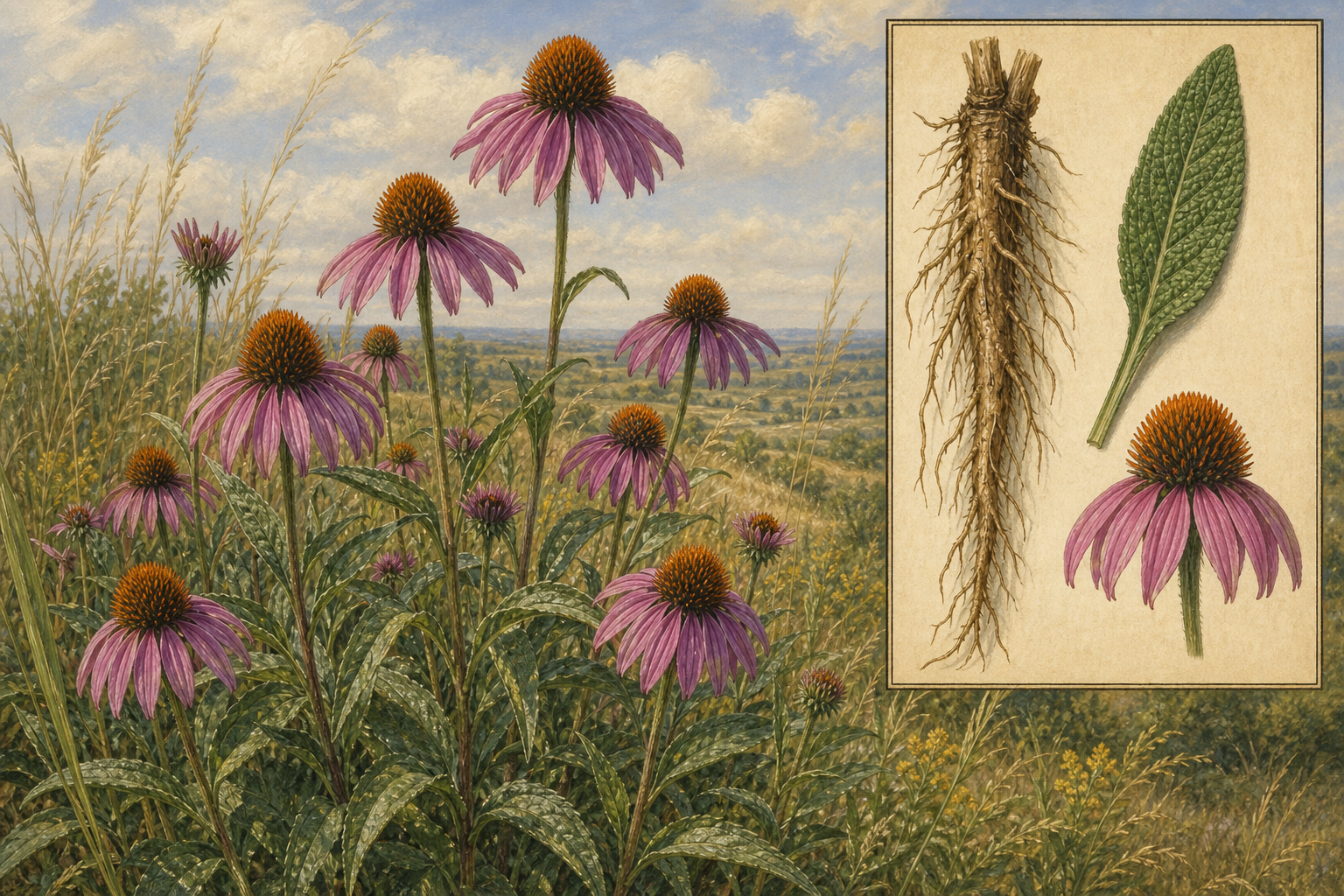
Echinacea, the purple coneflower of North American prairies, is one of the most popular herbs for colds, and one of the few whose cold use European regulators accept on the strength of clinical evidence. The plant is three medicinal species, two organs, and a century of extracts that do not share a chromatogram. Echinacea purpurea is the garden purple coneflower: drooping magenta rays around a bristly orange cone. Its fresh aerial juice is the European well-established cold product. E. angustifolia and E. pallida are the narrower-leaved prairie roots of older Eclectic practice. A capsule that only says echinacea has not told you which of these products you are taking.
This monograph keeps three facts in the same frame. First, NCCIH’s reading of the cold literature is modest: taking echinacea may slightly reduce your chances of catching a cold; it is still unclear whether it shortens one. The 2014 Cochrane review (Karsch-Völk, Barrett, Kiefer, Bauer, Ardjomand-Woelkart, and Linde; CD000530) assembled 24 double-blind trials and 4,631 people, refused to pool the main analysis because the products were too different, found no individually significant prevention trial, and a post-hoc 10–20% relative risk reduction if you force a pool. Treatment duration mostly did not beat placebo. Second, EMA’s herbal committee treats expressed juice of fresh E. purpurea herb as well-established for short-term prevention and treatment of the common cold in people over twelve, for no more than ten days. That is a specific juice, not a year-round gummy. Root products sit on the traditional shelf. Third, Turner’s 2005 New England Journal of Medicine challenge study of E. angustifolia root against experimental rhinovirus was negative. Barrett’s 2010 Annals of Internal Medicine treatment trial in Wisconsin adults was not a clinically meaningful win. Those papers are why the answer to “does echinacea work?” depends on the species and the extract.
Nothing here is medical advice. A cold that becomes pneumonia, a fever in an infant, or influenza that needs antivirals is a clinic problem. Do not take this plant year-round as an “immune” tonic; the EMA course is ten days at most. Do not confuse it with black-eyed Susan (Rudbeckia). Asteraceae allergy is a hard stop.
Featured in
Herbs for Colds, Flu and ImmunityIn this monograph
01 The plant
Botanical profile
Echinacea purpurea (L.) Moench sits in Asteraceae. NCBI Taxonomy treats it as taxon 53751. Linnaeus named it Rudbeckia purpurea in Species Plantarum (1753); Moench moved it to Echinacea in 1794. IPNI records that combination as 1174497-2. It is a perennial of mesic prairies and open woods east of the Rockies, now a garden staple worldwide: coarse lance-ovate leaves, unbranched or sparingly branched stems, and the hedgehog flower head that gives the genus its name (echinos, hedgehog). The medicinal aerial drug is flowering herb; the root is a separate pharmacopeial object.
E. angustifolia DC. (NCBI 308558) is the narrow-leaved purple coneflower of drier Great Plains ground. E. pallida (Nutt.) Nutt. is pale coneflower, with longer, paler, more strongly drooping rays. EMA files the dried roots of all three as distinct herbal substances. Before 1968, angustifolia and pallida were often treated as varieties of one species; they are not interchangeable extracts. Other Echinacea species (paradoxa, tennesseensis, laevigata) are conservation or ornamental stories, not the cold-trial material.
Do not confuse the genus with Rudbeckia hirta (black-eyed Susan), whose disk is softer and whose rays do not droop the same way. Do not treat “coneflower tea from the border” as Echinacin. Cultivated E. purpurea is the usual commercial aerial crop. Wild-dug angustifolia root has a conservation and adulteration history.
Chemistry splits by species and organ. Caffeic acid derivatives: cichoric acid (PubChem CID 5281764) is the usual marker in E. purpurea herb and root; echinacoside (CID 5281771) is the major caffeoyl glycoside of E. angustifolia and E. pallida roots and is typically low or absent in purpurea root. Alkylamides (isobutylamides) tingle the tongue; they bind CB2 in experimental systems and are the sensory quality check for some tinctures. Polysaccharides and glycoproteins were the 1980s immune-stimulant story. Volatile polyenes sit in pallida root. Gilroy and colleagues (Archives of Internal Medicine 2003) found US products that did not contain the labeled species. Two bottles can share a hedgehog on the label and not share an alkylamide.
02 Lineage
History
Plains Nations used Echinacea roots for toothache, sore throat, wounds, and snakebite long before a German juice plant existed. The Eclectic physicians of the nineteenth-century United States made E. angustifolia root a professional anti-infective and “alterative.” That is a medical-culture history, not a rhinovirus RCT. The plant crossed to Europe as an ornamental and then as a phytomedicine. Madaus and later German manufacturers built Echinacin-style expressed juices from fresh E. purpurea herb—the product class EMA still treats as well-established.
Late-twentieth-century North America turned the same genus into the default cold supplement. Goldenseal-echinacea blends, zinc lozenges, and “immune” teas piled on. Quality lagged: Gilroy 2003 is the labeling paper people still cite. Cochrane reviews (Melchart, then Linde, then Karsch-Völk 2014) tried to make one answer out of many extracts and mostly could not. Shah’s 2007 Lancet Infectious Diseases meta-analysis was more optimistic on prevention; Cochrane 2014 was more cautious about heterogeneity. NCCIH’s consumer page sits between them: a possible small prevention effect, unclear shortening of illness.
EMA adopted a well-established-use monograph for fresh E. purpurea herb juice (revision 24 November 2014, corrected 2015) and a separate traditional-use file for E. purpurea root (revision 2017: cold symptoms or mild acne). Angustifolia and pallida roots have their own traditional monographs. That regulatory split is the history: juice of one species’ aerial parts got the higher evidence rank; roots stayed traditional. In the United States the same plants are dietary supplements. History here is a product-class file, not a single prairie flower.
03 Chemistry
Active compounds and how it works
For the well-established juice, EMA states plainly that the mechanism of action is not known. Laboratory work offers several leads. Alkylamides can bind cannabinoid CB2 receptors and damp TNF-α in cell work. Cichoric acid is an antioxidant caffeoyl tartaric ester in dishes. Polysaccharides activate macrophages in older assays. Haron, Tyler, Pugh and colleagues (Planta Medica 2016), in NCCIH-supported work, found that Proteobacteria living in E. purpurea fully accounted for the macrophage activation of some extracts—bacterial LPS as a confounder of “immune stimulation.” That paper is a methods warning: two lots of prairie flower are not one drug.
Immunostimulation is why autoimmune disease and transplant drugs show up in cautions. It is also why year-round use was never the EMA plan. A ten-day cold course is not a chronic cytokine protocol. Effects on CYP1A2 and CYP3A4 appear in vitro and in some human phenotyping; clinical importance is unsettled (MSKCC, LiverTox). Etoposide thrombocytopenia is a case-level CYP3A4 worry. Immunosuppressants are a theoretical antagonism. Tongue tingle from a tincture is alkylamides, not proof the cold will be shorter.
04 In practice
Common uses
The common cold is echinacea’s main and best-studied use. NCCIH: taking echinacea may slightly reduce your chances of catching a cold; whether it shortens a cold is unclear. Cochrane 2014: 24 double-blind trials, 33 comparisons, products too heterogeneous to pool as one medicine; no single prevention trial of “at least one cold” was statistically significant; a post-hoc pool suggested a 10–20% relative risk reduction of questionable clinical size; of seven treatment trials reporting duration, only one was significant. David and Cunningham (Complementary Therapies in Medicine 2019) meta-analyzed upper-respiratory trials and still had to live with product scatter. Shah 2007 was the more positive prevention meta-analysis that Cochrane later qualified. The overall picture matters more than any single study.
Negative landmarks matter. Turner, Bauer, Woelkart, Hulsey, and Gangemi (NEJM 2005) experimentally infected volunteers with rhinovirus and tested three E. angustifolia root extracts (supercritical CO2, 60% ethanol, 20% ethanol) as prophylaxis and treatment: no significant effect on infection rate or symptom severity. Barrett, Brown, Rakel and colleagues (Ann Intern Med 2010) randomized Wisconsin adults with new colds to no pill, placebo, or echinacea (root and herb of E. purpurea and E. angustifolia) and found no statistically significant duration benefit, with a possible half-day trend that was not clinically decisive. Taylor, Weber, Standish et al. (JAMA 2003) found E. purpurea not effective for upper-respiratory infections in children and saw more rash. Those are not “the wrong brand” footnotes. They are why mixed reviews stay mixed.
EMA’s assessment is the most encouraging reading: in the most relevant adult trials, the expressed juice of fresh E. purpurea herb taken by mouth prevented colds and improved symptoms more rapidly than placebo when taken early. Its well-established use is correspondingly specific: oral expressed juice (or dried juice equivalent) of fresh E. purpurea herb, start at first signs, adolescents and adults, maximum ten days, see a doctor or pharmacist if symptoms last longer. Traditional root products: cold-symptom relief (and, for purpurea root, mild acne) on long-standing use. Topical herb juice: traditional small superficial wounds. An Echinacea hot drink compared with oseltamivir in one influenza non-inferiority trial (Raus 2015, in the MSKCC stack) is a formulated combination product, not a license to skip indicated antivirals.
Year-round “immune support,” cancer prevention, HIV, and chronic fatigue are not supported by clinical research. Preclinical cytokine and NK-cell stories are not a supplement protocol. Do not treat influenza, strep, COVID-19, or a child’s fever with a prairie flower as the only plan. Goldenseal-echinacea-zinc blends are a mixture, not stronger proof.
05 The apothecary
Preparations and traditional use
EMA well-established oral products: expressed juice of fresh E. purpurea flowering herb, DER 1.5–2.5:1, 1.5–4.5 ml per dose, 6–9 ml per day (or dried juice equivalent). Start at the first signs of a cold. Do not use more than ten days. Not for children under twelve. That is the juice file, not a tea bag of dried petals.
Traditional root products: dried E. purpurea, E. angustifolia, or E. pallida root as extracts, tinctures, or oromucosal forms on labeled traditional posology. EMA root indications are cold-symptom relief (and mild acne for some purpurea-root extracts), not the well-established juice claim. Topical herb preparations: small superficial wounds, up to one week; infection needs a clinician.
US supplements: dried herb, dried root, hydroalcoholic tinctures, capsules, gummies, and blends with goldenseal, elderberry, vitamin C, and zinc. Species and plant part are often missing. Gilroy 2003 found mislabeled products. Look for Echinacea purpurea herb juice if you want the EMA object; look for a named root if you want the Eclectic object. They are not bioequivalent. The tongue-tingle of alkylamides is a crude identity check for some tinctures, not a dose.
Do not graze garden coneflowers as a cold protocol. Do not give medicinal extracts to children as a winter plan; Taylor 2003 is the pediatric caution, and EMA does not recommend under twelve. A cold lasting more than ten days, high fever, or chest symptoms calls for a doctor or pharmacist, not a second bottle.
Safety
Before you use echinacea
06 Caution
Side effects
Common: digestive-tract symptoms—abdominal pain, nausea, stomach pain (NCCIH). Headache, dizziness, constipation, and rash also appear (MSKCC). Prevention trials in Cochrane’s pool trended toward more dropouts for adverse events in echinacea arms.
Allergy: urticaria, facial swelling, asthma, angioedema, Stevens-Johnson syndrome, and anaphylactic shock are reported, especially in atopic people (EMA). Frequency unknown. People who react to ragweed, chrysanthemums, marigolds, or chamomile are the obvious risk group. Taylor 2003 linked echinacea with more rash in children.
Liver: LiverTox likelihood D—possible rare cause of clinically apparent injury. Isolated jaundice cases one to three weeks in, usually recovering on stopping; some national-registry hepatitis reports. Mechanism unclear; contaminant and hypersensitivity are both nominated. Jaundice still means stop and get labs. This is not kava’s or ashwagandha’s denser file.
Other case-level signals in MSKCC: leukopenia with chronic use, autoimmune pemphigus flare, TTP, hypereosinophilia, etoposide-associated thrombocytopenia. Chronic daily “immune” capsules are how those stories start. EMA’s ten-day cap exists for a reason.
07 Caution
Contraindications
Do not use if you are allergic to echinacea or other Asteraceae. EMA: not recommended in progressive systemic disorders, autoimmune diseases, immunodeficiencies, immunosuppression, and diseases of the white-blood-cell system. Atopic patients should speak with a doctor first because severe hypersensitivity is the known risk.
Not for children under twelve as a well-established or traditional EMA product. Taylor’s pediatric RCT did not show benefit and saw more rash. High fever or a sick infant is emergency care, not a tincture.
Pregnancy and lactation: EMA has limited observational data without a clear harm signal and still does not recommend use unless a doctor advises it. MSKCC: talk with a clinician; safety is not established. Do not apply topical echinacea to the breast while nursing.
A cold is still a cold. Echinacea is not oseltamivir, not an antibiotic, and not a reason to skip vaccination. People on transplant immunosuppressants or some chemotherapy (etoposide, possibly other CYP3A4 substrates) need the oncology or transplant team, not a prairie protocol.
08 Caution
Drug and herb interactions
EMA’s well-established juice monograph lists no reported drug interactions. That is a regulatory sentence for that specific preparation, not a blank check for every tincture.
Immunosuppressants (cyclosporine, tacrolimus, and kin): theoretical antagonism because of echinacea’s immunostimulant reputation and an autoimmune-flare case (Lee and Werth 2004). MSKCC flags this. If you take anti-rejection drugs, skip the cold herb.
CYP: in-vitro and some in-vivo signals for CYP1A2 and CYP3A4; CYP2C8 and P-gp in dishes. Docetaxel pharmacokinetics did not clearly change in one cancer-patient study. Etoposide thrombocytopenia is the case that still sits in reviews. Caffeine (CYP1A2) is a theoretical footnote. Tell a pharmacist.
Do not stack echinacea, goldenseal, elderberry, zinc, and vitamin C and then credit one plant when the cold lasts five days either way. With a blend, there is no way to tell which ingredient, if any, helped.
09 Questions
Frequently Asked Questions
Maybe a little on prevention, unclear on duration. NCCIH says taking it may slightly reduce your chances of catching a cold and that shortening a cold is not established. Cochrane 2014 found no individually significant prevention trial and almost no significant duration effect, with a possible small post-hoc prevention pool. EMA’s herbal committee still accepts a specific E. purpurea herb juice as well-established for short-term prevention and treatment, because in adult trials it worked better than placebo when started early. Those sentences can all be true because they are not the same product.
No. Echinacea purpurea is the garden coneflower; its fresh aerial juice is the European well-established drug. E. angustifolia is a narrower prairie species whose root failed Turner’s 2005 rhinovirus challenge. E. pallida is a third root. Cichoric acid marks purpurea; echinacoside marks angustifolia/pallida roots. Read the Latin name and the plant part.
No. EMA’s well-established course is at most ten days, started at the first signs of a cold. Chronic “immune support” is how leukopenia and autoimmune-flare case reports show up. It is not a vaccine and not a reason to live on capsules from October to April.
EMA does not recommend it under twelve. Taylor’s 2003 JAMA trial in children with upper-respiratory infections found no benefit and more rash. A feverish toddler needs pediatric care, not a tincture.
They often pool unlike extracts or lean on Shah 2007. Cochrane 2014 refused a primary pooled estimate because species, plant parts, and solvents were too different. Barrett 2010 and Turner 2005 are large, careful negatives. Product scatter is the scientific problem, not a loophole.
Ragweed is Asteraceae; EMA contraindicates the family and warns atopic people about severe reactions including anaphylaxis and asthma. Autoimmune disease, immunodeficiency, and immunosuppression are on the not-recommended list. That is a clinician conversation, not a maybe.
Rarely. LiverTox rates it a possible, uncommon cause of self-limited hepatitis. It is not ashwagandha’s denser modern file. Jaundice, dark urine, or unusual fatigue still means stop and get labs.
Anyone with daisy-family allergy; people with progressive autoimmune or white-cell disease; people on immunosuppressants or some chemotherapy; children under twelve as a labeled herbal medicine; and anyone treating a serious respiratory infection with a coneflower instead of indicated care. A ten-day adult course of a named product is a different decision from a forever blend.
10 References
Sources
These references support the history, clinical, and safety claims on this page. They are not an endorsement of any product.
-
Echinacea: usefulness and safety
National Center for Complementary and Integrative Health (NIH), 2024
Consumer evidence: possible small reduction in catching a cold; unclear whether it shortens illness; short-term E. purpurea extracts likely safe for most adults; allergy and digestive side effects.
-
Colds, flu, and complementary health approaches: usefulness and safety
National Center for Complementary and Integrative Health (NIH), 2016
NCCIH cold/flu roundup: 2014 Cochrane conclusion that echinacea has not been convincingly shown to help, with a possible small effect of some products; product variability; rash signal in children.
-
Echinacea
Memorial Sloan Kettering Cancer Center, About Herbs, 2023
Clinical summary: mixed cold/flu data, species/extract scatter, immunosuppressant and etoposide cautions, allergy, and liver case reports.
-
Echinacea
LiverTox, National Institute of Diabetes and Digestive and Kidney Diseases (NIH), 2019
Likelihood D: possible rare clinically apparent liver injury; isolated jaundice cases; not a signal in controlled trials.
-
Echinaceae purpureae herba — herbal medicinal product
European Medicines Agency, Committee on Herbal Medicinal Products, 2015
HMPC landing page: well-established oral fresh-herb juice for short-term cold prevention/treatment; traditional topical use for small wounds; age 12+.
-
European Union herbal monograph on Echinacea purpurea (L.) Moench, herba recens
European Medicines Agency (EMA/HMPC/48704/2014 Corr.), 2015
Adopted 24 November 2014: 6–9 ml expressed juice daily, max 10 days, autoimmune/immunosuppression warnings, Asteraceae contraindication, atopic hypersensitivity.
-
Echinaceae purpureae radix — herbal medicinal product
European Medicines Agency, Committee on Herbal Medicinal Products, 2017
Separate traditional-use file for purple-coneflower root (cold symptoms, mild acne)—not the well-established aerial-juice indication.
-
Echinacea for preventing and treating the common cold
Cochrane Database of Systematic Reviews (PubMed 24554461), 2014
Karsch-Völk et al. CD000530: 24 RCTs, 4631 participants; too heterogeneous to pool; no individually significant prevention trial; little evidence of shorter colds.
-
An evaluation of Echinacea angustifolia in experimental rhinovirus infections
New England Journal of Medicine (PubMed 16049208), 2005
Turner et al.: three angustifolia root extracts did not prevent or treat experimental rhinovirus illness versus placebo.
-
Echinacea for treating the common cold: a randomized trial
Annals of Internal Medicine (PubMed 21173411), 2010
Barrett et al. Wisconsin RCT: no statistically significant shortening of established colds; possible half-day trend of limited clinical meaning.
-
Efficacy and safety of echinacea in treating upper respiratory tract infections in children: a randomized controlled trial
JAMA (PubMed 14657066), 2003
Taylor et al.: E. purpurea not effective for pediatric URI; more rash than placebo.
-
Echinacea for the prevention and treatment of upper respiratory tract infections: a systematic review and meta-analysis
Complementary Therapies in Medicine (PubMed 31126553), 2019
David and Cunningham: later URTI meta-analysis still limited by extract heterogeneity.
-
Evaluation of echinacea for the prevention and treatment of the common cold: a meta-analysis
The Lancet Infectious Diseases (PubMed 17597571), 2007
Shah et al.: more optimistic pooled prevention/treatment estimates that later Cochrane work treated more cautiously.
-
Echinacea and truth in labeling
Archives of Internal Medicine (PubMed 12639203), 2003
Gilroy et al.: US products that did not contain the labeled Echinacea species—the quality paper behind “read the Latin name.”
-
Taxonomy browser: Echinacea purpurea
NCBI Taxonomy (NIH), 2024
NCBI taxon 53751 for purple coneflower in Asteraceae.
-
Echinacea purpurea (L.) Moench
International Plant Names Index, 1794
Moench combination, Methodus 591 (1794); basionym Rudbeckia purpurea L. (1753); LSID urn:lsid:ipni.org:names:1174497-2.
-
Cichoric acid
PubChem, National Library of Medicine (NIH), 2024
Caffeoyl tartaric marker typical of E. purpurea herb and root; CID 5281764, C22H18O12.
-
Echinacoside
PubChem, National Library of Medicine (NIH), 2024
Major caffeoyl glycoside of E. angustifolia and E. pallida roots, usually low in purpurea root; CID 5281771, C35H46O20.