Monograph
Garlic
Allium sativum
Updated October 4, 2026
Key points
-
01
Crush chemistry, not a single pill
Alliin plus alliinase makes allicin. Cooking kills the enzyme. Aged extract is S-allylcysteine. Products are not interchangeable.
-
02
Lipid and BP effects are small
NCCIH: modest cholesterol and hypertensive signals. Gardner 2007 found no lipid benefit versus placebo for raw, powder, or AGE. Not a statin.
-
03
Traditional, not well-established
EMA lists adjuvant atherosclerosis prevention and cold symptom relief on long-standing use. Cochrane’s cold review is one trial.
-
04
Stop before surgery
Seven days. Bleeding is on the EMA adverse-effect list. Anticoagulants need a clinician, not a clove protocol.
-
05
Saquinavir is a hard no
Garlic supplements can collapse protease-inhibitor levels. That is a contraindication, not a rumor.
Garlic (Allium sativum) is a kitchen bulb that people treat as a cardiovascular drug. The clove in a pan is food. The enteric-coated tablet is an alliinase experiment. Aged garlic extract is a third chemistry, low-odor, built on S-allylcysteine rather than the flash of allicin. If the bottle only says garlic, you do not know which file you opened.
This monograph keeps three facts in the same frame. First, meta-analyses of supplements often show small drops in total and LDL cholesterol and, in people who already have high blood pressure, modest systolic and diastolic reductions. NCCIH’s consumer page says exactly that: small, and mainly in people who already have the numbers. Second, a careful Stanford trial (Gardner 2007) found raw garlic, a powdered supplement, and aged extract no better than placebo for lipids in moderate hypercholesterolemia. Small average effects and a negative well-run RCT can both be true. Garlic is not a statin. Third, the practical harms are not mysterious: breath and gut, bleeding and surgery, raw clove burns on skin, and a documented crash of saquinavir levels. EMA contraindicates garlic medicines with saquinavir/ritonavir and tells you to stop seven days before an operation.
Nothing here is medical advice. Hypertension and high LDL belong with a clinician and indicated drugs. Do not stop a statin or an antiretroviral for a clove. Do not tape raw garlic to a wart or a child’s foot. Elephant garlic and wild ramsons are other Allium species.
In this monograph
01 The plant
Botanical profile
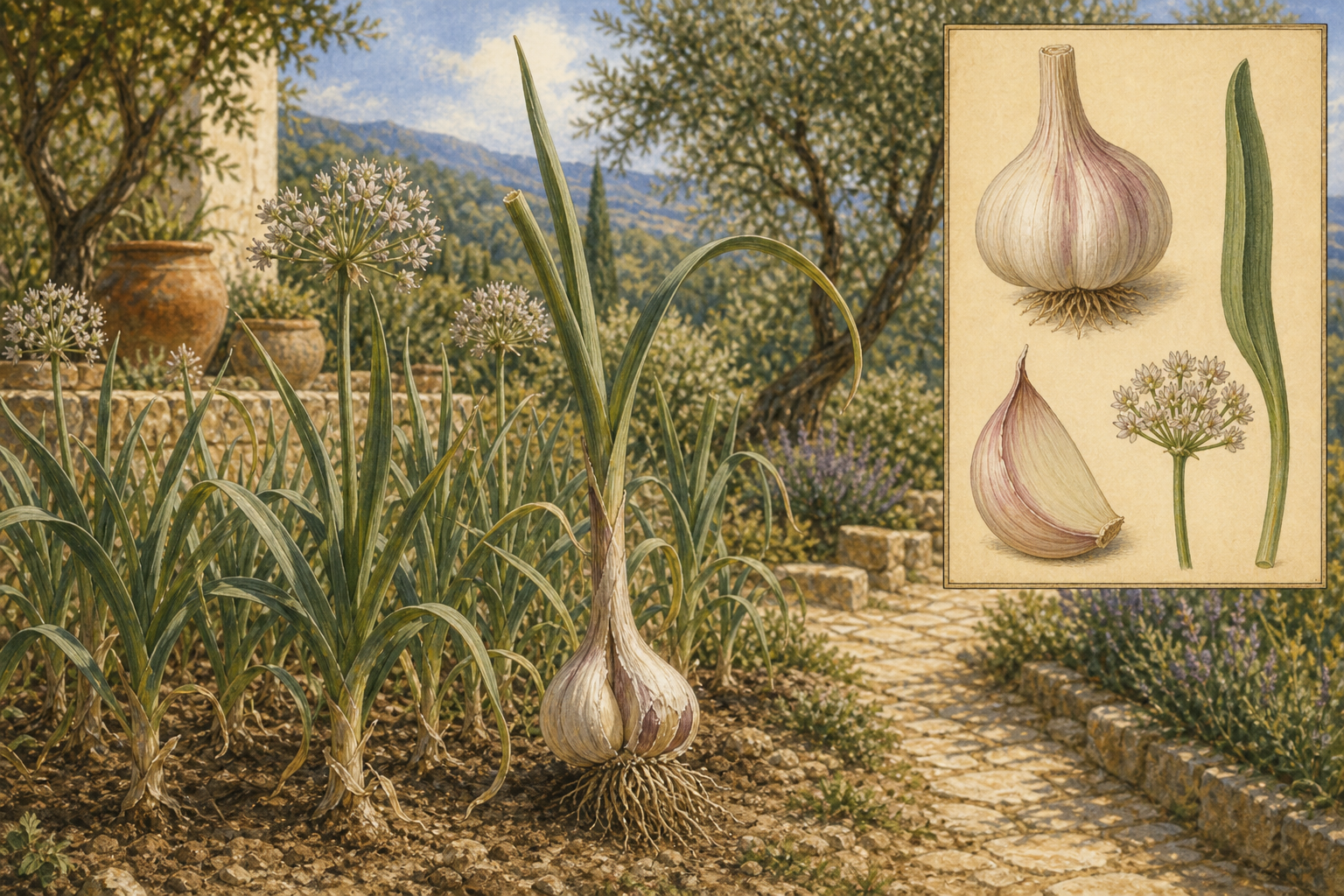
Allium sativum L. sits in Amaryllidaceae (Allioideae; older books file it in Liliaceae). NCBI Taxonomy treats it as taxon 4682. It is a sterile cultigen, propagated by cloves. The bulb is a cluster of cloves under a papery tunic, often flushed purple. Leaves are flat, keeled, and strap-like. Hardneck types send up a scape with a spherical umbel of flowers and bulbils; softnecks are the supermarket braid. The medicinal part is Allii sativi bulbus, Ph. Eur. 1216: the fresh or dried bulb.
Native as a crop of Central Asia, now grown worldwide. Culinary splits—hardneck versus softneck, purple stripe, silverskin—are flavor and storage, not separate monographs. Elephant garlic is Allium ampeloprasum, a leek kin. Ramsons (A. ursinum) and ramps (A. tricoccum) are wild greens, not A. sativum. Onion (A. cepa) shares sulfur chemistry and is not garlic extract.
The chemistry is a crush reaction. Intact cells hold the sulfoxide alliin apart from the enzyme alliinase. Cutting or chewing mixes them and makes allicin, the unstable thiosulfinate that smells like garlic and does not survive cooking or the shelf. Allicin rearranges to ajoene, diallyl sulfides, and vinyldithiins. Aged garlic extract (AGE) is sliced, soaked, and aged until the odor drops and S-allylcysteine dominates. Oil macerates and steam-distilled oils are still other profiles. Lawson’s point, which Cochrane repeats, is that commercial products do not share an allicin yield. A cooked clove has almost no allicin left. That is dinner, not an allicin tablet.
02 Lineage
History
Egyptian, Greek, Roman, Ayurvedic, and Chinese sources used garlic as food, wound herb, and “blood” tonic. Pliny listed complaints; military folklore fed cloves to laborers. None of that is a lipid trial. The twentieth century isolated alliin and allicin (Cavallito, 1940s), then built powders, oils, and Kyolic-style AGE for the supplement aisle.
German Commission E and later EU herbal law put the bulb on the traditional shelf. EMA’s HMPC monograph (18 July 2017) is traditional use only: an adjuvant for prevention of atherosclerosis, and relief of common-cold symptoms. There is no well-established cardiovascular indication. That regulatory rank reflects long use rather than statin-grade evidence.
The trial era is mixed on purpose. Ackermann-era systematic reviews already called lipid effects small. Gardner’s 2007 Archives of Internal Medicine RCT tested raw garlic against two commercial products and placebo. Ried’s later meta-analyses pooled BP and lipid RCTs and found modest hypertensive and cholesterol signals. Piscitelli’s 2002 saquinavir paper is the interaction that still sits in EMA contraindications. History here is a food that picked up a supplement industry, not a new plant.
03 Chemistry
Active compounds and how it works
Allicin is a reactive sulfur species, not a stable drug. In vitro it is antimicrobial; in people it is fleeting. Proposed vascular actions include hydrogen-sulfide and nitric-oxide signaling, modest antiplatelet effects (ajoene is the usual named antiaggregant), and small shifts in cholesterol synthesis. AGE’s S-allylcysteine is more bioavailable and less odorous; it is not allicin in slow release. Do not assume an AGE trial applies to a fresh-clove powder or the reverse.
Antiplatelet activity is why bleeding time and surgery show up in labels. The saquinavir interaction is pharmacokinetic: garlic supplements cut protease-inhibitor levels (Piscitelli 2002), with a risk of virologic failure. That is a contraindication, not a “take with food” note.
Cooking inactivates alliinase. Swallowing an intact enteric-coated powder is an attempt to dump allicin in the gut. Crushing a clove and waiting ten minutes before heat is kitchen pharmacology. Those rituals are not interchangeable with a 24-week lipid RCT.
04 In practice
Common uses
Lipids: NCCIH says supplements may reduce total and LDL cholesterol to a small extent in people who already have high cholesterol. Ried, Toben, and Fakler (Nutrition Reviews 2013) pooled 39 RCTs and estimated about a 10% drop in total and LDL cholesterol when taken more than two months by people with slightly elevated lipids. Gardner et al. (Arch Intern Med 2007) randomized adults with moderate hypercholesterolemia to raw garlic, powdered supplement, AGE, or placebo six days a week for six months and found no significant lipid differences. Read both: meta-analytic small effects, and a negative head-to-head of common US products. Garlic is not a replacement for indicated statin therapy.
Blood pressure: limited evidence for a small reduction in people who already have hypertension (NCCIH). Ried’s 2016 Journal of Nutrition update reported larger drops in hypertensive subgroups (on the order of ~8–9 mm Hg systolic in that pooling) than in normotensives. That is still adjunct territory, not an ACE inhibitor. Do not drop prescribed antihypertensives for Kyolic.
Atherosclerosis and colds: EMA traditional use—adjuvant prevention of atherosclerosis, and relief of cold symptoms. Lissiman, Bhasale, and Cohen (Cochrane 2014, CD006206) found a single eligible prevention trial: fewer colds over three months, similar duration when a cold occurred, not enough to recommend garlic. Josling 2001 is that trial, not a public-health program.
Diabetes, cancer prevention, “immune support”: NCCIH calls diabetes evidence limited and does not treat garlic as a proven cancer-prevention drug. Observational studies of allium vegetables in the diet do not translate into a supplement dose. Raw garlic on the skin can cause chemical burns; it is not a home antibiotic.
05 The apothecary
Preparations and traditional use
Food: cooked cloves in meals. Alliinase dies with heat; you get flavor and some other organosulfurs, not a measured allicin dose. This is the lowest-intensity exposure.
EMA traditional products: powdered bulb (atherosclerosis adjuvant: single doses 300–750 mg, daily 900–1380 mg in divided doses); fresh-bulb oil macerate (DER 2–3:1 in rapeseed oil); dry extract DER 5:1 ethanol 34% (cold symptoms: 100–400 mg/day). Cold use: see a clinician if symptoms last more than a week.
US supplements: garlic powder standardized to allicin potential, enteric-coated tablets, AGE (S-allylcysteine), and distilled oils. They are not bioequivalent. Gardner tested three common forms and still saw no lipid effect. Match the trial product if you and a clinician still want a course—and do not expect statin-sized numbers.
Stop medicinal garlic at least seven days before elective surgery (EMA). Do not apply crushed raw garlic to skin. Do not give high-dose tablets to children as a cold plan; EMA does not establish atherosclerosis use under 18 or cold use under 12.
Safety
Before you use garlic
06 Caution
Side effects
Common: malodorous breath and body odor, abdominal pain, bloating, flatulence, fullness, anorexia (EMA, frequency not known). Heartburn happens. Enteric-coated tablets are meant to reduce odor, though many people still notice it.
Allergy: contact dermatitis, conjunctivitis, rhinitis, bronchospasm, sometimes severe. Occupational garlic allergy is a known kitchen problem. Hypersensitivity is a contraindication.
Bleeding: listed among EMA undesirable effects. Case reports of postoperative and spontaneous bleeding exist, often with anticoagulants. Headache, dizziness, and sweating also appear.
Skin: fresh raw garlic can cause irritant burns and blistering. NCCIH: oral use has been studied for years; raw topical use is the unsafe form. Do not use it as a poultice.
07 Caution
Contraindications
Do not use garlic medicines if you are allergic to garlic. Do not use them with saquinavir/ritonavir (EMA contraindication: falling protease-inhibitor levels, loss of virologic response, possible resistance).
Avoid medicinal garlic for seven days before surgery. Use caution—or skip capsules—if you take warfarin, DOACs, or dual antiplatelet therapy unless the prescribing clinician agrees.
EMA: safety in pregnancy and lactation is not established; use is not recommended. Cooking with garlic is a different exposure from gram-level powder. Animal data include testicular toxicity at high powder doses; that is a preclinical footnote, not a human fertility trial.
Do not treat a heart attack, stroke, or LDL of 190 with cloves. Do not treat HIV with garlic. Do not treat a child’s fever with raw garlic on the feet.
08 Caution
Drug and herb interactions
Saquinavir (and the EMA pairing with ritonavir): Piscitelli et al. (Clin Infect Dis 2002) showed garlic supplements markedly reduced saquinavir concentrations. This is the hard stop.
Anticoagulants and antiplatelets: EMA advises caution because garlic may increase bleeding times. MSKCC flags warfarin. Food garlic in sauce is not the same as a 1 g extract, but supplements still belong on the list you give your surgical team.
Antihypertensives and glucose-lowering drugs: additive theoretical effects. Monitor if you add a high-dose product to a prescription regimen; do not freelance a substitution.
Do not stack garlic extract, high-dose ginkgo, fish oil, and ginger “blood” capsules. Stacking several antiplatelet supplements is a pattern seen in bleeding case reports.
09 Questions
Frequently Asked Questions
Sometimes a little, in people who already have high cholesterol, according to meta-analyses NCCIH cites. Gardner’s 2007 trial of raw garlic, powder, and aged extract found no significant lipid change versus placebo. It is not a substitute for indicated statin therapy.
Limited evidence for a small drop if you already have hypertension. Ried’s pooled hypertensive subgroups look larger than effects in people with normal pressure. Keep the prescription. Garlic is an adjunct at best.
No. Fresh crushed garlic makes allicin. Aged garlic extract is processed until S-allylcysteine dominates and the odor drops. Oil macerates are another profile again. Trials do not transfer automatically across those forms.
EMA allows traditional use for cold symptoms. Cochrane 2014 found one eligible prevention trial with fewer colds but similar illness length, and called the evidence insufficient to recommend garlic. One study is not a winter protocol.
Antiplatelet effects and bleeding reports. EMA says avoid garlic consumption for seven days before surgery. Tell the team about capsules, not only about last night’s pasta.
Not with saquinavir/ritonavir—EMA contraindicates it after pharmacokinetic data showed lower protease-inhibitor levels. Warfarin and other anticoagulants need caution because bleeding time may rise. Ask the prescribing clinician before any extract.
No. Fresh raw garlic can cause chemical burns and severe irritation. NCCIH flags topical raw garlic as the unsafe form. Oral food use is a different exposure.
Anyone on saquinavir/ritonavir; people facing surgery within a week; people with garlic allergy; pregnant or breastfeeding people using medicinal (not culinary) doses without a clinician; and anyone replacing indicated lipid, blood-pressure, or HIV therapy with cloves.
10 References
Sources
These references support the history, clinical, and safety claims on this page. They are not an endorsement of any product.
-
Garlic: usefulness and safety
National Center for Complementary and Integrative Health (NIH), 2025
Consumer evidence: small cholesterol and hypertensive signals; limited diabetes data; oral supplements studied for years; raw topical garlic can burn.
-
Garlic
Memorial Sloan Kettering Cancer Center, About Herbs, 2024
Clinical summary: lipid and BP context, bleeding/warfarin, surgery, saquinavir, and topical burn cautions.
-
Allii sativi bulbus — herbal medicinal product
European Medicines Agency, Committee on Herbal Medicinal Products, 2017
HMPC landing page: traditional use only as an atherosclerosis adjuvant and for common-cold symptoms.
-
European Union herbal monograph on Allium sativum L., bulbus
European Medicines Agency (EMA/HMPC/7685/2013), 2017
Adopted 18 July 2017: posology, 7-day pre-op stop, anticoagulant caution, saquinavir/ritonavir contraindication, pregnancy not recommended, odor/GI/bleeding adverse effects.
-
Effect of raw garlic vs commercial garlic supplements on plasma lipid concentrations in adults with moderate hypercholesterolemia
Archives of Internal Medicine (PubMed 17325296), 2007
Gardner et al. Stanford RCT: raw garlic, powdered supplement, and aged extract did not beat placebo on lipids over six months.
-
Effect of garlic on serum lipids: an updated meta-analysis
Nutrition Reviews (PubMed 23590705), 2013
Ried, Toben, and Fakler: 39 RCTs; modest total and LDL cholesterol reductions with longer use in people with mildly elevated lipids.
-
Garlic lowers blood pressure in hypertensive individuals, regulates serum cholesterol, and stimulates immunity: an updated meta-analysis and review
The Journal of Nutrition (PubMed 26764326), 2016
Ried: BP reductions concentrated in hypertensive subgroups; lipid and immune claims reviewed with the same product-heterogeneity caveat.
-
Garlic for the common cold
Cochrane Database of Systematic Reviews (PMC6465033), 2014
Lissiman, Bhasale, and Cohen CD006206: one eligible RCT; fewer colds, similar duration; insufficient evidence to recommend garlic.
-
The effect of garlic supplements on the pharmacokinetics of saquinavir
Clinical Infectious Diseases (PubMed 11740713), 2002
Piscitelli et al.: garlic reduced saquinavir exposure—the interaction behind EMA’s contraindication.
-
Taxonomy browser: Allium sativum
NCBI Taxonomy (NIH), 2024
NCBI taxon 4682 for garlic in Amaryllidaceae.
-
Allicin
PubChem, National Library of Medicine (NIH), 2024
Unstable thiosulfinate formed when alliin meets alliinase in crushed garlic; CID 65036.
-
Alliin
PubChem, National Library of Medicine (NIH), 2024
Intact-clove sulfoxide precursor of allicin; CID 9576089.
-
(+)-S-Allylcysteine
PubChem, National Library of Medicine (NIH), 2024
Marker water-soluble sulfur amino acid of aged garlic extract, distinct from allicin; CID 9793905.
-
Ajoene
PubChem, National Library of Medicine (NIH), 2024
Allicin rearrangement product discussed for antiplatelet and antimicrobial activity; CID 5386591.