Monograph
Ginkgo
Ginkgo biloba
Updated October 4, 2026
Key points
-
01
Leaf extract, not the fruit
EGb-type acetone leaf extract is the trial object. Sidewalk seeds are a seizure and stench problem, not a memory food.
-
02
It does not prevent dementia
GEM and GuidAge are large, long, negative. NCCIH leads with that. Do not take ginkgo as Alzheimer insurance.
-
03
Symptom data are mixed
EMA still lists well-established use for mild dementia quality of life. Cochrane 2009 and 2026 do not call the benefit reliable.
-
04
24/6 is a spec, not a tea
Flavone glycosides, terpene lactones, low ginkgolic acids. A simple leaf tea is not the GEM tablet.
-
05
Bleeding and seizures
Ginkgolide B vs PAF; ginkgotoxin in seeds. Hold before surgery. Skip if you seize or take warfarin without a plan.
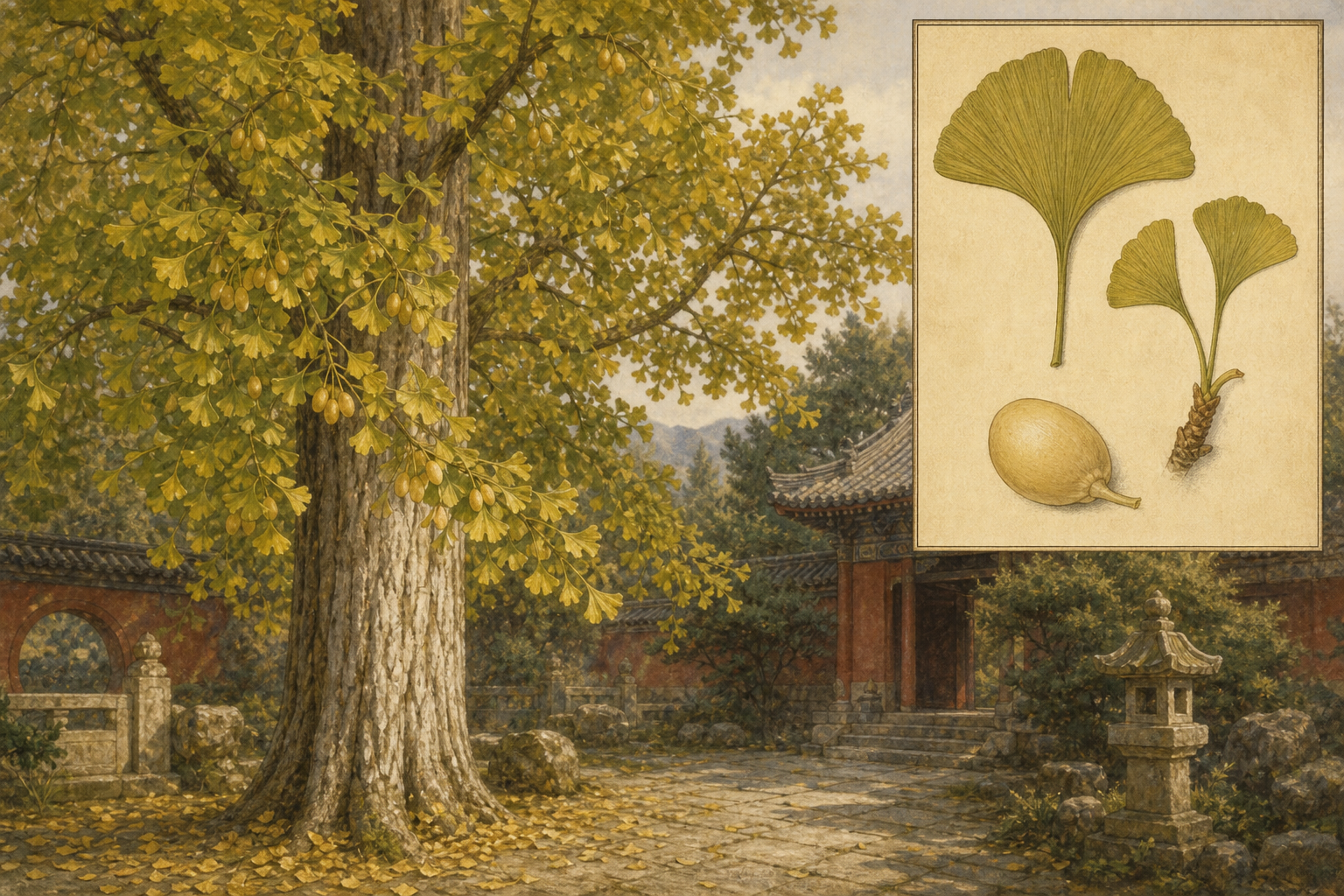
Ginkgo (Ginkgo biloba) is a living fossil with fan-shaped leaves, much loved as a street tree, though the female trees drop smelly seeds on the sidewalk. The tree is the last of Ginkgoales. The medicine that filled Western bottles is not the tree and not the stinking seed. It is a refined acetone leaf extract, classically EGb 761, standardized to about 24% flavone glycosides and 6% terpene lactones, with ginkgolic acids stripped down to parts per million. That object went to NIH-scale trials. Temple fruit did not.
This monograph keeps three facts in the same frame. First, ginkgo does not prevent dementia. The Ginkgo Evaluation of Memory (GEM) study and the French GuidAge trial said so, in thousands of older adults, for years. Second, evidence that leaf extract eases symptoms of already-diagnosed mild dementia is mixed: EMA still grants well-established use for age-associated cognitive impairment and quality of life in mild dementia; Cochrane’s 2009 and 2026 reviews call the benefit inconsistent or small. Third, seeds are a different toxicology file—ginkgotoxin, seizures, and a flesh that smells like rancid butter. Leaf capsules are not roasted bai guo.
Nothing here is medical advice. Memory loss that changes work or driving needs a clinician, not a supplement. Bleeding on warfarin or before surgery is a reason to stop, not to switch brands. Do not eat backyard seeds because the leaves are in a supplement.
Featured in
Herbs for Memory and Focus Herbs for Heart and Circulation Herbs for ADHD Herbs for Varicose VeinsIn this monograph
01 The plant
Botanical profile
Ginkgo biloba L. is the sole living species of Ginkgoaceae. NCBI Taxonomy files it as taxon 3311. It is dioecious: male trees drop pollen; female trees bear paired ovules with a fleshy sarcotesta that is not a true fruit. Leaves are fan-shaped, often notched (biloba), with open dichotomous veins and no midrib—the motif every city knows in autumn gold. Short spur shoots carry clusters of leaves; long shoots extend the branch. The “nut” inside the sarcotesta is the seed used in East Asian cooking after the flesh is removed and the kernel is cooked. Raw or poorly prepared seeds contain 4′-O-methylpyridoxine (ginkgotoxin), a B6 antagonist that can provoke seizures.
Native range is China; temple plantings saved the lineage, and the tree is now a street and park species worldwide. Fossil leaves from the Mesozoic look like today’s. That romance does not make the extract a nootropic. The pharmacognosy part is Ginkgo folium: dried leaf, and the Ph. Eur. refined, quantified dry extract (acetone 60% m/m, DER about 35–67:1) that EMA’s well-established monograph describes—22–27% flavone glycosides, 5–7% terpene lactones (ginkgolides A, B, C plus bilobalide), ginkgolic acids below 5 ppm. Teas of whole leaf and cheap powders are not that specification.
Chemistry splits leaf from seed. Unique diterpene lactones—ginkgolides, especially ginkgolide B, a platelet-activating-factor antagonist—and the sesquiterpene bilobalide sit with flavonol glycosides (quercetin, kaempferol, isorhamnetin). The seed’s problem is ginkgotoxin plus the butyric-acid stench of the sarcotesta. Do not confuse Ginkgo with maidenhair fern (Adiantum) just because Victorian gardeners used the same English nickname.
02 Lineage
History
Chinese pharmacy used bai guo (seed) for lung and bladder complaints and later the leaf. The silver-apricot name traveled through Japanese ginkyō into Kaempfer’s and Linnaeus’s Ginkgo. Nineteenth-century Europe planted the tree as an ornamental. The extract industry is twentieth-century German phytomedicine: Schwabe’s EGb 761 became the reference chemotype for dementia, tinnitus, and claudication trials.
Commission E and then EU herbal law put quantified leaf extract on the well-established shelf for cognitive complaints. The NIH-funded GEM study (DeKosky et al., JAMA 2008) was the American answer: more than three thousand people 75 or older, EGb 761 120 mg twice daily, median six years—no reduction in all-cause dementia or Alzheimer disease. Snitz and colleagues (JAMA 2009) reported the same trial’s cognitive-decline curves: no slowing. GuidAge (Vellas et al., Lancet Neurology 2012) in France, people 70-plus with memory complaints, likewise failed to prevent Alzheimer disease. Those three papers are why “ginkgo keeps you sharp” is not supported as a prevention claim.
EMA’s HMPC still adopted a 2015 well-established indication for improvement of age-associated cognitive impairment and quality of life in mild dementia, plus traditional use for heavy legs and cold hands after a doctor has ruled out serious disease. A Swedish HMPC member dissented, citing GEM, GuidAge, and Cochrane. That split is the regulatory history in brief: Europe licensed a symptom extract; the prevention trials were negative. NCCIH’s consumer page now leads with the prevention failure.
03 Chemistry
Active compounds and how it works
Proposed actions are plural and mostly preclinical: antioxidant flavonoid effects, modest vasodilation, antagonism of platelet-activating factor by ginkgolide B, and neuroprotective stories for bilobalide in animal ischemia models. Human cognitive benefit, when it appears in older dementia trials, is small and product-specific. It is not a cholinesterase inhibitor and not a substitute for indicated Alzheimer drugs.
Antiplatelet activity is the interaction that shows up in case reports: ginkgolide PAF blockade plus flavonoid effects on bleeding time. That is why surgery, warfarin, and other antiplatelets are a clinician conversation. CYP stories are mixed; LiverTox notes in-vitro inhibition that does not clearly translate at usual oral doses, while MSKCC still flags efavirenz and midazolam as losing effect.
Ginkgotoxin in seed (and in trace amounts in poorly refined leaf) can lower seizure threshold by interfering with vitamin B6 metabolism. Standardized EGb-type extracts keep ginkgolic acids low; they are not a license to eat the fruit that drops on the sidewalk.
04 In practice
Common uses
Dementia prevention: no. GEM (PMID 19017911; PMC2823569) and GuidAge (PMID 22959217) are the large, long trials. NCCIH states ginkgo has not been shown to prevent or slow progression to dementia. MSKCC’s clinical summary agrees: generally does not improve cognition or prevent Alzheimer disease.
Symptoms of mild dementia or age-associated cognitive impairment: the contested middle. EMA well-established use covers specified acetone dry extracts for that indication. Birks and Grimley Evans (Cochrane 2009, CD003120) called the evidence inconsistent and unreliable. The 2026 Cochrane update (PMID 41641880) still does not deliver a clean, high-certainty win on cognition or function. Some German and Chinese trials of 240 mg/day EGb 761 report modest gains; the two largest prevention RCTs did not. Treat “ginkgo for dementia” as a maybe-for-symptoms, never-for-prevention sentence, and only with a product that matches the extract used in trials.
Healthy memory and exam performance: not established. Do not take ginkgo as a study drug.
Peripheral circulation: EMA traditional use for heaviness of legs and cold extremities after serious disease is excluded. Cochrane 2013 (PMID 23744597) on intermittent claudication found no clinically important benefit of ginkgo over placebo. GEM did not reduce cardiovascular events.
Tinnitus: Sereda and colleagues (Cochrane 2022, CD013514, PMID 36383762) found no reliable evidence that ginkgo helps when tinnitus is the primary complaint. Older positive anecdotes do not override that.
Stroke: MSKCC notes limited acute-stroke data at high risk of bias and, from GEM, a signal of more strokes in the ginkgo arm in one secondary look. Do not self-treat a TIA with leaf extract.
05 The apothecary
Preparations and traditional use
Trial and EMA well-established object: refined, quantified dry leaf extract (acetone 60%), DER 35–67:1, ~24% flavone glycosides / ~6% terpene lactones, ginkgolic acids <5 ppm. Classic dose in GEM was 120 mg twice daily (240 mg/day). Symptom trials often use 120–240 mg/day in divided doses. EGb 761 is a brand chemotype, not a generic leaf tea.
Dietary supplements in the US vary. Many labels ape 24/6 without proving ginkgolic-acid limits or terpene identity. Powdered whole leaf and supermarket teas are closer to traditional use than to GEM material.
Seeds: cooked kernels in Chinese and Japanese food after the sarcotesta is removed. Limit portions; poisoning still happens, especially in children. Do not make tincture from fallen fruit.
Stop at least two weeks before elective surgery if a surgeon asks you to hold antiplatelet herbs—MSKCC says at least a week; many perioperative lists use two. There is no dose that makes a subdural on warfarin theoretical.
Safety
Before you use ginkgo
06 Caution
Side effects
Common with leaf extract: GI upset, headache, dizziness, palpitations, rash. In the large RCTs, serious adverse events were generally similar to placebo. That is not a bleeding waiver.
Bleeding: case reports of intracranial and postoperative hemorrhage, often with anticoagulants or NSAIDs. Ginkgolide B’s PAF antagonism is the usual mechanism story. Nosebleeds and easy bruising are a stop-and-call event if you also take warfarin or a DOAC.
Seizures: seed poisoning is the classic file (ginkgotoxin). Leaf extract has additional case reports, enough that MSKCC warns people with a seizure history. Combining ginkgo with drugs that already lower seizure threshold (for example prochlorperazine) is a combination to avoid.
Hyponatremia appears on MSKCC’s patient list. Animal NTP studies flagged liver tumors at high extract doses; that rodent finding has not been shown to apply to people, and LiverTox still rates ginkgo E (unlikely direct hepatotoxin).
07 Caution
Contraindications
Do not use if you have a bleeding disorder, are awaiting surgery, or take anticoagulants/antiplatelets unless the prescribing clinician agrees. Do not use if you have active seizures or eat raw ginkgo seeds.
Pregnancy and breastfeeding: skip it; safety is not established, and bleeding plus ginkgotoxin are enough reasons. Children should not be given seed snacks as “nuts.”
Do not use ginkgo to delay a dementia work-up. Normal-pressure hydrocephalus, depression, B12 deficiency, and Alzheimer disease are not leaf-extract problems first.
Hormone and cancer footnotes in MSKCC (ineffective for chemo brain; no cancer-prevention signal in GEM) mean this is not an oncology tonic.
08 Caution
Drug and herb interactions
Anticoagulants and antiplatelets: additive bleeding risk with warfarin, DOACs, aspirin, clopidogrel, and high-dose NSAIDs. This is the interaction that belongs in the preoperative list.
Efavirenz: MSKCC warns ginkgo can reduce effect. Midazolam: may lose effect. Insulin: glucose handling may shift. Prochlorperazine and other seizure-threshold drugs: extra seizure risk.
LiverTox: usual oral doses have little proven CYP effect in people despite in-vitro signals. Do not read that as “no interactions.” Tell a pharmacist about the Latin name and the milligram strength.
“Brain blends” that combine ginkgo with high-dose vitamin E, fish oil, and garlic extract can add up to more bleeding and bruising.
09 Questions
Frequently Asked Questions
No. The GEM trial (JAMA 2008) and GuidAge (Lancet Neurology 2012) found standardized leaf extract did not prevent dementia or Alzheimer disease. NCCIH’s consumer page says so in the first evidence bullets.
Maybe a little, maybe not. EMA licenses specified extracts for age-associated cognitive impairment and quality of life in mild dementia. Cochrane reviews (2009, 2026) find inconsistent or small effects. It is not a replacement for a dementia clinic.
No. The fleshy seed coat is foul and the kernel contains ginkgotoxin. Cooked seeds are a food with a poisoning record. Capsules are refined leaf extract. Do not eat park fruit because you take EGb 761.
Not without the person who manages your clotting. Ginkgo can increase bleeding. MSKCC flags warfarin. Stop before elective surgery on your surgeon’s timetable.
Cochrane 2022 found no reliable benefit for tinnitus as the main complaint. Cochrane 2013 found no clinically important benefit for intermittent claudication. EMA traditional use for heavy legs is not those trial endpoints.
Because HMPC granted well-established use in 2015 for a narrow symptom indication, using older extract trials. Sweden dissented, pointing at GEM, GuidAge, and Cochrane. A licensed symptom claim is not a prevention claim.
LiverTox rates ginkgo E—unlikely to cause clinically apparent liver injury by itself. Rodent NTP tumor findings at high extract doses have not made it a human hepatotoxin like kava. Bleeding and seizures are the practical risks.
People on blood thinners, facing surgery, with seizure disorders, pregnant or breastfeeding, children offered raw seeds, and anyone hoping to skip a memory work-up. Healthy students looking for an exam edge are not the GEM population either.
10 References
Sources
These references support the history, clinical, and safety claims on this page. They are not an endorsement of any product.
-
Ginkgo: usefulness and safety
National Center for Complementary and Integrative Health (NIH), 2025
Consumer evidence: no prevention of dementia (GEM), inconsistent modest symptom data, bleeding and other safety cautions.
-
Ginkgo
Memorial Sloan Kettering Cancer Center, About Herbs, 2023
Clinical summary: GEM/GuidAge negative for prevention; warfarin, seizures, efavirenz, midazolam, insulin; mixed tinnitus and stroke data.
-
Ginkgo
LiverTox, National Institute of Diabetes and Digestive and Kidney Diseases (NIH), 2018
Likelihood E as a direct hepatotoxin; bleeding via antiplatelet interactions; typical 120–240 mg/day extract doses.
-
Ginkgo folium — herbal medicinal product
European Medicines Agency, Committee on Herbal Medicinal Products, 2015
HMPC landing page: well-established use for age-associated cognitive impairment and quality of life in mild dementia; traditional use for minor circulatory complaints.
-
European Union herbal monograph on Ginkgo biloba L., folium
European Medicines Agency (EMA/HMPC/321097/2012), 2015
Official 28 January 2015 monograph: acetone dry extract (DER 35–67:1) for the well-established cognitive indication; powdered leaf for traditional circulatory use.
-
Ginkgo biloba for prevention of dementia: a randomized controlled trial
JAMA (PMC2823569), 2008
DeKosky et al., GEM study: EGb 761 120 mg twice daily did not reduce dementia or Alzheimer incidence in adults 75 and older.
-
Ginkgo biloba for preventing cognitive decline in older adults: a randomized trial
JAMA (PubMed 20040554), 2009
Snitz et al.: GEM cognitive secondary outcomes—no slowing of decline versus placebo.
-
Long-term use of standardised Ginkgo biloba extract for the prevention of Alzheimer’s disease (GuidAge)
The Lancet Neurology (PubMed 22959217), 2012
Vellas et al.: French RCT in people 70+ with memory complaints; no prevention of Alzheimer disease.
-
Ginkgo biloba for cognitive impairment and dementia
Cochrane Database of Systematic Reviews (PubMed 19160216), 2009
Birks and Grimley Evans CD003120: evidence for a predictable, clinically significant benefit called inconsistent and unreliable.
-
Ginkgo biloba for cognitive impairment and dementia
Cochrane Database of Systematic Reviews (PubMed 41641880), 2026
Updated Cochrane review (5 February 2026): still no high-certainty demonstration that ginkgo meaningfully improves cognition or function.
-
Ginkgo biloba for intermittent claudication
Cochrane Database of Systematic Reviews (PubMed 23744597), 2013
2013 Cochrane review: no clinically important benefit versus placebo for claudication.
-
Ginkgo biloba for tinnitus
Cochrane Database of Systematic Reviews (PubMed 36383762), 2022
Sereda et al. CD013514: no reliable evidence of benefit when tinnitus is the primary complaint; Cochrane plain-language page at CD013514.
-
Taxonomy browser: Ginkgo biloba
NCBI Taxonomy (NIH), 2024
NCBI taxon 3311 for the maidenhair tree, sole extant ginkgo.
-
Ginkgolide B
PubChem, National Library of Medicine (NIH), 2024
Diterpene lactone of ginkgo leaf; PAF-antagonist cited in bleeding discussions; CID 11973122.
-
Bilobalide
PubChem, National Library of Medicine (NIH), 2024
Sesquiterpene lactone unique to ginkgo; part of the 6% terpene-lactone spec in EGb-type extracts; CID 73581.
-
4′-O-Methylpyridoxine
PubChem, National Library of Medicine (NIH), 2024
Ginkgotoxin of the seed (and poorly refined leaf): B6 antagonist linked to seizures; CID 76581.