
Monograph
Lavender
Lavandula angustifolia
Updated October 4, 2026
Key points
-
01
Which lavender matters
True lavender (L. angustifolia) is the EMA medicinal species. Lavandin, spike lavender, and L. stoechas carry more camphor and are different oils.
-
02
One capsule carries the evidence
Silexan 80 mg beat placebo for anxiety in several Schwabe-sponsored trials. The effect is modest, about 3 HAMA points, and comes from one sponsor.
-
03
Aromatherapy evidence is early
Inhalation trials are small, hard to blind, and mostly high risk of bias. Cochrane found no convincing benefit in dementia, including for sleep.
-
04
EMA says traditional, not proven
The 2012 EU monographs support tea, tincture, and oil only for mild stress and sleep, on long-standing use, at age twelve and over.
-
05
Skin, kids, and burping
Oxidized linalool is a real contact allergen, the gynecomastia signal is contested, and Silexan causes eructation. Keep essential oils away from toddlers.
Lavender is the plant that smells like a clean linen cupboard and sells as calm in a bottle. The label usually says relaxing. The plant behind it may be one of four. Lavandula angustifolia is true or English lavender: narrow gray leaves, compact violet spikes, and an oil dominated by linalool and linalyl acetate. It is the species EMA’s herbal committee files as a medicine. Lavandin (L. × intermedia) is the big sterile hybrid that fills most of the postcard fields and supplies most of the world’s lavender oil. Spike lavender (L. latifolia) smells sharper because of 1,8-cineole and camphor. Spanish or topped lavender (L. stoechas), with its purple ear-like top bracts, makes an oil led by fenchone and camphor. A bottle that only says lavender oil has not told you which plant you are smelling.
This monograph keeps three facts in the same frame. First, NCCIH’s February 2025 summary is cautious: an oral lavender-oil product might help anxiety, including anxiety with depressive symptoms, but the studies are small, lack independent funding, and lack participant diversity; whether aromatherapy helps anxiety, sleep, or pain is unclear. Second, EMA’s Committee on Herbal Medicinal Products adopted two monographs on 27 March 2012, one for the flower and one for the oil, and both are traditional use only: relief of mild symptoms of mental stress and exhaustion and to aid sleep, in people twelve and older. The committee looked at the anxiety trials and judged them too small to establish an effect. Third, nearly all of the strong clinical data come from one standardized oral oil, Silexan (WS 1265), sold in Germany as Lasea by Dr. Willmar Schwabe. Kasper’s 2014 generalized anxiety trial, Woelk’s 2010 lorazepam comparison, and Dold’s 2023 meta-analysis of five placebo-controlled trials and 1,213 patients all belong to that program. The signal is real enough to take seriously and narrow enough to read carefully.
Nothing here is medical advice. Generalized anxiety disorder, insomnia, and depression are diagnoses with proven treatments; a capsule is not a reason to skip them, and coming off a benzodiazepine is a supervised taper, not a swap. Essential oil from a diffuser bottle is not the same object as a pharmaceutical capsule and is not meant to be swallowed. Small children and essential-oil bottles do not belong within reach of each other. Lavender is pleasant, mostly gentle, and has encouraging evidence in one specific form. That is less than some labels promise, and a genuine starting point.
Featured in
Herbs for Sleep Herbs for Anxiety and Stress Herbs for Headaches and Migraine Herbs for Low Mood and DepressionIn this monograph
01 The plant
Botanical profile
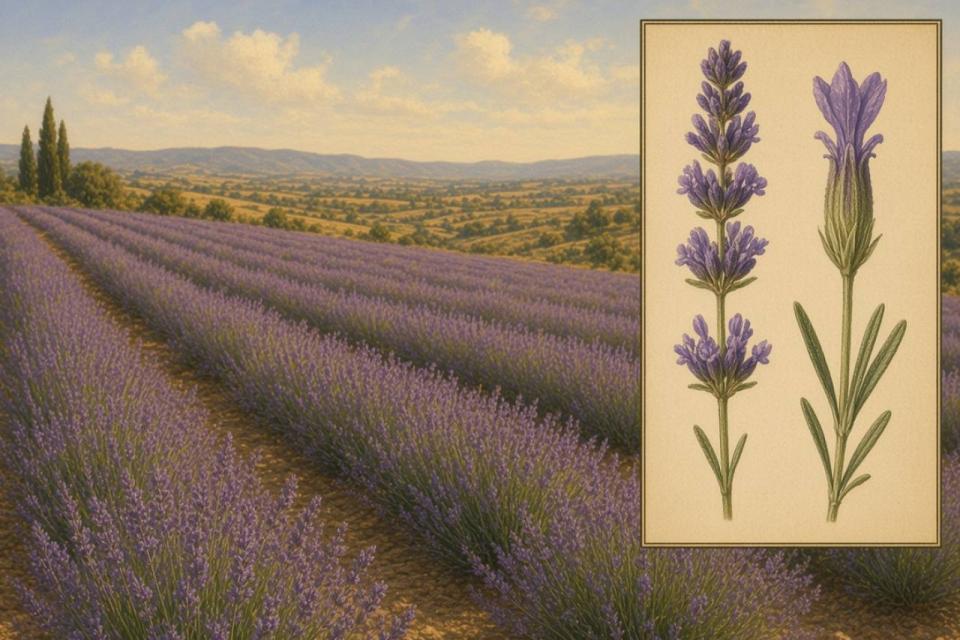
Lavandula angustifolia Mill. sits in Lamiaceae, the mint family. NCBI Taxonomy treats it as taxon 39329. IPNI records Philip Miller’s name from the eighth edition of The Gardeners Dictionary (1768) as 449008-1. EMA still lists the older synonym L. officinalis Chaix. It is an evergreen subshrub of dry, sunny Mediterranean ground; NCCIH describes it as native to the region, including France, Spain, Andorra, and Italy. It has narrow gray-green leaves, square young stems, and long bare stalks ending in whorls of small violet two-lipped flowers. The aromatic oil is made in glands on the surface of flowers and leaves. The pharmacopeial drug is the dried flower, which must hold at least 13 ml of essential oil per kilogram, and the medicinal oil is steam-distilled from the flowering tops.
Lavandin, L. × intermedia, is a sterile hybrid of true lavender and spike lavender. It is larger and hardier, can only be propagated from cuttings, and yields far more oil per hectare. One genome study estimated that lavandin accounts for roughly 85% of world lavender-oil production. Its oil is cheaper, more camphoraceous, and has a long history of being sold as true lavender oil. Spike lavender, L. latifolia (the broad-leaved one), is an Iberian species whose oil pairs linalool with large amounts of 1,8-cineole and camphor. L. stoechas, the Spanish, French, or butterfly lavender with showy purple bracts on top of a squat head, is chemically a different animal: its oils are led by fenchone and camphor. EMA’s assessment report warns that L. angustifolia is regularly confused with lavandin and spike lavender, and that flower lots without detailed quality specifications can be mixtures of species.
Common names are confusing. English lavender means L. angustifolia whether or not it grew in England. French lavender can mean L. stoechas, lavandin from Provence, or true lavender from Provence, depending on who is selling; NCCIH even lists French lavender as a common name for L. angustifolia itself. Pharmacopeial lavender oil means L. angustifolia distilled from flowering tops. A cosmetic lavender fragrance can be lavandin or a blend. Spike and stoechas oils are sold for aromatherapy under lavender names too. For anything you rub on skin, put in a bath, or swallow, the Latin binomial and the plant part are the minimum label. Price is a clue: true lavender oil costs more because the plant yields less.
Chemistry is the point. EMA’s assessment report describes true lavender oil as dominated by linalool (roughly 20–50%) and linalyl acetate (25–46%), with smaller amounts of cis-ocimene, terpinen-4-ol, limonene, 1,8-cineole, camphor, lavandulyl acetate, and lavandulol. Linalool is PubChem CID 6549 (C10H18O); linalyl acetate is CID 8294; camphor is CID 2537. The flower also carries rosmarinic and other phenolic acids, the coumarins umbelliferone and herniarin, flavonoids, and up to 13% tannins. Carrasco and colleagues (Planta Medica 2016) measured 37–54% linalool and 21–36% linalyl acetate in Spanish true lavender, against linalool plus 26–32% eucalyptol (1,8-cineole) and 10–18% camphor in spike. Pokajewicz and colleagues (Molecules 2022), growing both species on the same plots, found about 10–13% camphor in lavandin cultivars. The two signature molecules also matter for safety: linalool and linalyl acetate autoxidize in air into skin-sensitizing hydroperoxides. Pure is not the same as fresh.
02 Lineage
History
The name is a small argument. NCCIH repeats the popular derivation from Latin lavare, to wash, and a smell-history reference notes that lavender reportedly scented Roman bathwater. Etymologists are less sure: the Medieval Latin lavendula may come from lividus, bluish, with the washing association attaching later because the plant scented laundry and baths. Either way, the classical record is sparser than popular accounts suggest. In the twelfth century Hildegard of Bingen gave lavendula its own chapter in Physica: warm and dry, not worth eating, strong-smelling, deadly to lice if sniffed often, able to clear the eyes and to drive off evil spirits. That is the medieval file in miniature. Lavender was a smell used as medicine, not a dose.
Distillation turned the flower into an oil and then an industry. EMA’s assessment report gathers the early-modern record: distilled lavender water as a sedative nervinum and for toothache and headache, Dodoens in 1608 calling it calming, and the long habit of a few drops of oil on a sugar cube. In England, Ephraim Potter and William Moore began distilling lavender water at Mitcham in Surrey in 1749. Mitcham oil became a premium product until cheaper French oil and suburban housing displaced the fields; the old Potter and Moore distillery passed to W. J. Bush in 1886. In France, Grasse and the lavender growers of Haute-Provence supplied perfumers, British firms among them. The plant’s modern identity as linen, soap, and perfume was built in those stillrooms, not in clinics.
Aromatherapy has a founding story, and lavender is in it. René-Maurice Gattefossé, a Lyon chemist in his family’s perfumery business, was burned in a laboratory explosion in July 1910 and later wrote that a single rinse with lavender essence stopped gas gangrene spreading on his hands. Later retellings added vats of oil, reflex plunges, and scarless healing. His own account is two sentences. He coined aromathérapie in print in December 1935 and used it as the title of his 1937 book. The regulatory file is quieter. Lavender oil has been marketed as a bath additive since 1976, Germany authorized Silexan capsules in 2009, and EMA’s 2012 monographs settled on traditional use for mild stress and sleep. EMA opened a call for new data for periodic review in 2020. Lavender’s history is a perfume story that acquired a pharmacology chapter late.
03 Chemistry
Active compounds and how it works
EMA did not need a mechanism for a traditional-use monograph and did not claim one. The mechanistic file is mostly Silexan’s. Schuwald, Müller and colleagues (PLoS One 2013) reported that the oil, at nanomolar concentrations they matched to an 80 mg human dose, reduced calcium influx through several voltage-gated calcium channels (N-, P/Q-, and T-type) in synaptosomes, hippocampal neurons, and cell lines. That sounds like pregabalin, and the authors drew the comparison, but Silexan did not bind pregabalin’s α2δ site and its effect was moderate. Several authors were Schwabe employees or consultants. A PET imaging study (Baldinger 2015) summarized by MSKCC reported reduced serotonin-1A receptor binding after Silexan. Linalool is anxiolytic-like in rodents, and MSKCC cites mouse work in which inhaled lavender still worked in animals that could not smell, pointing to serotonergic mechanisms rather than odor alone.
Aromatherapy has a harder mechanism problem. Smell cannot be blinded: participants know when the room smells of lavender, and expectation, attention, massage, and the ritual of a calm room all travel with the scent. MSKCC notes that in massage studies the massage may be doing the work, and a breast-surgery trial it cites found that lavender oil and unscented oil both reduced preoperative anxiety. Endocrine activity is a separate file: Henley 2007 and Ramsey 2019 found mild estrogenic and antiandrogenic activity of lavender oil and some of its components in human cell lines. Whether skin exposure reaches doses that matter in a child is unknown. Oxidation is the third mechanism that matters clinically. Linalool and linalyl acetate turn into sensitizing hydroperoxides on contact with air, so an old bottle is chemically a different product from a fresh one.
04 In practice
Common uses
Anxiety is where lavender has its best data, and almost all of it is one product. Kasper and colleagues (International Clinical Psychopharmacology 2010) randomized 221 primary-care adults with anxiety disorder not otherwise specified to Silexan 80 mg daily or placebo for ten weeks; Hamilton Anxiety Scale (HAMA) scores fell 16.0 versus 9.5 points, and sleep-quality scores improved. Kasper 2015 (170 outpatients with anxiety-related restlessness) and Kasper 2016 (318 with mixed anxiety and depressive disorder) were also positive with smaller margins, 12.0 versus 9.3 HAMA points in 2015. Kasper’s 2014 International Journal of Neuropsychopharmacology trial in 539 adults with generalized anxiety disorder compared Silexan 160 mg, Silexan 80 mg, paroxetine 20 mg, and placebo for ten weeks: HAMA dropped 14.1, 12.8, 11.3, and 9.5 points. Both Silexan doses beat placebo; paroxetine only trended (p = 0.10) in the main analysis. Because the established drug did not clearly separate from placebo in this trial, “as good as paroxetine” should be read with care.
Woelk and Schläfke (Phytomedicine 2010) randomized 77 adults with generalized anxiety disorder to Silexan 80 mg or lorazepam 0.5 mg for six weeks; HAMA fell 11.3 and 11.6 points from a baseline of 25. There was no placebo arm, 0.5 mg is a low starting dose of lorazepam, and Schläfke worked for the sponsor. Pooled analyses agree in direction. Dold and colleagues (European Archives of Psychiatry and Clinical Neuroscience 2023) combined the five placebo-controlled 80 mg trials (1,213 patients) and found Silexan superior on HAMA, with a responder rate ratio of 1.34 and no excess of adverse events or adverse-event withdrawals; the author list includes a Schwabe employee. Donelli’s unfunded 2019 Phytomedicine review put the oral Silexan difference at about 2.9 HAMA points. Yap’s 2019 Scientific Reports network meta-analysis of five studies ranked 160 mg first, yet its own interval for 160 mg versus placebo crossed zero. The overall picture is a modest, consistent benefit, mostly from one sponsor’s trials. Depression trials, including a sertraline comparison, exist with fewer independent replications.
Aromatherapy has a larger but less rigorous literature. Donelli 2019 counted 65 randomized trials and judged most to carry a high risk of bias; pooled inhalation studies showed a sizable anxiety reduction (Hedges’ g −0.73), but the designs were too heterogeneous to call that established, and massage studies could not separate lavender from touch. NCCIH says it is unclear whether lavender aromatherapy helps anxiety, stress, depression, pain, or sleep. MSKCC lists small positive sleep studies, such as Lillehei 2015 combining inhaled lavender with sleep hygiene, and notes that in a cancer massage study the massage, not the lavender, seemed responsible. The 2020 Cochrane review of aromatherapy for dementia (Ball and colleagues; 13 trials, 708 participants, lavender in eight) found no convincing evidence of benefit and no evidence of benefit on sleep or mood. Lavender on a pillow is pleasant and may help some people unwind; as a sleep treatment it is not yet proven.
EMA’s traditional indications are narrow: tea, tincture, or oral oil for mild symptoms of mental stress and exhaustion and to aid sleep, plus the oil as a bath additive, in adolescents and adults. Other uses are still preliminary. Small trials on depression with lavender tea or tincture, post-herpetic pain, migraine, menstrual cramps, menopausal symptoms, and COVID-19 cough appear in the NCCIH and MSKCC summaries and need replication. Hair-growth, wound-healing, antibacterial, and anticancer claims rest on dishes, animals, blends, or single small studies. Perillyl alcohol is a laboratory and glioma-nasal-spray story, not a reason to drink lavender tea. Lavender oil is not a burn treatment, not an antibiotic, and not a stand-in for an anxiolytic or antidepressant that a clinician has prescribed.
05 The apothecary
Preparations and traditional use
EMA traditional oral oil: lavender oil meeting the European Pharmacopoeia standard, steam-distilled from L. angustifolia flowering tops, 20–80 mg per day by mouth for adolescents, adults, and the elderly. The monograph leaves it to manufacturers to convert that weight into drops for a given dropper, which is why a bottle of loose oil is not a dosing device. As a bath additive: 1–3 g per full bath once daily, at 35–38 °C for 10–20 minutes. Not recommended under twelve. See a doctor or pharmacist if symptoms persist or worsen. Full baths are contraindicated with open wounds, large skin injuries, acute skin disease, high fever, severe infections, severe circulatory disturbances, and cardiac insufficiency.
EMA traditional flower: 1–2 g of dried flower in 150 ml of boiling water as an infusion, three times daily; or a 1:5 tincture in 50–60% ethanol, 2–4 ml three times daily. Same age floor, same pregnancy caution, same warning that it may impair driving. A cup of lavender tea is a mild traditional preparation, not a dose equivalent to an 80 mg oil capsule, and no trial has compared the two. NCCIH considers lavender in normal food amounts likely safe, which is the right frame for culinary lavender in baking or syrups.
Silexan (WS 1265) is a specified essential oil from L. angustifolia flowers in 80 mg soft capsules taken once daily; the trials ran six to ten weeks and also tested 160 mg. In Germany it is sold as Lasea and has been an authorized medicine since 2009 for restlessness due to anxiety in adults over eighteen. A drugstore essential oil is not interchangeable with it: retail oils are not made, tested, or labeled for ingestion, and their linalool, linalyl acetate, and camphor content varies by species and lot. Other lavender capsules are supplements whose oil may or may not resemble the trial material. Read the label for species, oil amount, and manufacturer before assuming a trial applies.
Aromatherapy means diffusers, inhaler sticks, pillow sprays, and massage oils diluted in a carrier. None has a standardized dose. Undiluted oil on skin raises allergy risk, and so does oil that has been open to air: keep bottles tightly closed and treat an old, half-empty bottle as more allergenic than a fresh one. Store every essential oil with a child-resistant closure, away from oral medicines and out of reach. In Australian poison-center data most essential-oil exposures were accidental, nearly two-thirds involved children under fifteen, therapeutic errors often meant oil mistaken for a liquid medicine, and the authors noted that as little as 5 ml can cause life-threatening toxicity in a child.
Safety
Before you use lavender
06 Caution
Side effects
Oral: NCCIH lists diarrhea, headache, nausea, and burping; MSKCC adds belching, nausea, and confusion. With Silexan, eructation is the signature adverse event. The German product information summarized in EMA’s assessment report lists eructation at 7% and nausea at 2%, and Kasper’s 2016 trial found eructation the only adverse event substantially more frequent than with placebo. Dold’s 2023 meta-analysis found no overall excess of adverse events, serious adverse events, or adverse-event withdrawals. The trials did not show sedation or withdrawal effects. Trial populations, though, are not the same as people combining lavender with alcohol, opioids, or sleeping pills, and the long-term record outside sponsor studies is limited.
Skin: allergic contact dermatitis is the most concrete topical harm. Pure linalool is at most a mild allergen, but it autoxidizes in air into hydroperoxides that sensitize. Christensson and colleagues (Contact Dermatitis 2010) found positive patch tests to oxidized linalool in 5–7% of 3,418 consecutive dermatitis patients at the higher test concentrations. Hagvall and Christensson (Acta Dermato-Venereologica 2016) found that 2.8% of patients reacted to oxidized lavender oil itself, among the highest rates for the essential oils studied, and only about half of those were flagged by the baseline fragrance markers. EMA’s 2012 assessment called lavender allergy very rare, citing pillow and shampoo dermatitis and an aromatherapy student whose hands swelled and breathing tightened within minutes of massaging with a lavender blend. The newer patch-test work suggests under-detection rather than rarity. MSKCC also lists photosensitivity.
Hormonal: in 2007 Henley and colleagues described in the New England Journal of Medicine three otherwise healthy prepubertal boys, aged four to ten, whose breast enlargement coincided with lavender and tea tree products (a healing balm, a styling gel, scented soap) and resolved after stopping them; the oils showed mild estrogenic and antiandrogenic activity in human cell lines. Four letters in the journal that June questioned whether other ingredients could explain the cases. Ramsey and colleagues (Journal of Clinical Endocrinology and Metabolism 2019) added three girls with premature breast development and one boy, all continuously exposed to lavender-fragranced products, and found estrogenic and antiandrogenic activity in some oil components; they wrote that whether lavender’s potency is enough to cause these effects is unknown, and four comment letters followed. Hawkins and colleagues (Complementary Therapies in Medicine 2020) reviewed eleven published cases and found little to no evidence substantiating the lavender link. Treat it as a contested signal: plausible, reversible, rare, unproven.
Swallowed essential oil is a different hazard from a capsule. In the New South Wales poison-center series (Lee, Harnett, and Cairns, Medical Journal of Australia 2020), lavender accounted for 271 of 4,412 essential-oil exposure calls, behind eucalyptus and tea tree, and 63% of all exposures involved children under fifteen. Clinical effects of essential-oil poisoning include vomiting, central-nervous-system depression or excitation, and aspiration pneumonitis. Camphor-rich oils, which include spike lavender and L. stoechas, add a seizure risk in toddlers. Aromatherapy inhalation can cause headache or coughing (NCCIH). None of this makes a sniff of true lavender dangerous; it makes an open bottle on a low shelf a poisoning risk.
07 Caution
Contraindications
Do not use with known hypersensitivity to lavender (EMA). Anyone with a confirmed fragrance allergy, especially to oxidized linalool or linalyl acetate, should treat lavender soaps, creams, pillow sprays, and massage oils as likely triggers; pillow and shampoo dermatitis are documented patterns, not hypotheticals. Full lavender baths are contraindicated with open wounds, large skin injuries, acute skin disease, high fever, severe infections, severe circulatory disturbances, and cardiac insufficiency. People already under patch-test investigation for dermatitis should mention lavender products specifically, because standard fragrance screens can miss oxidized lavender oil.
Children: EMA does not recommend lavender flower or oil medicines under twelve because use in that age group has not been established, and the German Silexan product is labeled for adults over eighteen. Essential oil is never a child’s oral medicine. For repeated topical products on prepubertal children, the gynecomastia and thelarche reports are contested but cheap to act on: in Henley’s and Ramsey’s cases breast growth resolved after the fragranced products stopped. A child with breast development still needs a pediatric assessment rather than a change of soap alone.
Pregnancy and lactation: EMA says safety has not been established and, in the absence of sufficient data, use is not recommended. MSKCC advises against excessive internal use in pregnant and nursing women. NCCIH says little is known. Reproductive-toxicity, genotoxicity, and carcinogenicity tests have not been performed for the oil or the flower (EMA). Culinary amounts are a different exposure from daily capsules or concentrated oil.
Hormone-sensitive cancers: MSKCC advises avoiding long-term oral or topical use because of mild estrogenic and antiandrogenic activity in laboratory studies, while acknowledging that the clinical meaning is unclear. Driving and machinery: both EMA monographs say lavender may impair the ability to drive; Silexan trials did not find sedation, but the regulatory caution stands for traditional products. Surgery: NCCIH flags theoretical additive sedation, which matters before anesthesia. An anxiety disorder, major depression, or insomnia lasting weeks belongs with a clinician, with lavender at most an adjunct they know about.
08 Caution
Drug and herb interactions
EMA’s monographs list no reported interactions for lavender flower or oil. That is a statement about the case record for traditional products, not proof of absence, and EMA still warns about driving. The German Silexan product information summarized in EMA’s assessment report flagged a possible influence on medicines acting on GABA receptors, such as barbiturates and benzodiazepines, while noting that clinical data were not available.
Central nervous system depressants: MSKCC says lavender may potentiate sedatives and hypnotics and increase the effects of CNS depressants and anticonvulsants. NCCIH calls the sedative interaction theoretical but worth raising before surgery. The plausible risk is additive drowsiness with benzodiazepines, Z-drugs, opioids, gabapentinoids, sedating antihistamines, alcohol, and other calming herbs. If you take any of these, tell the prescriber before adding lavender capsules, and do not drive until you know how the combination affects you.
Pharmacokinetics: a 2024 review by Kasper and Eckert, both of whom report Schwabe ties, states that Silexan did not interact with cytochrome P450 enzymes and did not reduce hormonal contraceptive efficacy. That is reassuring for the capsule and silent on other oils, teas, tinctures, and blends, which have not been studied the same way. On skin, MSKCC cites a case of photoallergic contact dermatitis from lavender oil in a topical ketoprofen product, a reminder that fragrance and drug can sensitize together.
Do not stack lavender capsules, melatonin, valerian, a sleeping pill, and a diffuser and then credit one plant for the night’s sleep or blame it for the morning grogginess. Tell the anesthesiologist and the prescriber what you take. Swapping a prescribed benzodiazepine or antidepressant for lavender without a taper plan creates a withdrawal risk; that risk belongs to the swap, not to the plant.
09 Questions
Frequently Asked Questions
One specific product probably helps a little. Silexan, an 80 mg oral lavender-oil capsule, beat placebo in several randomized trials of subthreshold anxiety, generalized anxiety disorder, and mixed anxiety-depression, with a pooled difference of roughly 3 points on the Hamilton Anxiety Scale. Nearly all of those trials were sponsored by the manufacturer, and NCCIH notes the lack of independent funding. EMA’s monographs still class lavender as traditional use for mild stress. It is not a replacement for treatment of a diagnosed anxiety disorder.
No. Silexan (WS 1265, sold in Germany as Lasea) is a specified oil from L. angustifolia flowers made to pharmaceutical standards and dosed at 80 mg once daily. Retail essential oils are not made, tested, or labeled for swallowing, may be lavandin or spike lavender, and vary in camphor content. Do not drink diffuser oil and expect the trial result.
Unclear. NCCIH says it is not known whether lavender aromatherapy improves sleep quality or insomnia. Small positive trials exist, but smell cannot be blinded, and massage and expectation confound many studies. The 2020 Cochrane review of aromatherapy in dementia found no evidence of benefit on sleep. A pleasant scent at bedtime is harmless for most adults; it is not an insomnia treatment. Valerian, the most-studied sleep herb, has similarly inconsistent results.
Possibly, rarely, and it is disputed. Henley’s 2007 NEJM report described three boys whose breast enlargement coincided with lavender and tea tree products and resolved after stopping them, and Ramsey’s 2019 JCEM series added three girls and one boy. Both groups found mild estrogenic and antiandrogenic activity in cell lines. A 2020 systematic review of eleven cases found little to no evidence for a lavender link. Stopping the products is easy; a child with breast development still needs a doctor.
Oxidation is a likely culprit. Linalool and linalyl acetate, the main components of lavender oil, react with air to form hydroperoxides that are skin sensitizers. Patch-test studies find reactions to oxidized linalool in several percent of dermatitis patients and to oxidized lavender oil in about 3%, and standard fragrance screens miss some of them. Old, half-empty bottles and undiluted oil raise the risk. A dermatologist can patch test.
Ask the prescriber first. MSKCC warns that lavender may increase the effects of sedatives, hypnotics, CNS depressants, and anticonvulsants, and the German Silexan product information flagged a possible influence on GABA-acting drugs without clinical data. EMA says lavender may impair driving. Never replace a benzodiazepine with lavender without a supervised taper.
EMA does not recommend lavender medicines under twelve, and the German capsule is for adults over eighteen. Essential oils are a real poisoning risk: in an Australian poison-center series, nearly two-thirds of essential-oil exposures involved children, and as little as 5 ml of some oils can be life-threatening. Camphor-rich oils such as spike lavender and L. stoechas add seizure risk. Store bottles locked away and never give essential oil by mouth.
No. Lavandin (L. × intermedia) is a high-yield sterile hybrid with more camphor; spike lavender (L. latifolia) is rich in 1,8-cineole and camphor; Spanish or topped lavender (L. stoechas) is led by fenchone and camphor. EMA’s monographs and the Silexan trials concern L. angustifolia only. They smell related and are not the same medicine.
10 References
Sources
These references support the history, clinical, and safety claims on this page. They are not an endorsement of any product.
-
Lavender: usefulness and safety
National Center for Complementary and Integrative Health (NIH), 2025
Consumer evidence summary (updated February 2025): oral lavender oil might help anxiety but trials are small and lack independent funding; aromatherapy benefits unclear; burping, headache, nausea; topical allergy and contested breast-swelling reports.
-
Lavender
Memorial Sloan Kettering Cancer Center, About Herbs, 2021
Clinical summary: oral anxiety and depression data, aromatherapy and massage confounding, sedative and anticonvulsant cautions, contact dermatitis, photosensitivity, prepubertal gynecomastia and thelarche case reports.
-
Community herbal monograph on Lavandula angustifolia Miller, aetheroleum
European Medicines Agency (EMA/HMPC/143181/2010), 2012
Adopted 27 March 2012: traditional use for mild stress, exhaustion, and sleep; 20–80 mg oral oil daily or 1–3 g per bath; not under 12; not recommended in pregnancy; may impair driving.
-
Community herbal monograph on Lavandula angustifolia Miller, flos
European Medicines Agency (EMA/HMPC/734125/2010), 2012
Adopted 27 March 2012: traditional use; tea 1–2 g in 150 ml three times daily or 1:5 tincture 2–4 ml three times daily; not under 12; no interactions reported.
-
Assessment report on Lavandula angustifolia Miller, aetheroleum and Lavandula angustifolia Miller, flos
European Medicines Agency (EMA/HMPC/143183/2010), 2012
Constituents (linalool, linalyl acetate), confusion with lavandin and spike lavender, historical use, German 80 mg capsule data (eructation 7%), trials judged too small for well-established use, dermatitis and gynecomastia reports.
-
A multi-center, double-blind, randomised study of the Lavender oil preparation Silexan in comparison to Lorazepam for generalized anxiety disorder
Phytomedicine (PubMed 19962288), 2010
Woelk and Schläfke: 77 adults, Silexan 80 mg vs lorazepam 0.5 mg for six weeks; similar HAMA reductions; no placebo arm; sponsor-affiliated author.
-
Lavender oil preparation Silexan is effective in generalized anxiety disorder: a randomized, double-blind comparison to placebo and paroxetine
International Journal of Neuropsychopharmacology (PubMed 24456909), 2014
Kasper et al.: 539 adults with GAD; Silexan 160 and 80 mg superior to placebo over ten weeks; paroxetine 20 mg only trended (p = 0.10) in the full analysis set.
-
Efficacy of Silexan in patients with anxiety disorders: a meta-analysis of randomized, placebo-controlled trials
European Archives of Psychiatry and Clinical Neuroscience (PubMed 36717399), 2023
Dold et al.: five placebo-controlled trials, 1,213 patients, 80 mg for ten weeks; responder rate ratio 1.34; no excess adverse events; includes a Schwabe-employed author.
-
Effects of lavender on anxiety: a systematic review and meta-analysis
Phytomedicine (PubMed 31655395), 2019
Donelli et al.: 65 RCTs, mostly high risk of bias; inhalation Hedges’ g −0.73 with heterogeneous designs; oral Silexan 80 mg HAMA difference about −2.9.
-
Prepubertal gynecomastia linked to lavender and tea tree oils
New England Journal of Medicine (PubMed 17267908), 2007
Henley et al.: three prepubertal boys with gynecomastia during topical lavender and tea tree product use, resolving on cessation; estrogenic and antiandrogenic activity in cell lines.
-
Lavender products associated with premature thelarche and prepubertal gynecomastia: case reports and endocrine-disrupting chemical activities
Journal of Clinical Endocrinology and Metabolism (PubMed 31393563), 2019
Ramsey et al.: three girls and one boy with breast growth during continuous lavender-fragrance exposure; in vitro activity of oil components; potency sufficiency unknown.
-
The relationship between lavender and tea tree essential oils and pediatric endocrine disorders: a systematic review of the literature
Complementary Therapies in Medicine (PubMed 32147050), 2020
Hawkins et al.: four reports, eleven cases; insufficient reporting; little to no evidence substantiating a lavender–endocrine disruption link.
-
Patch testing with main sensitizers does not detect all cases of contact allergy to oxidized lavender oil
Acta Dermato-Venereologica (PubMed 26671837), 2016
Hagvall and Christensson: 2.8% of patients reacted to oxidized lavender oil; linalool and linalyl acetate hydroperoxides; baseline fragrance markers missed many cases.
-
Essential oil exposures in Australia: analysis of cases reported to the NSW Poisons Information Centre
Medical Journal of Australia (PubMed 31709543), 2020
Lee, Harnett, and Cairns: 4,412 exposures, 63% under age 15, lavender 6.1% of calls; as little as 5 ml can cause life-threatening toxicity in children.
-
Taxonomy browser: Lavandula angustifolia
NCBI Taxonomy (NIH), 2026
NCBI taxon 39329 for true lavender in Lamiaceae.
-
Linalool
PubChem, National Library of Medicine (NIH), 2026
Principal monoterpene alcohol of true lavender oil; CID 6549, C10H18O; autoxidizes to sensitizing hydroperoxides.