Monograph
Milk Thistle
Silybum marianum
Updated October 4, 2026
Key points
-
01
Silymarin, from the fruit
The medicine is silymarin, a mixture of six flavonolignans led by silibinin, extracted from the seed-like fruit. It is poorly absorbed by mouth.
-
02
Liver benefit not yet confirmed
Cochrane found no effect on mortality in alcoholic or viral liver disease. NCCIH-funded trials in hepatitis C and NASH missed their primary end points.
-
03
Hospital antidote, not a supplement
Intravenous silibinin is used for death cap mushroom poisoning in emergency care. Oral capsules cannot replicate that and are not a home treatment.
-
04
Quality is inconsistent
Tests of US and Czech supplements found silymarin content far from labels and contamination with mycotoxins, pesticides, and microbes.
-
05
Well tolerated, with allergy cautions
Side effects are mostly digestive. Avoid it with ragweed or daisy-family allergy, in pregnancy, and without checking narrow-margin drugs.
Milk thistle is the herb most people think of first for liver support. The plant is a spiny Mediterranean thistle with white-veined leaves; the medicine comes from its small, hard fruits, usually called seeds, and from silymarin, a mixture of flavonolignans extracted from them. Silymarin protects liver cells against a range of toxins in animal experiments, and for decades that laboratory picture has made it a popular choice for people with fatty liver, hepatitis, heavy drinking habits, or no liver disease at all.
Human trials have not yet confirmed those benefits. Cochrane’s 2007 review of 18 randomized trials in alcoholic and viral liver disease found no significant effect on overall mortality, complications, or liver histology, and the apparent benefit on liver-related deaths disappeared in the high-quality trials. Two US trials funded by NCCIH, one in chronic hepatitis C and one in non-alcoholic steatohepatitis (NASH), used higher-than-customary doses of a standardized product and found no benefit on their primary outcomes. There are encouraging hints: a Malaysian NASH trial found more fibrosis improvement with silymarin, and small studies suggest it may help blood sugar in type 2 diabetes, though both need confirmation. NCCIH’s February 2025 summary says there is not enough high-quality evidence to reach definite conclusions about milk thistle for any condition. The EU’s herbal committee recognizes it as a traditional remedy for digestive complaints and to support liver function, after a doctor has ruled out serious disease.
There is one striking exception, and it is not a supplement. Silibinin, the main component of silymarin, is given intravenously in hospitals as an antidote for poisoning by death cap mushrooms. That use depends on a specific mechanism, a specific drug, and emergency care. This monograph covers what is known and what is not. Liver disease is often silent until late; a capsule is not a substitute for testing, treatment, or stopping alcohol. Nothing here is medical advice.
Ingredient in
Iberogast (STW 5)In this monograph
01 The plant
Botanical profile
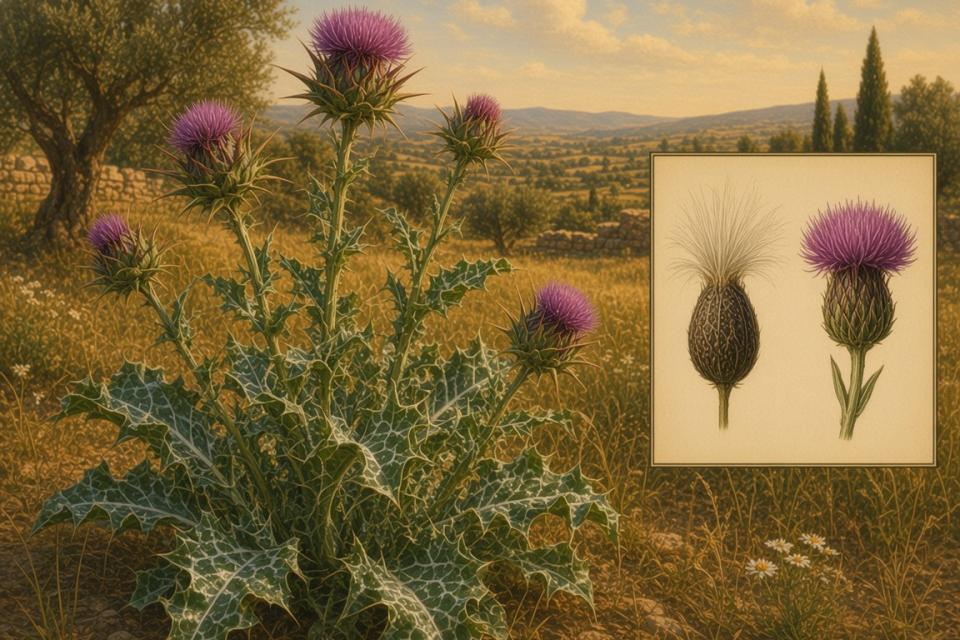
Silybum marianum (L.) Gaertn. is a member of Asteraceae, the daisy family, which matters for allergy. NCCIH lists Carduus marianus as a synonym and Mary thistle and holy thistle as common names; MSKCC adds lady’s thistle and Marian thistle. NCBI Taxonomy files it as taxon 92921. It is an annual or biennial that forms a rosette of large, glossy, spiny-edged leaves boldly marbled with white along the veins, then sends up a flowering stem that can reach well over a meter. Each stem ends in a large reddish-purple flower head wrapped in stiff, spine-tipped bracts. NCCIH describes it as native to Europe and introduced to North America by early colonists. It now grows as a weed of disturbed ground in many warm temperate regions.
The medicinal part is the ripe fruit, a hard, shiny, mottled achene a few millimeters long, with its silky pappus removed. The European Pharmacopoeia standard sets a minimum silymarin content, expressed as silibinin, for the dried fruit, and the EU monograph lists teas, powdered fruit, and a range of dry extracts made with acetone, ethanol, ethyl acetate, or methanol at drug-to-extract ratios between 20:1 and 70:1. Those ratios explain why a milk thistle capsule can contain very different amounts of active material: dried fruit and concentrated extract are not interchangeable.
Silymarin is not one compound. Wah Kheong and colleagues describe it as a complex mixture of six major flavonolignans plus minor polyphenols: silybin A and silybin B (together called silibinin or silybin; PubChem CID 31553, C25H22O10), isosilybin A and B, silychristin, and silydianin, along with the flavonoid taxifolin (CID 439533). Silibinin is usually the largest component and the one most studied. Silymarin dissolves poorly in water and is poorly absorbed by mouth, which has led to formulations that bind silybin to phosphatidylcholine or otherwise try to improve absorption. Comparisons between trials using different products are therefore rough.
Quality varies widely. NCCIH notes concerns about the chemical and microbiological quality of milk thistle supplements in the United States and elsewhere. Fenclova and colleagues (Scientific Reports 2019) tested 26 milk thistle supplements bought in the US and the Czech Republic and found large differences in silymarin content, often at odds with the label, substantial batch-to-batch variation, and mycotoxins, pesticide residues, and microbial contamination across the products tested. That is a good reason to choose independently tested products, since a supplement taken for the liver should not add mold toxins.
02 Lineage
History
NCCIH notes that milk thistle was historically used for liver disorders and to increase breast milk production. Classical and medieval European authors describe thistles in their herbals, and the identification with Silybum is usually made from descriptions of the white-veined leaves. The common names carry a Christian legend: the white marbling was said to come from drops of the Virgin Mary’s milk, giving Mary thistle, Marian thistle, and lady’s thistle. The same legend supports the old use as a galactagogue, an herb to increase milk supply. By the early modern period, English and German herbals recommended the plant for jaundice, obstructions of the liver and spleen, and melancholy, ideas built on humoral medicine rather than tests of liver function.
The modern story is German pharmacology. In the twentieth century, German researchers isolated and characterized silymarin and its components, and standardized extracts entered pharmacies there and across Europe as liver medicines. Laboratory work showing that silymarin protects animal livers from carbon tetrachloride, alcohol, and other toxins drove clinical studies in alcoholic cirrhosis and hepatitis from the 1970s onward. Ferenci’s 1989 trial in Vienna, which reported better four-year survival in cirrhosis, became the most cited positive result; Parés’s larger 1998 trial in Spain, which found no survival effect in alcoholic cirrhosis, became the most cited negative one.
Mushroom poisoning gave silibinin its hospital role. Intravenous silibinin, marketed in Europe as Legalon SIL, has been used for decades to treat amatoxin poisoning from death cap (Amanita phalloides) and related mushrooms, on the basis of case series rather than controlled trials. In the United States the supplement boom of the 1990s made milk thistle one of the best-known liver herbs. NIH-funded trials then tested silymarin properly: the SyNCH trial in hepatitis C (published 2012) and a separate trial in NASH (published 2019) both missed their primary end points. The EU’s Committee on Herbal Medicinal Products adopted its monograph on 5 June 2018, granting traditional use only.
03 Chemistry
Active compounds and how it works
Laboratory and animal studies describe several actions. MSKCC’s summary cites antioxidant and anti-inflammatory effects of silibinin, including reduced release of hydrogen peroxide and tumor necrosis factor alpha; antifibrotic effects through downregulation of collagen and other extracellular matrix proteins in animal models; and activity against hepatitis C virus entry in cell studies. Silymarin and silibinin also show estrogenic activity with a preference for estrogen receptor beta. None of these has been shown to translate into better outcomes in human liver disease, and doses in animal studies are often far higher than what people absorb from capsules.
The death cap mechanism is better defined. Amatoxins are taken up into liver cells through specific transporters and recirculate between liver and gut. Mengs and colleagues (Current Pharmaceutical Biotechnology 2012) describe silibinin as interacting with hepatic transport proteins to block the re-uptake of amatoxin into liver cells, interrupting that enterohepatic circulation. That effect requires intravenous silibinin at high doses given early, as part of aggressive supportive care. It is not something an oral supplement can reproduce, and it does not imply that silymarin protects the liver from alcohol, medicines, or fat.
On drug metabolism, MSKCC notes that milk thistle inhibits CYP3A4 in some studies, while other studies show no effect, and that silybin and isosilybin inhibited PXR-mediated induction of CYP3A4 in the laboratory. In a clinical study it did not reduce levels of the HIV drug indinavir. Milk thistle also modulates UGT enzymes in vitro. Overall, the interaction signal is limited and inconsistent, quite unlike St. John’s wort.
04 In practice
Common uses
Alcoholic and viral liver disease: Rambaldi, Jacobs, and Gluud (Cochrane 2007) reviewed 18 randomized trials with 1,088 patients. Methodological quality was low. Milk thistle had no significant effect on mortality (relative risk 0.78), complications of liver disease (0.95), or liver histology. Liver-related mortality was lower across all trials (0.50) but not in high-quality trials (0.57, not significant). Adverse events were no more common than with placebo. In cirrhosis, Ferenci and colleagues (Journal of Hepatology 1989) randomized 170 patients to 140 mg of silymarin three times daily or placebo and reported four-year survival of 58% versus 39%, with benefit concentrated in alcoholic cirrhosis and milder disease. Parés and colleagues (Journal of Hepatology 1998) randomized 200 alcoholics with cirrhosis to 150 mg three times daily or placebo and found survival similar in both groups, with no effect on the course of the disease.
Hepatitis C and NASH: the NCCIH-funded trials tested higher-than-customary doses of a standardized silymarin product (Legalon). Fried and colleagues (JAMA 2012) randomized 154 people with chronic hepatitis C who had not responded to interferon to 420 mg, 700 mg, or placebo three times daily for 24 weeks; only two participants in each group met the primary ALT target, and there were no differences in liver enzymes, viral load, or quality of life. Navarro and colleagues (PLoS One 2019) randomized 78 people with NASH without cirrhosis to 420 mg, 700 mg, or placebo three times daily for 48 weeks; 15%, 19%, and 12% reached the histological primary end point, a non-significant difference, though many participants turned out not to meet entry criteria on central review. In Malaysia, Wah Kheong and colleagues (Clinical Gastroenterology and Hepatology 2017) randomized 99 people with biopsy-proven NASH to 700 mg three times daily or placebo for 48 weeks; the primary end point was not met (32.7% versus 26.0%), but fibrosis improved by at least one stage in 22.4% versus 6.0%. That fibrosis signal needs confirmation in a larger trial.
Diabetes: NCCIH notes small studies, mostly from the Middle East, suggesting milk thistle may help blood sugar control in type 2 diabetes. Voroneanu and colleagues (Journal of Diabetes Research 2016) pooled five trials with 270 patients and found lower fasting glucose (about 27 mg/dL) and HbA1c (about 1.1 percentage points) with silymarin, but judged the evidence too low in quality and too heterogeneous to make a recommendation. Effects that large would be clinically meaningful if replicated; so far they have not been in well-powered trials elsewhere.
Other claims: NCCIH says it is unclear whether milk thistle affects breast milk production and unknown whether it helps other conditions. MSKCC lists small studies on chemotherapy-related liver toxicity, neuropathy, hand-foot syndrome, radiation dermatitis, and acne; these are early, and none is yet strong enough to guide care. The EU traditional indication is narrow: symptomatic relief of digestive disorders such as fullness and indigestion, and to support liver function, after serious conditions have been excluded by a doctor. “Detox” claims for liver cleanse products that contain milk thistle are not supported by research, and some of these products have caused harm through other ingredients or interactions. Death cap poisoning is a medical emergency treated with intravenous silibinin in hospital; it is never a reason to take milk thistle capsules at home.
05 The apothecary
Preparations and traditional use
EU traditional use (EMA/HMPC/294187/2013, adopted 5 June 2018): tea, 3–5 g of crushed fruit in 100 ml of boiling water, two to three times daily before meals; powdered fruit, 300–600 mg two to three times daily, up to 1,800 mg per day; or one of several dry extracts at doses that depend on the extract, for example an acetone extract (DER 20–70:1) at 82–239 mg two to three times daily, up to 478 mg per day, or a 96% ethanol extract (DER 30–40:1) at 200 mg once daily. Take before meals. Not recommended under 18. If symptoms persist beyond two weeks, see a doctor or qualified practitioner. The monograph lists no well-established use.
In trials, doses have ranged from 140–150 mg of silymarin three times daily in the older cirrhosis studies to 420–700 mg three times daily in the NCCIH-funded hepatitis C and NASH trials. Those higher doses were well tolerated, which is reassuring for safety, but did not produce benefit on primary outcomes. US supplements commonly state an amount of extract standardized to a percentage of silymarin, often 70–80%, which is a manufacturer specification rather than a pharmacopeial requirement. Independent testing has found many products far from their label claims.
Choose products that name the plant part (fruit or seed), the extract, its silymarin content, and an independent quality certification, given the contamination findings. Avoid multi-ingredient liver cleanse blends, which add unknown risks; MSKCC cites a case in which a liver cleanse supplement containing milk thistle raised a patient’s INR on warfarin from 2.64 to 4.12. Silymarin is not a substitute for hepatitis B or C antiviral treatment, which can now clear most hepatitis C infections and control hepatitis B.
Safety
Before you use milk thistle
06 Caution
Side effects
Milk thistle taken by mouth appears well tolerated. NCCIH lists digestive symptoms, especially bloating, nausea, and gas, as the most common side effects. EMA lists mild gastrointestinal symptoms such as dry mouth, nausea, upset stomach, gastric irritation, and diarrhea, headache, and allergic reactions including dermatitis, urticaria, rash, itching, anaphylaxis, and asthma, with frequency unknown. In the Cochrane review and the NCCIH-funded trials, adverse event rates were similar to placebo, including at 700 mg three times daily for up to 48 weeks.
Allergy: milk thistle may cause allergic reactions, particularly in people allergic to related plants such as ragweed, chrysanthemum, marigold, and daisy (NCCIH). EMA contraindicates it with hypersensitivity to plants of the Asteraceae family. MSKCC describes an occupational allergy case with mouth burning, tongue swelling, and difficulty swallowing, and other case reports of skin reactions. Stop it and get urgent care for swelling of the lips, tongue, or throat, or difficulty breathing.
Liver and other effects: MSKCC notes that high doses of silibinin can raise bilirubin and liver enzymes, usually without symptoms, and lists case reports of intermittent episodes of sweating, nausea, vomiting, diarrhea, abdominal pain, and collapse that resolved on stopping, as well as bleeding, bullous pemphigoid, and deep vein thrombosis, where causation is uncertain. EMA advises seeing a doctor immediately if jaundice or a change in the color of urine or stools appears, because those are signs of liver disease that milk thistle does not treat.
07 Caution
Contraindications
Do not use with known allergy to milk thistle or other Asteraceae plants, including ragweed, chrysanthemums, marigolds, and daisies (EMA, NCCIH). People with hay fever triggered by ragweed should be cautious.
Pregnancy and breastfeeding: EMA says safety has not been established and use is not recommended; NCCIH says little is known. Despite its history as a galactagogue, there is no reliable evidence it increases milk supply, and adequate tests on reproductive toxicity, genotoxicity, and carcinogenicity have not been performed (EMA). Children and adolescents: EMA does not recommend use under 18 because of a lack of data.
Hormone-sensitive conditions: silymarin and silibinin have estrogenic activity in laboratory studies (MSKCC); the clinical meaning is unclear, but people with hormone-sensitive cancers or conditions should discuss it with their oncologist or specialist. Suspected liver disease of any kind, including jaundice, dark urine, pale stools, abdominal swelling, vomiting blood, or confusion, needs urgent medical assessment. Suspected mushroom poisoning is an emergency: call poison control or emergency services, and do not wait for symptoms, which typically begin six or more hours after eating amatoxin-containing mushrooms.
08 Caution
Drug and herb interactions
EMA lists no reported interactions for milk thistle traditional products. MSKCC summarizes a more cautious picture from case reports and laboratory studies. Sirolimus: milk thistle may decrease clearance, and MSKCC advises monitoring, especially in kidney transplant recipients also receiving nivolumab. Haloperidol or risperidone: seven cases of pancreatitis were reported with concomitant milk thistle use. Aripiprazole: one case of liver toxicity was reported with combined use. Warfarin: a liver cleanse supplement containing milk thistle was followed by a rise in INR that normalized after stopping.
Metabolism: milk thistle inhibits CYP3A4 in some studies but not others, did not lower indinavir levels in a clinical study, and modulates UGT enzymes in vitro (MSKCC). The practical risk appears low for most drugs, but for medicines with a narrow margin between effective and toxic doses, such as warfarin, transplant immunosuppressants, some cancer drugs, and antipsychotics, tell your prescriber and pharmacist before starting or stopping milk thistle, and expect monitoring.
Diabetes medicines: if milk thistle does lower blood sugar, as small trials suggest, it could add to the effect of glucose-lowering drugs. Monitor glucose more closely when starting it. NCCIH’s general advice applies: if you take any medicine, talk with your healthcare provider before using milk thistle.
09 Questions
Frequently Asked Questions
Human trials have not confirmed that it does. Silymarin protects liver cells in animal studies, but Cochrane’s review of 18 trials in alcoholic and viral liver disease found no effect on mortality or complications, and NCCIH-funded trials in hepatitis C and NASH found no benefit on their main outcomes. A healthy liver clears toxins on its own; avoiding alcohol, managing weight and diabetes, vaccination, and treating hepatitis are what protect it. The same applies to dandelion and other herbs sold as liver cleanses.
Not clearly. In two 48-week trials in NASH, silymarin did not meet its primary end points. A Malaysian trial found more people with improved fibrosis on silymarin, which needs confirmation. Weight loss, physical activity, and managing diabetes and cholesterol remain the evidence-based approach, with medicines for some patients; ask a hepatologist.
Yes, but only in hospital. Intravenous silibinin, a purified component of milk thistle, is used as an antidote for amatoxin poisoning from death cap and related mushrooms, alongside intensive supportive care. Oral supplements are not a substitute. If you suspect mushroom poisoning, call poison control or emergency services immediately, even before symptoms start.
Usually mild digestive symptoms such as bloating, nausea, gas, upset stomach, or diarrhea, and sometimes headache. Allergic reactions can occur, especially in people allergic to ragweed, chrysanthemums, marigolds, or daisies. High doses of silibinin can raise bilirubin and liver enzymes without symptoms.
The signal is smaller than for many herbs, but not zero. Case reports involve sirolimus, warfarin (via a liver cleanse product), haloperidol, risperidone, and aripiprazole, and laboratory studies show effects on CYP3A4 and UGT enzymes. If you take medicines with a narrow safety margin, check with your pharmacist first.
It is a traditional use, but NCCIH says it is unclear whether milk thistle affects milk production, and EMA does not recommend it during breastfeeding because safety has not been established. A lactation consultant can help with supply concerns.
Possibly; small trials, mostly from the Middle East, found lower fasting glucose and HbA1c, but a 2016 meta-analysis judged the evidence too low in quality to recommend it. If you take diabetes medicines, monitor glucose closely if you add it, and do not change your treatment without your clinician.
10 References
Sources
These references support the history, clinical, and safety claims on this page. They are not an endorsement of any product.
-
Milk thistle
National Center for Complementary and Integrative Health (NIH), 2025
Consumer evidence summary (updated February 2025): insufficient high-quality evidence; NCCIH-funded hepatitis C and NASH trials negative; small diabetes studies; quality and contamination concerns; Asteraceae allergy.
-
Milk thistle
Memorial Sloan Kettering Cancer Center, About Herbs, 2026
Clinical summary (updated July 2026): mechanisms; elevated bilirubin and enzymes at high doses; case reports; interactions with sirolimus, haloperidol, risperidone, aripiprazole, warfarin; estrogenic activity.
-
European Union herbal monograph on Silybum marianum (L.) Gaertn., fructus
European Medicines Agency (EMA/HMPC/294187/2013), 2018
Adopted 5 June 2018: traditional use only for digestive complaints and to support liver function after serious disease is excluded; Asteraceae contraindication; not under 18 or in pregnancy.
-
Milk thistle for alcoholic and/or hepatitis B or C virus liver diseases
Cochrane Database of Systematic Reviews (PubMed 17943794), 2007
Rambaldi, Jacobs, and Gluud: 18 trials, 1,088 patients; no effect on mortality, complications, or histology; liver-related mortality benefit absent in high-quality trials.
-
Randomized controlled trial of silymarin treatment in patients with cirrhosis of the liver
Journal of Hepatology (PubMed 2671116), 1989
Ferenci et al.: 170 patients, 140 mg three times daily; four-year survival 58% vs 39%; benefit in alcoholic cirrhosis and Child A subgroups.
-
Effects of silymarin in alcoholic patients with cirrhosis of the liver: a controlled, double-blind, randomized, multicenter trial
Journal of Hepatology (PubMed 9566830), 1998
Parés et al.: 200 alcoholics with cirrhosis, 150 mg three times daily; survival and disease course similar to placebo.
-
Effect of silymarin (milk thistle) on liver disease in patients with chronic hepatitis C unsuccessfully treated with interferon therapy
JAMA (PubMed 22797645), 2012
Fried et al. (SyNCH): 154 patients, 420 or 700 mg three times daily for 24 weeks; no difference in ALT, viral load, or quality of life.
-
Silymarin in non-cirrhotics with non-alcoholic steatohepatitis: a randomized, double-blind, placebo controlled trial
PLoS One (PubMed 31536511), 2019
Navarro et al.: 78 patients, 420 or 700 mg three times daily for 48 weeks; primary histological end point not met (15%, 19%, 12%).
-
A randomized trial of silymarin for the treatment of nonalcoholic steatohepatitis
Clinical Gastroenterology and Hepatology (PubMed 28419855), 2017
Wah Kheong et al.: 99 patients, 700 mg three times daily for 48 weeks; primary end point not met; fibrosis improved in 22.4% vs 6.0%.
-
Silymarin in type 2 diabetes mellitus: a systematic review and meta-analysis of randomized controlled trials
Journal of Diabetes Research (PubMed 27340676), 2016
Voroneanu et al.: five trials, 270 patients; lower fasting glucose and HbA1c; low-quality, heterogeneous evidence; no recommendation.
-
Legalon SIL: the antidote of choice in patients with acute hepatotoxicity from amatoxin poisoning
Current Pharmaceutical Biotechnology (PubMed 22352731), 2012
Mengs, Pohl, and Mitchell: intravenous silibinin blocks hepatic amatoxin re-uptake; mortality under 10% across about 1,500 documented cases; no controlled trials exist.
-
Amanita phalloides poisoning and treatment with silibinin in the Australian Capital Territory and New South Wales
Medical Journal of Australia (PubMed 23330770), 2013
Roberts et al.: case series; high mortality despite standard care including silibinin; supply problems during poisoning clusters.
-
Poor chemical and microbiological quality of the commercial milk thistle-based dietary supplements
Scientific Reports (PubMed 31366891), 2019
Fenclova et al.: 26 US and Czech supplements; silymarin content often differed from labels; mycotoxins, pesticides, and microbial contamination found.
-
Silibinin
PubChem, National Library of Medicine (NIH), 2026
Main flavonolignan of silymarin (silybin A and B); CID 31553, C25H22O10.