
Monograph
Pine Bark
Pinus pinaster
Updated October 12, 2026
Key points
-
01
Pycnogenol is one brand
Pycnogenol is Horphag Research’s trademarked extract of maritime pine bark, standardized to about 70% procyanidins. Other “pine bark extracts” come from different pines or processes.
-
02
Evidence is low certainty
Cochrane pooled 27 trials in ten conditions and rated all the evidence low or very low certainty. The manufacturer funded 20 of the 27 trials.
-
03
Blood pressure findings conflict
One meta-analysis found no effect, a larger one found falls of about 2–3 mm Hg, and an independent 130-person trial found no benefit.
-
04
Small trials, mostly maker-linked
Swollen legs, ED with L-arginine, ADHD, knee arthritis, and melasma have positive small trials, mostly linked to the maker. Independent ADHD results are mixed.
-
05
Mild side effects, real cautions
Stomach upset, dizziness, and headache occur. It reduces platelet clumping, may lower blood sugar, and is best avoided with autoimmune disease or immunosuppressants.
Pine bark extract, as sold in supplements, usually means an extract of the bark of the maritime pine, Pinus pinaster, a tall two-needled pine of the western Mediterranean and Atlantic France that is farmed on a vast scale in the Landes forest of southwest France, where the bark is left over from timber production. The best-known product, Pycnogenol, is a registered trademark of Horphag Research and is standardized to about 70% procyanidins, chains of catechin and epicatechin units also sold as oligomeric proanthocyanidins, or OPCs. The same class of compounds is the selling point of grape seed extract. “Pine bark extract” on a label can also mean products from other pines, including radiata pine from New Zealand and Korean red pine, or a generic extract whose OPC percentage says nothing about where it came from. Most clinical research used Pycnogenol, and most of it was funded or supported by its maker.
The Cochrane review by Robertson and colleagues (Cochrane Database of Systematic Reviews 2020) gathered 27 randomized trials with 1,641 people across ten chronic conditions, including asthma, ADHD, high blood pressure and other heart risk factors, diabetes, erectile dysfunction, osteoarthritis, and chronic venous insufficiency. It rated the evidence low or very low certainty throughout and concluded that no definitive conclusions about efficacy or safety were possible; the manufacturer funded 20 of the 27 trials. Later reviews pull in different directions. For blood pressure, a meta-analysis of 7 trials found no effect (Fogacci and colleagues, Angiology 2020), a larger one of 27 trials found falls of about 2 to 3 mm Hg (Mohammadi and colleagues, BMC Complementary Medicine and Therapies 2025), and an independent Stanford trial of a different pine bark extract found nothing (Drieling and colleagues, Archives of Internal Medicine 2010). Positive signals for swollen legs, erectile dysfunction with L-arginine, ADHD, knee osteoarthritis, and melasma come from small, mostly maker-linked trials. NCCIH says research has not shown that it improves ADHD symptoms.
At the doses tested, mostly 50 to 200 mg a day for up to six months, pine bark extract appears well tolerated, and LiverTox has not linked it to liver injury. Trials report stomach upset, dizziness, headache, and nausea, at rates often close to placebo. The real cautions come from how it may act: it reduces platelet clumping, may add to the glucose-lowering effect of diabetes medicines, and, on the basis of laboratory work, might stimulate the immune system. Data in pregnancy and breastfeeding are thin. Nothing here is medical advice. If you take a blood thinner, a diabetes medicine, or an immunosuppressant, have an autoimmune disease, or have surgery coming up, talk with your clinician before taking pine bark extract.
Featured in
Herbs for Skin and Wound Care Herbs for Heart and Circulation Herbs for Joint Pain and Arthritis Herbs for Blood Sugar Herbs for Libido and Sexual Health Herbs for ADHDIn this monograph
01 The plant
Botanical profile
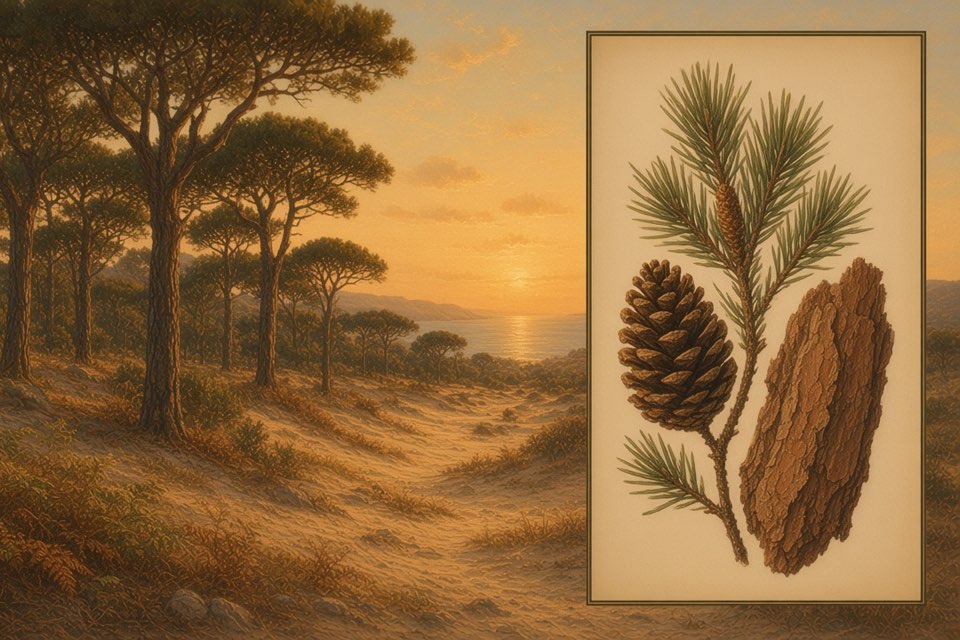
Maritime pine, also called cluster pine (pinheiro bravo in Portuguese, pino marítimo or pino resinero in Spanish), is an evergreen conifer that grows to about 40 m, according to the Gymnosperm Database. Male and female cones grow on the same tree. Its bark is unusually thick, deeply fissured into scaly plates patterned in red-brown, blackish, and buff, and that thick bark is the raw material for the extracts. The needles grow in pairs, occasionally threes, and are stout, about 2 mm thick and 12–25 cm long, staying on the tree for one and a half to three years. The cones are glossy chestnut brown, usually 9–18 cm long, ripen in the second year after pollination, and sometimes stay closed on the tree for years. The species name comes from the Italian pinastro.
Plants of the World Online (Kew) accepts Pinus pinaster Aiton, published in 1789, as native to the western and central Mediterranean: Portugal, Spain, France including Corsica, Italy including Sardinia and Sicily, the Balearic Islands, Morocco, Algeria, and Tunisia. It has been introduced to Britain, Ireland, Greece, Türkiye, the Canary Islands, Madeira, and several Australian states, among other places. POWO accepts three subspecies: subsp. pinaster, the Atlantic form of western France, Portugal, and Spain, which includes the Landes forest; subsp. escarena; and subsp. renoui. Supplement papers, including those by Horphag scientists, often call the source “subsp. atlantica,” but POWO lists that name as not validly published and treats it as a synonym. The older name Pinus maritima is ambiguous: Lamarck’s P. maritima is a synonym of subsp. pinaster, but P. maritima Mill. is a synonym of Aleppo pine, P. halepensis.
Rohdewald (International Journal of Clinical Pharmacology and Therapeutics 2002), a long-time Pycnogenol researcher, described the extract as procyanidins, ranging from single catechin units to chains of seven or more, together with taxifolin and phenolic acids. Bayer and Högger (Frontiers in Nutrition 2024) report that Pycnogenol meets the United States Pharmacopeia monograph for “Pine extract” and is standardized to 65–75% procyanidins. Grape seed extract also contains proanthocyanidins (NCCIH), and so do peanut skins, cranberries, and many barks. Because the common color tests for these compounds cannot tell one plant source from another, Gafner and colleagues (Journal of Natural Products 2023) note that pine bark is itself among the cheaper materials used to fortify or substitute cranberry and grape seed extracts. Telling sources apart takes fingerprinting methods such as HPLC or mass spectrometry.
02 Lineage
History
Pine bark marketing often opens with the French explorer Jacques Cartier, whose ships were trapped in the ice near Stadacona, now Quebec City, in the winter of 1535–36. Houston (Canadian Bulletin of Medical History 1990) recounts that about 75 men died or were given up for dead from scurvy before Don Agaya, an Indigenous man who had recovered, showed the French how to boil the bark and leaves of a tree called anneda. Historians have proposed eleven different trees. Houston judged eastern white cedar (Thuja occidentalis) the best candidate, while others argued for eastern white pine. Whichever it was, it was a North American evergreen, not the maritime pine used for Pycnogenol.
The modern source is the Landes de Gascogne. According to Britannica, maritime pines were planted from 1801 to fix the shifting coastal dunes, and in the second half of the 19th century the marshy plain behind them was drained and planted for timber and turpentine. NutraIngredients reports that Napoleon III’s law of 1857 required landowners to drain and plant. The Gymnosperm Database calls the result the largest artificial forest in Europe, about 8,200 km². Fires in 1937 and 1950 destroyed much of it before replanting, and the bark used for Pycnogenol is left over from the region’s timber industry (NutraIngredients).
The chemistry began with the French researcher Jack Masquelier, who in 1947 isolated oligomeric proanthocyanidins from peanut skins (Weseler and Bast, Nutrition Journal 2017). The company that still sells products under his name says that when peanut supplies changed around 1950 he turned to Landes pine bark, was granted French patent 1,427,100 in 1965, and launched a pine bark product called Flavan in France in 1968; he later developed grape seed OPCs. His US patent 4,698,360, filed in 1985 by an Aquitaine research company and Horphag Overseas and granted in 1987, described proanthocyanidins as part of a chemical group it called “pycnogenols.” Horphag Research, founded in Berlin in 1925 by Charles Haimoff, launched Pycnogenol in Europe in 1987 and the US in 1991, and says it was first registered as an over-the-counter medicine in Switzerland in 1991 for venous insufficiency (NutraIngredients 2025). The two companies tell the origin story differently.
03 Chemistry
Active compounds and how it works
Only part of the extract reaches the blood intact. Grimm and colleagues (BMC Clinical Pharmacology 2006) gave 11 volunteers a single 300 mg dose of Pycnogenol and found catechin, caffeic acid, ferulic acid, taxifolin, and a metabolite called M1, a valerolactone, in their plasma, some of it still detectable 14 hours later. In a 2024 review, Bayer and Högger, who has received Horphag research grants, describe the small molecules as absorbed in the small intestine, while the larger procyanidin chains are broken down by gut bacteria into M1. These compounds have been found in blood cells, joint fluid, and saliva, and are cleared through the kidneys.
The main proposed mechanism is on blood vessels. In a Horphag-funded crossover trial, Enseleit and colleagues (European Heart Journal 2012) gave 23 people with coronary artery disease 200 mg a day for eight weeks. Flow-mediated dilation, a measure of how well arteries widen, rose from 5.3% to 7.0%, and an oxidative stress marker fell, but blood pressure, inflammation markers, and platelet adhesion did not change. Rohdewald’s 2002 review attributes a mild blood pressure effect to inhibition of the enzyme ACE. Pütter and colleagues (Thrombosis Research 1999), with Rohdewald as co-author, found that 100–125 mg prevented the rise in platelet clumping caused by smoking in smokers, an effect similar to 500 mg of aspirin, yet unlike aspirin it did not lengthen bleeding time.
The immune findings are laboratory and animal work. MSKCC cites a mouse study showing immune-stimulating effects, and Verlaet and colleagues (Nutrients 2019) found in cell experiments that Pycnogenol activated toll-like receptors, the immune sensors TLR1/2 and TLR2/6, while its gut-derived metabolites had anti-inflammatory effects. These results are the basis for caution in autoimmune disease, but no human study has shown harm; a small pilot in 11 people with lupus (Stefanescu and colleagues, Phytotherapy Research 2001) actually reported lower disease activity scores with the extract. Antioxidant claims rest mostly on test-tube chemistry and blood markers rather than clinical outcomes.
04 In practice
Common uses
The Cochrane review by Robertson and colleagues (2020) is the best overall picture. Its 27 randomized trials lasted four weeks to six months, and only 4 were judged at low risk of bias; 22 were unclear. Every pooled result was rated low or very low certainty, and the authors could not draw definitive conclusions for any condition. They reported that the manufacturer funded 20 of the 27 trials, that manufacturers did not respond to requests for information, and that publication bias was possible. Many of the positive Pycnogenol trials outside Cochrane’s selection come from a single Italian group led by Gianni Belcaro, often published as registry or supplement studies. Funding, small size, and short duration should be kept in mind for every finding below.
Blood pressure and metabolic risk have the most data, and they conflict. Fogacci and colleagues (Angiology 2020) pooled 7 double-blind trials with 626 people and found no significant effect on systolic, diastolic, mean arterial, or pulse pressure. Mohammadi and colleagues (2025), whose authors declared no competing interests, pooled 27 trials with 1,685 people and found systolic pressure 2.26 mm Hg lower, diastolic 2.62 mm Hg lower, fasting glucose 6.25 mg/dL lower, HbA1c 0.32 percentage points lower, and LDL cholesterol 5.07 mg/dL lower, with no change in HDL, triglycerides, or insulin. The independent Stanford trial by Drieling and colleagues (2010) randomized 130 people at raised heart risk to 200 mg of a Japanese pine bark extract or placebo for 12 weeks and found no difference in blood pressure, cholesterol, glucose, or C-reactive protein. Liu and colleagues (Life Sciences 2004) found that 58 people with high blood pressure taking 100 mg of Pycnogenol could manage on a lower dose of nifedipine.
Leg veins and the eyes were the original vascular targets. Arcangeli (Fitoterapia 2000) randomized 40 people with chronic venous insufficiency to 100 mg three times daily or placebo for two months; swelling, heaviness, and pain fell with the extract, edema and pain disappeared in about 60%, and venous blood flow did not change. Koch (Phytotherapy Research 2002), in an open trial of 40 patients, found that 360 mg of Pycnogenol a day reduced leg circumference over four weeks while 600 mg of horse chestnut extract did not do so significantly. Cochrane rated the two venous trials it included, 60 people in total, very low certainty. In diabetic retinopathy, a Horphag-funded trial by Steigerwalt and colleagues (Journal of Ocular Pharmacology and Therapeutics 2009) in 46 people reported less retinal swelling, and 18 of 24 treated patients felt their vision improved.
Erectile dysfunction research almost always pairs the extract with L-arginine. Stanislavov and Nikolova (Journal of Sex and Marital Therapy 2003) gave 40 men L-arginine for three months, adding Pycnogenol in months two and three; normal erections rose from 5% after L-arginine alone to 80% and then 92.5%, but there was no placebo group. Ledda and colleagues (BJU International 2010) tested Prelox, a Horphag combination of pine bark extract and L-arginine aspartate, in 124 men aged 30–50; the erectile function score rose from 15.2 to 27.1 over six months versus 15.1 to 19.0 on placebo. A 2026 review for the French urology societies (Lebâcle and colleagues, French Journal of Urology) found only modest, low-certainty signals for Pycnogenol and concluded that the evidence does not support routinely recommending herbal treatments for ED. For ADHD, Trebatická and colleagues (European Child and Adolescent Psychiatry 2006), a trial Cochrane lists as Horphag-funded, gave 61 children 1 mg/kg a day for four weeks and reported less hyperactivity and better attention, with symptoms returning a month after stopping. In adults, Tenenbaum and colleagues (Journal of Attention Disorders 2002) found neither Pycnogenol nor methylphenidate better than placebo in 24 people. Weyns and colleagues (Journal of Functional Foods 2022), using product and blinding supplied by Horphag, randomized 88 children for ten weeks; teachers rated total and hyperactivity scores better with both pine bark extract and methylphenidate than placebo, but only methylphenidate improved inattention. In asthma, Lau and colleagues (Journal of Asthma 2004), another Horphag-funded trial, reported better lung function and less rescue inhaler use in 60 children aged 6–18.
Joints and skin round out the list. Cisár and colleagues (Phytotherapy Research 2008) gave 100 people with mild to moderate knee osteoarthritis 150 mg a day or placebo for three months; WOMAC scores and pain improved and painkiller use fell with the extract. Cochrane lists it as Horphag-funded, and Rohdewald was a co-author. MSKCC notes that a review of supplements for musculoskeletal pain recommended against pine bark, and the German Society for Rheumatology (Keyßer and colleagues, Zeitschrift für Rheumatologie 2026) does not recommend it for inflammatory joint disease, though it says rheumatologists need not discourage patients who choose it for osteoarthritis. For melasma, an uncontrolled study by Ni and colleagues (Phytotherapy Research 2002) treated 30 women, and a placebo-controlled Brazilian trial by Lima and colleagues (Journal of the European Academy of Dermatology and Venereology 2021) added 75 mg twice daily to a standard bleaching cream and sunscreen in 44 women for 60 days; melasma scores fell 49% with the extract versus 34% with placebo.
05 The apothecary
Preparations and traditional use
Pine bark extract is sold as capsules and tablets of standardized dry extract, alone or in combinations. Pycnogenol is the standard against which others are compared and is standardized to 65–75% procyanidins (Bayer and Högger). The Cochrane review lists several other branded extracts tested in trials, including Oligopin, Flavangenol, PineXol, and Enzogenol, along with the combination products Prelox and Lady Prelox, which add L-arginine. LiverTox notes that extracts are made from P. pinaster, radiata pine (P. radiata) from New Zealand, and Masson pine (P. massoniana) from China, and Cochrane includes trials of Korean red pine (P. densiflora). These are different extracts, so results from one cannot be assumed for another. A label percentage of “OPCs” or “proanthocyanidins” does not confirm the species, because the usual tests measure the compound class rather than its source (Gafner and colleagues).
Doses in trials ranged from 50 mg to 360 mg a day, most often 100–200 mg, which LiverTox gives as the typical Pycnogenol range. WebMD’s monograph cites 50 mg two or three times daily. Children’s trials used 1 mg per kg of body weight a day (Trebatická) or 20–40 mg a day by body weight (Weyns). Trials lasted four weeks to six months, and the osteoarthritis trial by Cisár gave the extract with meals. Combination ED products contain much larger amounts of L-arginine alongside the pine bark.
Regulation varies. In the United States, pine bark extract is sold as a dietary supplement, and Horphag says Pycnogenol is also registered as an over-the-counter medicine in Switzerland and several South American countries. We found no authorized EU health claim for pine bark extract on its own; Horphag’s chief executive told NutraIngredients in 2025 that no health claims had been approved in Europe or the US, while Korea’s food safety ministry had granted three. The one favorable EFSA opinion involving pine bark (EFSA Journal 2013) concerned Limicol, an eight-ingredient cholesterol supplement containing red yeast rice with monacolin K, which EFSA notes is also known as lovastatin; EFSA stressed that no evidence was provided for an LDL-lowering effect of any single ingredient.
Safety
Before you use pine bark
06 Caution
Side effects
Across the 27 trials in the Cochrane review by Robertson and colleagues (2020), seven reported mild adverse events and two hospitalizations occurred, both in pine bark groups, one for heart failure. LiverTox cites a review of 70 trials using 20–300 mg a day that found adverse events in 2.4% of participants, mainly stomach discomfort, dizziness, headache, and nausea. The independent Stanford trial by Drieling and colleagues (2010) reported similar adverse event rates on extract and placebo.
Individual trials give a sense of scale. In a diabetes trial by Liu and colleagues summarized by Cochrane, dizziness affected 7 of 34 people on the extract versus 4 of 43 on placebo, and digestive problems 5 of 34 versus 2 of 43. In the hypertension trial by Liu and colleagues, side effects were reported by 39% on the extract and 27% on placebo, a difference that was not statistically significant. In the ADHD trial by Trebatická, one child had stomach discomfort and one became noticeably slower. The melasma trial by Lima and colleagues found no adverse effects linked to the oral extract. MSKCC, citing Micromedex, also lists irritability and lower energy.
LiverTox gives pine bark extract a likelihood score of E, meaning it is unlikely to cause liver injury, and has no convincing cases on record. A single case report by Kermanshah and colleagues (Cureus 2025) described a 35-year-old man who took more than the labeled dose and developed rhabdomyolysis, a breakdown of muscle tissue, after lifting furniture; the authors rated the link “possible” and his kidneys were not harmed. One case cannot show cause, but unexplained muscle pain or dark urine while taking any supplement should be checked promptly.
Product quality is a separate risk. Proanthocyanidin extracts are hard to authenticate, and Gafner and colleagues (2023) describe cheaper plant tannins being used to substitute or bulk up these ingredients. Choosing a product that names the pine species and extract, and ideally carries third-party testing, reduces the chance of getting something other than what the label says.
07 Caution
Contraindications
Anyone who has had an allergic reaction to pine bark extract should avoid it (MSKCC). WebMD’s monograph advises people with autoimmune diseases such as multiple sclerosis, lupus, or rheumatoid arthritis to avoid it because it might stimulate the immune system. That caution rests on laboratory and animal findings rather than reported harm, and the one small lupus study pointed the other way, but there is not enough evidence to call it safe in these conditions.
Because pine bark extract reduces platelet clumping (Pütter and colleagues; MSKCC), people with bleeding disorders should be cautious, especially at high doses, and WebMD advises stopping it at least two weeks before scheduled surgery. Pütter found no prolonged bleeding time in smokers, so the risk is mainly theoretical, but the combination with other blood-thinning treatments has not been tested.
Pregnancy and breastfeeding data are limited. WebMD rates it possibly safe in later pregnancy based on limited study but advises caution or avoidance, and recommends avoiding it while breastfeeding. Children aged 6–18 took it for up to three months in the asthma and ADHD trials, but those trials were small, and pine bark extract is not a replacement for proven ADHD or asthma treatment.
People with diabetes or high blood pressure who are treated with medicines should monitor their readings if they start it, since meta-analyses suggest small falls in blood sugar and blood pressure. The French urology review by Lebâcle and colleagues (2026) stresses that herbal products should not replace validated care for erectile dysfunction.
08 Caution
Drug and herb interactions
Blood thinners and antiplatelet drugs are the main concern. MSKCC lists an interaction with anticoagulants and antiplatelet agents because pine bark extract inhibits platelet aggregation, and Pütter and colleagues (1999) showed that 100–125 mg blocked smoking-induced platelet clumping about as well as 500 mg of aspirin. In the laboratory, Golański and colleagues (2006) found that Pycnogenol added to aspirin’s effect on platelets. People taking warfarin, aspirin, clopidogrel, or similar drugs should use it only with their clinician’s agreement.
Diabetes and blood pressure medicines may be affected. WebMD warns that pine bark might lower blood sugar and add to diabetes drugs, and the meta-analysis by Mohammadi and colleagues (2025) found small falls in fasting glucose and HbA1c. In the hypertension trial by Liu and colleagues (2004), people taking the extract were controlled on a lower dose of nifedipine, which suggests an added effect on blood pressure. Watch for low blood sugar or dizziness after starting or stopping it.
WebMD advises against combining pine bark extract with immunosuppressant drugs, such as those taken after an organ transplant or for autoimmune disease, because it might stimulate the immune system and reduce their effect. This is a theoretical interaction based on laboratory findings, but the stakes are high for transplant patients. No important effects on drug-metabolizing liver enzymes are described in the sources reviewed here, and LiverTox reports no liver toxicity, but formal interaction studies are scarce.
09 Questions
Frequently Asked Questions
Pycnogenol is a standardized extract of the bark of the French maritime pine, Pinus pinaster, grown in the Landes forest of southwest France. It is a registered trademark of Horphag Research and contains 65–75% procyanidins, chains of catechin and epicatechin also called OPCs, plus taxifolin and phenolic acids. The word “pycnogenols” first appeared in a 1980s patent as a name for a chemical group, but today it refers to Horphag’s branded product. Other pine bark extracts come from different pines or processes and should not be assumed to work the same way.
Possibly a little, but the evidence conflicts. A 2020 meta-analysis of 7 double-blind trials with 626 people found no significant effect on blood pressure. A 2025 meta-analysis of 27 trials found average falls of about 2 to 3 mm Hg in both systolic and diastolic pressure. An independent Stanford trial of 130 people taking another pine bark extract for 12 weeks found no difference from placebo. Cochrane rated the cardiovascular evidence very low certainty. It is not a substitute for prescribed blood pressure treatment, and it may add to those drugs. See our heart health guide.
The trials nearly always combined it with L-arginine. An uncontrolled Bulgarian study and a placebo-controlled trial of Prelox, a Horphag pine bark and L-arginine product, in 124 men reported better erectile function scores, but Cochrane rated the evidence very low certainty. A 2026 review for the French urology societies called the signal modest and low certainty and did not recommend herbal treatments routinely. Like ginseng, it is an option to discuss rather than a proven treatment. See our libido guide.
Most people in trials had none. The most common complaints are stomach discomfort, dizziness, headache, and nausea, reported in about 2.4% of participants across 70 trials according to LiverTox, often at rates close to placebo. Irritability and lower energy have also been listed. LiverTox has not linked it to liver injury, and one 2025 case report described possible muscle breakdown in a man taking more than the labeled dose. The bigger concerns are interactions with blood thinners, diabetes medicines, and immunosuppressants.
No, though they share chemistry. Both are rich in proanthocyanidins, often sold as OPCs, and the same French researcher, Jack Masquelier, developed OPC extracts from both pine bark and grape seeds. The sources differ, the mix of compounds differs, and the clinical trials were done on specific products, so results from one do not transfer to the other. Because standard tests measure proanthocyanidins as a class, pine bark has even been used as a cheaper filler in other proanthocyanidin supplements. Check which plant and extract a product actually contains.
The evidence is mixed. A 2006 Slovak trial in 61 children, which Cochrane lists as funded by the manufacturer, reported less hyperactivity after four weeks, with symptoms returning after stopping. A small adult trial found no benefit over placebo. A 2022 Belgian trial in 88 children found teacher-rated improvements with both pine bark extract and methylphenidate, but only the drug improved inattention. NCCIH says research has not shown that it improves ADHD symptoms. Talk with your child’s doctor before trying it. See our ADHD guide.
Small trials suggest it may ease symptoms of chronic venous insufficiency. In a placebo-controlled Italian trial of 40 people, 100 mg three times daily for two months reduced swelling, heaviness, and pain, without changing venous blood flow. An open trial found it reduced leg circumference more than horse chestnut extract over four weeks. Cochrane rated the venous evidence very low certainty, so horse chestnut, with more trials, remains the better-studied herb. Compression and medical review matter for leg swelling.
There is some early support for melasma. In a Brazilian placebo-controlled trial of 44 women, 75 mg twice daily added to a standard bleaching cream and sunscreen for 60 days cut melasma scores by 49% versus 34% with placebo, with no side effects from the capsules. An earlier Chinese study of 30 women had no control group, and a 2026 review of melasma trials noted that studies of natural products, including Pycnogenol, were small. Sun protection remains the foundation of melasma care. See our skin guide.
10 References
Sources
These references support the history, clinical, and safety claims on this page. They are not an endorsement of any product.
-
Pinus pinaster Aiton
Plants of the World Online, Royal Botanic Gardens, Kew, 2026
Accepted name (1789); native range in the western and central Mediterranean; subsp. atlantica not validly published; three accepted subspecies.
-
Pinus pinaster (maritime pine)
The Gymnosperm Database, 2026
Description of bark, paired needles, and cones; common names; the Landes plantation as Europe’s largest artificial forest.
-
Pine bark (Pinus spp.) extract for treating chronic disorders
Cochrane Database of Systematic Reviews (PubMed 32990945), 2020
Robertson and colleagues: 27 RCTs, 1,641 people, ten disorders; low or very low certainty; manufacturer funded 20 of 27 trials.
-
Pine Bark
LiverTox, National Institute of Diabetes and Digestive and Kidney Diseases, 2025
Source species, typical 100–200 mg Pycnogenol dose, 2.4% adverse event rate across 70 trials, likelihood score E for liver injury.
-
Pine Bark Extract
Memorial Sloan Kettering Cancer Center, 2026
Clinical summary: mixed evidence, preclinical immune stimulation, antiplatelet interaction, irritability and lower energy as adverse reactions.
-
Attention-Deficit Hyperactivity Disorder at a Glance
National Center for Complementary and Integrative Health, 2019
States that limited research has not shown French maritime pine bark extract (Pycnogenol) improves ADHD symptoms.
-
Effect of Pycnogenol on blood pressure: a systematic review and meta-analysis of randomized, double-blind, placebo-controlled studies
Angiology (PubMed 31763928), 2020
Fogacci and colleagues: 7 trials, 626 people; no significant effect on systolic, diastolic, mean arterial, or pulse pressure.
-
Does supplementation with pine bark extract improve cardiometabolic risk factors? A systematic review and meta-analysis
BMC Complementary Medicine and Therapies (PubMed 39987124), 2025
Mohammadi and colleagues: 27 RCTs, 1,685 people; small falls in blood pressure, fasting glucose, HbA1c, weight, and LDL; no competing interests declared.
-
No beneficial effects of pine bark extract on cardiovascular disease risk factors
Archives of Internal Medicine (PubMed 20876405), 2010
Drieling and colleagues, Stanford: 130 people, 200 mg a day for 12 weeks; no effect on blood pressure, lipids, glucose, or CRP.
-
Pycnogenol in chronic venous insufficiency
Fitoterapia (PubMed 10844161), 2000
Arcangeli: 40 patients, 100 mg three times daily or placebo for two months; less edema, heaviness, and pain; no change in venous flow.
-
Phytotherapies and complementary therapies for erectile dysfunction: a focused secondary synthesis of the AFU/SFMS evidence base
French Journal of Urology (PubMed 42229757), 2026
Lebâcle and colleagues: ginseng, L-arginine, and Pycnogenol show modest low-certainty signals; no routine recommendation of phytotherapies.
-
Treatment of ADHD with French maritime pine bark extract, Pycnogenol
European Child and Adolescent Psychiatry (PubMed 16699814), 2006
Trebatická and colleagues: 61 children, 1 mg/kg a day for four weeks; less hyperactivity, relapse after stopping; manufacturer-funded per Cochrane.
-
Clinical investigation of French maritime pine bark extract on ADHD as compared to methylphenidate and placebo: Part 1, efficacy in a randomised trial
Journal of Functional Foods, 2022
Weyns and colleagues: 88 children for ten weeks; teacher-rated gains with extract and methylphenidate; only the drug improved inattention.
-
Effect of pine bark extract (Pycnogenol) on symptoms of knee osteoarthritis
Phytotherapy Research (PubMed 18570266), 2008
Cisár and colleagues: 100 patients, 150 mg a day for three months; better WOMAC and pain scores, less analgesic use; manufacturer-funded per Cochrane.
-
French maritime pine bark extract (pycnogenol) in association with triple combination cream for the treatment of facial melasma in women
Journal of the European Academy of Dermatology and Venereology (PubMed 32841433), 2021
Lima and colleagues: 44 women, 75 mg twice daily for 60 days; melasma score fell 49% versus 34% with placebo; no oral adverse effects.
-
Maritime Pine: Overview, Uses, Side Effects, Precautions, Interactions, Dosing and Reviews
WebMD, 2026
Cautions for autoimmune disease, bleeding, surgery, pregnancy, and breastfeeding; interactions with anticoagulants, diabetes drugs, and immunosuppressants.
-
Plant extract with a proanthocyanidins content as therapeutic agent having radical scavenger effect and use thereof (US Patent 4,698,360)
Google Patents, 1987
Masquelier patent filed in 1985 with Horphag Overseas; describes maritime pine bark proanthocyanidins and the “pycnogenols” chemical group.
-
Driving growth through science: behind the scenes at Horphag Research
NutraIngredients, 2025
Company history: founded 1925; Pycnogenol launched 1987 in Europe and 1991 in the US; Swiss OTC registration; no EU or US health claims approved.