Monograph
Sage
Salvia officinalis
Updated October 12, 2026
Key points
-
01
Kitchen first
Most of sage’s real-world use is culinary. A sprig in the pan is not a menopause extract or an essential oil.
-
02
A Salerno reputation
Medieval “why die while sage grows” lore made the plant a longevity emblem—history, not a survival trial.
-
03
Traditional EU uses
Leaf preparations are still framed for mild dyspepsia, sweating, and mouth or throat inflammation as gargles.
-
04
Hot flashes: modest data
Some extract trials look helpful for menopausal flushes; evidence is limited and product-specific.
-
05
Not white sage
Salvia officinalis is not Salvia apiana. Ceremonial white sage is a different species and a different cultural story.
Sage (Salvia officinalis), often called garden sage or common sage, is a woody Mediterranean mint whose gray-green, pebbled leaves have flavored meat, marked graves, and filled apothecary jars for two millennia. The Latin salvia is usually derived from salvere, to be well. That etymology is not a clinical trial, but it is a fair summary of how Europeans talked about the plant: as a household virtue, a bitter digestive, a gargle for the mouth, and—later—a symbol of wisdom that outlived the humoral theory that first praised it.
This monograph spends extra time on that history and on what “used today” actually means: a culinary herb in stuffing and brown butter; a traditional herbal medicine in the EU for dyspepsia, excessive sweating, and inflamed mouth or throat; a menopause supplement with a small but encouraging trial literature; and an essential oil that is not the same as a roast-chicken sprig. It also draws a hard line between S. officinalis and white sage (Salvia apiana), a different North American species bound up in Indigenous ceremonial practice and conservation conflict. Enjoying garden sage in the kitchen is a different thing from harvesting another community’s sacred plant.
Nothing here is medical advice. Sage in food is not a menopause protocol. Sage essential oil is not a tea. Persistent sore throat, unexplained night sweats, or cognitive change needs a clinician, not a stronger infusion.
Featured in
Herbs for Menopause and Hot Flashes Herbs for Memory and Focus Herbs for Cough and Sore Throat Herbs for Heartburn and Acid RefluxEvidence reviews
Sage for Hot Flashes →In this monograph
01 The plant
Botanical profile
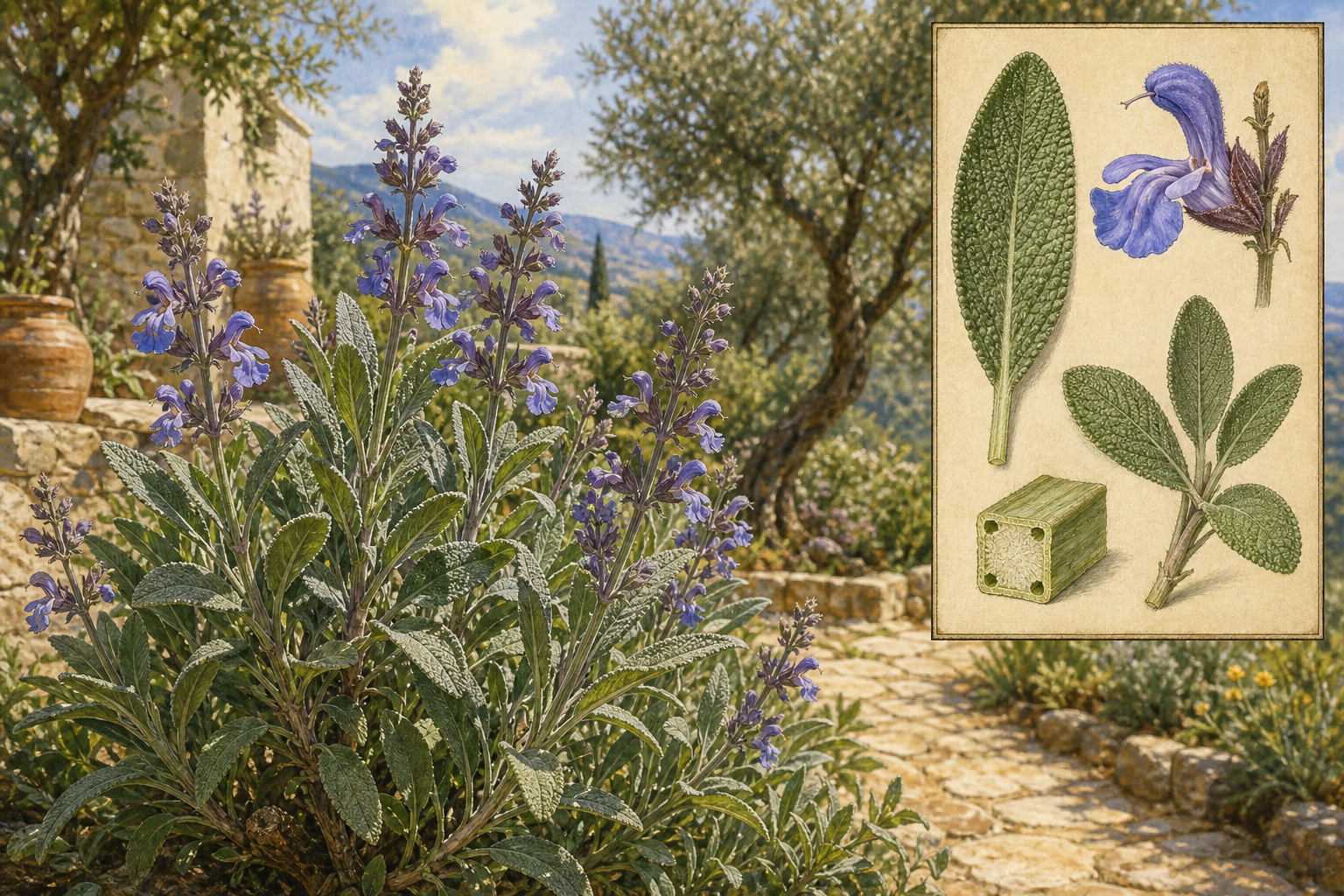
Salvia officinalis is an evergreen subshrub in the Lamiaceae, native to the northern Mediterranean—especially the western Balkans and adjacent Italy—and now planted worldwide in kitchen gardens. Stems are square in cross-section, becoming woody at the base. Leaves are opposite, oblong to lanceolate, finely wrinkled (rugose), and covered in a gray tomentum of glandular and covering hairs that give the classic dusty-green look and the camphoraceous-thujone scent when crushed. Flowers are two-lipped, typically violet-blue, arranged in interrupted spikes. Like other salvias, the flower is built for bees: a hooded upper lip and a landing-pad lower lip.
Garden forms vary. ‘Purpurascens’ and tricolor cultivars are ornamental; Dalmatian sage is a commercial name for strongly aromatic leaf from the eastern Adriatic, long preferred by the spice trade. Spanish sage (S. lavandulifolia) and Greek sage (S. fruticosa, often sold as S. triloba) are related culinary-medicinal species with overlapping but not identical oil profiles. Clary sage (S. sclarea) is another plant entirely, used more for its flowering tops and oil in perfumery than as a roast herb.
White sage (S. apiana) is a California chaparral shrub with silvery leaves, used by some Native nations in ceremonial smoke. It is not garden sage. Bundles sold as “sage” in gift shops are often S. apiana or mixed salvias, sometimes wild-harvested under conservation pressure. This page is about S. officinalis unless a sentence names another species.
The medicinal and culinary part is the dried or fresh leaf (Salviae officinalis folium). Flowering tops appear in some traditional preparations. The essential oil (Salviae aetheroleum) is a steam-distilled concentrate rich in thujone, camphor, and 1,8-cineole—chemistry that does not scale linearly from a pinch of stuffing.
02 Lineage
History
Sage’s written European trail begins in earnest with the Romans. Pliny and later Latin agricultural writers knew a salvia used as a culinary and medicinal leaf. The name itself did the ideological work: a plant of saving, of health. How much of that was S. officinalis in the modern taxonomic sense versus a cluster of Mediterranean salvias is a historian’s problem; the cultural payload is not. Sage entered the medieval Christian pharmacopeia as a garden simple that monasteries could actually grow.
The most quoted line in the sage literature is not from a trial. It is from the Regimen sanitatis Salernitanum, the Salerno school’s rhymed health advice, which asked—in various Latin wordings still printed on tea tins—why a man should die while sage grows in his garden. Cur moriatur homo cui salvia crescit in horto? That sentence did more to fix sage as a longevity emblem than any assay of rosmarinic acid. It is folklore with a zip code: southern Italy, high medieval Latin medicine, later printed across Europe. Take it as a window into how people wanted to feel about a bitter kitchen plant, not as a mortality result.
Hildegard of Bingen and other monastic writers recommended sage for digestive and respiratory complaints in the humoral frame of the time: warming, drying, useful against “phlegm.” Renaissance herbals (Fuchs, Gerard, Parkinson) kept it as a standard garden inhabitant—stuffing for fatty meats, a wash for gums and throat, a hair rinse in some domestic recipes, and a companion of rue and rosemary in the moralized garden. “Sage” as a synonym for a wise person is English metaphorical drift from the plant’s prestige, not a claim that the leaf raises IQ.
The spice trade made Dalmatian leaf a commodity. Nineteenth-century pharmacy distilled the oil and worried, eventually, about thujone—the same monoterpene ketone that made absinthe politically radioactive. Sage oil’s thujone content is why later pharmacopeias treated the distilled oil as a different, narrower object than the leaf infusion. Food use never required that distinction in the kitchen; toxicology did.
Colonial and American household manuals carried sage as a turkey herb and a sore-throat gargle. Native North American sagebrushes (Artemisia species) and ceremonial white sage are parallel stories that settlers often flattened into one English word. That flattening still causes harm: people burn “sage” without knowing the species or the cultural context. Historical honesty here means keeping the Mediterranean kitchen plant and the Indigenous ceremonial plants from collapsing into one wellness product.
Twentieth-century phytotherapy in German-speaking countries kept sage leaf as a textbook astringent bitter for the mouth and gut and as an anhidrotic (a traditional check on sweating). Commission E and later EMA HMPC monographs translated that into official traditional-use language. Interest in sage for menopause came later, building on older texts that had already associated the plant with drying and “women’s complaints” in vaguer humoral terms. History created the reputation; modern trials have only begun to test it.
03 Chemistry
Active compounds and how it works
Sage leaf is a mixed aromatic: phenolic acids (notably rosmarinic acid), flavonoids, diterpenes such as carnosic acid and carnosol (the same antioxidant family famous in rosemary), and a volatile oil whose composition shifts with chemotype, climate, and distillation. Typical S. officinalis oil is high in α- and β-thujone, camphor, and cineole. Spanish sage oil is often lower in thujone and higher in cineole—one reason species on a bottle matter.
The traditional “drying” action maps, loosely, onto astringency in the mouth and a folk anhidrotic use. Mechanisms for reducing sweat are not fully nailed down; they are inferred from old clinical phytotherapy and a handful of modern studies, not from a single receptor story. Menopause symptom trials usually use hydroalcoholic extracts or specific commercial preparations, not a random supermarket leaf.
Thujone is a GABA-A receptor modulator in experimental systems and a convulsant at sufficient dose. That is the essential-oil problem, not the roast-chicken problem. Leaf tea contains some volatiles; it is not equivalent to dropping oil on the tongue. Chronic high-thujone exposure is why internal use of sage oil is restricted or contraindicated in serious monographs.
Cognitive folklore—sage as a memory herb—has a small modern research trail, including studies of sage extracts and aromas on mood or attention in healthy adults. Effects, when reported, are modest and short-term. They do not make sage a treatment for dementia. Rosemary and sage share some diterpenes; that chemical rhyme is not a diagnosis.
04 In practice
Common uses
Today the dominant use is culinary. Fresh or dried leaf seasons poultry, pork, beans, brown butter, and sausages across European and American cooking. That is food. The dose is a few leaves or a teaspoon of dried herb in a dish, often with fat. Food use is how most people should meet the plant.
European traditional herbal indications for sage leaf preparations include symptomatic treatment of mild dyspepsia (heartburn, bloating, the “heavy meal” feeling), relief of excessive sweating, and inflammation of the mouth or throat as a gargle or rinse. Those are tradition-based listings in EMA-style documents, not proof that sage cures GERD or hyperhidrosis of every cause. Night sweats from infection or lymphoma are diagnostic problems.
Menopause is where most modern interest lies. Some randomized trials of sage preparations have reported reductions in hot-flush frequency or intensity versus baseline or placebo, typically over weeks, with products that are not identical to kitchen tea. NCCIH summarizes this as a few small studies suggesting common sage might help reduce hot-flash frequency. A 2023 meta-analysis of four small trials (310 women) found that each reported fewer or milder hot flashes, though the pooled estimates were imprecise, with confidence intervals that included no effect. Systematic reviewers tend to call the evidence promising but limited: small samples, heterogeneous extracts, short follow-up. Sage is not estrogen replacement. It is an option some clinicians and patients discuss among many nonhormonal strategies—not a substitute for indicated hormone therapy when that is the right treatment.
Sore throat and gingivitis folklore continues as gargles. Astringent phenolics make a plausible mouthwash story. Evidence is mostly traditional and small-scale. Strep throat still needs appropriate care. Sage is not an antibiotic course.
Memory and “brain fog” claims are still ahead of the data, though early studies are interesting: small trials in healthy younger and older adults have reported short-term gains on memory and attention tests. Aroma and extract studies in healthy volunteers are not Alzheimer’s disease trials. Do not delay dementia workups for a sage tincture.
Essential oil is used in aromatherapy and, unwisely, in homemade internal recipes. Inhaled scent in food-level cooking is not the same as ingesting oil. Topical oil can irritate skin. This is not tea tree’s twin; thujone sets a lower bar for casual internal use.
Smudging and “clearing energy” with bundled sage in retail culture usually involves S. apiana or mixed species, not a Dalmatian culinary cut. That practice has a specific Indigenous history. Buying farmed S. officinalis to cook with does not require a ceremony. Harvesting wild white sage to imitate one is a different ethical and ecological act. Keep them separate.
05 The apothecary
Preparations and traditional use
Kitchen use is fresh sprigs or crumbled dried leaf, added late in cooking so the perfume does not go medicinal. Dried sage is stronger, more camphoraceous, and easier to overdo.
Traditional medicinal forms are infusions (hot water on dried leaf), hydroalcoholic extracts, lozenges, and gargles. EMA-style posology for traditional indications is labeled and time-limited. Follow the product, not a social-media “handful in a quart of water.”
Menopause supplements are branded extracts; they are not interchangeable with stuffing spice. If someone uses them, the clinician should know—especially if there is a seizure history or other medicines.
Essential oil is for professional aromatherapy or labeled topical/inhalation products, not for “a few drops in water” as a drink. Distillation concentrates thujone.
Do not burn unknown “sage” bundles as a health intervention. Species, harvest ethics, and indoor smoke exposure (particulate irritation) all sit outside the Salvia officinalis tea monograph.
Safety
Before you use sage
06 Caution
Side effects
Culinary amounts are well tolerated for most people. Large bitter infusions can upset the stomach or dry the mouth. Allergic contact dermatitis to Lamiaceae happens. The pollen and dust of dried herb can bother sensitive noses.
Concentrated extracts may cause restlessness or GI upset. Sage oil and high-thujone preparations can cause dizziness, restlessness, vomiting, and—at toxic doses—seizures. That is a documented essential-oil poisoning pattern, not a tea anecdote.
Because of traditional anhidrotic use, people who already struggle with overheating in dangerous climates should not assume more sage is better thermoregulation. The menopause data are about flush frequency in trials, not heat-stroke prevention.
NCCIH considers sage likely safe in the amounts found in food, and larger amounts have been used safely for up to 8 weeks in studies. It cautions that sage may be unsafe in high doses or over long periods because of thujone, that it may be unsafe in pregnancy, and that little is known about safety while breastfeeding.
07 Caution
Contraindications
Do not ingest sage essential oil. Avoid medicinal-dose sage (strong teas, extracts, oil) in pregnancy; culinary seasoning in food is a different exposure, but concentrated products are generally avoided. Breastfeeding medicinal sage appears in caution lists because of traditional “drying” lore and limited safety data.
Seizure disorders are a reason to avoid thujone-rich oils and perhaps high-dose extracts unless a clinician agrees. Children should not be given sage oil.
Hormone-sensitive conditions sometimes appear in secondary caution lists because of mild estrogenic signals in lab work on some salvias; the clinical importance for leaf tea is unclear. The practical rule is disclosure, not panic over Thanksgiving stuffing.
Allergy to sage or other mints is a stop. Do not use sage gargles as the only treatment for airway compromise or abscess.
08 Caution
Drug and herb interactions
Sage is not St. John’s wort. Documented, dramatic CYP induction is not its reputation. That said, concentrated extracts plus sedatives, anticonvulsants, or diabetes medicines belong in the “tell the pharmacist” bucket because evidence is incomplete and thujone is neurologically active in principle.
Anticonvulsant therapy and sage oil are a poor mix. Do not add oil to a seizure regimen as a folk experiment.
Diabetes: some experimental work on sage and glucose exists; it is not a reason to change insulin without monitoring.
Do not stack multiple high-thujone oils (sage, some wormwoods) for a stronger “cleanse.” High combined thujone intake can cause seizures.
09 Questions
Frequently Asked Questions
Usually yes if the jar is garden or Dalmatian sage (Salvia officinalis). Dose and form still differ: stuffing is food; labeled extracts and gargles are medicinal-strength uses. Essential oil is another step more concentrated and is not a cooking spice.
The Salerno verse is a famous saying, not a dataset. It tells you sage was a prestige garden plant in Latin medical culture, and the poem itself answers its own question: against the power of death there is no remedy in the garden. Read it as intellectual history, then look at modern indications and safety separately.
Some clinical trials of specific sage preparations report fewer or milder flushes. The evidence is not as large or consistent as for some other nonhormonal options, and products differ. Sage is not a stand-in for indicated hormone therapy. Discuss extracts with a clinician if you try them.
Traditional European use includes sage as a gargle or rinse for inflamed mouth and throat. It may soothe; it does not replace care for strep, abscess, or breathing trouble. Use cooled tea as a gargle if you try it—not as a reason to skip diagnosis.
Distillation concentrates thujone and camphor. Thujone can cause neurologic toxicity, including seizures, at sufficient dose. A leaf in butter is a tiny volatile exposure by comparison. Do not drink the oil.
No. Retail “smudge sticks” are often white sage (Salvia apiana) or mixed species, tied to Indigenous ceremonial practices that are not interchangeable with Mediterranean cooking sage. Smoke is also an airway irritant. This monograph is about S. officinalis as food and traditional herbal leaf—not a how-to for ceremony.
The English word “sage” for a wise person comes from the plant’s prestige, and a few small studies have found short-term gains on memory and attention tests in healthy adults. That is an interesting start, not proof. There is no good evidence that sage tea treats dementia. Stay curious about the history; do not skip a memory clinic for a tincture.
Pregnant people should avoid concentrated products (food seasoning is a different question). Skip essential oil internally, especially in children and anyone with a seizure disorder. If you take anticonvulsants or are considering menopause extracts, ask a clinician first.
10 References
Sources
These references support the history, clinical, and safety claims on this page. They are not an endorsement of any product.
-
European Union herbal monograph on Salvia officinalis L., folium
European Medicines Agency, 2016
EU traditional-use framework for sage leaf: dyspepsia, hyperhidrosis, and oropharyngeal inflammation; posology and oil/thujone cautions.
-
Assessment report on Salvia officinalis L., folium and Salvia officinalis L., aetheroleum
European Medicines Agency (HMPC), 2016
HMPC assessment covering leaf versus essential oil, chemistry including thujone, traditional indications, and safety.
-
Sage
National Center for Complementary and Integrative Health (NIH), 2025
NCCIH fact sheet: small studies suggest common sage might reduce hot-flash frequency and may improve memory test scores in healthy people; likely safe in food amounts, but thujone makes high doses, long-term use, and pregnancy use potentially unsafe.
-
First time proof of sage's tolerability and efficacy in menopausal women with hot flushes
Advances in Therapy, 2011
Open-label menopause study often cited in sage hot-flush discussions; limited by design compared with large RCTs of other therapies.
-
Salvia officinalis L.
Plants of the World Online (Royal Botanic Gardens, Kew), 2024
Botanical nomenclature and distribution reference for garden sage.
-
Thujone
PubChem, National Library of Medicine (NIH), 2024
Chemical identity for a principal monoterpene ketone of sage essential oil, relevant to neurologic toxicity at high dose.
-
Salvia apiana Jeps.
Plants of the World Online (Royal Botanic Gardens, Kew), 2024
Nomenclature for white sage, included to keep ceremonial/California species distinct from culinary S. officinalis.
-
An extract of Salvia (sage) with anticholinesterase properties improves memory and attention in healthy older volunteers
Psychopharmacology, 2008
Scholey et al. placebo-controlled crossover study in 20 healthy adults over 65: a single 333 mg dose of standardized S. officinalis extract improved memory and attention scores for several hours. Small experimental work, not evidence for treating dementia.
-
Regimen sanitatis Salernitanum (ed. P. Tesdorpf and Th. Tesdorpf-Sickenberger, 1915)
Bibliotheca Augustana (Technische Hochschule Augsburg), c. 12th–13th century
Latin text of the Salerno health poem, including the “De salvia” chapter: “Cur moriatur homo, cui salvia crescit in horto? Contra vim mortis non est medicamen in hortis.”
-
Rosmarinic acid
PubChem, National Library of Medicine (NIH), 2024
Phenolic constituent shared with other Lamiaceae, often cited in sage’s antioxidant and astringent chemistry.
-
Phytoestrogens for menopausal vasomotor symptoms
Cochrane Database of Systematic Reviews, 2013
Lethaby et al. review of 43 trials of soy, red clover, and other phytoestrogen products for hot flushes: no conclusive evidence of benefit overall. Sage was not assessed; included as context for the broader, often mixed evidence base for plant-based hot-flush products.
-
Risk assessment of thujone in foods and medicines containing sage and wormwood: evidence for a need of regulatory changes?
Regulatory Toxicology and Pharmacology, 2010
Lachenmeier and Uebelacker benchmark-dose analysis of thujone (based on seizures in rats): proposes an acceptable daily intake and judges short-term medicinal sage tea safe, while supporting existing limits. Context for why distilled sage oil is regulated more tightly than culinary leaf.
-
The effect of Salvia officinalis on hot flashes in postmenopausal women: a systematic review and meta-analysis
International Journal of Community Based Nursing and Midwifery, 2023
Moradi et al. review of four small trials (310 women): each reported fewer or milder hot flashes with sage, though pooled estimates were imprecise and heterogeneous, with 95% CIs including no effect (frequency −1.12, −2.37 to 0.14); larger trials are needed.