Monograph
Yarrow
Achillea millefolium
Updated October 4, 2026
Key points
-
01
Traditional use, not proven use
EMA registers yarrow herb and flower on long-standing use only: appetite loss, mild digestive cramps, minor period pain, small wounds. No oral herb trial met the bar.
-
02
One name, many chemotypes
Yarrow is a polyploid complex. Some tetraploids make proazulenes that distil to blue chamazulene; hexaploids usually do not.
-
03
Small trials, promising signals
A 96-student period-pain tea trial and a 75-patient MS add-on trial were positive but single-center and unreplicated.
-
04
Neanderthal lore needs care
El Sidrón dental calculus hints at yarrow ingestion. The Shanidar “flower burial” pollen is better explained by rodents or bees.
-
05
Daisy allergy and pregnancy
Yarrow is a documented contact sensitizer. EMA contraindicates Asteraceae allergy and does not recommend use in pregnancy, lactation, or under 12.
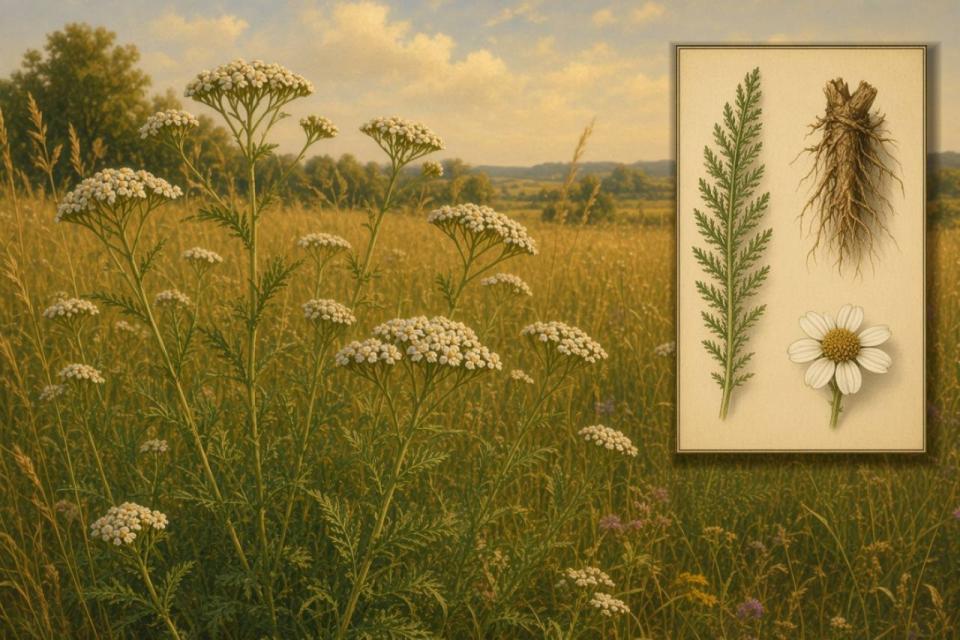
Yarrow is the flat-topped white weed of road verges, hay meadows, and lawns that refuse to stay mown. Crush a leaf and it smells sharp and camphoraceous. The leaf is the name: millefolium, thousand-leaf, for blades cut two or three times into feathery segments. People have pressed it into wounds for as long as anyone has written about wounds. It is also not quite one plant. Achillea millefolium is a circumboreal polyploid complex of diploid to octoploid populations, native and introduced, whose chemistry shifts with chromosome number. A tea bag labeled yarrow has told you the genus and the habit. It has not told you whether the oil inside would distill blue.
This monograph holds three facts together. First, regulators treat yarrow as a traditional medicine, not a proven one. The European Medicines Agency’s Committee on Herbal Medicinal Products (HMPC) keeps two traditional-use monographs: one for the herb (Millefolii herba, revision 1 adopted 23 September 2020) and one for the flower (Millefolii flos, adopted 12 July 2011). Both cover temporary loss of appetite, mild spasmodic digestive complaints with bloating and flatulence, minor menstrual cramps, and small superficial wounds. The herb assessment report is plain: no clinical study of oral yarrow herb was available, so well-established use was “not fulfilled.” Second, the human trials that do exist are small, single-center, and Iranian: a 96-student period-pain tea trial, a 75-patient multiple sclerosis add-on trial, and an episiotomy ointment trial with 32 women in the yarrow arm. Their results are encouraging, and they still need confirming in larger studies. Third, yarrow’s history is longer and stranger than its evidence. Achilles, a Neanderthal’s dental plaque, a contested “flower burial,” and the I Ching all sit in its file. Only some of those stories survive scrutiny.
Nothing here is medical advice. A wound that is deep, dirty, hot, or spreading needs a clinician, not a poultice. Severe, new, or worsening menstrual pain needs a diagnosis. Daisy-family allergy is a hard stop: yarrow is a documented contact sensitizer. Pregnancy is a do-not-use in the EU monographs, even though the animal evidence behind that caution is limited. Yarrow essential oil is a different, far more concentrated object than yarrow tea. And a pharmacy product registered under the EU traditional scheme, with a declared plant part and strength, is not the same object as a garden clump or an unlabeled capsule.
In this monograph
01 The plant
Botanical profile
Achillea millefolium L. sits in Asteraceae, tribe Anthemideae, alongside chamomile and tansy. Linnaeus published it in Species Plantarum (1753, vol. 2, p. 899). NCBI Taxonomy files it as taxon 13329 and, tellingly, nests it inside a node called the “Achillea millefolium complex.” It is a rhizomatous perennial, 6 to 65 cm or more tall, often forming clonal mats. Leaves are oblong to lanceolate in outline and one- to two-pinnately dissected into narrow lobes that often sit in several planes—hence thousand-leaf, milfoil, and the German Schafgarbe. Flora of North America records ten to more than a hundred small heads per stem, packed into flat-topped (corymbiform) arrays. Each head has (3–)5–8 short ray florets, usually white but sometimes pink to deep purple, surrounding 10–20 tiny disc florets. The ray blades are only 1.5–3 mm long. From a distance the cluster reads as one flower; up close it is a crowd of miniature daisies.
The range is circumboreal and then some. FNA lists the species in every Canadian province and territory, Greenland, nearly every US state, Mexico, and Eurasia, from sea level to 3,600 m, in pastures, roadsides, dunes, waste ground, and salty or clayey soils. Whether North American yarrow is native, introduced, or both has been argued for decades; at least 58 names have been applied to North American specimens, including A. lanulosa and A. borealis. FNA follows the view that this is one Northern Hemisphere polyploid complex of native and introduced plants that have hybridized, with chromosome counts of 2n = 18, 27, 36, 45, 54, 63, and 72. Other workers keep the native western tetraploids and hexaploids as A. borealis. Ramsey (PNAS 2011) used coastal Californian populations to show that hexaploids had a fivefold fitness advantage over tetraploids on sand dunes, and that first-generation neohexaploids already carried a 70% advantage. Genome duplication itself was doing ecological work.
In Europe the same complexity is split into named species. Ehrendorfer’s mid-century cytology recognized diploid, tetraploid, hexaploid, and octoploid levels in the aggregate (Achillea millefolium agg.). Hexaploids were treated as A. millefolium in the strict sense, octoploids as A. pannonica, and most of the variable tetraploids as A. collina; A. pratensis Saukel & Länger is a later-described tetraploid of mesic meadows (Danihelka and Rotreklová, Preslia 2001). Chromosome number matters to a pharmacist because it tracks chemistry. The EMA assessment report, citing WHO, puts it this way: diploid and tetraploid plants contain proazulene sesquiterpenes, including achillicin, and their oil can carry up to about 25% chamazulene; hexaploids are azulene-free; octoploids are dominated by oxygenated monoterpenes. A. collina is the classic proazulene-rich tetraploid. Later crossing work found that proazulene production behaves as a recessive, population-level trait, not a perfect species badge.
The European Pharmacopoeia drug is the dried flowering tops, with at least 2 ml/kg essential oil and at least 0.02% proazulenes expressed as chamazulene. EMA lists 3–4% tannins; 0.3–1.4% volatile oil (linalool, borneol, camphor, β-caryophyllene, 1,8-cineole); guaianolide sesquiterpene lactones (achillicin, achillin, leucodin); flavonoids (apigenin, luteolin, rutin); caffeic acid and dicaffeoylquinic acids; and small bases such as achilleine. Chamazulene (PubChem CID 10719, C14H16) is essentially absent from the living plant. Heat and water during steam distillation convert colorless achillicin, via chamazulenic acid, into the blue azulene—which is why some yarrow oils come off the still ink-blue and others do not. Thujone is the other chemotype story. Orav and colleagues found 0–26.6% α-thujone and 0–11% β-thujone across 19 European oil samples, with means near 2%; most other studies found little or none. EMA concluded that thujone is a minor component and calculated a worst case of no more than about 1.5 mg a day from maximum monograph tea doses.
02 Lineage
History
The genus name is a myth. Pliny the Elder’s Natural History (book 25, chapter 19) says Achilles, pupil of the centaur Chiron, discovered a wound-healing plant called achilleos and cured Telephus with it. In the same passage Pliny admits other authorities credited copper rust scraped from Achilles’ spear, and that Romans called the plant millefolium. The Iliad itself does not name yarrow, and the Telephus episode is a later literary layer. Linnaeus kept the hero for the genus anyway. The pseudo-Apuleius herbal tradition carried the plant as millefolium with “militaris” among its synonyms, and the uses stayed remarkably constant: wounds from iron weapons, nosebleeds, bleeding hemorrhoids, heavy periods. Yarrow stalks also have a separate, non-medical life. The classical method of consulting the Chinese I Ching uses fifty dried stalks, traditionally Achillea, divided and counted off in fours to build each line of a hexagram.
The prehistoric claims are where skepticism earns its keep. In 1975 Ralph Solecki reported in Science that pollen clumps beside the Shanidar IV Neanderthal in Iraq showed a burial on a bed of flowers; Arlette Leroi-Gourhan’s identifications included Achillea-type pollen. The “first flower people” became a textbook image. Sommer (Cambridge Archaeological Journal 1999) pointed out that Persian jirds, burrowing rodents present at the site, cache flower heads in their tunnels in quantities large enough to explain the pollen. Hunt, Pomeroy, Reynolds, Tilby, and Barker (Journal of Archaeological Science 2023) re-examined the palynology and concluded that at least some clumps were most likely left by nesting solitary bees. The burial is real; the bouquet probably is not. The El Sidrón evidence is firmer but narrower. Hardy and colleagues (Naturwissenschaften 2012) analyzed dental calculus from five Neanderthals in northern Spain and reported evidence that one individual had ingested yarrow and chamomile—bitter plants of little food value, which the authors read as possible self-medication. That is one tooth deposit and an inference, not a pharmacopoeia.
In North America, Daniel Moerman’s Native American Ethnobotany Database records yarrow from the Abenaki, who gave infusions to children with colds, to the Cheyenne, who packed crushed leaves into the nose for nosebleeds; the Cherokee used it for hemorrhage and restful sleep, the Blackfoot for sore throats and to ease labor, the Bella Coola as a burn poultice. Applequist and Moerman (Economic Botany 2011) called it “one of the most widely used medicinal plants in the world,” mainly for wounds, digestive problems, respiratory infections, and skin conditions, and asked whether it was a neglected panacea. In Germany, Commission E (1990) approved the herb internally for loss of appetite and mild spasmodic dyspeptic complaints, and in sitz baths for cramp-like pelvic pain in women; the Madaus handbook of 1938 already listed it for dysmenorrhea. EMA’s HMPC turned that heritage into traditional-use monographs for the flower (2011) and the herb (2011, revised 2020), and opened a call for data for a further periodic review in 2026.
03 Chemistry
Active compounds and how it works
EMA does not require a mechanism for traditional-use products; both monographs say pharmacodynamic data are “not required.” The herb assessment notes laboratory evidence of antibacterial, spasmolytic, and anti-inflammatory effects. The plausible story runs like this. Bitter sesquiterpene lactones and aromatic oil fit the old “bitter aromatic” appetite role. Apigenin, luteolin, and their glycosides were identified as spasmolytic flavonoids across the whole A. millefolium complex as early as 1968, which is the logic behind the cramp indications. Tannins are astringent, which fits the wound and bleeding folklore. Chamazulene is the compound most often highlighted on labels, but only some chemotypes make its precursors, and a water infusion carries little of the oil. None of that is a dose-response curve in a human gut or uterus.
The same chemistry that makes yarrow interesting makes it allergenic. Sesquiterpene lactones carrying an α-methylene-γ-butyrolactone group are the classic Asteraceae contact allergens. Hausen, Breuer, Weglewski, and Rücker (Contact Dermatitis 1991) identified α-peroxyachifolid, a guaianolide peroxide, as yarrow’s main sensitizer in guinea-pig experiments. The menstrual folklore also cuts both ways. Yarrow was called an emmenagogue and abortifacient in German folk sources and elsewhere, yet the one rat study usually cited (Boswell-Ruys, Ritchie, and Brown-Woodman, Birth Defects Research B 2003) found no increase in implantation loss or malformations at 56 times the human dose—only lower fetal weight and heavier placentas, with alcohol in the extract as a possible contributor. Much of the mechanism here is still inferred from folklore and laboratory work.
04 In practice
Common uses
The regulatory reading is narrow. Under EMA’s traditional-use rules, yarrow herb and yarrow flower may be registered for four uses: temporary loss of appetite; symptomatic relief of mild, spasmodic gastrointestinal complaints including bloating and flatulence; minor spasm associated with menstrual periods; and, applied to the skin, small superficial wounds. “Traditional” means at least 30 years of medicinal use, 15 of them in the EU, plausible efficacy, and a self-care indication. It does not mean a trial showed benefit. The herb assessment states that no clinical study of oral yarrow herb was available. The flower summary says the same: no clinical studies with yarrow flower medicines are available.
Menstrual cramps have the most-cited trial. Jenabi and Fereidoony (Journal of Pediatric and Adolescent Gynecology 2015) randomized 96 female university students in western Iran with primary dysmenorrhea to yarrow flower-head tea or a starch placebo tea; 91 were analyzed. The yarrow group drank 4 g in 300 ml of hot water three times a day for the first three days of two cycles. Pain on a visual analog scale fell more with yarrow at one and two months (P = .001 and P < .0001), and no side effects were reported. It is one small, single-site trial analyzed with simple t-tests, and its dose—about 12 g of flower a day—is well above EMA’s flower posology of 1–2 g two or three times daily. Encouraging, not established. It does not tell you how yarrow compares with an ordinary anti-inflammatory painkiller.
Two other trials are interesting and isolated. Ayoobi and colleagues (Phytomedicine 2019) randomized 75 people with relapsing-remitting multiple sclerosis at one Iranian center to placebo or 250 or 500 mg a day of an aqueous yarrow extract as add-on therapy for a year; 65 completed. Both doses lowered the annualized relapse rate, and the higher dose reduced MRI lesion-volume change and improved some disability and cognitive scores. Twenty-five patients per arm, many secondary outcomes, and no replication: that makes it a promising lead for a larger trial, not a reason to change an MS regimen. On the skin, Hajhashemi and colleagues (Journal of Maternal-Fetal and Neonatal Medicine 2018) compared a 5% yarrow extract ointment, a St. John’s wort ointment, placebo ointment, and no treatment on episiotomy wounds in 140 first-time mothers. Pain, redness, edema, and bruising were lower with both herbal ointments; wound breakdown and discharge did not differ. EMA noted that only 32 women used the yarrow ointment and that the product matches no monograph preparation.
Beyond those, popular uses run ahead of the research. Yarrow is sold for colds and fevers (the old “sweat it out” diaphoretic use), blood pressure, liver support, anxiety, ulcers, hemorrhoids, and cancer. Applequist and Moerman found preclinical signals for anti-inflammatory, anti-ulcer, hepatoprotective, and anxiolytic activity and argued that human trials should be funded—precisely because they had not been done. A tincture is not a styptic for a cut that will not stop bleeding, and a tea is not a treatment for hypertension, infection, or cancer. Folklore that agrees across continents is a good reason to study a plant, though it is not yet proof that it works.
05 The apothecary
Preparations and traditional use
EMA herb monograph (Millefolii herba, revision 1), for adolescents over 12, adults, and the elderly. For loss of appetite and mild spasmodic digestive complaints: herbal tea of 1.5–4 g comminuted herb in 150–250 ml boiling water, three or four times daily between meals. Alternatives in the same file: expressed juice of fresh herb, 5–10 ml two or three times daily; liquid extract (1:1, ethanol 25%), 2–4 ml three times daily; tincture (1:5, ethanol 45%), 2–4 ml three times daily; tincture (1:5, ethanol 31.5%), 4.3 ml four times daily; or, for digestive complaints only, 334 mg of an aqueous dry extract (DER 6–9:1) three or four times daily. For appetite, liquid preparations are taken 30 minutes before meals. See a doctor or qualified practitioner if symptoms last more than two weeks.
For minor menstrual cramps the herb monograph lowers the dose: 1–2 g in 250 ml boiling water two or three times daily, or 250 mg of an aqueous dry extract (DER 5–10:1) two or three times daily. For small superficial wounds: an infusion of 3–4 g in 250 ml boiling water, applied two or three times daily as an impregnated dressing. Both carry a one-week limit before seeing a clinician, and signs of skin infection mean medical advice now. The flower monograph (Millefolii flos) is parallel but lighter: tea of 1.5–2 g in 250 ml twice daily for appetite and digestion; a wine-and-ethanol liquid extract, 10–20 drops two or three times daily, for digestive spasm; 1–2 g tea two or three times daily for menstrual cramps; and 1.5 g in 250 ml water as a wound dressing.
Outside licensed EU products, yarrow arrives as loose dried herb, tea blends, tinctures of unstated strength, capsules, creams, and essential oil. Plant part, chemotype, and ploidy are almost never declared. A proazulene-rich tetraploid and an azulene-free hexaploid can both be sold as Achillea millefolium. Pharmacopoeial herb must reach 0.02% proazulenes as chamazulene and 2 ml/kg oil; a roadside harvest has no known chemotype, dose, or spray history. If you want the object EMA assessed, look for a product that names the plant part, the preparation, and a strength that matches the monograph.
Blue yarrow essential oil is not tea. It concentrates the volatile fraction, including whatever camphor, 1,8-cineole, or thujone a given chemotype carries, and no EMA monograph covers it for internal use. Do not drink it, do not give it to children, and do not put it on skin undiluted—skin is where yarrow allergy shows up. Fresh leaves pressed on a scrape are the oldest preparation of all; they are also a direct route to contact dermatitis in sensitized people.
Safety
Before you use yarrow
06 Caution
Side effects
EMA lists one undesirable effect in both monographs: hypersensitivity reactions of the skin, frequency unknown. The trials are reassuring as far as they go. Jenabi and Fereidoony reported no side effects. Ayoobi’s group ran blood counts, liver, kidney, lipid, glucose, and thyroid tests through a year and found no notable abnormalities. The EMA assessment notes that the topical trials mention no adverse effects. Small trials miss rare events, and they excluded the people most at risk.
Allergic contact dermatitis to yarrow has been described since 1899. Hausen’s Hamburg group (Contact Dermatitis 1991) found that more than half of Compositae-sensitive patients followed from 1985 to 1990 reacted on patch testing to a short ether extract of yarrow. In a broader German series cited by EMA, 118 of 3,851 patients (3.1%) reacted to a Compositae mix containing yarrow; on single-plant testing, 51.8% of those reacted to yarrow. Reactions run from itchy, blistering “meadow dermatitis” to airborne contact eczema of the face and hands. EMA also records an occupational case of rhinitis, asthma, and hives in a dried-flower arranger, confirmed by bronchial challenge with yarrow extract.
Claims that yarrow causes photosensitivity are weakly supported. Hausen’s patch-test sites were never worsened by ultraviolet irradiation, and EMA cites cosmetic-safety testing in which alcoholic extracts of the aerial parts produced no phototoxic response. That does not rule out sun-aggravated Compositae dermatitis in already sensitized people, but “yarrow makes you sun-sensitive” is not a well-documented finding. A rash on the hands, face, and forearms after gardening or handling yarrow is more likely ordinary allergic contact dermatitis, which concentrates on exposed skin anyway. The response is the same either way: stop contact, and ask a dermatologist about patch testing with a Compositae series.
Thujone is the systemic worry people raise. EMA calls it the known toxic principle of yarrow oil, but its worst-case calculation for maximum monograph tea doses lands at no more than about 1.5 mg a day, and the committee judged that too low to pose a risk. No overdose is reported in either monograph. The calculus changes with concentrated essential oil and unknown chemotypes. That is a reason to keep the oil off the menu, not to fear the tea.
07 Caution
Contraindications
EMA contraindication: hypersensitivity to yarrow or to other plants of the Asteraceae (Compositae) family. That family includes ragweed, chamomile, arnica, feverfew, tansy, chrysanthemums, and marigolds. People with known Compositae dermatitis or prior reactions to chamomile or arnica should treat yarrow as off-limits, on the skin as well as by mouth. Cross-reactivity is the point. In the German patch-test series EMA cites, patients sensitized to a Compositae mix reacted to the individual plants at similar rates: feverfew 70.1%, chrysanthemum 63.6%, tansy 60.8%, chamomile 56.5%, arnica 51.8%, and yarrow 51.8%. Asthma and hives from handling dried yarrow flowers have also been reported. Atopic people and anyone with unexplained hand or face eczema are the obvious risk groups.
Pregnancy and lactation: EMA says safety has not been established and use is not recommended. The emmenagogue and abortifacient reputation is why many sources go further and say avoid. The experimental basis is limited. Boswell-Ruys and colleagues gave pregnant rats 56 times the human dose and saw no increase in implantation loss or malformations, only lower fetal weight and heavier placentas, possibly compounded by alcohol in the extract; EMA’s assessor judged that preparation not comparable to monograph products. Applequist and Moerman argue the pregnancy contraindication rests on that single low-quality rat study, incorrectly interpreted. Absence of harm in rats is still not evidence of safety in people, and there is no reason to test the question on a pregnancy.
Children under 12: not recommended by EMA for lack of adequate data. No pediatric trials exist. The EMA wording records a data gap, not a toxicity finding, but a data gap is enough. The assessment report notes that Romanian folk practice included bathing babies in yarrow infusion; that is a folk record, not a safety study, and an infant’s skin is exactly where a lifelong contact allergy can start. A child’s wound, fever, or abdominal pain deserves a pediatric assessment rather than a home tea.
Yarrow is not a substitute for assessment of heavy menstrual bleeding, persistent digestive symptoms, or a wound that will not heal; those can signal conditions from fibroids to diabetes to cancer. Folk use as a styptic and preclinical hints of anticoagulant activity point in opposite directions, and neither is a clinical finding. People with bleeding disorders or upcoming surgery should still tell their clinician about any herbal product.
08 Caution
Drug and herb interactions
Both EMA monographs list interactions as “none reported.” In a traditional-use file that reflects an absence of reports and studies, not a demonstrated absence of effect. Traditional registration does not require a dedicated interaction study, and none has been done for yarrow. The herb assessment says plainly that no drug interactions were reported, while also advising that interaction with medicines that have similar or opposing effects “should be considered.” Pharmacists are left to reason from constituents.
Anticoagulants and antiplatelets: the EMA herb assessment notes limited preclinical evidence that achilleine, a yarrow constituent, has anticoagulant activity, and says the clinical relevance, if any, is not clear. There are no human interaction studies with warfarin, newer oral anticoagulants, or aspirin. A theoretical additive bleeding risk is the most accurate description. Yarrow’s folk reputation as a styptic points the other way, which is a reminder that neither folklore nor a test-tube result predicts what happens in a patient on warfarin. Unusual bruising, nosebleeds, or blood in urine or stool on any combination means stopping the herb and calling the prescriber.
Cytochrome P450: Farasati Far, Behzad, and Khalili (Heliyon 2023) wrote a narrative literature review that catalogues possible interactions raising levels of drugs such as erythromycin, diazepam, and cyclosporine. EMA’s regulatory file contains no controlled human pharmacokinetic study. Sedatives: Cherokee use for restful sleep and preclinical anxiolytic signals make additive drowsiness conceivable, but no interaction has been documented. Tell a pharmacist about yarrow if you take narrow-margin drugs.
EMA notes that yarrow is often combined with other herbal substances, and those combinations are outside its assessment. Each extra daisy-family ingredient adds allergy exposure, and a blend makes it impossible to attribute either benefit or harm to any one plant. Tinctures and liquid extracts also carry alcohol—the monograph preparations use 25–45% ethanol—and EMA requires ethanol labeling for them. That matters for anyone avoiding alcohol, in recovery, or taking drugs that react badly with it, such as metronidazole or disulfiram.
09 Questions
Frequently Asked Questions
It is the oldest use and the least tested. EMA accepts small superficial wounds as a traditional indication, using a 3–4 g infusion as a dressing for up to a week. The only controlled wound trial is an Iranian episiotomy-ointment study in which 32 women used yarrow and pain and redness fell versus placebo. No trial shows yarrow stops serious bleeding. Deep, dirty, or infected wounds need medical care.
Possibly, though the evidence is still limited. EMA lists minor menstrual spasm as a traditional use. Jenabi and Fereidoony’s 2015 trial in 96 Iranian students found less pain with 4 g of flower-head tea three times daily than with placebo tea over two cycles. That is one small study at a dose above EMA’s; it has not been replicated or compared with standard painkillers.
EMA does not recommend it in pregnancy or breastfeeding because safety has not been established. Folklore calls it an emmenagogue and abortifacient. The main rat study found no miscarriage or malformation signal but lower fetal weight at 56 times the human dose. With limited evidence in either direction, avoiding it is the safer choice.
Some yarrow plants, mainly diploid and tetraploid types such as A. collina, contain proazulene sesquiterpene lactones like achillicin. Steam distillation converts these into chamazulene, a blue azulene. Hexaploid yarrow is generally azulene-free, so its oil is not blue. Color tells you chemotype, not strength or safety.
Maybe one did. Hardy and colleagues reported evidence of yarrow and chamomile in the dental calculus of one El Sidrón Neanderthal and suggested self-medication. The famous Shanidar “flower burial” is less convincing: the pollen clumps are better explained by burrowing jirds or nesting bees than by a bouquet.
Only in legend. Pliny the Elder, writing in the first century CE, says Achilles discovered a wound herb called achilleos and healed Telephus with it—while noting others said he used rust from his spear. The Iliad does not mention the plant. Linnaeus borrowed the hero’s name for the genus.
Yes. It contains sesquiterpene lactones, including the strong sensitizer α-peroxyachifolid, and more than half of Compositae-sensitive patients in one German series reacted to yarrow extract. Anyone allergic to ragweed, chamomile, arnica, or other daisy-family plants should avoid it on the skin and by mouth.
EMA’s monographs report no interactions, but none have been properly studied in people. Preclinical work hints at anticoagulant activity, so blood thinners are a theoretical concern, and a 2023 review lists possible cytochrome P450 effects. Tell your pharmacist if you use yarrow alongside prescription drugs.
10 References
Sources
These references support the history, clinical, and safety claims on this page. They are not an endorsement of any product.
-
Millefolii herba — herbal medicinal product
European Medicines Agency, Committee on Herbal Medicinal Products, 2020
HMPC landing page and public summary: traditional use for temporary loss of appetite, mild digestive complaints, minor menstrual cramps, and small superficial wounds; age 12+; Asteraceae contraindication; 2026 call for data for periodic review.
-
European Union herbal monograph on Achillea millefolium L., herba — Final, Revision 1
European Medicines Agency (EMA/HMPC/376416/2019), 2020
Adopted 23 September 2020: tea 1.5–4 g three to four times daily for appetite/digestion, 1–2 g for menstrual spasm, 3–4 g infusion as wound dressing; juice, extract, tincture, and dry-extract posology; pregnancy and under-12 not recommended; interactions none reported.
-
Assessment report on Achillea millefolium L., herba — Final, Revision 1
European Medicines Agency (EMA/HMPC/376415/2019), 2020
Constituents and ploidy–chemotype link, Ph. Eur. proazulene minimum, thujone worst-case ≤1.5 mg/day, Commission E history, no oral clinical studies, contact-allergy data, achilleine anticoagulant note, and critique of the rat pregnancy study.
-
Community herbal monograph on Achillea millefolium L., flos
European Medicines Agency (EMA/HMPC/143949/2010), 2011
Adopted 12 July 2011: traditional-use yarrow flower tea 1.5–2 g twice daily, liquid extract 10–20 drops, 1–2 g for menstrual spasm, 1.5 g wound infusion; same Asteraceae, pregnancy, and under-12 cautions.
-
Yarrow (Achillea millefolium L.): a neglected panacea? A review of ethnobotany, bioactivity, and biomedical research
Economic Botany 65(2):209–225 (DOI 10.1007/s12231-011-9154-3), 2011
Applequist and Moerman: one of the world’s most widely used medicinal plants; preclinical anti-inflammatory, anti-ulcer, hepatoprotective, anxiolytic signals; pregnancy contraindication traced to a single misread rat study; calls for human trials.
-
Native American Ethnobotany Database: Achillea millefolium
Botanical Research Institute of Texas (BRIT), from the work of Daniel E. Moerman (Internet Archive copy), 2024
Searchable records of yarrow uses across Native North American nations, e.g., Cheyenne nosebleed plugs, Cherokee hemorrhage and sleep remedies, Abenaki cold infusions, Bella Coola burn poultices. Archived July 2024 snapshot; the live database is served only over insecure http.
-
Neanderthal medics? Evidence for food, cooking, and medicinal plants entrapped in dental calculus
Naturwissenschaften (PubMed 22806252), 2012
Hardy et al.: dental calculus from five El Sidrón Neanderthals; evidence that one individual ingested bitter yarrow and chamomile, read as possible self-medication.
-
Shanidar et ses fleurs? Reflections on the palynology of the Neanderthal “Flower Burial” hypothesis
Journal of Archaeological Science, vol. 159, 2023
Hunt, Pomeroy, Reynolds, Tilby, and Barker revisit Solecki’s 1975 Science claim (pollen including Achillea type) and Sommer’s 1999 jird-burrow critique; conclude nesting bees likely emplaced at least some pollen clumps.
-
Effect of Achillea millefolium on relief of primary dysmenorrhea: a double-blind randomized clinical trial
Journal of Pediatric and Adolescent Gynecology (PubMed 26238568), 2015
Jenabi and Fereidoony: 96 Iranian students (91 analyzed), 4 g flower-head tea three times daily for three days over two cycles; greater pain reduction than placebo tea; no side effects reported.
-
Achillea millefolium is beneficial as an add-on therapy in patients with multiple sclerosis: a randomized placebo-controlled clinical trial
Phytomedicine (PubMed 30599916), 2019
Ayoobi et al.: 75 relapsing-remitting MS patients, 250 or 500 mg/day aqueous extract vs placebo for 12 months; lower relapse rate; single center, 65 completers, unreplicated.
-
The effect of Achillea millefolium and Hypericum perforatum ointments on episiotomy wound healing in primiparous women
Journal of Maternal-Fetal and Neonatal Medicine (PubMed 28027682), 2018
Hajhashemi et al.: 140 women, four arms; yarrow and St. John’s wort ointments reduced pain, redness, edema, and ecchymosis vs controls; no difference in dehiscence or discharge.
-
alpha-Peroxyachifolid and other new sensitizing sesquiterpene lactones from yarrow (Achillea millefolium L., Compositae)
Contact Dermatitis (PubMed 1868717), 1991
Hausen et al.: α-peroxyachifolid identified as main sensitizer; over 50% of Compositae-sensitive patients reacted to yarrow extract; UV never exacerbated patch-test sites.
-
Preliminary screening study of reproductive outcomes after exposure to yarrow in the pregnant rat
Birth Defects Research Part B (PubMed 14745991), 2003
Boswell-Ruys et al.: 56× human dose in rats; no implantation loss or malformations; reduced fetal weight and increased placental weight; authors advised against use in pregnancy pending further study.
-
Achillea millefolium Linnaeus
Flora of North America, Asteraceae vols. 19–21 (eFloras; Internet Archive copy), 2006
Morphology (heads 10–100+, rays (3–)5–8, discs 10–20), range across North America and Eurasia, 2n = 18–72, and treatment of A. lanulosa and A. borealis as synonyms within one polyploid complex. Archived October 2024 snapshot; eFloras’ https certificate is not valid.
-
Taxonomy browser: Achillea millefolium
NCBI Taxonomy (NIH), 2026
NCBI taxon 13329, placed within an “Achillea millefolium complex” node in Asteraceae, Anthemideae.
-
Chamazulene
PubChem, National Library of Medicine (NIH), 2026
Blue azulene formed from proazulenes such as achillicin during steam distillation; CID 10719, C14H16 (7-ethyl-1,4-dimethylazulene).