Monograph
Black Seed
Nigella sativa
Updated October 12, 2026
Key points
-
01
Not cumin
Black seed (Nigella sativa, kalonji) is a buttercup-family plant, not cumin or Bunium persicum, a carrot-family spice also sold as black cumin. Check the botanical name.
-
02
Modest metabolic effects
Meta-analyses of small, short trials suggest modest falls in glucose, HbA1c, cholesterol, blood pressure, and weight. No trial has shown fewer heart attacks or complications.
-
03
Revered, not proven
A hadith in Sahih al-Bukhari calls black seed healing for all diseases except death. That is tradition and faith; MSKCC notes it has not been shown to treat cancer.
-
04
Oil can burn the skin
Black seed oil on the skin can cause allergic dermatitis, sometimes severe with blistering, skin loss, and fever. Stop at the first sign of a rash.
-
05
Real drug interactions
Black seed can add to diabetes and blood pressure drugs, inhibited CYP2D6 and CYP3A4 in volunteers, and may affect warfarin and cyclosporine. Avoid supplement doses in pregnancy.
Black seed, the small, angular black seed of Nigella sativa, is both a kitchen spice and one of the most revered remedies of Islamic and South Asian traditional medicine. It is also sold as black cumin, black caraway, and kalonji. A hadith collected in Sahih al-Bukhari, narrated by Abu Huraira, records the Prophet Muhammad saying, “There is healing in black cumin for all diseases except death.” Despite its names, black seed is not cumin or caraway. Nigella belongs to the buttercup family, Ranunculaceae, while cumin (Cuminum cyminum) and the spice Bunium persicum, which is also called black cumin, belong to the carrot family.
Black seed has attracted a large body of clinical research, mostly small and short trials of seed powder or seed oil. Pooled analyses suggest modest reductions in fasting blood glucose, HbA1c, total and LDL cholesterol, blood pressure, and body weight, and one placebo-controlled trial found better asthma control when the oil was added to usual treatment. The effects are small, the trials vary widely in product, dose, and quality, and there is no trial evidence that black seed prevents heart attacks, strokes, or diabetic complications. Memorial Sloan Kettering Cancer Center (MSKCC) states plainly that black seed has not been shown to treat cancer in humans.
Culinary amounts appear safe, but concentrated oils and capsules carry real risks. Black seed oil on the skin can cause allergic contact dermatitis, occasionally severe enough to strip large areas of skin. Case reports link oral use to acute kidney injury. Black seed can add to the effects of diabetes and blood pressure medicines, inhibited drug-metabolizing enzymes in a small human study, and may interact with warfarin and cyclosporine. Safety in pregnancy and breastfeeding has not been established. Nothing here is medical advice; do not stop or reduce any prescribed medicine in favor of black seed, and tell your doctor or pharmacist if you take it.
Featured in
Herbs for Heart and Circulation Herbs for Inflammation Herbs for Blood Sugar Herbs for Liver HealthIn this monograph
01 The plant
Botanical profile
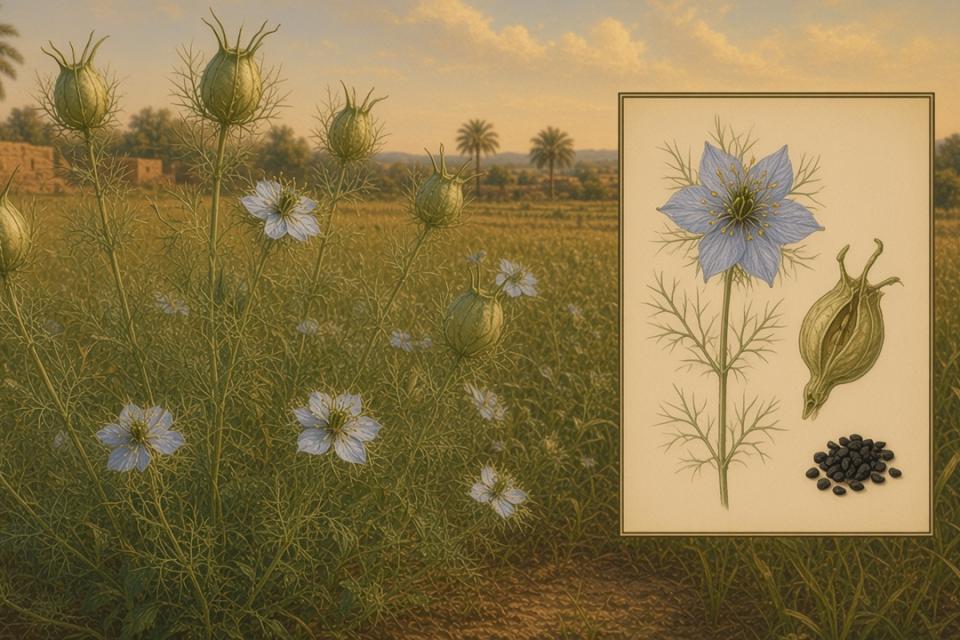
Nigella sativa L. is an annual herb in Ranunculaceae, the buttercup family; NCBI Taxonomy files it as taxon 555479, under the common name black cumin. Hannan and colleagues (Nutrients 2021) describe it as growing 20–30 cm tall, with linear leaves, bluish flowers, capsule-shaped fruits, and small black seeds that resemble cumin, hence the name. The garden flower love-in-a-mist, Nigella damascena, belongs to the same genus. Hannan and colleagues give the plant’s native range as a vast region of the eastern Mediterranean, northern Africa, the Indian subcontinent, and south-west Asia, and list Egypt, Iran, Greece, Syria, Albania, Turkey, Saudi Arabia, India, and Pakistan among the countries that cultivate it. The seeds are the part used, whole or ground, or pressed for oil.
The names cause real confusion. MSKCC lists black cumin, black caraway, black seed, and kalonji as common names, and Hannan and colleagues note the Arabic name habbat al-barakah, blessed seed. But true cumin is Cuminum cyminum, a member of the carrot family (Apiaceae), and the name black cumin is also used for Bunium persicum, an Apiaceae spice sold in South Asia as kala zeera; a 2011 cytogenetic study of that plant is titled with the words black cumin. Recipes, shop labels, and even some research papers mix these plants up. For medicinal purposes, the only reliable identifier is the botanical name Nigella sativa. Products include whole seed, ground seed in capsules, cold-pressed seed oil, honey-and-seed mixtures, and concentrated extracts.
Thymoquinone (PubChem CID 10281, C10H12O2) is the compound most researchers focus on: Hannan and colleagues describe it as the main bioactive component of the seed’s essential oil, and MSKCC also names nigellone, a constituent of crude extracts. Gaudin and colleagues (JAMA Dermatology 2018) analyzed one patient’s black seed oil and found mainly terpenes, thymoquinone, linoleic acid, and other fatty acids, with p-cymene among the terpenes. Composition varies a great deal. A 2022 safety assessment by Burdock and colleagues (Regulatory Toxicology and Pharmacology) reported widely variable results for the volatile fraction, which it attributed to crop origin, possible varietal differences, contamination or adulteration, extraction method, and seed maturity. Hannan and colleagues note that thymoquinone has poor bioavailability, so laboratory results with the pure compound may say little about what a capsule delivers.
02 Lineage
History
Black seed has deep roots in the ancient Near East. Among Howard Carter’s records of Tutankhamun’s tomb, now published by the Griffith Institute at the University of Oxford, a 1933 botanical report identifies black cumin (Nigella sativa), also called gith, and notes that seeds of the species were present in one sample from the tomb. That is a single find, and claims that black seed was a staple of Egyptian medicine or mummification go well beyond it. Burdock and colleagues describe a three-millennial history of use as a food ingredient in Middle Eastern and Far Eastern cultures. Hannan and colleagues write that Hippocrates and Dioscorides knew the seed as melanthion, and that Avicenna’s Canon of Medicine credited it with restoring energy and relieving tiredness.
Its special status in Islamic tradition comes from the hadith. In Sahih al-Bukhari, in the book of medicine, Abu Huraira reports hearing the Prophet say, “There is healing in black cumin for all diseases except death.” The narrator Ibn Shihab adds that the word translated as death is al-sam, and that the black seed meant is shuniz, another name for nigella. For many Muslims this saying gives black seed a place in what is often called prophetic medicine (al-Tibb al-Nabawi), and Hannan and colleagues note that it has long been prescribed in the Unani, Ayurveda, and Tibb systems. The hadith is a statement of faith and tradition; it is not a clinical claim, and it does not mean black seed can replace medical treatment for any illness.
Traditional uses are broad. Hannan and colleagues list asthma, bronchitis, rheumatism, headache, back pain, loss of appetite, amenorrhea, paralysis, inflammation, eczema, and high blood pressure, along with topical use of the oil on the skin. The US National Library of Medicine’s LactMed database notes that black seed and a related species have been used to increase breast milk supply in India, Türkiye, and the Middle East. Laboratory work on the seed and thymoquinone was under way by the 1990s, as MSKCC’s reference list shows, and was followed by a wave of small clinical trials, including many in Saudi Arabia and Iran. By the late 2010s enough trials existed for meta-analyses of blood glucose, lipids, blood pressure, asthma, and weight, and Burdock and colleagues concluded in 2022 that the seed, at historical levels of food use, is safe.
03 Chemistry
Active compounds and how it works
Most mechanistic evidence comes from cells and animals. MSKCC summarizes studies in which thymoquinone acted as an antioxidant, restoring glutathione and superoxide dismutase levels in animal models, and in which black seed oil reduced inflammatory signaling by inhibiting cyclooxygenase and lipoxygenase, the enzymes that make prostaglandins and leukotrienes. Nigellone inhibited histamine release from rat mast cells, which is the usual rationale for trials in asthma and allergy. In rats, black seed lowered blood pressure, probably through a diuretic effect, and in mice the oil lowered blood glucose, triglycerides, and cholesterol and also reduced platelet and white cell counts (MSKCC). Hannan and colleagues review animal studies attributing glucose lowering to increased insulin secretion and reduced oxidative stress.
Translating this to people is uncertain. Thymoquinone is poorly bioavailable, products vary widely in composition, and the doses used in animals are often far higher than human intakes or given by injection. Hannan and colleagues show how much the route matters: in rats and mice, the lethal dose of thymoquinone was roughly 795–871 mg/kg by mouth but 57–105 mg/kg by injection into the abdomen. The anticancer effects MSKCC describes, including inhibition of DNA synthesis and promotion of cell death in tumor cells, come from laboratory and animal models only. MSKCC also notes that the antioxidant effects that might protect healthy tissue from radiation could, in theory, protect cancer cells too, and that it is not known whether black seed makes radiotherapy less effective.
Black seed also affects drug handling. Al-Jenoobi and colleagues (Drug Metabolism Letters 2010) found that black seed extract inhibited the liver enzymes CYP2D6 and CYP3A4 in human liver microsomes and, in four healthy volunteers who took 2.5 g of seed twice daily for a week, changed urinary markers of the metabolism of the probe drug dextromethorphan in the same direction. Wang and colleagues (Chemico-Biological Interactions 2022) found that thymoquinone competitively inhibited the CYP2C9-mediated breakdown of warfarin in the laboratory and predicted that more than 1 g a day of seed or oil might alter warfarin levels. In rabbits, black seed lowered blood levels of cyclosporine, an anti-rejection drug (Al-Jenoobi and colleagues, BioMed Research International 2013).
04 In practice
Common uses
Blood glucose in type 2 diabetes: Daryabeygi-Khotbehsara and colleagues (Complementary Therapies in Medicine 2017) pooled seven trials in people with type 2 diabetes. Black seed lowered fasting blood glucose by about 18 mg/dl and HbA1c by 0.71 percentage points, and also lowered total and LDL cholesterol; effects on triglycerides and HDL cholesterol were not significant, and there was evidence of publication bias for HbA1c. In one of the better-known trials, Bamosa and colleagues (Indian Journal of Physiology and Pharmacology 2010) gave 94 people with type 2 diabetes capsules of 1, 2, or 3 g of seed a day for three months, added to their usual tablets. At 2 g a day, HbA1c fell by 1.52 percentage points from baseline; 1 g produced non-significant trends and 3 g added nothing. The trial had no placebo group, so some of that fall may reflect closer attention during the study. MSKCC describes the diabetes evidence as small studies showing benefit.
Cholesterol and blood pressure: Sahebkar and colleagues (Pharmacological Research 2016) pooled 17 randomized controlled trials and found that black seed lowered total cholesterol by about 16 mg/dl, LDL cholesterol by 14 mg/dl, and triglycerides by 21 mg/dl, with no overall effect on HDL; seed oil had larger effects on total and LDL cholesterol than seed powder. A companion meta-analysis (Journal of Hypertension 2016) pooled 11 trials with 860 people and found reductions of 3.3 mmHg in systolic and 2.8 mmHg in diastolic blood pressure compared with control after an average of about eight weeks, with powder doing better than oil. These are modest effects in short trials, MSKCC calls the blood pressure data conflicting, and no trial has shown fewer heart attacks or strokes.
Asthma: Koshak and colleagues (Phytotherapy Research 2017) randomized 80 adults with asthma to black seed oil capsules, 500 mg twice daily, or placebo for four weeks alongside their usual treatment. The Asthma Control Test score was modestly better with the oil (21.1 versus 19.6) and blood eosinophils, a marker of allergic inflammation, fell; lung function improved slightly but not significantly, and ten people dropped out of each group. He and Xu (American Journal of Emergency Medicine 2020) pooled just four trials and found improved asthma control scores and FEV1, but no clear effect on peak flow. MSKCC says black seed may help prevent asthma symptoms. It is an add-on that has been tested for weeks, not a substitute for inhalers.
Weight: Namazi and colleagues (Journal of Ethnopharmacology 2018) pooled 11 placebo-controlled trials and found that black seed reduced body weight by about 2.1 kg, body mass index by 1.2 kg/m², and waist circumference by 3.5 cm. The authors called the effect moderate, warned that heterogeneity for body weight was high and high-quality trials few, and noted that no serious side effects were reported. A difference of two kilograms over a few weeks or months is small, and the trials were too short to show whether any loss is maintained.
Other uses: MSKCC lists small trials suggesting benefit in rheumatoid arthritis, allergic symptoms, functional dyspepsia, Helicobacter pylori infection, and fatty liver disease; topical oil for cyclical breast pain and knee osteoarthritis; a gel that reduced the severity of radiation dermatitis in women with breast cancer; and fewer episodes of febrile neutropenia in children with brain tumors. In knee osteoarthritis, oral seed powder did not help, although oral oil did in another trial. A pilot study of thymoquinone in children with drug-resistant epilepsy is also listed. LactMed notes that no scientifically valid clinical trials support black seed as a galactogogue to increase milk supply. All of these findings need larger, independent trials.
05 The apothecary
Preparations and traditional use
There is no standard medicinal dose. Clinical trials have used ground seed in capsules at 1–3 g a day, with 2 g a day the most effective dose in the Bamosa diabetes trial; seed oil at 500 mg twice daily in the Koshak asthma trial; and 2.5 g of seed twice daily for a week in the Al-Jenoobi interaction study. Most trials lasted between a few weeks and three months, so longer-term effects of supplement doses are unknown. Hannan and colleagues describe a small study in which people with Helicobacter pylori took a mixture providing 6 g of ground seed and 12 g of honey a day for two weeks. Use as a cooking spice involves much smaller amounts, which Burdock and colleagues consider safe at historical levels of consumption.
Quality is a genuine problem. Burdock and colleagues report widely variable composition between samples, and LactMed notes that dietary supplements in the United States do not need pre-marketing approval, that labeled and actual contents often differ, and that results from one product may not apply to another. Choose products that name Nigella sativa, state whether they contain seed powder or oil, and give the amount per dose. Seed powder and oil are different products, and a result from a trial of one does not automatically apply to the other. Independent quality certification confirms content, not safety or effectiveness.
Applying black seed oil to the skin, including in hair and beard products, is a common source of allergic reactions. MSKCC notes that topical use of pure oil has caused allergic reactions, and the severe cases described by Gaudin and colleagues all followed use of the oil on the skin. Do not apply the oil to large areas or broken skin, stop at the first sign of a rash, and seek urgent care for blistering, peeling, fever, or a rash spreading beyond the area of use. If you take black seed regularly alongside any medicine, tell your prescriber and pharmacist, and do not take more than the doses used in trials.
Safety
Before you use black seed
06 Caution
Side effects
In clinical trials black seed has generally been well tolerated. Namazi and colleagues found no serious side effects reported across the weight-loss trials, Bamosa and colleagues saw no adverse effects on kidney or liver function at up to 3 g a day for three months, and LactMed summarizes the limited information as indicating that black seed is generally well tolerated. Trials were small and short, however, and MSKCC notes that high doses caused liver and kidney damage in rats, while human data are lacking.
Skin reactions are the best-documented harm. Allergic contact dermatitis from black seed oil has been reported repeatedly in Contact Dermatitis since the 1990s. Gaudin and colleagues (JAMA Dermatology 2018) described three women with severe acute contact dermatitis after using the oil: lesions spread beyond the area of application, mimicked Stevens–Johnson syndrome or toxic epidermal necrolysis, and caused severe illness with more than 15% skin detachment and fever. Biopsies showed death of skin cells, patch tests to each patient’s oil were positive, and the authors pointed to thymoquinone and p-cymene as the likely culprits. MSKCC also cites a case of drug reaction with eosinophilia and systemic symptoms (DRESS) in a 28-year-old woman after topical use that needed corticosteroid treatment, and a severe dermatitis in a partner exposed through a beard cosmetic.
Kidney and muscle injury have been reported after oral use. Arslan and colleagues (Journal of Integrative Medicine 2013) described acute kidney failure associated with Nigella sativa in a patient with diabetes. Sener and colleagues (Toxicon 2024) reported rhabdomyolysis, a breakdown of muscle tissue, together with acute kidney injury and liver toxicity after a person took black seed oil by mouth. Single case reports cannot prove cause, and black seed is widely used, but these reports are a reason to stop and seek care for reduced urine, dark urine, muscle pain, or jaundice.
Because black seed lowers blood glucose and blood pressure in trials, people taking diabetes or blood pressure medicines may see larger effects than expected, including low blood sugar, with shakiness, sweating, and confusion, or dizziness from low blood pressure. These are predictable from the pharmacology rather than common in published reports. In mice, black seed oil lowered platelet counts (MSKCC), and laboratory data suggest it could raise warfarin levels, so unusual bruising or bleeding should prompt a check.
07 Caution
Contraindications
Do not use black seed if you have had an allergic reaction to it or to black seed oil. Kurihara and colleagues (Contact Dermatitis 2020) identified thymoquinone as a causative allergen and found cross-reactivity with tert-butylhydroquinone (TBHQ), a common food and cosmetic preservative, and Seiller and colleagues (Contact Dermatitis 2021) reported five more cases in which TBHQ sensitivity marked black seed oil allergy. People known to react to TBHQ should be cautious with black seed products, especially on the skin.
Pregnancy and breastfeeding: there are no adequate human safety data for supplement doses in pregnancy. Hannan and colleagues summarize rat studies in which thymoquinone injected at 35–50 mg/kg during pregnancy caused maternal and embryonic toxicity, including complete loss of the pregnancy at the highest dose, although 15 mg/kg had no effect and injected doses do not translate directly to oral intake. Traditional uses include treating amenorrhea, which is another reason for caution. Culinary amounts are a different matter from capsules and oils. LactMed reports no data on the passage of black seed into breast milk or on safety in breastfed infants.
Medical conditions: people with diabetes treated with insulin or sulfonylureas, people with low blood pressure or on several blood pressure drugs, and people with kidney or liver disease should use black seed only with their doctor’s knowledge and monitoring. Transplant recipients taking cyclosporine or similar drugs should avoid it. People with cancer should discuss it with their oncology team, particularly during radiotherapy or chemotherapy, given MSKCC’s caution about antioxidants and the lack of evidence of anticancer benefit in humans.
Surgery and bleeding: because of the laboratory warfarin signal and the effect on platelets in mice, tell your surgical team if you take black seed supplements, and stop them before planned surgery if advised. Children: there are few safety data in children outside small trials, and black seed supplements should not be given to children without medical advice. Older adults who take several regular medicines face the greatest exposure to the interactions described below, and should ask a pharmacist to review their medicines before adding black seed capsules or oil.
08 Caution
Drug and herb interactions
Diabetes and blood pressure medicines: trials such as Bamosa’s added black seed to oral diabetes drugs and saw further falls in glucose and HbA1c, and in rats thymoquinone raised blood levels of the sulfonylurea glibenclamide (glyburide) by 13–22% with an added glucose-lowering effect (Hannan and colleagues). The meta-analyses show small reductions in blood pressure. If you take insulin, a sulfonylurea, or blood pressure drugs, monitor your glucose and blood pressure more closely when starting or stopping black seed, and tell your prescriber.
Drug metabolism: black seed inhibited CYP2D6 and CYP3A4 in human liver microsomes and in a four-person volunteer study (Al-Jenoobi and colleagues 2010), enzymes that process a large share of prescription drugs. The volunteers took 2.5 g of seed twice daily for a week and were then given the cough suppressant dextromethorphan as a probe drug; the breakdown of the probe slowed through both pathways, but four people is far too few to estimate the size of the effect. MSKCC advises that black seed may increase the side effects of drugs metabolized by cytochrome P450 enzymes, while noting that the clinical relevance is not known. In animals, black seed and thymoquinone lowered levels of cyclosporine taken by mouth, which could risk transplant rejection.
Warfarin and other blood thinners: Wang and colleagues found that thymoquinone competitively inhibited the CYP2C9 pathway that breaks down warfarin, and predicted that more than 1 g a day of seed or oil might alter warfarin levels; MSKCC lists the interaction with clinical significance unknown. Raised warfarin levels increase bleeding risk. Anyone on warfarin should avoid black seed supplements or use them only with extra INR monitoring agreed with their anticoagulation clinic, and people on other anticoagulants or antiplatelet drugs should ask their pharmacist first.
09 Questions
Frequently Asked Questions
No. Black seed is Nigella sativa, a member of the buttercup family. Cumin is Cuminum cyminum, from the carrot family, and the name black cumin is also used for a different carrot-family spice, Bunium persicum (kala zeera). The seeds look a little alike, which is where the confusion comes from. Check the botanical name on any supplement.
Modestly, in trials. A meta-analysis of seven trials in type 2 diabetes found falls of about 18 mg/dl in fasting glucose and 0.71 percentage points in HbA1c, and one trial found 2 g of seed a day worked best. The trials were small and short. If you take insulin or a sulfonylurea, check your glucose more often and tell your doctor. Cinnamon and fenugreek are other herbs studied for blood sugar, with similarly mixed evidence.
Meta-analyses suggest small reductions: about 14 mg/dl in LDL cholesterol across 17 trials, and about 3 mmHg in systolic blood pressure across 11 trials. These are modest, short-term changes, and no study has shown that black seed prevents heart attacks or strokes. It is not a replacement for prescribed treatment.
One placebo-controlled trial of 80 adults found 500 mg of oil twice daily for four weeks modestly improved asthma control scores and lowered eosinophils, with no significant change in lung function. A meta-analysis pooled only four trials. Use it, if at all, alongside your inhalers, never instead of them.
In Sahih al-Bukhari, Abu Huraira reports hearing the Prophet Muhammad say, “There is healing in black cumin for all diseases except death.” The saying gives black seed an honored place in prophetic medicine. It is a statement of faith and tradition rather than a clinical finding, and it does not mean black seed should replace medical care.
Not for everyone. Allergic contact dermatitis from black seed oil is well documented, and some reactions have been severe, with blistering, skin detachment, and fever. Avoid applying undiluted oil to large areas or broken skin, and stop and seek care if a rash appears or spreads.
Culinary amounts in food are a different matter from supplements, but there are no adequate human safety data for capsules or oils in pregnancy, and high injected doses of thymoquinone harmed pregnancies in rats. LactMed reports no data on black seed in breast milk and no valid trials supporting its use to increase milk supply. Avoid supplement doses unless your doctor advises otherwise.
It can. It may add to the effects of diabetes and blood pressure drugs, it inhibited the liver enzymes CYP2D6 and CYP3A4 in a small human study, it lowered cyclosporine levels in animals, and laboratory data suggest it could raise warfarin levels. Tell your doctor and pharmacist before taking it with any prescription medicine.
10 References
Sources
These references support the history, clinical, and safety claims on this page. They are not an endorsement of any product.
-
Nigella sativa
Memorial Sloan Kettering Cancer Center, About Herbs, 2023
Clinical summary (updated August 2023): not shown to treat cancer; small trials in diabetes, asthma, and other conditions; conflicting blood pressure data; contact dermatitis and DRESS; CYP2D6, CYP3A4, and warfarin interactions.
-
Black Seed
Drugs and Lactation Database (LactMed), NICHD (PubMed 30000936), 2025
Updated July 2025: traditional galactogogue use without valid supporting trials; no data on breast milk transfer or infant safety; generally well tolerated; allergic contact dermatitis; supplement quality caveats.
-
Black Cumin (Nigella sativa L.): A Comprehensive Review on Phytochemistry, Health Benefits, Molecular Pharmacology, and Safety
Nutrients (PubMed 34073784), 2021
Hannan et al.: botany, native range, traditional uses, thymoquinone pharmacology and bioavailability, animal toxicity and pregnancy data, and herb–drug interaction studies.
-
Sahih al-Bukhari 5688, Book of Medicine: black cumin
Sunnah.com, 2026
Hadith narrated by Abu Huraira: “There is healing in black cumin for all diseases except death,” with Ibn Shihab’s gloss of the terms.
-
Botanical specimens (Tutankhamun Archive, TAA i.3.2)
Griffith Institute, University of Oxford, archived by the Internet Archive, 2026
Archived copy (March 2026) of the Griffith Institute page, which is not available over https. Transcribed 1933 botanical report from Howard Carter’s records: seeds of Nigella sativa (black cumin) present in one sample from Tutankhamun’s tomb.
-
Nigella sativa improves glucose homeostasis and serum lipids in type 2 diabetes: A systematic review and meta-analysis
Complementary Therapies in Medicine (PubMed 29154069), 2017
Daryabeygi-Khotbehsara et al.: seven trials; fasting glucose −17.84 mg/dl, HbA1c −0.71%, total and LDL cholesterol lowered; possible publication bias for HbA1c.
-
Effect of Nigella sativa seeds on the glycemic control of patients with type 2 diabetes mellitus
Indian Journal of Physiology and Pharmacology (PubMed 21675032), 2010
Bamosa et al.: 94 patients on oral drugs given 1, 2, or 3 g/day for 12 weeks; 2 g/day lowered HbA1c by 1.52% from baseline; no placebo group; no renal or hepatic harm.
-
Nigella sativa (black seed) effects on plasma lipid concentrations in humans: A systematic review and meta-analysis of randomized placebo-controlled trials
Pharmacological Research (PubMed 26875640), 2016
Sahebkar et al.: 17 RCTs; total cholesterol −15.65, LDL −14.10, and triglycerides −20.64 mg/dl; no effect on HDL overall.
-
A systematic review and meta-analysis of randomized controlled trials investigating the effects of supplementation with Nigella sativa (black seed) on blood pressure
Journal of Hypertension (PubMed 27512971), 2016
Sahebkar et al.: 11 RCTs, 860 participants; systolic −3.26 and diastolic −2.80 mmHg versus control after about eight weeks; powder more effective than oil.
-
Nigella sativa Supplementation Improves Asthma Control and Biomarkers: A Randomized, Double-Blind, Placebo-Controlled Trial
Phytotherapy Research (PubMed 28093815), 2017
Koshak et al.: 80 adults with asthma; oil 500 mg twice daily for four weeks improved Asthma Control Test scores and eosinophils; FEV1 change not significant.
-
The effects of Nigella sativa L. on obesity: A systematic review and meta-analysis
Journal of Ethnopharmacology (PubMed 29559374), 2018
Namazi et al.: 11 placebo-controlled trials; weight −2.11 kg, BMI −1.16 kg/m², waist −3.52 cm; high heterogeneity and few high-quality studies.
-
Association Between Severe Acute Contact Dermatitis Due to Nigella sativa Oil and Epidermal Apoptosis
JAMA Dermatology (PubMed 30073256), 2018
Gaudin et al.: three women with severe reactions mimicking Stevens–Johnson syndrome, more than 15% skin detachment and fever; thymoquinone and p-cymene implicated.
-
Rhabdomyolysis and acute kidney injury after consumption of black seed oil
Toxicon (PubMed 38844000), 2024
Sener et al.: case report of rhabdomyolysis, acute kidney injury, and liver toxicity after ingestion of black seed oil.
-
Effect of black seed on dextromethorphan O- and N-demethylation in human liver microsomes and healthy human subjects
Drug Metabolism Letters (PubMed 20201775), 2010
Al-Jenoobi et al.: black seed inhibited CYP2D6 and CYP3A4 in microsomes and in four volunteers taking 2.5 g twice daily for seven days.
-
Potential food-drug interaction risk of thymoquinone with warfarin
Chemico-Biological Interactions (PubMed 35921950), 2022
Wang et al.: thymoquinone competitively inhibited CYP2C9-mediated warfarin 7-hydroxylation in vitro; modeling suggested more than 1 g/day of seed or oil might alter warfarin levels.