Monograph
Holy Basil
Ocimum tenuiflorum
Updated October 4, 2026
Key points
-
01
Sacred herb, early evidence
Tulsi is central to Ayurveda and Hindu worship, but a 2017 review found only seven high-quality human studies, and the Merck Manual says it is not proven for any condition.
-
02
Modest stress signals
Two placebo-controlled trials of proprietary extracts found lower stress scores, and one found lower cortisol, over six to eight weeks. Both were small and one was manufacturer-funded.
-
03
Blood sugar cuts both ways
Small trials suggest holy basil lowers glucose. That is a reason for monitoring if you take diabetes medicines, not a substitute for treatment.
-
04
Avoid when trying to conceive
Animal studies found impaired implantation and pregnancy and reduced sperm counts. The Merck Manual advises avoiding it in pregnancy and when trying to conceive.
-
05
Thyroid and bleeding cautions
Holy basil may lower thyroxine, reduce the effect of thyroid medicines, and slow clotting. Tell your doctor if you have thyroid disease, take blood thinners, or face surgery.
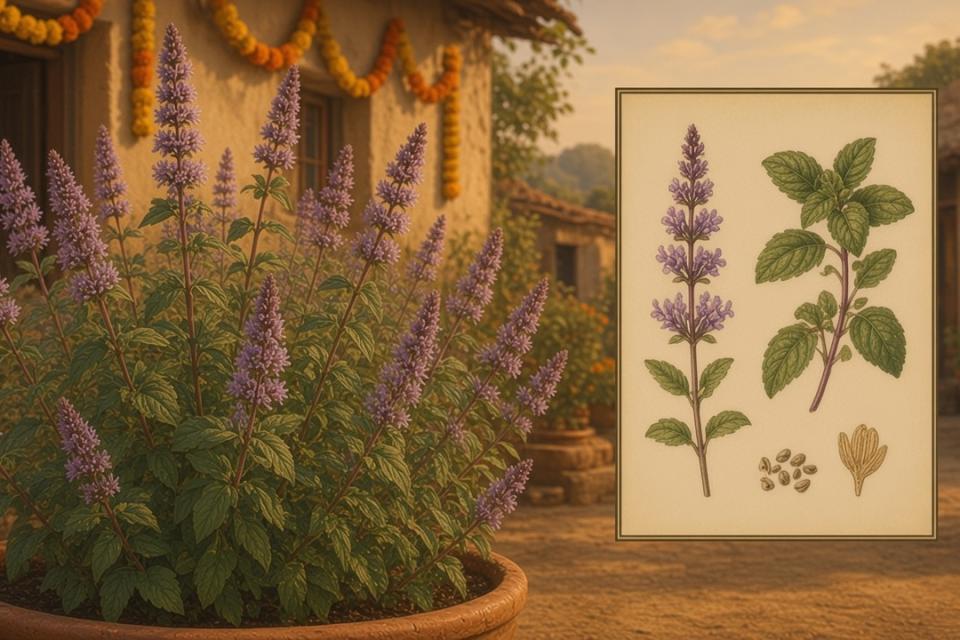
Holy basil, known in India as tulsi, is the most revered plant in Ayurveda and in many Hindu homes. Ayurvedic texts call it the elixir of life and the queen of herbs, and households traditionally keep a living plant in a pot in the courtyard for daily worship. Botanically it is Ocimum tenuiflorum, long known by the synonym Ocimum sanctum, a clove-scented perennial relative of the sweet basil used in cooking. In Western shops it is sold as tea, capsules, and extracts, usually marketed as an adaptogen: a herb said to help the body adapt to stress.
The evidence is encouraging but still limited. Small trials, mostly from India and several funded by extract manufacturers, suggest that standardized extracts may modestly reduce self-reported stress and improve sleep; the best of them, an Australian trial of 100 stressed adults published in 2022, found lower perceived stress and lower hair cortisol after eight weeks. Jamshidi and Cohen’s 2017 systematic review found 24 human studies that all reported favorable results, but judged only seven to be of high quality. The Merck Manual, reviewing the herb in 2025, says there are few high-quality studies showing that holy basil is effective for any health condition. There is no EU herbal monograph, no NCCIH fact sheet, and no agreed dose.
The cautions are specific. The Merck Manual advises people who are pregnant or trying to conceive to avoid holy basil, because large doses impaired implantation and pregnancy in animals. It may lower thyroid hormone, slow blood clotting, and add to the effect of diabetes medicines, and its safety beyond about eight weeks of use has not been studied. Tulsi tea is a pleasant, traditional drink; concentrated extracts are medicines with unknowns. Nothing here is medical advice, and persistent anxiety, insomnia, low mood, or raised blood sugar deserve proper assessment rather than a supplement alone.
Featured in
Herbs for Anxiety and Stress Herbs for Energy and Fatigue Herbs for Low Mood and Depression Herbs for Blood Sugar Herbs for Libido and Sexual HealthIn this monograph
01 The plant
Botanical profile
Ocimum tenuiflorum L. belongs to Lamiaceae, the mint family, alongside sweet basil, rosemary, and sage. NCBI Taxonomy files it as taxon 204149, with Ocimum sanctum as a synonym and holy basil as the common name; MSKCC lists both scientific names and stresses that holy basil should not be confused with culinary basil. Cohen (Journal of Ayurveda and Integrative Medicine 2014) describes an aromatic shrub thought to have originated in north central India that now grows throughout the tropics of the eastern world. Jamshidi and Cohen describe three types of tulsi. Rama or Sri tulsi, with green leaves, and Krishna or Shyama tulsi, with purplish leaves, are two cultivars of O. tenuiflorum. Vana, or wild forest tulsi, is a different species, Ocimum gratissimum, with about six times as much DNA, though it is traditionally used the same way. True tulsi types are distinguished from other basils by yellow pollen, high eugenol content, and a smaller chromosome number.
Genetics explains some of the visible differences. Upadhyay and colleagues (BMC Plant Biology 2015) published a draft genome of Krishna tulsi, assembling 374 megabases of an estimated 612-megabase genome. Genes for anthocyanin pigments were highly expressed in Krishna tulsi leaves, accounting for their purple color, while genes for ursolic acid production were most active in young leaves of the Rama type; mass spectrometry confirmed eugenol and ursolic acid in the plant. Cohen notes that Krishna tulsi has a higher phenolic content and antioxidant capacity than Vana tulsi. The leaf, fresh or dried, is the part most often used.
MSKCC attributes holy basil’s effects to constituents including eugenol, carvacrol, ursolic acid (PubChem CID 64945), β-caryophyllene, the flavonoids orientin and vicenin, and rosmarinic acid. Eugenol (PubChem CID 3314, C10H12O2) gives tulsi its clove-like smell, and Jamshidi and Cohen describe it as the major bioactive compound common to all three tulsi types, though amounts vary between cultivars and with growing conditions. The Merck Manual adds camphor, eucalyptol, and bisabolenes. Quality is a practical issue: Cohen cites reports that European products sold as tulsi were frequently substituted with sweet basil (Ocimum basilicum), and that tulsi leaves grown in polluted areas carried almost twice the concentration of toxic elements as leaves from clean areas. A capsule labeled holy basil may not contain what the trials tested.
02 Lineage
History
Jamshidi and Cohen (Evidence-Based Complementary and Alternative Medicine 2017) note that tulsi, Tulasi in Sanskrit, has been used in Ayurvedic medicine for more than 3,000 years. Cohen records its traditional titles, The Incomparable One, Mother Medicine of Nature, and The Queen of Herbs, and its Ayurvedic description as hot and bitter in taste, able to penetrate deep tissues and balance the kapha and vata doshas. Daily use was said to prevent disease and promote longevity. Traditional indications were broad: anxiety, cough, asthma, diarrhea, fever, dysentery, arthritis, eye diseases, earache, indigestion, vomiting, skin diseases, snake and scorpion bites, and malaria. The Indian Materia Medica describes leaf extracts for bronchitis, rheumatism, and fever, leaf juice dropped into the ear for earache, and tulsi tea for stomach and liver complaints.
Tulsi is as much a sacred plant as a medicine. Cohen explains that in Hinduism tulsi is worshipped as a goddess, every part of the plant is considered holy, and a Hindu household is considered incomplete without a tulsi plant, typically grown in an ornate earthen pot in the courtyard. Its clove-like aroma, from eugenol, was also valued for repelling mosquitoes and flies. The leaves are taken in morning and evening rituals, steeped as tea, and used to make holy water, a practice Cohen notes in some Greek Orthodox churches as well. Beads carved from tulsi wood or seeds are strung into malas for prayer and meditation. Hundreds of thousands of tulsi plants have been planted around the Taj Mahal in an effort to protect the marble from air pollution.
Laboratory research came later. Jamshidi and Cohen note animal studies over the past fifty years reporting effects on blood glucose and lipids, and laboratory work has attributed an enormous list of actions to tulsi; Cohen’s list includes anti-stress, antidiabetic, and anti-inflammatory effects, but also antithyroid, antifertility, and anticoagulant activity, a reminder that strong pharmacology cuts both ways. Small human trials followed in India, including a crossover trial in type 2 diabetes published in 1996. Standardized commercial extracts were then tested against placebo for stress, in India in 2012 and in Australia in 2022. Tulsi teas are now sold worldwide. Readers should know that the author of both major reviews cited here declared paid consultancy for a company that sells tulsi products.
03 Chemistry
Active compounds and how it works
Stress hormones are the main proposed target. MSKCC summarizes laboratory and animal work suggesting that holy basil inhibits cortisol release, blocks the corticotropin-releasing hormone receptor CRHR1, and inhibits the enzymes 11β-hydroxysteroid dehydrogenase type 1 and catechol-O-methyltransferase, which regenerate cortisol and break down catecholamines respectively. In the one rigorous human trial to measure this, Lopresti and colleagues (Frontiers in Nutrition 2022) found lower hair cortisol after eight weeks of extract, and smaller rises in salivary cortisol, salivary amylase, and blood pressure during a laboratory stress test, consistent with damping of the hypothalamic-pituitary-adrenal axis and sympathetic nervous system. That is a single, industry-funded trial of one proprietary extract.
For blood sugar, MSKCC cites laboratory evidence that holy basil leaf extracts stimulate insulin secretion from pancreatic tissue and beta cells. Jamshidi and Cohen add that eugenol may lower glucose by competing with glucose for binding to serum albumin and by slowing the conversion of complex carbohydrates to glucose. Cohen attributes anti-inflammatory effects seen in animal models to eugenol and linoleic acid, acting through inhibition of the cyclooxygenase and lipoxygenase pathways, the same broad targets as anti-inflammatory painkillers. These mechanisms are plausible but come mainly from cell and animal studies at doses well above typical human intake.
Some actions matter more for safety than benefit. Panda and Kar (Pharmacological Research 1998) gave male mice 0.5 g of leaf extract per kilogram daily for 15 days and found lower serum thyroxine (T4) without a change in T3. Ahmed and colleagues (Journal of Basic and Clinical Physiology and Pharmacology 2002) found that a leaf extract given to rats for 48 days reduced sperm count and motility, an effect they attributed to anti-androgenic activity and that reversed two weeks after stopping. The Merck Manual notes that holy basil appears to inhibit platelet aggregation and prolong clotting times. Cohen cites laboratory evidence that tulsi increases the activity of liver cytochrome P450 enzymes, which could in principle change drug levels; no human interaction studies were found.
04 In practice
Common uses
Stress is the best-studied use. Saxena and colleagues (Evidence-Based Complementary and Alternative Medicine 2012) randomized 150 adults with symptoms of general stress to an extract called OciBest, 1,200 mg of actives per day, or placebo for six weeks. Forgetfulness, exhaustion, recent sleep problems, and recent sexual problems improved more on the extract, and total symptom scores improved about 39% more than with placebo; no adverse events were reported. Lopresti and colleagues (Frontiers in Nutrition 2022) randomized 100 stressed adults aged 18 to 65 to 125 mg of a standardized extract (Holixer) twice daily or placebo for eight weeks. Perceived stress fell 37% versus 19%, and insomnia scores 48% versus 27%, with lower hair cortisol at eight weeks. Sleep measured by a wrist tracker did not differ between groups, and the study was funded by the extract’s manufacturer.
Anxiety and thinking have smaller evidence bases. Bhattacharyya and colleagues (Nepal Medical College Journal 2008) gave 35 adults with generalized anxiety disorder 500 mg of leaf extract twice daily after meals for 60 days and reported reduced anxiety, stress, and depression scores; Lopresti’s team notes that this study had no placebo group, so it cannot separate the herb from time and expectation. Sampath and colleagues (Indian Journal of Physiology and Pharmacology 2015) gave healthy adults 300 mg of ethanolic leaf extract or placebo daily for 30 days and found faster reaction times and fewer errors on memory and attention tasks with the extract. Both are small single-center studies that have not been independently replicated.
Blood sugar and metabolic health make up most of the human literature. Agrawal, Rai, and Singh (International Journal of Clinical Pharmacology and Therapeutics 1996) ran a single-blind crossover trial of holy basil leaves versus placebo leaves in type 2 diabetes; the Merck Manual describes it as involving 40 patients. Fasting glucose fell by 21 mg/dL (17.6%) and after-meal glucose by 15.8 mg/dL (7.3%) during the basil period. The Merck Manual also cites a 90-day study of 60 patients in which adding holy basil to glibenclamide gave slightly more improvement in glucose and HbA1c than the drug alone. Jamshidi and Cohen counted 15 metabolic studies, but most were small, short, unblinded, or poorly reported. Holy basil is not a substitute for diabetes treatment, and any glucose-lowering effect is a reason for monitoring, not for adjusting medicines on your own.
Other uses are early. Mondal and colleagues (Journal of Ethnopharmacology 2011) gave 300 mg of ethanolic leaf extract or placebo to 24 healthy volunteers in a crossover trial and found increases in interferon-gamma, interleukin-4, T-helper cells, and natural killer cells after four weeks; laboratory markers like these do not show fewer or milder infections. MSKCC notes small studies of tulsi mouthwashes for oral health and of a multi-herb eye drop formulation, and Cohen reports trials in which tulsi mouth rinses reduced levels of Streptococcus mutans, the main tooth-decay bacterium, comparably to 0.2% chlorhexidine. Jamshidi and Cohen conclude that there is insufficient evidence for any specific tulsi formulation in any one condition, and that larger, longer, standardized trials are needed before specific recommendations can be made.
05 The apothecary
Preparations and traditional use
There is no official dose. Holy basil has no EU herbal monograph and no NCCIH fact sheet, so doses come from individual trials of specific products: 1,200 mg per day of the OciBest extract for six weeks; 125 mg of the Holixer extract twice daily for eight weeks; 500 mg of leaf extract twice daily after meals for 60 days in anxiety; 300 mg of ethanolic leaf extract daily for 30 days in the cognition study and four weeks in the immunity study; and 250 mg of extract twice daily before meals for eight weeks in a small obesity study. Across 24 studies, Jamshidi and Cohen found doses from 300 mg to 3,000 mg per day of aqueous leaf extract and 300–1,000 mg once or twice daily of ethanolic extract, for 2 to 13 weeks. These products are not interchangeable.
Tea is the traditional form. Cohen notes that many Ayurvedic practitioners recommend regular tulsi tea as a daily lifestyle practice, and dried leaf teas, alone or blended, are widely sold. No trial has established a tea dose or tested tea against placebo for a clinical outcome, so tea should be thought of as a food-level exposure rather than a treatment. The Merck Manual says holy basil seems safe for most people when taken by mouth for up to eight weeks and that the safety of longer use has not been studied; the longest study in the Jamshidi review lasted 13 weeks.
Product choice matters because substitution and contamination have been reported. Look for a product that names Ocimum tenuiflorum or Ocimum sanctum, the plant part, the type of extract and its standardization, and independent testing for identity, heavy metals, and pesticides. The trial extracts were proprietary; Holixer, for example, was standardized to at least 5% of a manufacturer-defined bioactive complex, so results from one brand do not transfer to another. The clinical studies used leaves, teas, tinctures, and extracts, not essential oil, which is a concentrated product and not a studied oral remedy. Stop and seek advice if new symptoms appear.
Safety
Before you use holy basil
06 Caution
Side effects
In short trials holy basil appears well tolerated. MSKCC lists nausea, headache, and agitation as reported side effects; the Merck Manual lists nausea and diarrhea. Jamshidi and Cohen found that across 24 studies only one reported a side effect, transient mild nausea, but several studies did not report on adverse events at all, which is not the same as showing there were none. All the studies were short, so long-term effects are unknown.
The Australian trial gives the clearest picture. In Lopresti’s study, 83% of participants reported no adverse events, and the frequency of side effects was similar on extract and placebo: digestive disturbances in five people in each group, headache in three on extract and two on placebo, and occasional reports of vivid dreams, skin rash, sleep disturbance, agitation, and reduced libido. One person taking holy basil withdrew because of increased agitation, and one taking placebo withdrew because of nausea. No serious adverse events occurred.
The more important effects are pharmacological. The Merck Manual warns that holy basil might decrease thyroxine levels and worsen hypothyroidism, and that by inhibiting platelets and prolonging clotting it may increase the risk of bleeding during and after surgery. Its glucose-lowering effect, useful in theory, could contribute to low blood sugar in people taking diabetes medicines. Watch for unusual bruising or bleeding, tiredness or cold intolerance suggestive of an underactive thyroid, or shakiness and sweating suggestive of low blood sugar, and stop the supplement and seek advice if they occur.
07 Caution
Contraindications
Pregnancy and conception: the Merck Manual says holy basil might not be safe for women who are pregnant or trying to become pregnant, because in animal studies large doses reduced the chance that a fertilized egg would implant and that a pregnancy would go to full term, and it advises anyone trying to conceive to avoid it. Safety during breastfeeding has not been studied. Animal data also show reduced sperm count and motility in rats, reversible after stopping; whether this happens in men is unknown, but couples trying to conceive have reason to avoid concentrated extracts.
Thyroid disease: because holy basil may lower thyroxine (Merck Manual) and lowered T4 in mice (Panda and Kar 1998), people with hypothyroidism or other thyroid conditions should not use it without discussing it with their doctor, and those who do should have thyroid function checked. Bleeding: people with bleeding disorders, and anyone due to have surgery or dental procedures, should avoid it; tell your surgeon if you have been taking it, because of the possible effect on platelets and clotting.
Diabetes: people taking insulin, sulfonylureas such as glibenclamide, or other glucose-lowering drugs should only use holy basil with their prescriber’s knowledge and with closer glucose monitoring. Children: Jamshidi and Cohen found studies in people aged 10 to 80, but there are too few data in children to recommend use. Anxiety and insomnia that persist or interfere with daily life, low mood, or thoughts of self-harm need medical or psychological care; a herb should not delay that.
08 Caution
Drug and herb interactions
The Merck Manual lists three interaction concerns. Holy basil may reduce the effectiveness of thyroid hormone medicines such as levothyroxine. Its effect on clotting may increase the risk of bleeding in people taking antiplatelet drugs (aspirin, clopidogrel) or anticoagulants (warfarin, apixaban, rivaroxaban, and others). And animal data suggest it may enhance the sedating effect of barbiturates. If you take any of these, talk to your prescriber or pharmacist before starting holy basil.
Diabetes medicines: in trials holy basil lowered fasting and after-meal glucose and gave slightly more improvement when added to glibenclamide (Merck Manual). Combined with insulin or sulfonylureas, that could cause low blood sugar, with shakiness, sweating, hunger, or confusion. The effect size in the small trials was large enough to matter clinically if it is real, and products vary in strength, so the response to a new brand is hard to predict. Monitor glucose more often when starting, stopping, or switching holy basil products, and do not change diabetes medicines without advice.
Drug metabolism: Cohen cites laboratory evidence that tulsi increases the activity of liver cytochrome P450 enzymes, which could lower levels of some drugs, but no human studies of this were identified and MSKCC’s summary does not list specific drug interactions. For medicines with a narrow margin between effective and toxic doses, such as transplant drugs, anticonvulsants, and some cancer treatments, ask a pharmacist before taking concentrated extracts regularly. Tulsi tea at ordinary amounts is a smaller exposure than extract capsules.
09 Questions
Frequently Asked Questions
No. Holy basil (Ocimum tenuiflorum, also called Ocimum sanctum) is a different species from sweet basil (Ocimum basilicum), with a clove-like scent from eugenol. MSKCC warns not to confuse the two, and products sold as tulsi have sometimes been found to contain sweet basil instead.
Possibly, modestly. Two placebo-controlled trials of standardized extracts found greater reductions in stress symptoms than placebo over six to eight weeks, and one also found lower cortisol and better self-rated sleep. The trials were small, short, and partly manufacturer-funded, and an anxiety study had no placebo group. Persistent anxiety deserves proper assessment.
It is marketed that way. Adaptogen is a traditional and marketing concept rather than a medical category, describing herbs said to help the body cope with stress. Holy basil is often grouped with ashwagandha and rhodiola; each has small trials for stress, and none is a proven treatment for anxiety or burnout.
There is no official dose. Trials used specific extracts at 250–1,200 mg per day for one to two months, and results from one product do not transfer to another. Tulsi tea has not been tested as a treatment. The Merck Manual says use up to eight weeks seems safe for most people but longer use has not been studied.
Small trials suggest it may lower fasting and after-meal glucose, including when added to diabetes medicine. Evidence quality is low. If you take insulin or other glucose-lowering drugs, use it only with your prescriber’s knowledge and check your blood sugar more often, because the combination could cause hypoglycemia.
It is best avoided. The Merck Manual notes that large doses reduced implantation and full-term pregnancy in animals and advises anyone trying to conceive not to use it. It also reduced sperm counts in rats. Safety in breastfeeding has not been studied.
It may. The Merck Manual warns that holy basil may lower thyroxine and reduce the effect of thyroid hormone medicines, and that its anti-clotting effect may raise bleeding risk with antiplatelet drugs or anticoagulants. Animal data also suggest added sedation with barbiturates. Ask your pharmacist before combining them.
Tulsi tea is drunk daily in India and short trials of much more concentrated extracts reported few side effects, but long-term safety has not been formally studied. People who are pregnant or trying to conceive, have thyroid disease, or take blood thinners or diabetes medicines should check with a professional first. Lemon balm and chamomile are other traditional calming teas.
10 References
Sources
These references support the history, clinical, and safety claims on this page. They are not an endorsement of any product.
-
Holy Basil
Memorial Sloan Kettering Cancer Center, About Herbs, 2026
Clinical summary (updated September 2026): Ayurvedic uses; small studies on stress, sleep, anxiety, cognition, and oral health; proposed cortisol, CRHR1, 11β-HSD1, and COMT mechanisms; nausea, headache, and agitation.
-
Holy Basil
Merck Manual Professional Edition, 2025
Reviewed July 2025: few high-quality human studies; safety beyond 8 weeks unstudied; pregnancy and conception caution from animal data; may lower thyroxine and impair clotting; thyroid, anticoagulant, and barbiturate interactions.
-
Tulsi – Ocimum sanctum: a herb for all reasons
Journal of Ayurveda and Integrative Medicine (PubMed 25624701), 2014
Cohen: narrative review of Ayurvedic status, religious use, laboratory pharmacology, and product substitution with sweet basil. Author declares consultancy for a tulsi product company.
-
The clinical efficacy and safety of tulsi in humans: a systematic review of the literature
Evidence-Based Complementary and Alternative Medicine (PubMed 28400848), 2017
Jamshidi and Cohen: 24 studies, 1,111 participants, all favorable, only 7 high quality; durations 2–13 weeks; one report of mild nausea; three tulsi types described.
-
A randomized, double-blind, placebo-controlled trial investigating the effects of an Ocimum tenuiflorum (Holy Basil) extract (Holixer) on stress, mood, and sleep in adults experiencing stress
Frontiers in Nutrition (PubMed 36185698), 2022
Lopresti et al.: 100 adults, 125 mg twice daily for 8 weeks; perceived stress down 37% vs 19%, lower hair cortisol; tracker-measured sleep unchanged; manufacturer-funded.
-
Efficacy of an extract of Ocimum tenuiflorum (OciBest) in the management of general stress: a double-blind, placebo-controlled study
Evidence-Based Complementary and Alternative Medicine (PubMed 21977056), 2012
Saxena et al.: 150 adults, 1,200 mg per day for 6 weeks; total stress symptom score improved about 39% more than placebo; no adverse events reported.
-
Controlled programmed trial of Ocimum sanctum leaf on generalized anxiety disorders
Nepal Medical College Journal (PubMed 19253862), 2008
Bhattacharyya et al.: 35 adults with generalized anxiety disorder, 500 mg twice daily for 60 days; anxiety scores fell; no placebo group.
-
Holy basil (Ocimum sanctum Linn.) leaf extract enhances specific cognitive parameters in healthy adult volunteers: a placebo controlled study
Indian Journal of Physiology and Pharmacology (PubMed 26571987), 2015
Sampath et al.: 300 mg ethanolic leaf extract daily for 30 days improved reaction time and error rates on Sternberg and Stroop tasks versus placebo.
-
Randomized placebo-controlled, single blind trial of holy basil leaves in patients with noninsulin-dependent diabetes mellitus
International Journal of Clinical Pharmacology and Therapeutics (PubMed 8880292), 1996
Agrawal, Rai, and Singh: crossover trial; fasting glucose fell 21 mg/dL (17.6%) and postprandial glucose 15.8 mg/dL (7.3%) during holy basil treatment.
-
Double-blinded randomized controlled trial for immunomodulatory effects of Tulsi (Ocimum sanctum Linn.) leaf extract on healthy volunteers
Journal of Ethnopharmacology (PubMed 21619917), 2011
Mondal et al.: 24 healthy volunteers, 300 mg ethanolic extract for 4 weeks in a crossover design; raised interferon-gamma, IL-4, T-helper, and NK cells.
-
Genome sequencing of herb Tulsi (Ocimum tenuiflorum) unravels key genes behind its strong medicinal properties
BMC Plant Biology (PubMed 26315624), 2015
Upadhyay et al.: draft genome of Krishna tulsi; anthocyanin genes explain purple leaves; ursolic acid genes high in young Rama leaves; eugenol and ursolic acid confirmed.
-
Ocimum sanctum leaf extract in the regulation of thyroid function in the male mouse
Pharmacological Research (PubMed 9721597), 1998
Panda and Kar: 0.5 g/kg leaf extract for 15 days lowered serum T4 in male mice without changing T3; basis for thyroid cautions.
-
Reversible anti-fertility effect of benzene extract of Ocimum sanctum leaves on sperm parameters and fructose content in rats
Journal of Basic and Clinical Physiology and Pharmacology (PubMed 12099405), 2002
Ahmed et al.: 250 mg/kg leaf extract for 48 days reduced sperm count and motility in rats, attributed to anti-androgenic activity; reversed 2 weeks after stopping.
-
Ocimum tenuiflorum (holy basil)
NCBI Taxonomy, National Library of Medicine (NIH), 2026
Taxon 204149; lists Ocimum sanctum as a synonym and holy basil as the common name.
-
Eugenol
PubChem, National Library of Medicine (NIH), 2026
Clove-scented phenylpropanoid and major bioactive constituent of tulsi; CID 3314, C10H12O2.