
Monograph
Hops
Humulus lupulus
Updated October 10, 2026
Key points
-
01
Traditional EU remedy for stress and sleep
EMA accepts hop teas, tinctures, and extracts as traditional medicines for mild stress and to aid sleep. No trials have tested hops alone for insomnia.
-
02
Best studied with valerian
Valerian-hops combinations have well-established EU status for sleep disorders. The largest trial, of 184 adults, found only modest benefits over placebo.
-
03
A strong phytoestrogen
Hops contain 8-prenylnaringenin, one of the strongest plant estrogens known. Small trials of 8-PN extracts for hot flashes have not shown clear efficacy.
-
04
Drowsiness and hormone cautions
Hops may impair driving and add to alcohol and sedatives. Avoid in pregnancy and breastfeeding, and ask a doctor first with a hormone-sensitive cancer.
-
05
Toxic to dogs
Dogs that eat hops, including spent brewing hops, can develop dangerous hyperthermia within hours. Some die even with treatment; treat it as an emergency.
Hops are the papery green cones of the female hop plant, and almost everyone has tasted them: they are what make beer bitter. EMA’s assessment report notes that hops have been used in beer for their bitterness and preservative action for more than a thousand years, and that the plant gained a reputation as a sedative partly because hop pickers were observed to tire easily. Today the EU’s herbal committee accepts hop strobile teas, tinctures, and extracts as traditional herbal medicines for relief of mild symptoms of mental stress and to aid sleep, and accepts fixed combinations of valerian and hop extracts as well-established medicines for sleep disorders.
The science is still catching up with that history. EMA found no clinical trials of hops alone for restlessness or insomnia; the sleep evidence comes almost entirely from valerian and hops taken together, and the largest such trial found only modest benefits. Hops are also chemically unusual. They contain 8-prenylnaringenin (8-PN), which Milligan and colleagues (Journal of Clinical Endocrinology and Metabolism 1999) identified as a phytoestrogen stronger than other established plant estrogens, and a few small trials have tested 8-PN-standardized hop extracts for menopausal hot flashes with mixed results.
The cautions follow from that profile. Hops may cause drowsiness and may add to the effects of alcohol and sedative drugs, so EMA advises against driving if affected. Their estrogenic potential makes them a poor choice for anyone with a hormone-sensitive cancer without medical advice, and EMA does not recommend them in pregnancy or breastfeeding. And hops are dangerous to dogs: eating hops, including spent hops left over from brewing, can cause a severe and sometimes fatal rise in body temperature. Nothing here is medical advice, and persistent insomnia, low mood, or anxiety deserve proper assessment rather than a herbal sedative.
Ingredient in
Valerian and HopsIn this monograph
01 The plant
Botanical profile
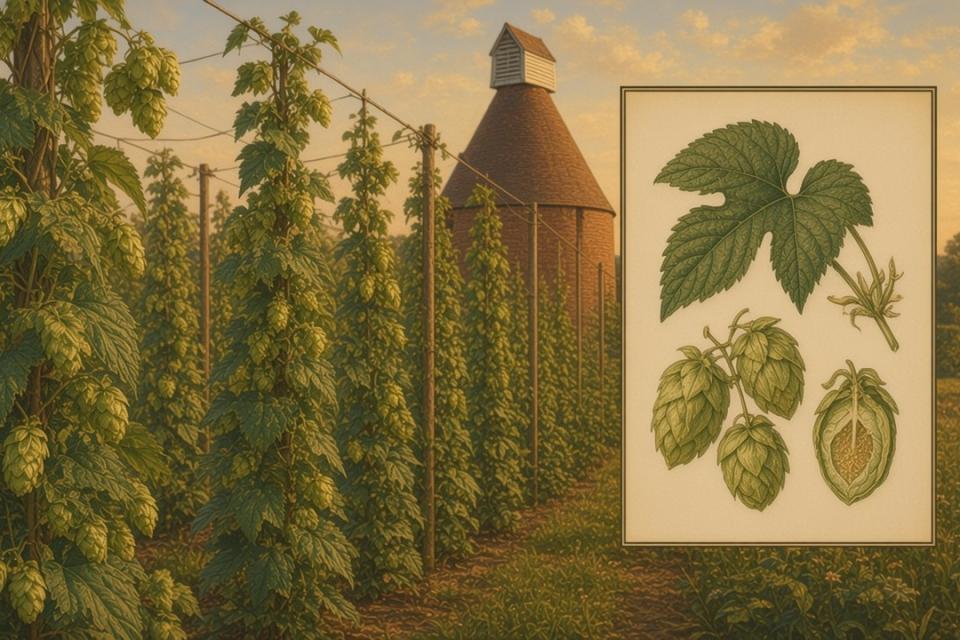
Humulus lupulus L., the common hop, belongs to Cannabaceae, the same small family as hemp; NCBI Taxonomy files it as taxon 3486. Korpelainen and Pietiläinen (Economic Botany 2021) describe it as an herbaceous perennial climber, one of three Humulus species, all present in China, the likely region of origin of the genus; H. lupulus now grows in temperate regions around the world. The annual stems, called bines, twine clockwise around any support with the help of stout, downward-facing hairs and can reach 10–18 m. The leaves have three to five lobes. The species name lupulus is Latin for little wolf; Pliny the Elder linked it to the plant’s habit of climbing over and smothering neighboring plants, often riverside willows.
Hops are dioecious: male and female flowers are usually on separate plants. The female plants bear cone-like strobiles, the hops of brewing and medicine, made of yellowish-green overlapping bracts on a central axis (Korpelainen and Pietiläinen). At the base of the bracts sit lupulin glands, tiny glandular hairs that secrete lupulin, a yellowish granular powder containing the bitter acids, essential oil, and polyphenols. The European Pharmacopoeia, quoted by EMA, defines the medicinal herb as the dried, generally whole female inflorescences. There are a few hundred cultivated varieties, grown mostly for bitterness and aroma in beer. Young hop shoots have been eaten as a vegetable in Europe since Roman times.
EMA lists the main constituents of the dried strobile. The bitter acids are alpha-acids or humulones (2–12%, chiefly humulone, PubChem CID 442911) and beta-acids or lupulones (1–10%, chiefly lupulone). The essential oil (0.5–1.5%) is mostly myrcene, beta-caryophyllene, humulene, and farnesene. Flavonoids (0.5–1.5%) include at least 22 prenylated compounds, notably xanthohumol (up to 1% of the strobile and 80–90% of total flavonoids), isoxanthohumol, and 8-prenylnaringenin (PubChem CID 480764, C20H20O5) at only 25–60 mg per kilogram. Storage changes the chemistry: 2-methyl-3-buten-2-ol, a volatile alcohol with sedative properties in animals, is present only in traces in fresh hops but rises to about 0.15% of dry weight after two years as the bitter acids break down. That is one reason EMA notes that different raw materials, storage, and extraction methods give contradictory pharmacological results.
02 Lineage
History
Hops entered history through beer. Korpelainen and Pietiläinen, citing the brewing historian Ian Hornsey, date the first mention of hops in connection with brewing to a monastery document of 736 from the Hallertau region of Bavaria, and describe monasteries in France and Belgium demanding dues of hops and malt from their tenants within the following century. The abbess Hildegard of Bingen wrote about hops around 1150; she disliked them and preferred sweet gale for beer, but recognized their antibacterial, preservative value. Hop pollen found inside a tenth-century boat at Graveney in Kent suggests hops were traded early, but English hop gardens appeared only towards the end of the fourteenth century, and in the fifteenth century unhopped ale was still the preferred English drink.
Medicinal use grew from observation. EMA’s assessment report records that hop pickers tired easily, apparently from transferring hop resin from their hands to their mouths, and that the plant gained a reputation as a sedative and hypnotic; pillows filled with hops were used for sleeplessness and nervous conditions. A folk legend held that women who traveled to pick hops began to menstruate two days after arriving, and in 1953 two researchers following up the legend reported estrogen-like activity in hops. Hops appear in the German, French, and British pharmacopoeias of the late twentieth century, and Germany’s Commission E approved hop strobiles as a sedative in 1984, for restlessness, anxiety, and sleep disturbances. In practice, EMA notes, hops have mostly been used in combination with other calming herbs such as valerian, passionflower, and lemon balm.
The modern era brought both regulation and chemistry. Milligan and colleagues identified 8-prenylnaringenin as the strong phytoestrogen in hops in 1999, offering an explanation for the reports about female hop workers, and noted that beer contains it at levels too low to cause concern. The EU herbal committee adopted its first hop monograph in May 2008 and revised it on 6 May 2014, granting only traditional use. EMA found that hop products met the criteria for traditional use in Denmark, France, Germany, and Poland, while in many other European countries hops were sold mainly in combinations with valerian. The committee’s separate monograph on valerian and hop combinations, revised on 25 September 2019, grants well-established use for sleep disorders.
03 Chemistry
Active compounds and how it works
How hops might calm or aid sleep is not settled. EMA’s assessment report summarizes animal studies in which hop extracts reduced spontaneous activity, prolonged sleep induced by pentobarbital or ketamine, and lowered body temperature in mice and rats, consistent with a central sedative effect, with no clear anti-anxiety effect. The alpha-bitter acids appeared most active, with beta-acids and hop oil contributing. Candidate molecules such as myrcene and 2-methyl-3-buten-2-ol have been proposed but not confirmed. In laboratory work, xanthohumol influenced GABA-A receptors, the same receptor family targeted by benzodiazepines, without acting at the benzodiazepine binding site, and hop extracts produced melatonin-like drops in body temperature in mice that a melatonin receptor blocker prevented. EMA stresses that these findings still need confirmation in people, and that varying raw materials and extraction methods make results hard to compare.
The estrogenic activity is better characterized. Milligan and colleagues used activity-guided fractionation and estrogen receptor assays to identify 8-PN as the active compound, with activity greater than other plant estrogens. EMA’s report cites work showing that 8-PN binds both estrogen receptors, prefers ERα, and was described as the strongest plant-derived ERα agonist identified so far, yet its estrogenic effect in reproductive tissue in animals was about 20,000 times smaller than that of estradiol. Xanthohumol and isoxanthohumol were inactive in those assays. EMA adds that 8-PN occurs in significant amounts in hop preparations only when old hops and special enrichment procedures are used, which matters both for efficacy claims and for safety worries.
On drug metabolism, MSKCC notes that laboratory studies suggest hop extracts may inhibit CYP1A2, 2C8, 2C9, and 2C19, but that a standardized hop extract did not cause clinically relevant interactions with CYP1A2, 2C9, 2D6, 3A4, or 3A5 in a human study.
04 In practice
Common uses
Mild stress and sleep: EMA accepts hop strobile as a traditional herbal medicine for relief of mild symptoms of mental stress and to aid sleep, based on long-standing use rather than clinical trials. Its assessment report is clear that no clinical studies had been conducted with hops as a single-ingredient product for restlessness or insomnia. The only study of hops alone that EMA could find gave 17 nurses on rotating or night shifts non-alcoholic beer with supper for 14 days; sleep latency measured by wrist actigraphy fell compared with controls, but EMA considered the study anecdotal because the hop content of the beer was assumed rather than measured. MSKCC likewise concludes that data on hop extracts for insomnia, pain, or menopausal symptoms are too limited to draw conclusions.
Valerian and hops together have more evidence. EMA lists four uncontrolled and three placebo- or reference-controlled trials of one fixed valerian-hops extract (Ze 91019) and further trials of related combinations. In the largest, Morin and colleagues (Sleep 2005) randomized 184 adults with mild insomnia at nine US sleep centers to two nightly tablets of a standardized valerian (187 mg) and hop (41.9 mg) extract combination for 28 days, placebo, or diphenhydramine. Improvements in sleep diaries were modest, few comparisons with placebo were statistically significant, and sleep laboratory recordings showed no differences, though quality of life improved more with the combination and there was no rebound insomnia on stopping. Koetter and colleagues (Phytotherapy Research 2007) found that Ze 91019, containing 500 mg of valerian extract and 120 mg of hop extract, shortened sleep latency compared with placebo over four weeks, while the same amount of valerian alone did not, suggesting the hops contribute. That trial had only 30 patients (10 per group) and counted p = 0.10 as significant; a larger Zeller-sponsored trial of 169 patients, never published in a journal, found no significant difference from placebo or the single extracts, and EMA says it is not known whether hops add to valerian. The first author was employed by Max Zeller Söhne AG, a Swiss herbal medicine company. See the valerian page for the broader valerian evidence.
Menopausal hot flashes: EMA describes three small placebo-controlled trials. A 1990 study in which 20 women received a hop extract and five a placebo reported lower hot flash scores with the extract, but the product was not standardized. Heyerick and colleagues (Maturitas 2006) randomized 67 women with menopausal discomfort to hop extract standardized to 100 or 250 micrograms of 8-PN daily or placebo for 12 weeks. All groups improved; the 100-microgram dose beat placebo at six weeks but not at 12, and the higher dose worked less well than the lower one, so there was no dose-response relationship. Erkkola and colleagues (Phytomedicine 2010) ran a 16-week crossover pilot in 36 women with the 100-microgram extract and found no significant overall effect, although some measures favored the extract in the second period. EMA concluded that these studies fail to show clinical efficacy and that a larger trial is needed.
Other uses remain preliminary. MSKCC notes laboratory and animal research on antibacterial, anti-inflammatory, and anticancer activity of hop compounds, and small preliminary human studies of hop-containing products for osteoarthritis pain and blood sugar control, none of which supports a recommendation. Hop pillows are a traditional sleep aid with no clinical trial evidence.
05 The apothecary
Preparations and traditional use
EU traditional use, hop strobile (EMA/HMPC/682384/2013, adopted 6 May 2014), for adolescents and adults. For mild mental stress: tea made from 500 mg of dried hops in 150–200 ml of boiling water, up to four times a day; powdered hops 400 mg twice daily for adults or 200 mg twice daily for adolescents; liquid extract (1:1, 45% ethanol) 0.5–2.0 ml up to three times daily; tincture (1:5, 60% ethanol) 1–2 ml up to three times daily; or dry extract (4–5:1) 125 mg two or three times daily. To aid sleep: tea from 500–1,000 mg of dried hops, or 800–2,000 mg of powder, 30–60 minutes before bed, or 125–250 mg of dry extract an hour before bed. Not recommended under 12. See a doctor if symptoms last more than two weeks or worsen.
EU well-established use, valerian and hop combinations (EMA/HMPC/327107/2017, revision adopted 25 September 2019), for sleep disorders in adolescents and adults: fixed combinations of dry extracts containing 187–500 mg of valerian and 28–65 mg of hops, or 200–350 mg of valerian and 45–70 mg of hops, taken as one or two doses half an hour to an hour before bed, without exceeding 500 mg of valerian extract. EMA lists various traditional combination products for stress and sleep at other strengths. Because the effect builds gradually, EMA says these combinations are not suitable for acute use and recommends continuous use over four weeks for the best effect; if symptoms persist or worsen after four weeks, see a doctor.
Hop products vary widely. Extract strength, solvent, and the age of the hops change the content of bitter acids, volatile compounds, and 8-PN, so studies on one extract do not automatically apply to another. Menopause products standardized to 8-PN are a different proposition from a bedtime hop tea. Tinctures and some liquid extracts contain substantial alcohol, which EMA requires to be labeled. Beer is not a hop medicine: its alcohol may add to any sedative effect, as EMA notes for alcohol generally, and Milligan found 8-PN levels in beer to be low.
Safety
Before you use hops
06 Caution
Side effects
For hop strobile alone, EMA’s monograph lists no known undesirable effects and no reported cases of overdose, while warning that hops may impair the ability to drive or use machines. The assessment report notes that no serious side effects have been reported from traditional use or studies, but that drowsiness or sedation may occur. For valerian-hops combinations, EMA lists gastrointestinal symptoms such as nausea and abdominal cramps, frequency unknown. In Morin’s 184-person trial there were no serious adverse events, no significant next-day residual effects, and no rebound insomnia after stopping.
Allergy and skin reactions are mainly occupational. EMA’s assessment report records allergic reactions particularly in hop harvesters: contact dermatitis in hop pickers has been attributed to myrcene in the fresh oil, and a mechanical skin irritation to the rough hairs on the stems and the secretions of the glandular hairs. Respiratory allergy from handling hop cones has been documented, and positive patch tests have been reported to fresh hop oil, humulone, and lupulone. MSKCC notes several cases of respiratory disease linked to inhaling hop dust during harvest and processing. EMA found no published cases of allergy or anaphylaxis from therapeutic use of hops.
Hormonal effects are a theoretical rather than documented concern. EMA notes that because hop extracts might contain small amounts of estrogenic compounds, the effects of use for more than three months on conditions such as breast, uterine, cervical, or prostate cancer, or endometriosis, are unknown. Most ordinary hop preparations contain little 8-PN, but products deliberately enriched in 8-PN for menopause are designed to have estrogenic activity. EMA also notes that adequate genotoxicity tests have not been performed and that reproductive toxicity and carcinogenicity tests are lacking.
Hops are a serious poison for dogs. Duncan and colleagues (Journal of the American Veterinary Medical Association 1997) described five dogs, four of them Greyhounds, that ate spent hops; within an average of three hours they developed marked hyperthermia, restlessness, panting, vomiting, abdominal pain, and seizures, and four died despite aggressive treatment, a picture the authors likened to malignant hyperthermia. Pfaff and colleagues (Journal of Veterinary Emergency and Critical Care 2022) reviewed 71 dogs: 68 developed hyperthermia, 59 survived, and those that died had eaten more hops and died a median of 10.7 hours after ingestion. In 177 calls to a US pet poison helpline, Becker and colleagues (2023) found that 74% of dogs developed signs, usually rapid breathing, hyperthermia, and vomiting within two to eight hours; 79 of the 83 dogs with known outcomes survived, but three of eight with severe hyperthermia above 41.4°C died. Keep hops, including used brewing hops and hop pellets, away from dogs, and treat any ingestion as a veterinary emergency.
07 Caution
Contraindications
EMA contraindicates hops only in people with hypersensitivity to the herb. Its monograph does not recommend use under 12 because adequate data are lacking, and advises seeing a doctor if symptoms worsen or last longer than two weeks. Anyone who has reacted to hops at work, such as hop pickers or brewery workers with skin or breathing problems, should avoid hop products.
Pregnancy and breastfeeding: EMA says safety has not been established and use is not recommended, for hops alone and for valerian-hops combinations. Its assessment report adds that some hop preparations contain high levels of alcohol, another reason to avoid them in pregnancy. No fertility data are available.
Hormone-sensitive conditions: MSKCC advises people with hormone-sensitive cancers to consult their doctors before using products containing hops, and EMA flags unknown long-term effects in breast, uterine, cervical, and prostate cancer and endometriosis. This applies most strongly to 8-PN-standardized menopause supplements. Women seeking relief from hot flashes after breast cancer should discuss options with their oncology team rather than self-treat with a phytoestrogen.
Depression and sedation: EMA’s assessment report notes a suggestion that people with depressive illness should not take hops, because the sedative effect may accentuate symptoms. Because hops may impair alertness, do not drive or operate machinery if you feel drowsy. Persistent insomnia can have treatable causes, such as sleep apnea, depression, anxiety, pain, or medicines, and a herbal sedative should not delay assessment.
08 Caution
Drug and herb interactions
Sedatives and alcohol are the main concern. EMA’s monographs list no reported interactions, but its assessment report notes limited evidence from one animal study that hops may potentiate sedative drugs and states that hops may theoretically increase the drowsiness caused by sedatives and alcohol. Be cautious combining hops with benzodiazepines, Z-drugs such as zolpidem, sedating antihistamines, opioids, other sedating herbs, or alcohol.
Hormonal products: EMA’s report considers interactions with other phytoestrogens theoretically possible. Combining an 8-PN-standardized hop extract with hormone therapy, hormonal contraception, tamoxifen, aromatase inhibitors, or other phytoestrogen supplements has not been studied; tell your prescriber if you use them together. Effects on blood sugar are unclear: EMA’s report cites animal data suggesting hops might raise blood sugar in diabetic animals but lower it in non-diabetic ones, alongside reports that isohumulones, hop bitter acids, may improve insulin sensitivity in type 2 diabetes. No clinical data settle the question, so people taking diabetes medicines should monitor their glucose if they start a hop product.
Drug metabolism: MSKCC reports that a standardized hop extract did not cause clinically relevant interactions with CYP1A2, 2C9, 2D6, 3A4, or 3A5 in humans, despite laboratory signs of enzyme inhibition, and that in animal studies some hop species slowed clearance of paracetamol (acetaminophen), with unknown clinical relevance. MSKCC still advises patients to check with their doctor before taking hops alongside prescription drugs.
09 Questions
Frequently Asked Questions
Possibly a little, mainly in combination with valerian. EMA accepts hops as a traditional sleep aid, but no trials have tested hops alone for insomnia. Valerian-hops combinations have stronger evidence, though the largest trial found only modest improvements over placebo. See valerian for the companion herb, and talk to a doctor about insomnia that lasts more than a few weeks.
EMA’s traditional dose is a tea made from 500–1,000 mg of dried hops in 150–200 ml of boiling water, or 125–250 mg of dry extract, 30–60 minutes before bed. Valerian-hops combinations are taken half an hour to an hour before bed, and EMA recommends four weeks of continuous use because the effect builds gradually. Not recommended under 12.
Hops contain 8-prenylnaringenin (8-PN), one of the strongest plant estrogens identified, although far less active than the body’s own estradiol. Ordinary hop preparations contain little of it; menopause supplements are standardized to deliver it. Beer contains only low levels. Other plants studied for menopausal symptoms include red clover and black cohosh.
The evidence is still limited. Three small trials of hop extracts, two standardized to 8-PN, gave mixed results: one found benefit at six weeks but not 12, and the higher dose worked less well than the lower one. EMA concluded the studies fail to show clinical efficacy. Women with a history of breast cancer should not use hop phytoestrogens without medical advice.
Yes. Dogs that eat hops, including spent hops from brewing, can develop rapid breathing, vomiting, restlessness, and a dangerous rise in body temperature, usually within a few hours. In veterinary case series most dogs survived with treatment, but deaths occurred, especially with severe hyperthermia. Contact a vet or animal poison service immediately if a dog eats hops.
It is best avoided. EMA notes that hops may theoretically increase the drowsiness caused by sedative drugs and alcohol, and one animal study suggested they can strengthen sedatives. Do not combine hops with prescription sleep medicines without advice, and do not drive if you feel drowsy.
EMA does not recommend hops or valerian-hops combinations during pregnancy or breastfeeding because safety has not been established, and some liquid hop preparations contain a lot of alcohol.
No. Beer’s alcohol may add to drowsiness rather than act as a sleep remedy, and 8-PN levels in beer are low. A single small study of non-alcoholic beer in shift-working nurses reported shorter sleep latency, but EMA considered it anecdotal. For a calming tea, lemon balm is a common caffeine-free option often blended with hops.
10 References
Sources
These references support the history, clinical, and safety claims on this page. They are not an endorsement of any product.
-
Community herbal monograph on Humulus lupulus L., flos
European Medicines Agency (EMA/HMPC/682384/2013), 2014
Adopted 6 May 2014: traditional use of hop strobile for mild mental stress and to aid sleep; doses for tea, powder, tincture, and extracts; not under 12; not in pregnancy; may impair driving.
-
Assessment report on Humulus lupulus L., flos
European Medicines Agency (EMA/HMPC/418902/2005), 2014
Constituents; hop picker history; animal sedation and 8-PN pharmacology; no trials of hops alone for sleep; three small menopause trials judged insufficient; occupational allergy; sedative interactions.
-
European Union herbal monograph on Valeriana officinalis L., radix and Humulus lupulus L., flos (Revision 1)
European Medicines Agency (EMA/HMPC/327107/2017), 2019
Adopted 25 September 2019: well-established use of fixed valerian-hops extracts for sleep disorders; four weeks of continuous use advised; nausea and abdominal cramps possible.
-
Hops
Memorial Sloan Kettering Cancer Center, About Herbs, 2021
Clinical summary (updated February 2021): data too limited for conclusions; hormone-sensitive cancer caution; respiratory disease from hop dust; no clinically relevant CYP interactions in humans.
-
Hop (Humulus lupulus L.): traditional and present use, and future potential
Economic Botany, 2021
Korpelainen and Pietiläinen: botany of the dioecious climbing hop, lupulin glands, origin of the name lupulus, and brewing history from 736 to Hildegard of Bingen and English hop gardens.
-
Identification of a potent phytoestrogen in hops (Humulus lupulus L.) and beer
Journal of Clinical Endocrinology and Metabolism (PubMed 10372741), 1999
Identified 8-prenylnaringenin as a phytoestrogen stronger than other plant estrogens; low levels in beer.
-
A first prospective, randomized, double-blind, placebo-controlled study on the use of a standardized hop extract to alleviate menopausal discomforts
Maturitas (PubMed 16321485), 2006
Heyerick et al.: 67 women, 100 or 250 micrograms 8-PN or placebo for 12 weeks; lower dose better than placebo at six weeks only; no dose-response.
-
A randomized, double-blind, placebo-controlled, cross-over pilot study on the use of a standardized hop extract to alleviate menopausal discomforts
Phytomedicine (PubMed 20167461), 2010
Erkkola et al.: 36 postmenopausal women, 16-week crossover with 100 micrograms 8-PN; no significant overall effect; some second-period benefits.
-
Valerian-hops combination and diphenhydramine for treating insomnia: a randomized placebo-controlled clinical trial
Sleep (PubMed 16335333), 2005
Morin et al.: 184 adults with mild insomnia for 28 days; modest subjective benefits, no polysomnography differences, improved quality of life, no rebound insomnia.
-
A randomized, double blind, placebo-controlled, prospective clinical study to demonstrate clinical efficacy of a fixed valerian hops extract combination (Ze 91019) in patients suffering from non-organic sleep disorder
Phytotherapy Research (PubMed 17486686), 2007
Koetter et al.: four weeks of Ze 91019 (500 mg valerian, 120 mg hops) shortened sleep latency vs placebo; valerian alone did not; industry-affiliated first author.
-
Malignant hyperthermia-like reaction secondary to ingestion of hops in five dogs
Journal of the American Veterinary Medical Association (PubMed 8977648), 1997
Duncan et al.: five dogs, four of them Greyhounds, ate spent hops; marked hyperthermia, panting, vomiting, and seizures; four died.
-
Retrospective analysis of hops toxicosis in dogs (2002-2014): 71 cases
Journal of Veterinary Emergency and Critical Care (PubMed 34498796), 2022
Pfaff et al.: 71 dogs; hyperthermia in 68; 59 survived; non-survivors ate more hops and died a median of 10.7 hours after ingestion.
-
A retrospective evaluation of hops ingestion in 177 dogs (2005-2018)
Journal of Veterinary Emergency and Critical Care (PubMed 36908194), 2023
Becker et al.: 177 poison helpline cases; signs in 74%, mostly rapid breathing, hyperthermia, and vomiting within 2–8 hours; 79 of 83 with known outcome survived.
-
8-Prenylnaringenin
PubChem, National Library of Medicine (NIH), 2026
Hop phytoestrogen 8-PN (indexed as sophoraflavanone B); CID 480764, C20H20O5.
-
Humulus lupulus
NCBI Taxonomy, National Library of Medicine (NIH), 2026
Taxonomic record for the common hop, taxon 3486, family Cannabaceae.