
Monograph
Marshmallow Root
Althaea officinalis
Updated October 4, 2026
Key points
-
01
A traditional demulcent
EMA accepts marshmallow root for throat irritation with dry cough and for mild stomach discomfort, based on long-standing use rather than clinical trials.
-
02
Clinical evidence is still limited
WHO lists no uses supported by clinical data. The studies are uncontrolled reports in children, user surveys, and one 63-patient trial with an undescribed product.
-
03
Space it from medicines
Its mucilage may delay absorption of other drugs. EMA advises taking it at least half an hour to an hour apart from other medicines.
-
04
Root, not sweets
The confection was once made from the root, which gave it its name. Modern marshmallows are made with gelatin and contain no Althaea.
-
05
Know when to see a doctor
Seek advice if a cough lasts over a week or brings fever, breathlessness, or discolored phlegm. EMA does not recommend it under 3 or in pregnancy.
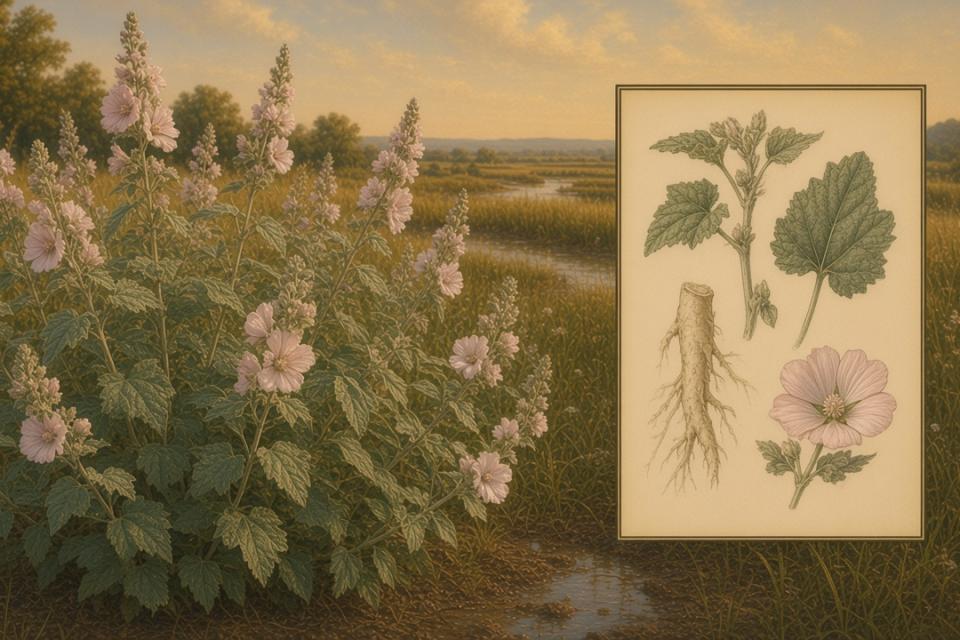
Marshmallow root is the classic mucilage herb. The pale root of Althaea officinalis, a tall, soft-leaved plant of marshy ground near the sea, is rich in polysaccharides that swell into a slippery gel in water. The EU’s herbal committee accepts marshmallow root as a traditional demulcent, a preparation that soothes by coating, for irritation of the mouth or throat with an associated dry cough, in adults and children over 3, and for mild stomach and gut discomfort in adults and adolescents over 12. The plant also gave its name to a sweet: Britannica notes that the root was formerly used to make marshmallows.
Its gentle soothing effect is well established in tradition, but clinical research is still limited. WHO’s 2002 monograph lists no uses supported by clinical data. EMA’s assessment found two uncontrolled studies of marshmallow syrup in about 900 children and one placebo-controlled trial of 63 adults with a poorly described product, and concluded that none of it proves efficacy; its approval rests on more than 30 years of documented use. There are no clinical data at all for the stomach indication. In 2025 EMA reviewed a decade of new publications and found nothing that changed its view.
Safety concerns are modest but practical. The same coating that soothes a throat may slow the absorption of medicines, so EMA advises not taking marshmallow root within half an hour to an hour of other medicines. It is not recommended under 3, or in pregnancy or breastfeeding, because of a lack of data, and a cough that lasts more than a week or comes with breathlessness, fever, or discolored phlegm needs a doctor. Modern marshmallow sweets contain no root at all. Nothing here is medical advice.
Featured in
Herbs for Colds, Flu and Immunity Herbs for Cough and Sore Throat Herbs for Heartburn and Acid RefluxIn this monograph
01 The plant
Botanical profile
Althaea officinalis L. belongs to Malvaceae, the mallow or hibiscus family, and NCBI Taxonomy files it as taxon 145745. WHO describes a perennial herb with erect, woody stems 60–120 cm high, alternate, velvety, toothed leaves that are oval to slightly heart-shaped and sometimes three-lobed, and pale pink flowers in the leaf axils, followed by a ring of small fruits. Britannica gives flowers about 5 cm across on stalks that can reach about 1.8 meters. WHO lists it as native to Europe and western Asia and naturalized in the United States; Britannica, which places its native range in eastern Europe and northern Africa, notes that it grows mainly in marshy areas near the sea, the origin of the English name. Old names collected by WHO include white mallow, sweet weed, and the French guimauve.
The medicinal part is the root. The European Pharmacopoeia defines marshmallow root as the peeled or unpeeled, whole or cut, dried root, with a swelling index of at least 10, a measure of how much the powdered root swells in water (EMA). Roots are taken in autumn from cultivated plants at least two years old (WHO, EMA). The unpeeled root is grayish-brown and deeply furrowed; peeled root is grayish-white and fibrous, with a faint smell and a mucilaginous taste (WHO). Leaves and flowers also contain mucilage, and the leaf has its own traditional uses, but the EU monograph, the WHO monograph, and almost all research concern the root. Related plants cause confusion: in its 2025 review EMA set aside three papers because they concerned a different species, Althaea rosea, a hollyhock.
Mucilage is the defining constituent. EMA’s assessment report cites a mucilage content of 5–11.6% depending on season, while WHO gives 10–20% and sets a minimum of 10% in peeled root. The mucilage is a mixture of polysaccharides: acidic rhamnogalacturonans whose backbone is made of D-galacturonic acid (PubChem CID 439215, C6H10O7) and L-rhamnose units in equal proportions, along with arabinogalactans, arabans, and glucans. The root also holds about 11% pectin, 25–35% starch, and around 10% sucrose, plus small amounts (0.14–0.28%) of flavonoids such as hypolaetin-8-glucoside (EMA). Traditional preparations extract the mucilage by soaking the cut root in water, either as a cold macerate or as a syrup base.
02 Lineage
History
EMA’s assessment report, drawing on the German pharmacognosist Madaus (1938), says marshmallow has been used in European medicine since ancient times, though ancient descriptions do not always clearly refer to the same plant: Theophrastus described an althaea with yellow flowers and Dioscorides one with rose-red flowers. Hippocrates is said to have recommended a decoction of the root for wounds, and Dioscorides listed uses ranging from failure to pass urine, diarrhea, and stones to nerve pain, bee stings, and toothache. Later European physicians, including Paracelsus, Lonicerus, and Matthiolus, prescribed it to soften abscesses, as an expectorant and diuretic, and externally for ulcers and burns.
Marshmallow root then became a fixture of official pharmacy. EMA traces continuous documentation through the German pharmacopoeia of 1926, the British Pharmaceutical Codex of 1949, Martindale, the British Herbal Pharmacopoeia of 1983, Germany’s Commission E, the WHO and ESCOP monographs, and the European Pharmacopoeia. Marshmallow syrup (Sirupus althaeae) appears in Austrian, Czechoslovak, Polish, and German pharmacopoeias; the 1949 British version is now considered obsolete because it contained chloroform. One Lithuanian syrup has been on the market for more than 100 years, and a German syrup since at least 1976 (EMA). WHO notes that the root was also added to cough mixtures to mask the taste of bitter drugs. The EU herbal committee adopted its first monograph in May 2009 and revised it on 12 July 2016; a periodic review adopted on 19 November 2025 found no reason to change it.
The sweet is the plant’s most famous legacy. Britannica notes that the root was formerly used to make marshmallows, and in French the same word, guimauve, names both the plant and the confection. Modern marshmallows are made with gelatin rather than root: Clarebrough and colleagues (Colorectal Disease 2015) tested the folk belief that eating marshmallows thickens ileostomy output, and attributed the plausible mechanism to the gelatin they contain. In their crossover trial, 28 people with ileostomies who ate three marshmallows three times a day for a week had a median reduction in output of 75 ml a day. That is a property of the confectionery, not of Althaea. Marshmallow root itself is still used as a flavoring in food (EMA), and LactMed notes that the FDA considers marshmallow generally recognized as safe in food amounts.
03 Chemistry
Active compounds and how it works
Marshmallow root works mainly by physical means. WHO attributes its demulcent effect to its high content of polysaccharide hydrocolloids, which form a protective coating on the lining of the mouth and throat and soothe local irritation. EMA notes that the only non-clinical study directly supporting this is an experiment in which purified root polysaccharides adhered moderately, in a concentration-dependent way, to isolated pig cheek lining. Deters and colleagues (Journal of Ethnopharmacology 2010) found that an aqueous root extract stimulated the viability and growth of human epithelial cells in culture, and that the polysaccharides were taken up into epithelial cells and formed adhesive layers on other cells, which the authors linked to tissue repair. These are laboratory findings; no human study has measured how long the coating lasts or what it does to healing.
Animal studies support a cough-suppressing effect. EMA summarizes work in cats in which oral root extract and isolated mucilage reduced mechanically induced coughing, less than codeine but more than two non-narcotic cough drugs. Šutovská and colleagues (Bratislava Medical Journal 2011) found that rhamnogalacturonan from the root suppressed citric-acid-induced cough in guinea pigs in a dose-dependent way, with the higher dose comparable to codeine, without widening the airways; the effect was shorter-lived in animals with allergic airway inflammation. A related study pointed to serotonin 5-HT2 receptors rather than bronchodilation (EMA). Whether these effects occur at human doses has not been tested.
Other laboratory signals are inconsistent. Isolated mucilage injected into mice lowered blood glucose for several hours, and mucilage stimulated immune cells in mice; a 20% root ointment reduced skin irritation in rabbits, but less than dexamethasone, while an oral alcoholic extract had no anti-inflammatory effect in rats (EMA, WHO). EMA concluded that these results cannot be related directly to clinical use. The interaction warning comes from the same physical property: a mucilage layer in the gut could delay absorption of other medicines, though EMA notes this has never been tested in animals or people.
04 In practice
Common uses
Mouth and throat irritation with dry cough is the main use, and the evidence is observational. In a post-marketing study (Fasse and colleagues, 2005, reviewed by EMA), 313 children aged 3 months to 12 years with throat irritation and dry cough took an aqueous marshmallow root syrup, 2.5–10 ml four to six times daily, mostly for three days. Physicians and parents rated efficacy very good or good in 84% and tolerability very good or good in 97%. In a retrospective review by 53 physicians (Bässler, 2005), 599 children treated for up to two weeks were rated very good or good in over 90%, with no adverse effects recorded. EMA notes that neither study was randomized or controlled and that no objective measures were made, so they support only traditional use.
Adult evidence is scarcer. EMA describes a double-blind trial by Rouhi and Ganji (2007) in 63 Iranian patients with dry cough caused by ACE inhibitor blood pressure drugs: those taking marshmallow drops, 20 drops three times daily for four weeks, saw their cough score fall from 2.66 to 1.23 on a 0–4 scale, against 2.7 to 2.33 with placebo. EMA could not count it as proof because the preparation was not described. Fink and colleagues (Complementary Medicine Research 2018) surveyed 822 pharmacy customers who bought marshmallow root lozenges or syrup for dry cough and reported rapid relief, often within 10 minutes, with three minor adverse events; EMA’s 2025 review dismissed the surveys as uncontrolled and based only on users’ impressions. A 2020 review by Mahboubi, of the medicinal plants research department of an Iranian pharmaceutical company, concluded that marshmallow is effective for dry cough, especially in combinations, but EMA found it added no new clinical data.
Combination products have the best-controlled data, but cannot isolate marshmallow’s contribution. Brinckmann and colleagues (Journal of Alternative and Complementary Medicine 2003) randomized 60 adults with acute pharyngitis to Throat Coat, a tea containing slippery elm, licorice, and marshmallow root, or a placebo tea. Pain on swallowing fell significantly more with the herbal tea from 5 to 30 minutes after drinking (sum of pain intensity difference −43.8 versus −16.5). The first author worked for the tea’s manufacturer. EMA also notes a liquid combination of marshmallow root and thyme registered in several EU countries for cough.
Mild stomach and gut discomfort is the second traditional EU indication, but EMA states that no clinical data exist for it. WHO lists gastric irritation, along with asthma, cystitis, and dysentery, as folk uses not supported by experimental or clinical data, and the 1983 British Herbal Pharmacopoeia recommended the root for gastritis and peptic ulcer (EMA). LactMed notes that marshmallow is promoted to increase breast milk supply and is in some proprietary mixtures for that purpose, but no scientifically valid clinical trials support this. WHO also records traditional external use as an emollient for wounds and dry skin, which the EU monograph does not cover.
05 The apothecary
Preparations and traditional use
EU traditional use for mouth or throat irritation and dry cough (EMA/HMPC/436679/2015, adopted 12 July 2016): cut root as a macerate, made by soaking in 150 ml of water and used immediately; adolescents and adults 0.5–3 g several times daily, up to 15 g a day; children 6–11 years 0.5–1.5 g three times daily; children 3–5 years 0.5–1 g three times daily. Syrup made from a macerate: adults 10–15 ml three to five times daily; children 6–11, 5 ml three to five times daily; children 3–5, 5 ml up to four times daily. An aqueous liquid extract, dry extracts such as lozenges (not under 6 because of the dosage form), and, for adults only, a 25% ethanol liquid extract at 2–5 ml three times daily are also listed. Preparations can be swallowed or held in the mouth. Not recommended under 3. If symptoms last longer than a week, see a doctor.
EU traditional use for mild gastrointestinal discomfort: adolescents and adults, 2–5 g of cut root in 150 ml of water as a macerate three times daily, up to 15 g a day; not recommended under 12; see a doctor if symptoms last longer than two weeks (EMA). Commission E, quoted by EMA, gave 6 g of root a day and described the traditional cold maceration: 2–5 g in 150 ml of cold water for 30 minutes with frequent stirring, then strained and warmed before drinking, up to three times a day. WHO gives similar doses, 0.5–3 g as a cold macerate or 2–8 ml of syrup for cough and throat irritation, and 3–5 g up to three times daily for gastric irritation.
Practical points: take marshmallow root at least half an hour to an hour apart from other medicines (EMA). Traditional syrups are mostly sugar; German and Austrian pharmacopoeial recipes cited by EMA dissolve roughly 1.6–1.8 parts of sucrose in each part of macerate, which matters for people with diabetes and for children’s teeth. Alcoholic extracts must be labeled for ethanol content (EMA). Choose products made to pharmacopoeial standards; EMA notes that the root can be identified unambiguously, but its 2025 review included two papers examining lead and cadmium in marshmallow root preparations, a reminder that sourcing matters.
Safety
Before you use marshmallow root
06 Caution
Side effects
Marshmallow root appears to be very well tolerated. EMA’s monograph lists no known undesirable effects, and no side effects had been reported at the time of its assessment. LactMed describes marshmallow as generally well tolerated in adults, with allergic reactions reported rarely, and WHO’s monograph records no information on adverse reactions. No case of overdose has been reported (EMA). EMA also points out that exposure is considerable beyond medicines, because marshmallow root is used as a flavoring in food, and that no intoxications are reported in the literature it reviewed.
Across the two pediatric studies, which together included 912 children, one child under 3 developed obstructive bronchitis and another developed bronchopneumonia requiring hospital admission; the treating physicians judged these unrelated or unlikely to be related to the syrup (EMA). In Fink’s consumer surveys, there were three minor complaints with the syrup: bloating, abdominal discomfort, and poor tolerability. EMA’s 2025 review found three non-serious reports in the EU’s pharmacovigilance database over the previous decade, of palpitations, throat swelling, and throat irritation, with no certainty that marshmallow root caused them.
The larger risks are indirect. A soothing syrup can mask a cough that needs medical attention, such as pneumonia, asthma, whooping cough, or a cough caused by a medicine. Sugar-rich syrups add to sugar intake. Formal toxicology is incomplete: EMA notes that adequate genotoxicity tests have not been performed and that reproductive toxicity and carcinogenicity have not been tested. A negative bacterial mutation test of one extract could not be counted because the extract was not shown to match the preparations in the monograph.
07 Caution
Contraindications
Do not use marshmallow root if you are allergic to it (EMA). For cough and throat irritation, EMA advises consulting a doctor if breathlessness, fever, or purulent (discolored, pus-like) sputum develops, if symptoms worsen, or if they last more than a week. For stomach complaints, the limit is two weeks. Persistent indigestion, difficulty swallowing, vomiting, black stools, or weight loss need medical assessment rather than a demulcent.
Children: EMA does not recommend marshmallow root for cough under 3 because of concerns requiring medical advice, or solid forms such as lozenges under 6 because of the dosage form. It does not recommend the stomach indication under 12, or ethanol extracts under 18, because of a lack of adequate data. WHO advises that it should not be given to children without medical supervision. A young child with a cough, especially one who is breathing fast, wheezing, feverish, or unusually drowsy, needs medical assessment rather than a home remedy.
Pregnancy and breastfeeding: EMA does not recommend use because safety has not been established, and WHO also advises against use without medical supervision. LactMed notes that no data exist on excretion into breast milk or on safety in nursing mothers or infants, although it considers marshmallow root unlikely to harm a breastfed infant. It should not be relied on to increase milk supply; LactMed says galactogogues should never replace evaluation of the factors that affect milk production.
Diabetes and ACE inhibitor cough: people with diabetes should account for the sugar in syrups, and the blood-glucose effect seen in mice, though of unknown relevance, is a reason to monitor if taking large amounts. A dry cough that started after beginning an ACE inhibitor blood pressure medicine should be discussed with the prescriber, who can consider the cause, rather than simply soothed.
08 Caution
Drug and herb interactions
The one practical interaction is timing. EMA’s monograph states that absorption of medicines taken at the same time may be delayed and advises, as a precaution, not taking marshmallow root half an hour to an hour before or after other medicines; WHO gives the same warning. EMA is explicit that this rests on statements in the literature and has not been confirmed by tests in animals or humans, which is why it appears as a precaution rather than a documented interaction, and the monograph’s interaction section reads “none reported”. Spacing doses costs little, and it matters most for medicines whose absorption needs to be reliable, such as thyroid hormone, anticonvulsants, anticoagulants, and heart drugs.
No pharmacokinetic or enzyme interaction data exist for marshmallow root (EMA). The theoretical blood-sugar effect comes from mice given injected mucilage and has not been studied in people taking diabetes medicines. Combination products deserve separate checks: throat teas and cough syrups often include licorice, thyme, or other herbs with their own cautions. Tell your pharmacist about any herbal products you take, and ask how to time them around your medicines.
09 Questions
Frequently Asked Questions
Mainly for soothing an irritated mouth or throat and the dry, tickly cough that goes with it. EMA also accepts it as a traditional remedy for mild stomach and gut discomfort. Both uses rest on long-standing traditional use; there are no good clinical trials, and none at all for the stomach use.
It may give short-lived soothing relief by coating the throat. Large observational studies in children reported good results, and a small trial in adults with ACE inhibitor cough found less coughing, but none of these studies was strong enough for EMA to treat as proof. A throat tea combining marshmallow root with slippery elm and licorice eased pain on swallowing in a 60-person trial run by the manufacturer.
Use a cold macerate rather than boiling water. Commission E describes soaking 2–5 g of cut root in 150 ml of cold water for 30 minutes, stirring often, then straining and warming it. EMA’s adult dose for throat irritation is 0.5–3 g several times a day, up to 15 g daily. Use the macerate straight away.
Not any more. The confection was originally made with the root, which is how it got its name, but modern marshmallows are made with sugar and gelatin. They have no medicinal value as a source of Althaea, although one small trial found that eating marshmallows slightly thickened ileostomy output, an effect attributed to the gelatin.
Both contain mucilage, but the root is the part with an EU monograph, a WHO monograph, and nearly all of the research. Marshmallow leaf has its own traditional uses but even less evidence. Check the label, because some products blend root with leaf or flower.
Yes, but space them. EMA advises not taking marshmallow root within half an hour to an hour before or after other medicines, because its mucilage may delay their absorption. This has not been tested directly, but it is an easy precaution, especially with medicines such as thyroid hormone or anticonvulsants.
EMA allows marshmallow syrup and macerates for coughs in children from 3 years, with lozenges from 6. It does not recommend use under 3, because coughs in young children need medical advice, or in pregnancy and breastfeeding, because safety has not been established. See a doctor if a child’s cough lasts more than a week or comes with fever or difficulty breathing.
Both are mucilage herbs that soothe by coating. Marshmallow root has an EU traditional-use monograph, while slippery elm does not, and its cautions are partly borrowed from marshmallow. Wild slippery elm is also under harvesting pressure, which is one reason herbalists suggest marshmallow or mullein instead. Neither has strong clinical evidence.
10 References
Sources
These references support the history, clinical, and safety claims on this page. They are not an endorsement of any product.
-
European Union herbal monograph on Althaea officinalis L., radix
European Medicines Agency (EMA/HMPC/436679/2015), 2016
Adopted 12 July 2016: traditional demulcent use for oral or pharyngeal irritation with dry cough and for mild gastrointestinal discomfort; doses by age; not under 3; separate from other medicines by ½–1 hour.
-
Assessment report on Althaea officinalis L., radix
European Medicines Agency (EMA/HMPC/436680/2015), 2016
Constituents, history from Hippocrates to modern pharmacopoeias, animal cough studies, pediatric observational studies in 912 children, the 63-patient ACE inhibitor cough trial, and the untested basis of the absorption warning.
-
Addendum to assessment report on Althaea officinalis L., radix
European Medicines Agency (EMA/HMPC/301260/2025), 2025
Periodic review adopted 19 November 2025: no new data warranting revision; user surveys and reviews judged insufficient; three non-serious pharmacovigilance reports.
-
WHO monographs on selected medicinal plants, Volume 2 (Radix Althaeae)
World Health Organization, 2002
Volume 2 PDF (ISBN 9241545372) in WHO IRIS record 10665/42052. Botanical description and distribution; 10–20% mucilage; no uses supported by clinical data; demulcent and cough uses from pharmacopoeias; may delay absorption of other drugs.
-
Marshmallow
Drugs and Lactation Database (LactMed), NICHD (PubMed 30000899), 2024
Updated May 2024: no valid trials as a galactogogue; no breastfeeding safety data but unlikely to harm the infant; rare allergy; FDA GRAS in food amounts.
-
Marsh mallow
Encyclopaedia Britannica, 2026
Mallow family plant of marshy areas near the sea; pinkish flowers about 5 cm across; root formerly used to make the confection marshmallow.
-
Althaea officinalis
NCBI Taxonomy, National Library of Medicine (NIH), 2026
Taxonomy ID 145745; family Malvaceae.
-
D-Galacturonic acid
PubChem, National Library of Medicine (NIH), 2026
Sugar acid forming the backbone of marshmallow root’s rhamnogalacturonan mucilage with L-rhamnose; CID 439215, C6H10O7.
-
Safety and efficacy of a traditional herbal medicine (Throat Coat) in symptomatic temporary relief of pain in patients with acute pharyngitis: a multicenter, prospective, randomized, double-blinded, placebo-controlled study
Journal of Alternative and Complementary Medicine (PubMed 12804082), 2003
Brinckmann et al.: 60 adults; tea with slippery elm, licorice, and marshmallow root reduced pain on swallowing vs placebo 5–30 minutes after drinking; first author from the manufacturer.
-
Marshmallow root extract for the treatment of irritative cough: two surveys on users’ view on effectiveness and tolerability
Complementary Medicine Research (PubMed 30064132), 2018
Fink et al. (in German): 822 pharmacy customers using lozenges or syrup; users reported rapid relief; uncontrolled, consumer-reported outcomes; three minor adverse events.
-
Marsh mallow (Althaea officinalis L.) and its potency in the treatment of cough
Complementary Medicine Research (PubMed 31770755), 2020
Mahboubi, from an Iranian herbal pharmaceutical company: narrative review of root, leaf, and flower studies; concludes efficacy for dry cough, mainly in combinations.
-
Aqueous extracts and polysaccharides from Marshmallow roots (Althea officinalis L.): cellular internalisation and stimulation of cell physiology of human epithelial cells in vitro
Journal of Ethnopharmacology (PubMed 19799989), 2010
Deters et al.: root extract and polysaccharides stimulated epithelial cell viability in vitro and formed bioadhesive layers on cells.
-
Antitussive activity of Althaea officinalis L. polysaccharide rhamnogalacturonan and its changes in guinea pigs with ovalbumine-induced airways inflammation
Bratislavské Lekárske Listy (PubMed 22372330), 2011
Šutovská et al.: root rhamnogalacturonan dose-dependently suppressed cough in guinea pigs, the higher dose comparable to codeine; no bronchodilation.
-
Eating marshmallows reduces ileostomy output: a randomized crossover trial
Colorectal Disease (PubMed 25951410), 2015
Clarebrough et al.: 28 completers; marshmallow sweets reduced ileostomy output by a median 75 ml/day, attributed to their gelatin content.