Monograph
Stinging Nettle
Urtica dioica
Updated October 4, 2026
Key points
-
01
Two parts, two uses
Nettle leaf or herb is a traditional remedy for urine flow, minor joint pain, and oily skin. Nettle root is used for prostate symptoms. Check which part a product contains.
-
02
Prostate evidence is limited
EMA accepts nettle root as a traditional remedy for enlarged-prostate symptoms, but it reviewed eight placebo-controlled trials and found none adequate to prove benefit.
-
03
Hay fever evidence is early
A small one-week trial of freeze-dried nettle was only marginally positive, and a later root trial found placebo did about as well. Lab antihistamine effects are promising but not proof.
-
04
Mild side effects, real sting
Stomach upset and allergic skin reactions are the usual side effects of oral nettle. The sting of the fresh plant can burn and itch for more than 12 hours.
-
05
Get urinary symptoms checked
Prostate-type symptoms can signal cancer, infection, or retention. Use nettle root only after a doctor has excluded serious disease, and avoid nettle herb in pregnancy.
Stinging nettle is two medicines in one plant. The leaves and flowering tops, the parts that sting, have been brewed, eaten, and pressed against aching joints since antiquity, and the EU’s herbal committee recognizes nettle herb as a traditional remedy to increase urine flow in minor urinary complaints, to ease minor joint pain, and for oily, seborrheic skin. The root is a different product with a different job: in Germany and elsewhere in Europe, nettle root extracts have been sold for decades for the urinary symptoms of an enlarged prostate, often combined with saw palmetto. The two parts should not be confused on a label or in a conversation with a pharmacist.
The clinical evidence is still catching up with that long history. EMA reviewed eight randomized, placebo-controlled trials of nettle root for benign prostatic hyperplasia (BPH) and concluded in 2025 that none was adequate to prove efficacy, so the root is accepted only as a traditional medicine. The largest European trial found a difference from placebo in symptom scores that EMA judged too small to matter, while a large Iranian trial reporting dramatic benefit used a preparation that cannot be identified from the paper. For the leaf, the trials are small: a week-long study of freeze-dried nettle in hay fever, a crossover trial of deliberately stinging a painful thumb joint, and studies in diabetes with inconsistent results.
Nettle is generally well tolerated: mild stomach upset and allergic skin reactions are the usual complaints, and the sting of the fresh plant is the most common harm. The cautions are practical. Prostate symptoms overlap with prostate cancer, infection, and bladder problems, so a man with new urinary symptoms needs examination before self-treatment. Nettle herb is taken to increase urine, so it is unsuitable where a doctor has restricted fluids. EMA does not recommend nettle herb in pregnancy or breastfeeding. Nothing here is medical advice, and blood in the urine, fever, pain, or difficulty passing urine need prompt medical care.
Featured in
Herbs for Urinary Tract HealthIngredient in
Saw Palmetto and Nettle RootIn this monograph
01 The plant
Botanical profile
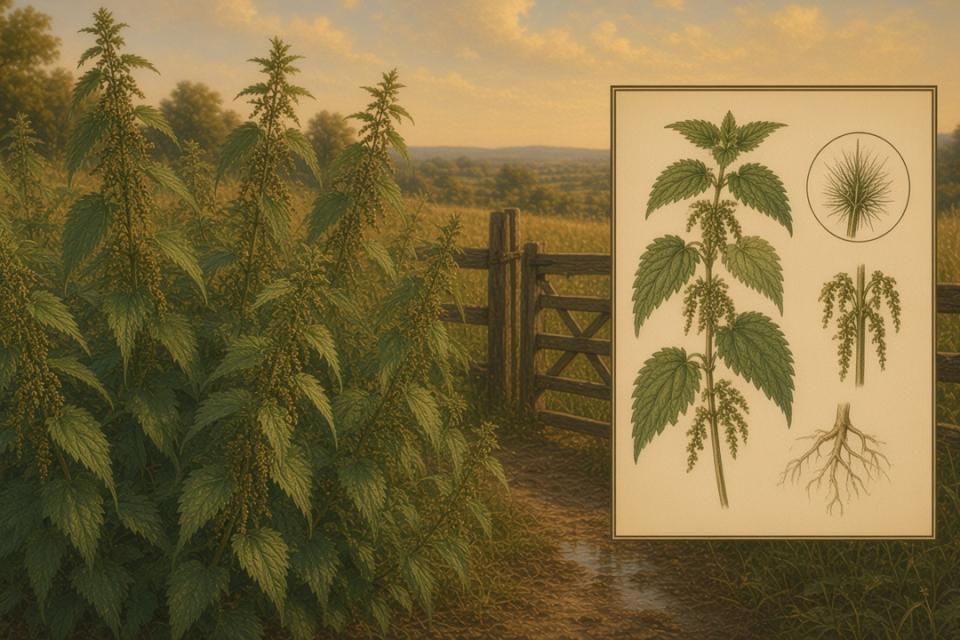
Urtica dioica L. belongs to Urticaceae, the nettle family, in the order Rosales; NCBI Taxonomy files it as taxon 3501 under the common name great nettle. MSKCC describes it as a perennial herbaceous flowering plant native to Asia, Europe, and North America, and it is one of the most familiar plants of field edges, ditches, gardens, and farmyards, favoring rich, disturbed ground. It spreads by creeping roots and rhizomes into dense clumps of upright stems, with opposite, heart-shaped, coarsely toothed leaves and drooping tassels of tiny green flowers. The species name dioica, “two houses”, refers to male and female flowers usually being borne on separate plants. The EU monographs cover it together with the small annual nettle, Urtica urens L., and their hybrids.
The sting comes from hollow hairs on the leaves and stems. Each is a fine needle with a brittle tip that breaks on contact, letting the hair inject a small amount of irritant fluid into the skin. EMA’s assessment report lists small amounts of histamine, choline, acetylcholine, and serotonin, particularly in the stinging hairs, and the textbook explanation has long credited these amines and formic acid with the burning. Fu and colleagues (Annals of Botany 2006) complicated that story: in the hairs of a related Asian species, Urtica thunbergiana, histamine, oxalic acid, and tartaric acid were the main constituents, serotonin and formic acid were present only at low levels, and oxalic and tartaric acids produced long-lasting pain in rats. Whether the same is true of U. dioica has not been shown.
Two very different materials reach the market. Nettle herb or leaf is the dried aerial parts. EMA’s assessment report, citing older handbooks, describes it as rich in minerals including calcium, potassium, silicon, iron, and magnesium, with flavonoid glycosides of kaempferol, isorhamnetin, and quercetin, triterpenes and sterols including β-sitosterol, and the coumarin scopoletin. Nettle root, defined by the European Pharmacopoeia as the dried underground parts, contains a small lectin called Urtica dioica agglutinin (UDA, 0.05–0.6%), lignans, polysaccharides, sterols, and other compounds. EMA notes that none of these has been established as the active principle, and that phytosterols, often credited on supplement labels, make up only about 0.01% of nettle products. Extracts differ widely: the EU root monograph lists seven preparations, from a simple tea to dry extracts concentrated as much as 16:1.
02 Lineage
History
Nettle has been a medicine and a food for as long as people have lived beside it. EMA’s assessment report notes that the ancient Greeks knew its effects and that Dioscorides regarded the herb as a tonic, diuretic, digestive, blood purifier, cough remedy, styptic to stop bleeding, and aid to healing wounds; Pliny and later writers also praised it as a styptic, and Dioscorides remained the main authority on nettle into the sixteenth century. Folk medicine across Europe used the herb for dropsy (fluid retention), rheumatism, gout, skin eruptions, poor milk supply, and heavy bleeding, and Sebastian Kneipp promoted it in 1891 as a metabolic enhancer. Stinging the skin over painful joints with fresh nettles is an old practice too; Randall and colleagues noted numerous published references to nettle sting for arthritis pain before they tested it.
The root came later. EMA’s root assessment report says it was first mentioned as a medicine by Paracelsus and Matthiolus, and that in folk medicine the herb and leaves mattered more than the root. The Eclectic physicians used leaf and root as a blood purifier, styptic, tonic, and diuretic. Nettle root was first used for urinary tract disorders in the 1950s, and in 1986 Germany’s Commission E approved it for urination problems in early-stage benign prostatic enlargement. Root extracts, especially a dry extract made with 20% methanol, were on the German market from the 1970s, and four large observational studies there enrolled more than 14,000 men, all reporting significant improvement in symptoms but without a placebo group for comparison.
The modern evidence base grew out of that market. EMA counts more than 17,000 men treated with nettle root preparations in 34 clinical studies, most of them open and uncontrolled. Randomized trials were run in Germany, Russia, and Iran, including trials of a fixed combination of saw palmetto and nettle root extracts. Nettle also entered clinical research on hay fever, in Mittman’s small 1990 trial at a naturopathic college in Portland, Oregon, and arthritis pain, in Randall’s 2000 trial at the University of Plymouth. The EU’s Committee on Herbal Medicinal Products first adopted monographs on nettle herb in 2008, nettle leaf in 2010, and nettle root in 2012, and revised the herb and root monographs on 22 January 2025, granting traditional use only.
03 Chemistry
Active compounds and how it works
How nettle root might act on the prostate is unknown. Chrubasik and colleagues (Phytomedicine 2007), in a comprehensive review, concluded that only a few components of the active principle have been identified and the mechanism remains unclear. They judged it likely that sex hormone binding globulin (SHBG), aromatase, epidermal growth factor, and prostate steroid membrane receptors are involved, and less likely that the root acts on 5-alpha-reductase, the target of finasteride, or on androgen receptors. Extracts and a polysaccharide fraction showed anti-inflammatory activity, and a methanolic extract inhibited cell proliferation in the laboratory. In small human studies summarized by EMA, root extract lowered SHBG levels without significantly changing testosterone or other sex hormones, and Safarinejad found PSA and testosterone unchanged after six months. EMA concludes it is unclear whether the laboratory and animal data predict effects in people.
For the leaf, EMA describes a diuretic effect in animals that is only partly explained. Early studies found more urine with increased chloride and urea, and flavonoids and the high potassium content have been suggested as contributors. But in rats a clear diuretic and blood-pressure-lowering effect appeared only when an extract was infused into a vein, while oral doses in several studies produced little or no effect, so EMA judges the findings of limited relevance to people. In the laboratory, nettle extract blocked the histamine H1 receptor and inhibited COX-1, COX-2, and prostaglandin D2 synthase, enzymes in inflammatory pathways relevant to hay fever (MSKCC). Nettle phenolic compounds also inhibited the carbohydrate-digesting enzymes alpha-glucosidase and alpha-amylase in vitro, a proposed basis for effects on blood sugar.
Deliberate stinging works as a counter-irritant. The injected irritants cause burning, itching weals that, according to Fu and colleagues, can last more than 12 hours. The idea behind applying fresh nettle to a painful joint is that this local irritation dampens the perception of deeper pain, a principle shared with other counter-irritants such as capsaicin creams, but the mechanism has not been studied directly in people using nettle.
04 In practice
Common uses
Prostate symptoms are the root’s main use, and the evidence is contested. Schneider and Rübben (Urologe A 2004) gave 246 men 459 mg of a dry methanolic root extract or placebo daily for a year. The International Prostate Symptom Score (IPSS) fell from 18.7 to 13.0 with nettle and from 18.5 to 13.8 with placebo, a statistically significant difference, but peak urine flow and residual urine improved about equally in both groups, and the authors wrote that a strong increase in flow should not be expected. EMA’s assessors noted that a 31% versus 25% fall in symptom score is not clinically significant. Smaller German trials from the 1980s and 1990s, with 40 to 72 men each, gave mixed results that EMA judged unconvincing because of small size, short duration, poorly defined outcomes, or unbalanced groups.
The most positive single trial is also the hardest to interpret. Safarinejad (Journal of Herbal Pharmacotherapy 2005) randomized 620 men in Iran to nettle root or placebo for six months. The IPSS fell from 19.8 to 11.8 with nettle and from 19.2 to 17.7 with placebo, peak flow rose by 8.2 versus 3.4 ml per second, residual urine halved, and prostate volume shrank modestly, with no side effects reported. Those effects are far larger than in other trials, and EMA declined to rely on the study because the preparation could not be identified. Combination products have somewhat firmer support: Lopatkin and colleagues (World Journal of Urology 2005) randomized 257 men to a capsule of 160 mg saw palmetto extract plus 120 mg nettle root extract twice daily or placebo for 24 weeks, and symptom scores fell by 6 versus 4 points. Because saw palmetto is in the mix, that trial cannot show what nettle contributes. Chrubasik and colleagues concluded that the size and significance of any effect of nettle root remained to be established before it could be accepted in BPH guidelines.
Hay fever: Mittman (Planta Medica 1990) randomized 98 people with allergic rhinitis to a freeze-dried nettle preparation or placebo for one week; 69 finished. Nettle was rated higher than placebo in the global assessment at follow-up but only slightly higher in daily symptom diaries. Bakhshaee and colleagues (Iranian Journal of Pharmaceutical Research 2017) gave 74 people with allergic rhinitis 150 mg tablets of nettle root extract or placebo for a month; only 40 completed, symptom scores improved in both groups, and the authors acknowledged that placebo produced similar effects, although nasal eosinophil counts fell with nettle. MSKCC concludes that evidence is lacking to support nettle for allergies. The popular idea of nettle as a natural antihistamine rests on encouraging laboratory findings that larger trials have yet to confirm.
Joint pain: Randall and colleagues (Journal of the Royal Society of Medicine 2000) ran a double-blind crossover trial in 27 people with osteoarthritis pain at the base of the thumb or index finger. Applying fresh stinging nettle leaf to the painful area daily for a week reduced pain and disability scores more than white deadnettle (Lamium album), a non-stinging lookalike used as placebo. It was a small trial, and keeping people blind is difficult when one leaf stings. EMA accepts oral nettle herb only as a traditional product for minor articular pain, noting that the available studies are open and uncontrolled. Blood sugar: Ziaei and colleagues (Phytotherapy Research 2020) pooled eight trials with 401 people with type 2 diabetes and found fasting glucose about 18 mg/dL lower with nettle, but no significant change in HbA1c, insulin, or insulin resistance, with very high heterogeneity between studies. That is not a reason to use nettle in place of diabetes treatment.
05 The apothecary
Preparations and traditional use
EU traditional use, nettle root (EMA/HMPC/322646/2023, revision 1, adopted 22 January 2025): for relief of lower urinary tract symptoms related to benign prostatic hyperplasia in adult men, after serious conditions have been excluded by a doctor. Options include 2 g of comminuted root in 150 ml of water as an infusion two to three times daily; a dry extract (DER 7–14:1, methanol 20%) at 150–160 mg three times daily, 300 mg twice daily for the first three months, or 460 mg once daily; a dry extract (DER 5.4–8.3:1, ethanol 20%) at 240 mg three times daily; or a 1:1 liquid extract (ethanol 30%) at 40 drops three times daily. Long-term use is possible. There is no relevant use under 18. See a doctor if symptoms worsen or if fever, spasms, blood in the urine, painful urination, or urinary retention occur.
EU traditional use, nettle herb (EMA/HMPC/261302/2022, revision 1, adopted 22 January 2025). To increase urine in minor urinary complaints, together with plenty of fluid: 1.5 g of dried herb in 150 ml of boiling water as an infusion three to four times daily, for adults; or, from age 12, powdered herb at 380–570 mg three to four times daily or expressed fresh juice at 10–15 ml three times daily. See a doctor if symptoms last longer than two weeks. For minor joint pain in adults: 3–6 g of herb in 200 ml of boiling water three times daily, or juice, liquid extract, or tincture (1:5, 2–6 ml up to three times daily); see a doctor if symptoms last longer than four weeks, and have joints that are swollen, red, or feverish examined. For seborrheic skin conditions: 275 mg of powdered herb three times daily from age 12.
Wear sturdy gloves to harvest fresh nettles, and avoid gathering from roadsides or sprayed field margins. Choose medicinal products that state the plant part (leaf, herb, or root), the extract type, and the dose; a capsule labeled simply “nettle” may contain either part, and the two are used for different things. Root products sold for prostate health are often combined with saw palmetto, pygeum, or other ingredients, as MSKCC notes, which changes both the evidence and the risks. Nettle root does not replace monitoring of an enlarged prostate by a doctor.
Safety
Before you use stinging nettle
06 Caution
Side effects
Oral nettle preparations are generally well tolerated. For the root, EMA lists nausea, heartburn, a feeling of fullness, flatulence, and diarrhea, and allergic skin reactions such as itching, rash, and hives, all of unknown frequency. Across more than 17,000 men in clinical studies, reported adverse effects were mainly mild gastrointestinal complaints; in the largest open study, of 5,492 men, 84 stopped because of side effects such as stomach upset, nausea, heartburn, or diarrhea. In the year-long Schneider and Rübben trial, adverse events were less frequent with nettle than with placebo.
For the herb, EMA lists nausea, vomiting, and diarrhea, and allergic itching, rash, and hives. Older references cited in EMA’s assessment report describe occasional allergic reactions after nettle tea, including skin reactions, swelling, reduced urine output, and stomach irritation. MSKCC lists several case reports: enlarged breasts in a man and nipple discharge in a woman after drinking nettle tea, hives in a breastfed newborn whose mother had used nettle-boiled water on cracked nipples, low blood sugar in a 78-year-old man taking a herbal prostate remedy containing nettle, and allergic rhinitis triggered by nettle pollen.
The sting itself is the commonest harm. Contact with the hairs produces burning pain, itching, and raised weals that can last more than 12 hours (Fu and colleagues). It is usually harmless if unpleasant, but widespread stings in a young child, or swelling that spreads well beyond the area touched, deserve medical attention. MSKCC notes two adults who needed intensive care after contact with an Australian stinging tree, a related plant with a far more dangerous sting, not Urtica dioica.
07 Caution
Contraindications
Do not use with known allergy to nettle (EMA). Because nettle herb is taken to increase urine and must be accompanied by adequate fluid, EMA does not recommend it for people with conditions in which a doctor has advised reduced fluid intake; older references cited by EMA list edema caused by reduced heart or kidney function as a contraindication. Anyone with heart failure or kidney disease should ask their doctor before using nettle as a diuretic.
Pregnancy and breastfeeding: EMA says safety of nettle herb has not been established and use is not recommended. Its assessment report notes that nettle is reputed to be an abortifacient and to affect the menstrual cycle, and that effects on the uterus have been documented in animal studies. Tests on reproductive toxicity, genotoxicity, and carcinogenicity have not been performed for either the herb or the root. EMA treats pregnancy as not relevant for the root because its use is limited to men with prostate symptoms. Children: the herb tea for urinary complaints and all joint-pain preparations are for adults only, other herb preparations are not recommended under 12, and the root has no relevant use under 18.
Prostate symptoms need a diagnosis first. Frequent or urgent urination, a slow or reduced stream, and getting up at night to pass urine are common with benign enlargement, but similar symptoms can come from prostate cancer, infection, bladder problems, or other conditions. EMA’s indication applies only after serious conditions have been excluded by a doctor. Seek urgent care for inability to pass urine, fever with urinary symptoms, blood in the urine, or pain. Men already taking prescription treatment for BPH should not swap it for nettle without discussing it with their doctor.
08 Caution
Drug and herb interactions
EMA lists no reported interactions for either nettle herb or nettle root. Its herb assessment report mentions a suggestion, derived from animal studies, that excessive use could interact with treatment for diabetes or high blood pressure and potentiate drugs with sedative effects, but EMA did not consider a warning necessary. MSKCC similarly notes animal evidence that nettle may lower blood pressure and add to the effects of antihypertensives or diuretics, and that it inhibits CYP450 enzymes in animals, all with unknown clinical relevance. Combination prostate supplements often pair nettle root with saw palmetto, pygeum, or other ingredients, each with its own interaction profile, so tell your doctor and pharmacist about any nettle product, especially if you take blood pressure medicines, diuretics, diabetes medicines, or prescription prostate treatment.
Diabetes medicines: given the case report of low blood sugar with a nettle-containing prostate remedy and the modest fall in fasting glucose in pooled trials, people on glucose-lowering drugs should check their blood sugar more closely when starting nettle. Warfarin: nettle is often said to be rich in vitamin K, but EMA calculated that even the maximum daily dose of dried herb supplies only 24–96 micrograms, less than 1% of a therapeutic vitamin K dose, and expects no interaction. That calculation applies to medicinal doses of dried herb, not to nettle eaten in quantity as a vegetable, and people on warfarin should keep their intake consistent and tell their anticoagulation clinic.
09 Questions
Frequently Asked Questions
Possibly a little, but it is not proven. In the largest European trial, symptom scores improved only slightly more than with placebo, and EMA found none of eight placebo-controlled trials adequate to prove efficacy, so it accepts nettle root only as a traditional remedy. Many products combine it with saw palmetto; one such combination beat placebo, but that cannot show what the nettle adds. See a doctor before self-treating urinary symptoms.
They are different products. Nettle leaf or herb (the aerial parts) is used traditionally to increase urine in minor urinary complaints, for minor joint pain, and for oily skin. Nettle root is used for lower urinary tract symptoms of benign prostatic hyperplasia. EMA has separate monographs for each, with different doses and cautions, so check the label for the plant part.
The evidence is still limited. A 1990 trial of freeze-dried nettle in 98 people found it rated slightly better than placebo after one week, and a 2017 trial of nettle root extract found symptoms improved about as much with placebo. Nettle extracts block histamine receptors in the laboratory, but MSKCC concludes that evidence is lacking to support nettle for allergies.
One small trial suggests they might. In 27 people with osteoarthritis at the base of the thumb or index finger, rubbing fresh stinging nettle leaf on the painful area daily for a week reduced pain and disability more than a non-stinging lookalike. EMA also lists oral nettle herb as a traditional remedy for minor joint pain. Joints that are swollen, red, or hot need a doctor.
For most adults, in usual amounts, it appears to be well tolerated; mild stomach upset and allergic skin reactions are the main reported side effects. EMA does not recommend nettle herb in pregnancy or breastfeeding, or where a doctor has restricted fluids. Nettle tea is taken as a traditional way to increase urine, like dandelion leaf, so drink plenty of fluid with it.
EMA does not recommend it. Safety has not been established, nettle is reputed to affect the menstrual cycle and to be an abortifacient, and effects on the uterus have been seen in animal studies. MSKCC also reports a breastfed newborn who developed hives after the mother used nettle-boiled water on cracked nipples.
EMA lists no reported interactions, and it calculated that medicinal doses of dried nettle contain far too little vitamin K to affect warfarin. Animal studies suggest nettle could add to the effects of blood pressure drugs, diuretics, and diabetes medicines, and one older man developed low blood sugar on a nettle-containing remedy. Tell your doctor or pharmacist if you take any of these.
Perhaps slightly. A 2020 meta-analysis of eight small trials in type 2 diabetes found fasting glucose about 18 mg/dL lower with nettle but no significant change in HbA1c, and the studies varied widely. Do not use nettle instead of prescribed diabetes treatment, and monitor your glucose if you add it.
10 References
Sources
These references support the history, clinical, and safety claims on this page. They are not an endorsement of any product.
-
Nettle
Memorial Sloan Kettering Cancer Center, About Herbs, 2021
Clinical summary (updated December 2021): root widely used for BPH, often with saw palmetto and pygeum; evidence lacking for allergies; case reports of gynecomastia, infant urticaria, and hypoglycemia; theoretical interactions with diuretics, antihypertensives, and CYP450 substrates.
-
European Union herbal monograph on Urtica dioica L.; Urtica urens L., herba (Revision 1)
European Medicines Agency (EMA/HMPC/261302/2022), 2025
Adopted 22 January 2025: traditional use for minor urinary complaints with adequate fluid intake, minor articular pain, and seborrheic skin; doses; not recommended in pregnancy, lactation, or where fluid intake is restricted.
-
Assessment report on Urtica dioica L.; Urtica urens L., herba (Revision 1)
European Medicines Agency (EMA/HMPC/261303/2022), 2025
Constituents including amines in the stinging hairs; history from Dioscorides onward; limited animal diuretic data; reputed abortifacient; vitamin K content too low for a warfarin interaction at medicinal doses.
-
European Union herbal monograph on Urtica dioica L.; Urtica urens L., radix (Revision 1)
European Medicines Agency (EMA/HMPC/322646/2023), 2025
Adopted 22 January 2025: traditional use for lower urinary tract symptoms of BPH after a doctor has excluded serious conditions; seven preparations and doses; gastrointestinal and allergic side effects.
-
Assessment report on Urtica dioica L.; Urtica urens L., radix (Revision 1)
European Medicines Agency (EMA/HMPC/322627/2023), 2025
Reviews eight placebo-controlled BPH trials and finds none adequate to prove efficacy; more than 17,000 men in 34 studies; history from Paracelsus to Commission E (1986).
-
Urtica dioica
NCBI Taxonomy, National Library of Medicine (NIH), 2026
Taxon 3501, great nettle; family Urticaceae, order Rosales.
-
Urtica dioica for treatment of benign prostatic hyperplasia: a prospective, randomized, double-blind, placebo-controlled, crossover study
Journal of Herbal Pharmacotherapy (PubMed 16635963), 2005
Safarinejad: 620 men in Iran, six months; IPSS 19.8 to 11.8 vs 19.2 to 17.7 on placebo; EMA could not identify the preparation used.
-
Stinging nettle root extract (Bazoton-uno) in long term treatment of benign prostatic syndrome (BPS): results of a randomized, double-blind, placebo controlled multicenter study after 12 months
Der Urologe A (PubMed 15045190), 2004
Schneider and Rübben: 246 men, 459 mg dry extract daily for a year; IPSS 18.7 to 13.0 vs 18.5 to 13.8; no difference in flow or residual urine.
-
Long-term efficacy and safety of a combination of sabal and urtica extract for lower urinary tract symptoms: a placebo-controlled, double-blind, multicenter trial
World Journal of Urology (PubMed 15928959), 2005
Lopatkin et al.: 257 men; 160 mg saw palmetto plus 120 mg nettle root extract twice daily for 24 weeks; IPSS fell 6 vs 4 points.
-
A comprehensive review on the stinging nettle effect and efficacy profiles. Part II: urticae radix
Phytomedicine (PubMed 17509841), 2007
Chrubasik et al.: mechanism unclear (SHBG, aromatase likelier than 5-alpha-reductase); evidence mainly open studies; effect size still to be established.
-
Randomized, double-blind study of freeze-dried Urtica dioica in the treatment of allergic rhinitis
Planta Medica (PubMed 2192379), 1990
Mittman: 98 participants, 69 completed one week; nettle rated higher than placebo globally but only slightly higher in symptom diaries.
-
Efficacy of supportive therapy of allergic rhinitis by stinging nettle (Urtica dioica) root extract: a randomized, double-blind, placebo-controlled, clinical trial
Iranian Journal of Pharmaceutical Research (PubMed 29844782), 2017
Bakhshaee et al.: 74 randomized, 40 completed one month; symptoms improved similarly with placebo; nasal eosinophils fell with nettle.
-
Randomized controlled trial of nettle sting for treatment of base-of-thumb pain
Journal of the Royal Society of Medicine (PubMed 10911825), 2000
Randall et al.: 27 patients with hand osteoarthritis; one week of nettle sting reduced pain and disability more than white deadnettle placebo.
-
Identification of oxalic acid and tartaric acid as major persistent pain-inducing toxins in the stinging hairs of the nettle, Urtica thunbergiana
Annals of Botany (PubMed 16675601), 2006
Fu et al.: histamine, oxalic acid, and tartaric acid dominated the hairs; serotonin and formic acid were low; sting pain can last more than 12 hours.
-
The effect of nettle (Urtica dioica) supplementation on the glycemic control of patients with type 2 diabetes mellitus: a systematic review and meta-analysis
Phytotherapy Research (PubMed 31802554), 2020
Ziaei et al.: eight RCTs, 401 participants; fasting glucose about 18 mg/dL lower; no significant change in HbA1c or insulin resistance; high heterogeneity.