Monograph
Saw Palmetto
Serenoa repens
Updated October 4, 2026
Key points
-
01
EU backs one extract
EMA accepts a hexane extract at 320 mg daily as well-established for BPH symptoms, based mainly on trials comparing it with finasteride and tamsulosin rather than placebo.
-
02
Little benefit in the largest trials
Cochrane’s 2023 review of 27 trials found, with high certainty, that saw palmetto alone gives little to no improvement in urinary symptoms from an enlarged prostate.
-
03
Higher doses did not help
The NIH-funded CAMUS trial raised the dose to 960 mg a day over 72 weeks and found no benefit over placebo. The STEP trial at 320 mg a day was also negative.
-
04
Does not affect PSA
Unlike finasteride, saw palmetto did not change PSA even at high doses, so it should not mask prostate cancer screening. It does not prevent or treat prostate cancer.
-
05
Bleeding and warfarin
Rare case reports describe serious surgical bleeding and raised INR with warfarin. Tell your doctor or surgeon if you take it, especially with blood thinners.
Saw palmetto is the herb most men reach for when they start getting up at night to pass urine. Extracts of the berries of this low Florida palm are sold for the lower urinary tract symptoms of benign prostatic hyperplasia (BPH), the non-cancerous enlargement of the prostate that becomes common with age. When the US STEP trial was published in 2006, its authors estimated that over 2 million American men were using saw palmetto for BPH. In Europe one hexane extract is a licensed medicine, and the EU’s herbal committee accepts it as a well-established treatment for BPH symptoms at 320 mg a day.
The largest independent trials have been less encouraging. Two large NIH-funded trials, STEP and CAMUS, found saw palmetto no better than placebo, even at three times the usual dose. Cochrane’s 2023 review of 27 trials with 4,656 men concluded, with high certainty, that saw palmetto alone provides little to no benefit for urinary symptoms. NCCIH’s April 2025 summary says it is probably not helpful for this purpose. The case for it rests mainly on older, shorter placebo-controlled trials and on comparison trials, at least one led by the manufacturer, in which one product performed about as well as standard prostate drugs.
Saw palmetto is generally well tolerated and does not distort PSA test results, which is reassuring. It does carry rare reports of bleeding, liver injury, and pancreatitis, and a warning about warfarin. The bigger risk is delay: urinary symptoms in older men can come from prostate cancer, bladder problems, infection, diabetes, or medicines, and need a doctor’s assessment before any self-treatment. Saw palmetto does not prevent or treat prostate cancer. Nothing here is medical advice.
Featured in
Herbs for Urinary Tract HealthIngredient in
Saw Palmetto and Nettle RootIn this monograph
01 The plant
Botanical profile
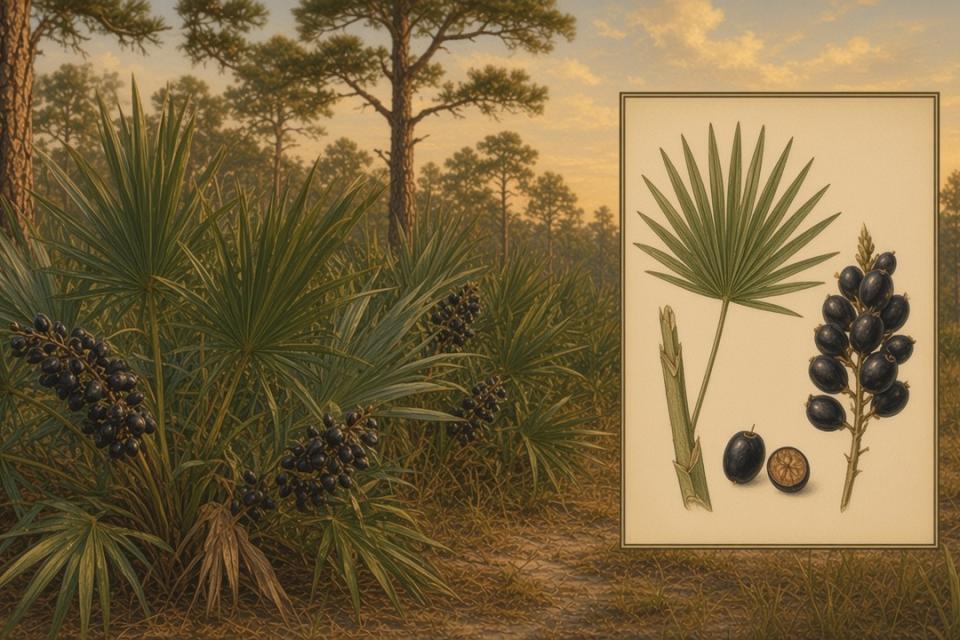
Serenoa repens (W. Bartram) Small is a palm (family Arecaceae). NCCIH lists Serenoa serrulata and Sabal serrulata as synonyms and American dwarf palm tree and cabbage palm as other common names; NCBI Taxonomy files it as taxon 4722. LiverTox describes it as a low-growing small palm with fan-shaped leaves, native to Florida and the southeastern United States; NCCIH adds the West Indies and gives a height of 6 to 10 feet. Bennett and Hicklin (Economic Botany 1998) call it the most common native palm in the United States. They describe a sprawling, shrubby palm, and EMA notes that it grows on dunes and in pine forests. EMA describes leaves split into 18 to 24 sharp-tipped segments, and the leaf stalks are edged with small teeth, the saw of its name.
The medicinal part is the ripe fruit, a drupe that EMA describes as ovoid to round, dark brown or blackish, up to 2.5 cm long and 1.5 cm across. The plant is also an ecological keystone: Bennett and Hicklin note that black bears, white-tailed deer, and cattle eat the fruit, honey bees favor the flowers, and the thickets shelter birds, reptiles, and small animals. Bennett and Hicklin estimated in 1998 that about 6.8 million kg of fruit a year were shipped to Europe, and that, on preliminary data, harvesting might be worth more than cattle grazing on the same land.
The fruit is oily. The European Pharmacopoeia standard requires at least 11% total fatty acids in the dried fruit (EMA). The fatty acids include lauric acid (PubChem CID 3893, C12H24O2), oleic, myristic, palmitic, capric, caprylic, and caproic acids, present free, as ethyl esters, or in triglycerides, along with plant sterols such as beta-sitosterol (CID 222284), flavonoids, and polysaccharides. Extracts are made with hexane, ethanol, or supercritical carbon dioxide, and EMA regards hexane and ethanol extracts as chemically different. The EU-approved hexane extract contains about 92% fatty acids. EMA’s assessment report cites analyses in which free fatty acids ranged from 41% to 81% of total lipid across products, and notes that some marketed products contain olive oil, so capsules labeled saw palmetto are not equivalent.
02 Lineage
History
Saw palmetto was food long before it was medicine. Bennett and Hicklin describe its edible fruits as a staple in the diet of Florida’s pre-contact inhabitants, and its leaves and stems as sources of fiber, wax, and roof thatch. EMA’s assessment report states that Native Americans used the plant for infertility and impotence, that colonists later adopted the whole berries as a tonic, and that the first reports in the medical literature of its use for urinary complaints date from the beginning of the twentieth century. Traditional indications listed by EMA include chronic cystitis, catarrh of the genitourinary tract, testicular atrophy, sex hormone disorders, and, most specifically, prostatic enlargement; EMA adds that there is no scientific support for these traditional applications.
The modern market was built largely in Europe. A hexane extract, Permixon, made by Pierre Fabre in France, became the most studied product, and by the late 1990s Florida was shipping millions of kilograms of fruit to Europe each year (Bennett and Hicklin). In 1996 Carraro and colleagues reported a six-month trial in 1,098 men comparing Permixon with finasteride, and in 2002 Debruyne and colleagues compared it with tamsulosin over a year; both found similar symptom relief. A 1998 JAMA systematic review by Wilt and colleagues concluded that saw palmetto improved urinary symptoms and flow, though the trials were short and varied.
Rigorous US trials followed. The STEP trial (Bent, New England Journal of Medicine 2006) and the NIH-funded CAMUS trial (Barry, JAMA 2011) found no benefit over placebo, and Cochrane’s updated reviews, incorporating them, reached the 2023 conclusion of little to no benefit. The EU’s Committee on Herbal Medicinal Products took a different view: its monograph, adopted on 24 November 2015, grants well-established use to the hexane extract on the strength of the comparative trials, and traditional use to ethanol extracts. HMPC explicitly declined to base its monograph on the 2012 Cochrane review, calling its conclusions too general.
03 Chemistry
Active compounds and how it works
EMA’s monograph states plainly that the mechanism of action is not known. Its assessment report lists effects seen in laboratory studies: inhibition of 5-alpha-reductase (the enzyme that converts testosterone to the stronger androgen dihydrotestosterone, or DHT), interference with androgen receptor binding, alpha-receptor binding, inhibition of inflammatory eicosanoid synthesis, and antispasmodic and anti-inflammatory effects. EMA notes that these findings often required high concentrations and doses and that activity differs between extracts, probably according to their fatty acid content. MSKCC adds that a liposterolic extract reduced tissue uptake of testosterone and DHT by more than 40% in laboratory studies and that the berries inhibit the cyclooxygenase and 5-lipoxygenase inflammatory pathways.
In people, saw palmetto does not behave like the prescription 5-alpha-reductase inhibitors. In the Carraro trial, finasteride shrank the prostate by 18% and lowered PSA by 41%, while the saw palmetto extract reduced prostate volume by only 6% and left PSA unchanged; the authors concluded it had little effect on androgen-dependent measures. In CAMUS, PSA changed no more with saw palmetto than with placebo even at 960 mg a day (Andriole, Journal of Urology 2013). Whatever saw palmetto does, it is not a herbal finasteride, and EMA reports no pharmacokinetic data on how its constituents are absorbed.
04 In practice
Common uses
BPH symptoms, the large independent trials: in STEP, Bent and colleagues (New England Journal of Medicine 2006) randomized 225 men over 49 with moderate to severe symptoms to 160 mg of saw palmetto extract twice daily or placebo for a year. There was no difference in symptom scores (mean difference 0.04 points), urinary flow, prostate size, residual urine, quality of life, or PSA. In CAMUS, Barry and colleagues (JAMA 2011) randomized 369 men aged 45 or older at 11 North American centers to saw palmetto at 320 mg a day, rising to 640 mg and then 960 mg, or placebo, over 72 weeks. Symptom scores fell by 2.20 points with saw palmetto and 2.99 with placebo, a difference of 0.79 points favoring placebo, and saw palmetto beat placebo on no secondary outcome.
Systematic reviews: Wilt and colleagues (JAMA 1998) pooled 18 short trials (mean nine weeks) with 2,939 men and found modest improvements in symptoms, night-time urination, and flow, and results similar to finasteride with less erectile dysfunction (1.1% versus 4.9%). As longer, better-blinded trials accumulated, the picture changed. Franco and colleagues (Cochrane 2023) included 27 placebo-controlled studies with 4,656 men. In the studies at low risk of bias, saw palmetto made little to no difference to symptoms at three to six months (0.90 points on the 35-point International Prostate Symptom Score) or at 12 to 17 months, or to quality of life, with high-certainty evidence. Ten of the 27 studies were industry funded. NCCIH notes that the reviewers analyzed hexane-extracted products separately and found no difference from other products.
The case for the hexane extract: EMA grants well-established use to one hexane extract, mainly on the basis of comparative trials. Carraro and colleagues (Prostate 1996) found that 320 mg a day reduced symptom scores by 37% over six months, against 39% for finasteride. Debruyne and colleagues (European Urology 2002) randomized 704 men to the extract or tamsulosin for a year; symptom scores fell by 4.4 points in both groups, and ejaculation problems were more common with tamsulosin. Vela-Navarrete and colleagues (BJU International 2018), in a meta-analysis that included a Pierre Fabre author, pooled 27 studies of this extract with 5,800 men and reported 0.64 fewer night-time voids and 2.75 ml/s more flow than placebo. A limitation of equivalence trials is that, without a placebo arm, they cannot show whether either treatment beat placebo; EMA itself noted the tendency of symptoms to converge in active and placebo groups in BPH.
Other uses: NCCIH reports that a 2022 review of five studies found no significant benefit for chronic prostatitis or chronic pelvic pain syndrome, and that a few small studies of oral or scalp-applied saw palmetto for male-pattern hair loss are too limited for conclusions. MSKCC states that saw palmetto is not an effective treatment for prostate cancer and that a large epidemiological study found no link between its use and lower prostate cancer risk. EMA sees no relevant use in women or children. Combination products with other herbs have low-certainty evidence of little to no difference from placebo (Cochrane 2023).
05 The apothecary
Preparations and traditional use
EU well-established use (EMA/HMPC/280079/2013, adopted 24 November 2015): soft extract of the fruit (drug-to-extract ratio 7–11:1, extracted with hexane, containing about 92% fatty acids and 2% unsaponifiable matter), 320 mg once daily or 160 mg twice daily, by mouth, for symptomatic treatment of BPH in adult and elderly men. Long-term use is possible. EU traditional use: soft extract made with 90–96% ethanol (7.5–14.3:1), 320 mg once daily, for lower urinary tract symptoms related to BPH after serious conditions have been excluded by a doctor. For both, see a doctor or pharmacist if symptoms persist or worsen, or if fever, spasms, blood in the urine, painful urination, or urinary retention develop.
Trial doses match these: 160 mg twice daily in STEP and 320 mg daily, rising to 960 mg, in CAMUS, which used an ethanol extract. Older references cited by EMA describe 0.5–1.0 g of dried fruit as a decoction three times daily, but such preparations are not well documented. EMA’s traditional-use section notes that digestive complaints are more likely on an empty stomach, so taking capsules with food is sensible. Allow several weeks to judge any effect; in EMA’s summary, improvements in positive trials appeared between four weeks and 12 months.
Get a diagnosis first. A doctor can check for prostate cancer, infection, bladder stones, diabetes, and medicines that affect urination, and discuss proven options such as alpha-blockers and 5-alpha-reductase inhibitors. Because saw palmetto does not change PSA (Andriole 2013; NCCIH), unlike finasteride, it does not interfere with PSA monitoring. US supplements vary and are not necessarily the extracts EU regulators assessed, and EMA’s assessment report documents wide variation in fatty acid content and products padded with olive oil; look for the extraction solvent, the extract amount, and independent quality certification.
Safety
Before you use saw palmetto
06 Caution
Side effects
Saw palmetto is well tolerated in trials. NCCIH says it has been used safely in research studies for up to three years and that adverse effects are mild and infrequent, including digestive symptoms, dizziness, and headache. For the hexane extract, EMA lists abdominal pain and headache as common (up to 1 in 10 people) and nausea, raised liver enzymes (transaminases or gamma-glutamyltransferase), skin rash, and reversible gynecomastia (breast enlargement in men) as uncommon (up to 1 in 100). For ethanol extracts EMA lists nausea, vomiting, diarrhea, and abdominal pain, especially on an empty stomach, plus allergic reactions and headache. Cochrane found adverse events about equally common with saw palmetto and placebo (risk ratio 1.01).
The large US trials looked hard for harm. EMA’s assessment report summarizes STEP, where serious adverse events occurred in 5.4% of the saw palmetto group and 9.7% on placebo, and CAMUS, where Avins and colleagues found no evidence of toxicity at up to three times the usual dose over 18 months, with no differences in adverse events, vital signs, or laboratory tests. Compared with finasteride, saw palmetto caused fewer complaints of decreased libido and impotence (Carraro 1996), though MSKCC lists decreased libido among reported effects.
Rare serious reports exist. EMA’s assessment report describes acute liver injury in a 58-year-old man that resolved within 10 days of stopping, and several cases of pancreatitis, including one in a 65-year-old man a week after starting saw palmetto; causation was uncertain and the products were poorly characterized. LiverTox (NIH) says saw palmetto has been implicated in rare cases of clinically apparent liver injury, though its specific role remains uncertain. Bleeding is the other concern: Cheema and colleagues described a 53-year-old man who lost about 2 liters of blood during brain tumor surgery with a prolonged bleeding time that normalized days after he stopped saw palmetto (EMA), and MSKCC lists blood around the heart in a man also taking rivaroxaban, and blood in the urine with clotting problems in a 79-year-old.
Children have had hormonal effects. MSKCC describes hot flashes followed by early menarche in an 11-year-old girl and a 10-year-old girl given supplements containing saw palmetto for hair problems; symptoms stopped when the supplement was withdrawn and, in one case, returned on re-exposure. MSKCC suggests anti-estrogenic activity and increased sex hormone-binding globulin as possible explanations. Some European product labels mention floppy iris syndrome during cataract surgery, but EMA did not include it in the monograph because a causal link was not established.
07 Caution
Contraindications
Do not use saw palmetto if you are allergic to it (EMA). EMA considers it to have no relevant use in women, children, or adolescents, and NCCIH says it may be unsafe during pregnancy or breastfeeding. MSKCC notes that, in laboratory studies, it counters the effects of male sex hormones such as testosterone and DHT. Given its anti-androgen effects in the laboratory and the reports of hot flashes and early menarche in girls, it should not be given to children, including in hair or skin supplements.
Bleeding risk and surgery: people with bleeding disorders, those taking anticoagulants or antiplatelet drugs, and anyone scheduled for surgery should discuss saw palmetto with their doctor or surgeon, given the case reports of severe surgical bleeding and the warfarin warning in the EU monograph. MSKCC also describes a bleeding complication, a retroperitoneal hematoma, after hernia repair in a man who had taken saw palmetto before surgery. MSKCC advises patients to consult a physician before using saw palmetto during radiation therapy, because a laboratory study found it made normal prostate cells more sensitive to radiation.
Urinary symptoms need assessment, not assumptions. EMA’s monograph tells users to see a doctor if symptoms worsen or if fever, spasms, blood in the urine, painful urination, or urinary retention occur, and its traditional-use indication applies only after a doctor has excluded serious conditions. Sudden inability to pass urine is an emergency. People with a history of liver disease or pancreatitis should be cautious given the rare case reports, and anyone who develops jaundice, dark urine, or severe abdominal pain while taking saw palmetto should stop it and seek care.
08 Caution
Drug and herb interactions
Anticoagulants and antiplatelets are the main concern. EMA’s monograph notes a few cases of suspected interactions with warfarin with increased INR values. Its assessment report describes a 61-year-old man whose INR rose from about 2.4 to 3.4 within six days of starting a combination product containing saw palmetto, pumpkin, and vitamin E, and notes that some European product labels warn of increased bleeding risk with phenprocoumon, warfarin, clopidogrel, aspirin, and NSAIDs. MSKCC lists possible additive effects with anticoagulants, antiplatelet drugs, and NSAIDs, including a case of bleeding around the heart in a man taking rivaroxaban. If you take any blood thinner, tell your prescriber before starting saw palmetto and expect closer monitoring.
Drug metabolism appears largely unaffected in people. EMA’s assessment report summarizes clinical studies in healthy volunteers in which 320 mg daily for about two weeks did not change the handling of dextromethorphan (CYP2D6) or alprazolam (CYP3A4), and 160 mg twice daily for 28 days did not affect midazolam (CYP3A4), caffeine (CYP1A2), or chlorzoxazone (CYP2E1). MSKCC notes that saw palmetto inhibits CYP3A4, 2D6, and 2C9 and UGT enzymes in laboratory studies, with unknown clinical relevance. On combining it with prostate drugs, evidence is limited and mixed: EMA describes a small study in which adding saw palmetto to tamsulosin gave no extra benefit, while MSKCC cites an open-label study reporting better storage symptoms with the combination. Do not add it to finasteride, dutasteride, or an alpha-blocker without discussing it with your doctor.
09 Questions
Frequently Asked Questions
For most men, the best current evidence suggests little benefit, although it is well tolerated and older, shorter trials were more encouraging. Two large NIH-funded trials, STEP and CAMUS, found saw palmetto no better than placebo, and Cochrane’s 2023 review of 27 trials concluded with high certainty that it provides little to no benefit for urinary symptoms. NCCIH says it is probably not helpful. The EU still accepts one hexane extract as a BPH treatment, based mostly on older trials comparing it with prescription drugs.
Possibly, but it is unproven. EMA grants well-established use only to a hexane extract, and industry-linked trials found it about as effective as finasteride or tamsulosin. Those trials had no placebo group, though, and when Cochrane analyzed hexane-extracted products separately it found no difference from other products. CAMUS, the negative high-dose trial, used an ethanol extract.
The EU dose for the licensed hexane extract is 320 mg once daily or 160 mg twice daily, and 320 mg once daily for traditional ethanol extracts, in adult men. Taking it with food may reduce stomach upset. Higher doses have not worked better: CAMUS tripled the dose to 960 mg a day without benefit.
No. In the CAMUS trial, PSA changed no more with saw palmetto than with placebo, even at 960 mg a day, and STEP found the same at the usual dose. That differs from finasteride, which lowered PSA by about 41% in a head-to-head trial and must be accounted for when interpreting results. Tell your doctor about any supplements before a PSA test anyway.
No. MSKCC states that it is not an effective treatment for prostate cancer, and a large epidemiological study found no link between saw palmetto use and lower prostate cancer risk. Urinary symptoms can occasionally be a sign of prostate cancer, so they should be checked by a doctor rather than self-treated.
The evidence is too limited to say. NCCIH notes only a few small studies of saw palmetto taken by mouth or applied to the scalp for male-pattern hair loss. It should not be given to children for hair problems; MSKCC describes girls who developed hot flashes and early periods after taking supplements containing it.
Use caution. EMA notes cases of raised INR in people taking warfarin, and there are case reports of serious bleeding during surgery and of bleeding with rivaroxaban. If you take an anticoagulant or antiplatelet drug, or other supplements with bleeding concerns such as ginkgo, talk to your doctor first, and tell your surgeon before any operation.
Many products combine saw palmetto with other herbs such as stinging nettle root, pumpkin, selenium, or lycopene. Cochrane found only low-certainty evidence for such combinations, suggesting little to no difference in symptoms compared with placebo. Multi-ingredient products also make side effects and interactions harder to trace, as in a reported warfarin case involving a saw palmetto, pumpkin, and vitamin E product.
10 References
Sources
These references support the history, clinical, and safety claims on this page. They are not an endorsement of any product.
-
Saw palmetto
National Center for Complementary and Integrative Health (NIH), 2025
Consumer evidence summary (updated April 2025): probably not helpful for BPH symptoms; hexane products no different; no benefit for chronic prostatitis; hair loss evidence too limited; safe in studies up to 3 years; no effect on PSA.
-
Saw palmetto
Memorial Sloan Kettering Cancer Center, About Herbs, 2023
Clinical summary (updated October 2023): anti-androgen and anti-inflammatory mechanisms; not effective for prostate cancer; case reports of bleeding, pancreatitis, liver injury, and hot flashes in girls; anticoagulant and NSAID cautions.
-
European Union herbal monograph on Serenoa repens (W. Bartram) Small, fructus
European Medicines Agency (EMA/HMPC/280079/2013), 2015
Adopted 24 November 2015: well-established use of hexane extract 320 mg daily for BPH symptoms; traditional use of ethanol extracts; warfarin INR warning; side effect frequencies; mechanism not known.
-
Assessment report on Serenoa repens (W. Bartram) Small, fructus
European Medicines Agency (EMA/HMPC/137250/2013), 2015
History and traditional uses; constituents and product variability; review of all major trials; STEP and CAMUS safety data; liver, pancreatitis, and bleeding case reports; clinical interaction studies.
-
Saw palmetto
LiverTox, National Institute of Diabetes and Digestive and Kidney Diseases (PubMed 31643699), 2020
NIH drug-induced liver injury database (updated April 2020): implicated in rare cases of clinically apparent liver injury, specific role uncertain.
-
Serenoa repens for the treatment of lower urinary tract symptoms due to benign prostatic enlargement
Cochrane Database of Systematic Reviews (PubMed 37345871), 2023
Franco et al.: 27 trials, 4,656 men; saw palmetto alone gives little to no difference in symptoms or quality of life (high-certainty evidence); adverse events similar to placebo.
-
Saw palmetto for benign prostatic hyperplasia
New England Journal of Medicine (PubMed 16467543), 2006
Bent et al. (STEP): 225 men, 160 mg twice daily for one year; no difference from placebo in symptoms, flow, prostate size, quality of life, or PSA.
-
Effect of increasing doses of saw palmetto extract on lower urinary tract symptoms: a randomized trial
JAMA (PubMed 21954478), 2011
Barry et al. (CAMUS): 369 men, doses rising from 320 to 960 mg daily over 72 weeks; no benefit over placebo on any outcome.
-
The effect of increasing doses of saw palmetto fruit extract on serum prostate specific antigen: analysis of the CAMUS randomized trial
Journal of Urology (PubMed 23253958), 2013
Andriole et al.: PSA changes similar with saw palmetto and placebo, even at 960 mg daily.
-
Comparison of a phytotherapeutic agent (Permixon) with an alpha-blocker (tamsulosin) in the treatment of benign prostatic hyperplasia: a 1-year randomized international study
European Urology (PubMed 12074791), 2002
Debruyne et al. (PERMAL): 704 men randomized; symptom scores fell 4.4 points with both hexane extract and tamsulosin; no placebo arm.
-
Comparison of phytotherapy (Permixon) with finasteride in the treatment of benign prostate hyperplasia: a randomized international study of 1,098 patients
The Prostate (PubMed 8876706), 1996
Carraro et al.: six months; symptom scores fell 37% vs 39% with finasteride; saw palmetto left PSA unchanged and barely reduced prostate volume.
-
Efficacy and safety of a hexanic extract of Serenoa repens (Permixon) for the treatment of lower urinary tract symptoms associated with benign prostatic hyperplasia: systematic review and meta-analysis
BJU International (PubMed 29694707), 2018
Vela-Navarrete et al.: 27 studies, 5,800 men; fewer night-time voids and better flow than placebo; similar to tamsulosin. Includes an author from the manufacturer.
-
Saw palmetto extracts for treatment of benign prostatic hyperplasia: a systematic review
JAMA (PubMed 9820264), 1998
Wilt et al.: 18 short trials, 2,939 men; modest symptom and flow improvements; similar to finasteride with less erectile dysfunction.
-
Uses of saw palmetto (Serenoa repens, Arecaceae) in Florida
Economic Botany, 1998
Bennett and Hicklin: most common native US palm; fruit a staple food of pre-contact Floridians; fiber, wax, and thatch; wildlife value; about 6.8 million kg of fruit shipped to Europe yearly.
-
Lauric acid
PubChem, National Library of Medicine (NIH), 2026
One of the main fatty acids in saw palmetto fruit extracts; CID 3893, C12H24O2.