
Monograph
Bibhitaki
Terminalia bellirica
Updated October 10, 2026
Key points
-
01
One of triphala’s three fruits
Bibhitaki, the beleric myrobalan, is the dried fruit rind of Terminalia bellirica. Most people meet it in triphala, an equal mix with amla and haritaki.
-
02
Uric acid trials, one company
Two Indian trials of one manufacturer-supplied extract found it lowered uric acid, less than febuxostat. Only one had a placebo group, and both were small.
-
03
Mostly lab evidence otherwise
Claims for cough, digestion, blood sugar, and liver protection rest on tradition and laboratory or animal studies, not human trials of bibhitaki alone.
-
04
Ancient dice from its nuts
In the Rigveda’s Gambler’s Lament, dice were made from vibhīdaka nuts. The seed kernel is reported to be narcotic, so it should not be eaten.
-
05
Quality is the main risk
One in five Ayurvedic medicines bought online contained lead, mercury, or arsenic. Triphala also inhibits drug-processing enzymes, so check with a pharmacist.
Bibhitaki is the fruit of Terminalia bellirica, a tall deciduous forest tree of South and Southeast Asia, and it is best known as one of the three fruits in triphala, the classic Ayurvedic formula. In English it is the beleric myrobalan, in Hindi bahera, and in Sanskrit vibhītaka. The medicinal part is the dried rind of the ripe fruit, a grey-brown, velvety, and strongly astringent shell. The Ayurvedic Pharmacopoeia of India, the government standard for Ayurvedic drugs, lists it for cough, hoarseness, vomiting, worms, constipation, and eye diseases, at 3–6 g of powder. Few people take bibhitaki on its own. Most meet it in triphala, which combines equal parts of bibhitaki, amla (Phyllanthus emblica), and haritaki (Terminalia chebula), according to Memorial Sloan Kettering Cancer Center (MSKCC) and a 2017 review by Peterson and colleagues. The tree also has a remarkable past: in the Rigveda, the oldest Indian scripture, gamblers threw dice made from its nuts.
Modern evidence for bibhitaki alone is thin. Two randomized trials from one research group in Hyderabad, India, both using a single commercial extract supplied by its manufacturer, found that it lowered uric acid. In 110 people with high uric acid (Usharani and colleagues, Clinical Pharmacology 2016), 500 mg twice a day brought average levels down from 8.07 to 5.78 mg/dL over 24 weeks, while levels rose slightly on placebo; the prescription drug febuxostat did more. A second trial in 59 people with chronic kidney disease had no placebo group. In a small mouth rinse study, a 10% bibhitaki rinse cut levels of a tooth-decay bacterium in saliva, though triphala did better. Most other claims, from liver protection to blood sugar control, rest on laboratory and animal work, as a 2020 review in Phytomedicine makes clear. Triphala has more human trials, mainly as a mouthwash, but MSKCC still calls human studies limited, and those results belong to the mixture, not to bibhitaki.
Rats have tolerated very large doses of a water extract of the fruit, and in the trials the extract caused only occasional mild stomach upset. The kernel is another matter: the World Agroforestry tree database warns that it can be eaten but is somewhat dangerous because it has a narcotic effect. Safety in pregnancy, breastfeeding, and childhood has not been studied. The biggest real-world risk is product quality. In a 2008 study by Saper and colleagues in JAMA, about one in five Ayurvedic medicines bought online, whether made in the United States or India, contained lead, mercury, or arsenic. Triphala also blocks two drug-processing liver enzymes in laboratory tests. Nothing here is medical advice; gout attacks, kidney disease, and a lasting change in bowel habit need a doctor, and anyone taking prescription medicines should check with a pharmacist before adding bibhitaki or triphala.
Ingredient in
TriphalaIn this monograph
01 The plant
Botanical profile
Terminalia bellirica (Gaertn.) Roxb. belongs to Combretaceae and shares its genus with haritaki, Terminalia chebula. Gaertner first described it in 1790 as Myrobalanus bellirica, and Roxburgh moved it to Terminalia in Plants of the Coast of Coromandel in May 1805, spelling it ‘bellerica’ (International Plant Names Index). Kew’s Plants of the World Online (POWO) accepts the spelling bellirica, but bellerica and belerica remain common: the Ayurvedic Pharmacopoeia of India uses Terminalia belerica, and most clinical trials use bellerica. POWO lists 16 synonyms, including T. punctata, T. gella, and T. laurinoides. It gives the native range as the Indian Subcontinent to southern Yunnan in China and Malesia, from Pakistan, Nepal, India, Sri Lanka, and Bangladesh through Myanmar, Thailand, Laos, Cambodia, and Vietnam to Malaya, Sumatra, Java, Borneo, Sulawesi, and the Maluku Islands, with introduced populations in Mauritius, Rodrigues, and Trinidad and Tobago. The pharmacopoeia records Sanskrit names vibhīta, akṣa, and akṣaka, alongside regional names such as bahera in Hindi, baheda in Bengali, and thanrikkai in Tamil; the World Agroforestry database adds bedda nut tree in English, samo-phiphek in Thai, and thitsein in Burmese.
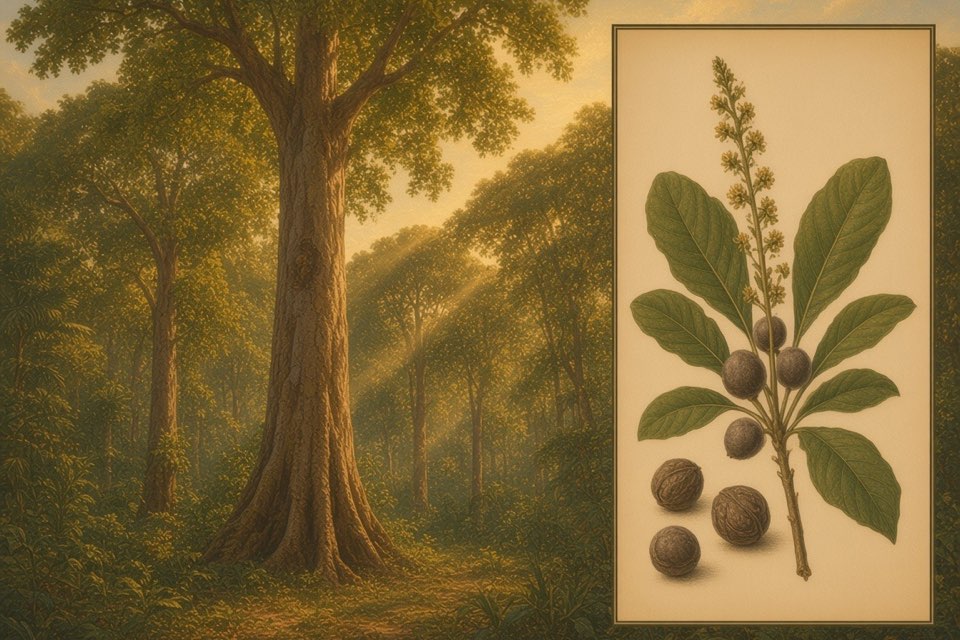
It is a big tree. The World Agroforestry database, compiled by Orwa and colleagues in 2009, describes a deciduous tree up to 50 m tall and 3 m across, with a rounded crown and a frequently buttressed trunk that can rise 20 m before branching. The bark is bluish or ashy grey with fine lengthwise cracks. Broad, elliptic to obovate leaves, up to 24 cm long on stalks of 2.5–9 cm, cluster toward the ends of the branches; the genus name comes from the Latin terminus, for this habit of bearing leaves at the shoot tips. New leaves open copper-red, turn parrot green, then dark green, and appear together with small greenish-white flowers on spikes 3–15 cm long that have a strong, honey-like smell. The fruit is roughly round to broadly ellipsoid, 2–4 cm long, densely velvety, and faintly five-angled. The pharmacopoeia describes fresh ripe fruits as silvery with a shiny, whitish down, drying grey or greyish-brown and slightly wrinkled, with a rind 3–5 mm thick and an astringent taste. The tree grows in monsoon and mixed deciduous forests, often with teak, up to about 1,000 m, demands light, tolerates drought fairly well, and has seeds that cannot be dried and stored like grain; animals eat the fruit and spread the seeds.
The pharmacopoeia defines the drug as the rind (pericarp) of the dried ripe fruit, with no more than 2% foreign matter, no more than 7% total ash, and at least 35% water-soluble extract, and it names gallic acid, tannic acid, and glycosides as constituents. Gupta and colleagues (Phytomedicine 2020) list tannins, gallic acid, corilagin, ellagic acid, ethyl gallate, galloyl glucose, chebulagic acid, and arjunolic acid among the main compounds, and a 2018 review by Tarasiuk and colleagues in Chinese Medicine adds β-sitosterol and chebulic acid, noting that gallic acid is the major phytoconstituent of all three triphala fruits. Valsaraj and colleagues (Journal of Natural Products 1997) isolated two new lignans from the fruit rind, which they named termilignan and thannilignan, together with anolignan B and a flavan. The commercial extract used in the uric acid trials, sold as Ayuric, is a water extract standardized by its maker to at least 1% each of chebulinic and chebulagic acids and at least 15% other small hydrolysable tannins. The tree has many other uses: World Agroforestry records that its leaves are valued fodder and feed tussar silkworms, the fruit yields tannins and dyes for leather, cloth, mats, and ink, the kernel gives an oil used in soap, and the soft, whitish wood is used for boxes and furniture.
02 Lineage
History
Bibhitaki’s oldest appearance is at the gambling table. Arthur Macdonell’s A Vedic Reader for Students (1917) introduces Rigveda hymn 10.34, the Gambler’s Lament, as the monologue of a man who cannot resist the dice and has ruined himself and his family, and explains that the dice (akṣás) were the nuts of a large tree called vibhīdaka, Terminalia bellerica, which he says was still used for this purpose in India. The hymn’s first verse names the vibhīdaka directly. The word turns up again in a hymn to the god Varuna (7.86), where Macdonell translates it simply as dice: the speaker tells Varuna that it was not his own intent but seduction, ‘liquor, anger, dice, thoughtlessness.’ The link survives in the plant’s names: the Ayurvedic Pharmacopoeia of India records akṣa and akṣaka as Sanskrit synonyms for bibhitaki, the same word Macdonell gives for the Vedic dice. The medicinal history of the fruit is harder to date, but Gupta and colleagues describe it as one of the oldest medicinal herbs of India, Pakistan, Nepal, Bangladesh, and Sri Lanka, used in Ayurveda, Unani, Siddha, and traditional Chinese medicine.
The connection with dice, numbers, and bad luck reappears in the Mahabharata. In the story of King Nala in the Vana Parva, translated by Kisari Mohan Ganguli (section 72), Nala is working in disguise as charioteer to King Rituparna when the king stops beside a vibhitaka tree and states exactly how many leaves and fruits it carries. Nala fells the tree to count them, finds the king was right, and asks how he did it; Rituparna answers that he is proficient at dice besides being versed in numbers, and the two trade knowledge, the king’s skill with dice for Nala’s horse lore. At that moment Kali, the spirit who had long afflicted Nala, leaves his body and, frightened, takes refuge in the vibhitaka tree. The epic adds that from the touch of Kali the vibhitaka tree fell into disrepute from that hour, a story that ties the tree once more to dice, numbers, and misfortune.
In medicine, bibhitaki matters mostly as part of triphala. Peterson and colleagues (Journal of Alternative and Complementary Medicine 2017) explain that triphala means ‘three fruits’ in Sanskrit, that it is classed as a tridoshic rasayana, a rejuvenating remedy suitable for all constitutions, and that it is described in the Charaka Samhita and Sushruta Samhita, the foundational Ayurvedic texts; Charaka wrote that taking triphala daily with honey and ghee could let a person live a hundred years free of old age and disease. Classical texts call triphala a mild laxative at normal doses, a bowel tonic at low doses, and a purgative at high doses, as well as carminative and expectorant. For bibhitaki itself, the Ayurvedic Pharmacopoeia of India records an astringent taste and heating potency, classes it as good for the eyes and hair, purgative, worm-expelling, and cough-relieving, and lists it for vomiting, cough, worm infestation, constipation, hoarseness, and eye diseases. Its listed formulations are Triphala Churna, Triphaladi Taila, and Lavangadi Vati. World Agroforestry adds Ayurvedic uses for tuberculosis, dyspepsia, diarrhea, dysentery, liver disease, leprosy, and hair growth.
03 Chemistry
Active compounds and how it works
Bibhitaki is above all a tannin-rich fruit, which explains its astringent taste. Its main polyphenols, gallic acid, ellagic acid, and hydrolysable tannins such as chebulagic acid and corilagin, are strong antioxidants in the test tube, and Gupta and colleagues (Phytomedicine 2020) summarize laboratory and animal studies reporting antioxidant, anti-inflammatory, immune-modulating, antimicrobial, liver-protecting, kidney-protecting, blood-sugar-lowering, cholesterol-lowering, and anticancer effects. Their review is a useful map of this literature but also a reminder of its limits: they conclude that more animal studies and clinical trials are needed before these activities can be called medicinal benefits. Gut bacteria also shape what these compounds do. Peterson and colleagues describe how gut microbes break down triphala polyphenols such as chebulinic acid into smaller compounds called urolithins, and report that triphala compounds such as quercetin and gallic acid encourage Bifidobacteria and Lactobacillus while inhibiting less welcome gut bacteria. How much of this applies to bibhitaki alone, at the doses people take, has not been measured.
The uric acid trials point to a more specific mechanism. Uric acid is made by xanthine oxidase, the enzyme blocked by the gout drugs allopurinol and febuxostat. Usharani and colleagues (Clinical Pharmacology 2016) report that in test-tube assays carried out by the extract’s manufacturer, Natreon, the bibhitaki and haritaki extracts inhibited xanthine oxidase as effectively as allopurinol, but these data are cited as on file rather than published, and no independent group has confirmed them. In the later kidney disease trial (Pingali and colleagues, BMC Complementary Medicine and Therapies 2020), the extract groups, like the febuxostat group, also showed improvements in a measure of blood-vessel function and in high-sensitivity C-reactive protein, a marker of inflammation, while none of the three treatments affected platelet aggregation. Because that trial had no placebo group, it cannot show whether these changes were caused by the extract.
Bibhitaki compounds also act on microbes in the laboratory. Valsaraj and colleagues (Journal of Natural Products 1997) traced the activity of a fruit rind extract to four compounds, the lignans termilignan, thannilignan, and anolignan B and a flavan, each of which showed activity against HIV-1, a malaria parasite, and fungi in vitro, and World Agroforestry notes fruit extracts active against Micrococcus pyogenes and Escherichia coli. Test-tube activity of this kind says nothing on its own about treating infections in people. A more relevant laboratory finding concerns drug metabolism: MSKCC reports that triphala inhibits CYP3A4 and CYP2D6, two liver enzymes that clear many prescription drugs, and notes that compounds in triphala may encourage bacterial biofilm on teeth despite their antibacterial effects. The laxative action that Ayurveda attributes to bibhitaki has not been studied in human physiology experiments.
04 In practice
Common uses
High uric acid is the only use of bibhitaki alone backed by randomized trials. Usharani and colleagues (Clinical Pharmacology: Advances and Applications 2016) randomized 110 people with raised uric acid at a hospital in Hyderabad to five groups for 24 weeks: bibhitaki extract 250 mg or 500 mg twice a day, haritaki extract 500 mg twice a day, febuxostat 40 mg once a day, or placebo. Of the 88 who completed the study, those on bibhitaki 500 mg saw average uric acid fall from 8.07 to 5.78 mg/dL, a drop nearly twice that seen with haritaki or the lower bibhitaki dose, while febuxostat brought levels from 8.53 to 4.28 mg/dL and levels on placebo rose. All treatments were well tolerated. The study is small, roughly 17 or 18 completers per group, a fifth of participants were lost to follow-up, and it measured blood levels rather than gout attacks, joint damage, or kidney outcomes. The extract, Ayuric, and the matching placebo were supplied by its manufacturer, Natreon, although the authors declared no conflicts of interest.
The same group then tested the extract in people with chronic kidney disease and high uric acid (Pingali and colleagues, BMC Complementary Medicine and Therapies 2020). Fifty-nine adults were randomized to febuxostat 40 mg once a day or bibhitaki extract 500 mg or 1,000 mg twice a day for 24 weeks, and 55 finished. Uric acid fell by an average of 63.7% with febuxostat, 19.8% with the lower bibhitaki dose, and 33.9% with the higher one. Creatinine fell and estimated kidney function rose in all groups, and the increase with the higher dose was similar to febuxostat’s. The authors suggested the extract could be a natural alternative for lowering uric acid, but the trial had no placebo arm, so natural variation and better medical follow-up during the study could explain part of the kidney improvement. It was also registered only after it had been completed, and Natreon again provided the medicines and laboratory kits. Two trials from one center, both using one company’s product, are a promising start rather than proof, and people with gout or kidney disease should not swap prescribed treatment for an extract.
Mouth and teeth: Saxena and colleagues (Journal of Clinical and Diagnostic Research 2017) ran a double-blind crossover study in dental clinic visitors aged 15 to 40, who each rinsed in turn with 15 ml of freshly made 10% water extracts of bibhitaki, haritaki, amla, and triphala. All four rinses reduced Streptococcus mutans, a bacterium linked to tooth decay, in saliva samples taken 5 and 60 minutes later, but triphala reduced it significantly more than any single fruit, and amla least. The study measured only short-term bacterial counts after single rinses, not plaque, gum health, or cavities. Triphala mouthwash has been tested more often. MSKCC reports that several clinical studies suggest it may reduce dental plaque, but that it is not clear whether it works as well as chlorhexidine, the standard antiseptic mouthwash, and adds that compounds in triphala may actually promote bacterial biofilm formation in the mouth. Those findings concern triphala, not bibhitaki alone.
Cough, digestion, and constipation are bibhitaki’s main traditional uses. The Ayurvedic Pharmacopoeia of India lists it for cough, hoarseness, vomiting, worm infestation, constipation, and eye diseases, and classes it as purgative, and World Agroforestry adds uses for dyspepsia, diarrhea, dysentery, and liver disease. None of these uses has been tested in modern controlled trials of bibhitaki on its own. Laboratory and animal studies summarized by Gupta and colleagues report liver-protecting, kidney-protecting, blood-sugar-lowering, and cholesterol-lowering activity, but these have not been confirmed in people. A similar trial in type 2 diabetes from the same Hyderabad group, which measured blood sugar, lipids, and blood-vessel function, tested an extract of haritaki, not bibhitaki, so it does not apply here. For a cough, a sore throat, or ongoing digestive trouble, bibhitaki remains a traditional remedy rather than an evidence-based one.
Triphala, the three-fruit combination, accounts for most of the human research involving bibhitaki. Peterson and colleagues (2017) describe it as a cornerstone of Ayurvedic gastrointestinal and rejuvenating treatment and review laboratory and early clinical findings for constipation, dental plaque, inflammation, and immune function, though their review is enthusiastic in tone and many of the studies are small. Tarasiuk and colleagues (2018) concluded that the limited clinical data do not allow firm conclusions about triphala for irritable bowel syndrome (IBS), suggested it might suit constipation-predominant IBS, and noted that its laxative action makes it unhelpful when diarrhea predominates. MSKCC calls human studies of triphala limited and notes that a double-blind trial of triphala combined with guggulu, a resin, did not lower cholesterol, body mass index, or waist size more than placebo. Any benefit seen with triphala belongs to that combination and cannot be credited to bibhitaki, which makes up only a third of it.
05 The apothecary
Preparations and traditional use
Traditionally, bibhitaki is used as a powder of the dried fruit rind. The Ayurvedic Pharmacopoeia of India gives a dose of 3–6 g of powder, which it describes as an approximate conversion of classical measures intended for adults, and lists three classical formulations that contain it: Triphala Churna, a powder; Triphaladi Taila, an oil; and Lavangadi Vati, a tablet. Triphala churna is the form most people encounter. MSKCC and Peterson and colleagues describe it as equal portions of the three dried, powdered fruits, and Saxena and colleagues note that the Ayurvedic Formulary of India specifies a 1:1:1 mixture. Charaka recommended taking triphala with honey and ghee, and Ayurvedic texts describe it as mildly laxative at ordinary doses and purgative at high ones (Peterson). Triphala is now sold as loose powder, capsules, tablets, and liquid extracts, and the amount of bibhitaki in a daily dose varies widely between them, so it is worth reading the label for the weight of each fruit or extract.
The clinical trials used a different kind of product: Ayuric, a standardized water extract of the fruit made by Natreon, in capsules. In the hyperuricemia trial, people took 250 mg or 500 mg twice a day after meals, and in the kidney disease trial 500 mg or 1,000 mg twice a day, for 24 weeks in both cases. Because extracts are concentrated, these doses do not translate directly into grams of powdered fruit, and results from this extract cannot be assumed for other bibhitaki or triphala products. The mouth rinse study used 15 ml of a freshly made 10% water extract, rinsed once. Labels may use any of the three spellings of the Latin name, Terminalia bellirica, bellerica, or belerica, or one of the common names bibhitaki, vibhitaki, bahera, baheda, or beleric myrobalan; all refer to the same plant.
Choosing a product carefully matters more for Ayurvedic remedies than for most herbs. Saper and colleagues (JAMA 2008) analyzed 193 Ayurvedic medicines ordered online and found lead, mercury, or arsenic in 20.7%, with similar rates for US-made and Indian-made products; 75% of the contaminated products claimed to follow Good Manufacturing Practices, and every one exceeded at least one standard for acceptable daily intake of a toxic metal. Products made by rasa shastra, the deliberate combining of herbs with metals, minerals, or gems, were contaminated more often, 40.6% versus 17.1%. The National Center for Complementary and Integrative Health (NCCIH) notes that there is no significant regulation of Ayurvedic practice or education in the United States. Simple plant-only products from manufacturers that publish heavy metal testing for each batch are the safer choice. Do not eat the seed kernels of the fruit in quantity, given World Agroforestry’s warning about their narcotic effect.
Safety
Before you use bibhitaki
06 Caution
Side effects
In the two uric acid trials, the bibhitaki extract was well tolerated. Usharani and colleagues reported that all treatments, including bibhitaki 250 mg and 500 mg twice a day for 24 weeks, were well tolerated with no serious adverse effects. In the kidney disease trial (Pingali and colleagues), two people taking bibhitaki had mild gastrointestinal intolerance, compared with four on febuxostat who had nausea and vomiting, and no one stopped treatment because of side effects. MSKCC lists gastrointestinal side effects as rare with triphala. Because Ayurveda classes bibhitaki as purgative and describes triphala as purgative at high doses, loose stools are a likely effect of taking too much. These trials were small and lasted no longer than 24 weeks, so rarer or longer-term effects would not have been detected.
Animal studies suggest low toxicity for the fruit rind. Sireeratawong and colleagues (African Journal of Traditional, Complementary and Alternative Medicines 2013) gave rats a single dose of 5,000 mg/kg of a water extract of the dried fruit with no signs of toxicity, and then fed rats 300, 600, or 1,200 mg/kg every day for 270 days without abnormalities in behavior, blood tests, organ weights, or tissue examination. These results are reassuring but do not establish safety in people, particularly over years of daily use, in pregnancy, or with other medicines. In people, the only safety monitoring comes from the uric acid trials; in the kidney disease trial, routine safety blood counts and biochemistry tests stayed within normal limits in all three groups after 24 weeks. No human studies of reproductive safety have been published, and there are no long-term studies in children.
The kernel and contaminants are the clearer hazards. World Agroforestry warns that the kernels of the fruit can be eaten but are somewhat dangerous because of their narcotic effect, and it describes the kernel oil as non-edible. Medicinal bibhitaki uses the rind, so seed kernels should not be eaten as a snack or remedy. The greater documented danger comes from heavy metals in some Ayurvedic products, which can cause poisoning over weeks or months. NCCIH cites a 2015 survey of people using Ayurvedic preparations in which 40% had raised blood lead levels and some had raised mercury, and a 2015 case of high blood lead in a 64-year-old woman who used Ayurvedic preparations bought online. Metal poisoning can build up slowly and be mistaken for the problem a remedy was taken for, so anyone using Ayurvedic products who feels unwell should mention them to a doctor and ask whether a blood lead test is appropriate.
07 Caution
Contraindications
Pregnancy, breastfeeding, and children: there are no human safety data for bibhitaki or triphala in pregnancy or breastfeeding, and Ayurveda classes bibhitaki as purgative, so medicinal use is best avoided in these situations. NCCIH advises anyone who is pregnant or nursing to consult their own or their child’s health care provider before using Ayurvedic products, because some may contain substances that could be harmful, and metal contamination is a particular concern when a baby is developing. Although Peterson and colleagues note that Ayurveda considers triphala suitable for the very young, there are no modern safety studies in children, and remedies should not be given to them without a pediatric assessment.
Kidney disease, gout, and high uric acid: the bibhitaki trials were run under close medical supervision, with regular blood tests. People with chronic kidney disease should not start any herbal extract, bibhitaki included, without their kidney specialist, both because kidney function changes how substances are cleared and because the trial in kidney disease lacked a placebo group. Both trials also excluded people with kidney stones, liver disease, or uncontrolled diabetes or blood pressure, so their results say nothing about these groups. Gout needs a proper diagnosis and treatment plan; a single hot, red, swollen joint can also be an infection and needs same-day care. High uric acid without symptoms is a matter to discuss with a doctor rather than to self-treat, and prescribed urate-lowering medicines should not be stopped or swapped for a supplement.
Digestive conditions: because bibhitaki and triphala are laxative, they are unsuitable for people with ongoing diarrhea, including diarrhea-predominant IBS, as Tarasiuk and colleagues point out, and for anyone with inflammatory bowel disease unless their gastroenterologist agrees. Constipation that is new, persistent, or comes with blood in the stool, black stools, unexplained weight loss, vomiting, or severe abdominal pain needs a medical assessment rather than a herbal laxative. Cough lasting more than three weeks, coughing up blood, or breathlessness also needs a doctor, whatever traditional texts say about bibhitaki for cough. The Ayurvedic Pharmacopoeia also lists it for eye disease and hoarseness, but painful red eyes, changes in vision, or persistent hoarseness should be checked by a doctor rather than treated at home.
Medicines and surgery: MSKCC advises against taking triphala with drugs that are broken down by the liver enzymes CYP3A4 and CYP2D6, which handle many prescription medicines. Anyone on regular prescription drugs, especially those where small changes in blood level matter, should ask a pharmacist before using triphala or concentrated bibhitaki extracts. The kidney disease trial excluded people taking steroids or immunosuppressant drugs, so there are no data at all for transplant recipients or others on these medicines. Products that have not been tested for heavy metals are best avoided by everyone, and especially by anyone who has had raised blood lead in the past. Tell your surgical team about any Ayurvedic products before an operation, so they can check the ingredients.
08 Caution
Drug and herb interactions
Uric-acid-lowering drugs: in the trials, bibhitaki extract was compared with febuxostat rather than combined with it, and no study has tested it alongside allopurinol or febuxostat. If its effect on uric acid is real, adding it to these drugs could change uric acid levels in ways that have not been measured, and the manufacturer’s own test-tube data suggest it acts on the same enzyme, xanthine oxidase. People taking urate-lowering treatment should tell their prescriber before adding bibhitaki or triphala, and any combination should be followed with blood tests. Because the kidney disease trial reported changes in creatinine and estimated kidney function, people whose drug doses depend on kidney function should be especially careful.
Drugs cleared by CYP3A4 and CYP2D6: MSKCC reports that triphala inhibits these two liver enzymes, which could raise blood levels of drugs they metabolize and increase side effects, and it advises people taking such drugs not to use triphala. The finding comes from laboratory studies, and whether bibhitaki alone, or triphala at ordinary doses, has a meaningful effect in people has not been tested. Since CYP3A4 and CYP2D6 process many prescription medicines, the practical advice is to ask a pharmacist to check your medicines before starting either product, and to report any new side effects after starting it.
Diabetes medicines and other products: MSKCC notes preliminary data suggesting that triphala may improve blood sugar levels, so people taking diabetes medicines should monitor their glucose if they start it. Combining triphala or bibhitaki with other laxatives, such as senna or stimulant laxative teas, may add to cramping and loose stools. Both uric acid trials excluded people taking aspirin, other nonsteroidal anti-inflammatory drugs (NSAIDs), or diuretics (water pills), so how bibhitaki behaves alongside these common medicines is unknown. Many Ayurvedic formulas contain several herbs and sometimes minerals, which makes it hard to know what you are taking and adds to the risk of contamination, so tell your doctor and pharmacist about every Ayurvedic product you use, including teas and powders.
09 Questions
Frequently Asked Questions
Bibhitaki, also called vibhitaki, bahera, or beleric myrobalan, is the dried fruit of Terminalia bellirica, a large deciduous tree of South and Southeast Asia. The rind of the ripe fruit is powdered and used in Ayurveda, which lists it for cough, hoarseness, vomiting, worms, constipation, and eye diseases. It is best known as one of the three fruits in triphala. Modern human research on bibhitaki alone is limited to a few small studies, mainly on uric acid.
No. Triphala, Sanskrit for ‘three fruits’, is a blend of equal parts bibhitaki, amla, and haritaki, so bibhitaki is one third of it. Most human research has tested triphala, mainly as a mouthwash for plaque and gum inflammation, and those results belong to the combination, not to bibhitaki on its own. Bibhitaki alone has been tested mainly as a standardized extract for high uric acid.
It may lower uric acid, but it has not been shown to prevent gout attacks. In a 24-week trial of 110 people with high uric acid, a bibhitaki extract at 500 mg twice a day lowered average levels from 8.07 to 5.78 mg/dL, while febuxostat did more and placebo did nothing. A second trial, in kidney disease, had no placebo group. Both used one company’s extract and came from one research center. Gout and high uric acid need a doctor’s care, and prescribed treatment should not be swapped for a supplement.
Ayurveda has long used both as laxatives, but neither has strong modern evidence. Bibhitaki alone has not been tested for constipation, and reviews of triphala describe only small and mostly uncontrolled studies. Better-studied options are psyllium, a soluble fiber, and senna for short-term use; see their pages for the evidence. Constipation that is new, persistent, or comes with bleeding or weight loss needs a doctor.
Bibhitaki is a traditional Ayurvedic cough remedy, and the Ayurvedic Pharmacopoeia of India lists it for cough and hoarseness, but no modern trials have tested it for either. Herbs with more research for coughs include thyme, which has been tested in combination with ivy leaf, and pelargonium for acute bronchitis. A cough that lasts more than three weeks, or comes with blood, chest pain, or breathlessness, needs a medical assessment.
In trials lasting up to 24 weeks, a bibhitaki extract caused only occasional mild stomach upset, and rats tolerated very large doses. Its laxative action can cause loose stools at high doses. There are no safety data in pregnancy, breastfeeding, or children, so it is best avoided then. Triphala inhibits two drug-processing liver enzymes in laboratory tests, so check with a pharmacist if you take prescription medicines. Do not eat the seed kernels, which are reported to be narcotic.
Some can. In a 2008 JAMA study, 20.7% of Ayurvedic medicines bought online, whether made in the United States or India, contained lead, mercury, or arsenic, including many that claimed Good Manufacturing Practices. Products made by rasa shastra, which deliberately adds metals or minerals, were contaminated about twice as often. Choose plant-only products from makers that publish batch testing for heavy metals, and tell your doctor if you feel unwell while using Ayurvedic remedies.
Yes. In the Rigveda’s Gambler’s Lament (hymn 10.34), the dice were nuts of the vibhīdaka tree, Terminalia bellerica, and Arthur Macdonell wrote in 1917 that they were still used for this purpose in India. One Sanskrit name for the tree, akṣa, is the word for these dice. In the Mahabharata, the spirit Kali takes refuge in a vibhitaka tree after leaving King Nala, and the tree is said to have fallen into disrepute from then on.
10 References
Sources
These references support the history, clinical, and safety claims on this page. They are not an endorsement of any product.
-
Terminalia bellirica (Gaertn.) Roxb.
Plants of the World Online, Royal Botanic Gardens, Kew, 2026
Accepted name and spelling bellirica; first published by Roxburgh in 1805; native range from the Indian Subcontinent to southern Yunnan and Malesia; introduced in Mauritius, Rodrigues, and Trinidad and Tobago; 16 synonyms including Myrobalanus bellirica Gaertn.
-
Terminalia bellirica
World Agroforestry, Agroforestree Database 4.0 (Orwa et al.), 2009
Common names; deciduous tree to 50 m with buttressed trunk; copper-red young leaves, honey-scented flower spikes, velvety fruit; monsoon forest ecology; fodder, tannin, dye, timber, and kernel oil uses; kernels edible but somewhat dangerous because of a narcotic effect.
-
The Ayurvedic Pharmacopoeia of India, Part I, Volume I: Bibhitaka (fruit)
Government of India, Ministry of Health and Family Welfare, Department of AYUSH, via Internet Archive, 1986
Defines bibhitaka as the pericarp of dried ripe fruits of Terminalia belerica; Sanskrit synonyms vibhīta, akṣa, akṣaka; purity standards; gallic acid, tannic acid, and glycosides; listed for vomiting, cough, worms, constipation, hoarseness, and eye diseases; 3–6 g of powder.
-
A Vedic Reader for Students
Arthur Anthony Macdonell, Clarendon Press, Oxford, via Internet Archive, 1917
Introduction to Rigveda 10.34, the gambler’s hymn: the dice (akṣás) were nuts of the vibhīdaka tree, Terminalia bellerica, still used for this purpose in India; translation of vibhīdaka as dice in hymn 7.86.
-
The Mahabharata, Book 3: Vana Parva, Section LXXII
Kisari Mohan Ganguli (translator), online edition via Wisdom Library, 2010
King Rituparna counts the leaves and fruits of a vibhitaka tree and trades his knowledge of dice and numbers for Nala’s horse lore; Kali leaves Nala and enters the tree, which from that hour fell into disrepute.
-
Terminalia bellirica (Gaertn.) Roxb. (Bahera) in health and disease: A systematic and comprehensive review
Phytomedicine (PubMed 32781393), 2020
Gupta et al.: traditional use in Ayurveda, Unani, Siddha, and Chinese medicine; constituents including gallic acid, ellagic acid, corilagin, chebulagic acid, and arjunolic acid; mostly in vitro and animal evidence; more clinical trials needed.
-
New anti-HIV-1, antimalarial, and antifungal compounds from Terminalia bellerica
Journal of Natural Products (PubMed 9249982), 1997
Valsaraj et al.: isolated the new lignans termilignan and thannilignan, plus anolignan B and a flavan, from the fruit rind; all four active against HIV-1, malaria parasites, and fungi in vitro.
-
A randomized, double-blind, placebo-, and positive-controlled clinical pilot study to evaluate the efficacy and tolerability of standardized aqueous extracts of Terminalia chebula and Terminalia bellerica in subjects with hyperuricemia
Clinical Pharmacology: Advances and Applications (PubMed 27382337), 2016
Usharani et al.: 110 randomized, 88 completed 24 weeks; bibhitaki 500 mg twice daily lowered uric acid from 8.07 to 5.78 mg/dL versus febuxostat 8.53 to 4.28; placebo rose; well tolerated; extract and placebo supplied by Natreon.
-
A randomized, double-blind, positive-controlled, prospective, dose-response clinical study to evaluate the efficacy and tolerability of an aqueous extract of Terminalia bellerica in lowering uric acid and creatinine levels in chronic kidney disease subjects with hyperuricemia
BMC Complementary Medicine and Therapies (PubMed 32933504), 2020
Pingali et al.: 59 adults with kidney disease; uric acid fell 63.7% with febuxostat, 19.8% and 33.9% with bibhitaki 500 and 1,000 mg twice daily; no placebo arm; registered retrospectively; two cases of mild GI intolerance; medicines supplied by Natreon.
-
Anti Bacterial Efficacy of Terminalia Chebula, Terminalia Bellirica, Embilica Officinalis and Triphala on Salivary Streptococcus Mutans Count - A Linear Randomized Cross Over Trial
Journal of Clinical and Diagnostic Research (PubMed 28384980), 2017
Saxena et al.: single 10% rinses of each fruit and of triphala all reduced salivary S. mutans at 5 and 60 minutes; triphala reduced it most and amla least; triphala prepared 1:1:1 per the Ayurvedic Formulary of India.
-
Therapeutic Uses of Triphala in Ayurvedic Medicine
Journal of Alternative and Complementary Medicine (PubMed 28696777), 2017
Peterson et al.: triphala as equal parts amla, bibhitaki, and haritaki; a tridoshic rasayana described in the Charaka and Sushruta Samhitas; laxative at normal doses and purgative at high doses; gut microbiome metabolism of its polyphenols.
-
Triphala: current applications and new perspectives on the treatment of functional gastrointestinal disorders
Chinese Medicine (PubMed 30034512), 2018
Tarasiuk et al.: equal-part composition; gallic acid as the major constituent of all three fruits; β-sitosterol, ellagic and chebulic acids listed for bibhitaki; limited data preclude firm conclusions for IBS; not suited to diarrhea-predominant IBS.
-
Triphala
Memorial Sloan Kettering Cancer Center, About Herbs, 2022
Updated January 2022: equal portions of the three fruits; human studies limited; may reduce plaque but unclear versus chlorhexidine and may promote biofilm; guggulu-triphala trial showed no cholesterol benefit; rare GI effects; inhibits CYP3A4 and CYP2D6.
-
Lead, mercury, and arsenic in US- and Indian-manufactured Ayurvedic medicines sold via the Internet
JAMA (PubMed 18728265), 2008
Saper et al.: 20.7% of 193 Ayurvedic medicines bought online contained lead, mercury, or arsenic; similar for US and Indian products; rasa shastra 40.6% versus 17.1%; 75% of contaminated products claimed Good Manufacturing Practices.
-
Ayurvedic Medicine: In Depth
National Center for Complementary and Integrative Health (NIH), 2019
Some Ayurvedic preparations contain toxic lead, mercury, or arsenic; 2015 survey finding raised blood lead in 40% of users; consult a provider in pregnancy or nursing; no significant US regulation of Ayurvedic practice.
-
Acute and chronic toxicity studies of the water extract from dried fruits of Terminalia bellerica (Gaertn.) Roxb. In Spargue-Dawley rats
African Journal of Traditional, Complementary and Alternative Medicines (PubMed 24146445), 2013
Sireeratawong et al.: no toxicity after a single 5,000 mg/kg dose, or after 300, 600, or 1,200 mg/kg daily for 270 days, in male and female rats.