Monograph
Pumpkin Seed
Cucurbita pepo
Updated October 9, 2026
Key points
-
01
An EU traditional remedy
EMA accepts pumpkin seed for urinary symptoms of an enlarged prostate or overactive bladder as a traditional medicine, based on long use, once a doctor has excluded serious disease.
-
02
Modest, mixed trial results
In the 1,431-man GRANU trial, extract capsules matched placebo. Whole seeds did slightly better, 58.5% versus 47.3% responders, a result that still needs confirmation.
-
03
Eases symptoms at most
Trials found no reduction in prostate size or improvement in urine flow. Pumpkin seed is not a substitute for proven BPH medicines.
-
04
Nutritious and well tolerated
An ounce of kernels supplies about 168 mg of magnesium and 158 calories. Mild stomach upset affects about 4% of users, and allergy is rare but can be severe.
-
05
Get urinary symptoms checked
Urinary symptoms can signal infection or prostate cancer. See a doctor before self-treating, and get help right away if you cannot pass urine or see blood.
Pumpkin seed is a snack, a salad oil, and a traditional prostate remedy all at once. The seeds come from Cucurbita pepo, the species that includes field pumpkins and many squashes, a plant first domesticated in Mexico around 10,000 years ago. In Austria a variety whose seeds grow without a hard shell, the Styrian oil pumpkin, yields dark green kernels that are pressed into a nutty salad oil with a protected EU name. Pumpkin seed was once listed in the US Pharmacopeia as a remedy for tapeworm. In Europe today it is used for the lower urinary tract symptoms of benign prostatic hyperplasia (BPH), the non-cancerous enlargement of the prostate that becomes common with age, and for an overactive bladder. The European Medicines Agency (EMA) accepts it for both as a traditional herbal medicine, on the strength of long use rather than proof, and only after a doctor has excluded serious conditions.
The trial evidence is modest and mixed. In the largest study, the German GRANU trial of 1,431 men followed for a year, capsules of pumpkin seed extract did no better than placebo, while men eating 5 g of whole seeds twice a day responded somewhat more often (58.5% versus 47.3%), a difference the authors called descriptive and in need of confirmation. An earlier year-long trial of 476 men, summarized by EMA, found a small improvement in symptom scores without any change in urine flow or prostate size. Smaller trials of pumpkin seed oil are weak, and in an Iranian trial the prescription drug tamsulosin worked better. EMA concluded in 2012, and again on review in 2021, that the data support only traditional use. A single Korean trial of pumpkin seed oil capsules reported more hair growth in men with male-pattern baldness, but it has not been repeated.
As a food, pumpkin seeds are safe for almost everyone and are rich in magnesium, protein, iron, and zinc, although an ounce of kernels also carries about 158 calories. EMA lists mild digestive complaints in about 4% of users, rare allergic reactions that can be severe, and no reported drug interactions, and it does not recommend medicinal use under 18 or in pregnancy because urinary symptoms in those groups need medical supervision. Eating large amounts of whole seeds with their shells can, rarely, form a hard mass in the rectum. The bigger risk is delay. Nothing here is medical advice; urinary symptoms in men can come from infection, bladder problems, or prostate cancer, so have them checked before treating yourself, and get help right away if you cannot pass urine, see blood in your urine, or have a fever with painful urination.
Featured in
Herbs for Urinary Tract HealthIn this monograph
01 The plant
Botanical profile
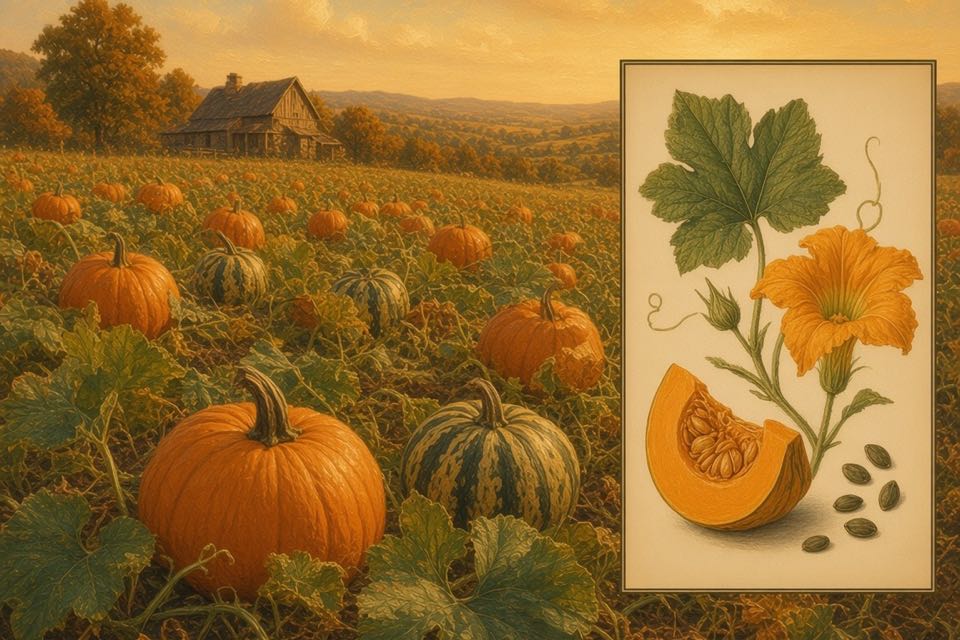
Cucurbita pepo L. belongs to Cucurbitaceae, the gourd or melon family, which EMA’s assessment report puts at about 95 genera and 950 to 980 species. Linnaeus named it in Species Plantarum in 1753. Kew’s Plants of the World Online describes its native range as a cultigen from Mexico, meaning it is known as a crop rather than a wild plant, and lists it as introduced in dozens of regions across the Americas, Europe, Africa, Asia, and the Pacific. It is an annual. King’s American Dispensatory (1898) describes a rough, bristly plant with a trailing stem, branching tendrils, and large heart-shaped leaves with five palm-like lobes. The flowers are large, yellow, and bell-shaped, borne singly where the leaves join the stem, and the male flowers sit on long stalks. In the United States the plant flowers in July and ripens its fruit in September and October; King’s describes the fruit as very large, round or oblong, furrowed, and yellow when ripe.
The medicinal part is the whole, ripe, dried seed (EMA). King’s, quoting the US Pharmacopeia, describes seeds about 2 cm long, broadly oval, flat, and whitish, with a shallow groove running parallel to the edge, no smell, and a bland, oily taste, and estimates them at about a quarter husk and three-quarters kernel. There is no European Pharmacopoeia monograph; EMA notes that the German Pharmacopoeia defines the drug as the whole, dry, ripe seeds of Cucurbita pepo and its cultivated varieties. For medicines, the preferred variety is the Styrian oil pumpkin, Cucurbita pepo var. styriaca, because of its thin seed coat and mild taste. Its seeds grow without the usual tough white shell, leaving the green kernel exposed. The EU’s 1996 registration of Styrian pumpkin seed oil (Steirisches Kürbiskernöl) as a protected geographical indication describes a dark, viscous oil made by grinding, gently splitting, and pressing these skinless seeds. EMA adds that the seeds are roasted just before pressing and that the oil is dark red to green, fluorescent red, and nutty, and is not used for cooking because of its color and tendency to foam.
Pumpkin seeds are a dense food. USDA FoodData Central lists one ounce (28 g) of dried kernels at about 158 calories, with 8.6 g of protein, 13.9 g of fat, 1.7 g of fiber, 168 mg of magnesium, 2.5 mg of iron, and 2.2 mg of zinc. EMA’s assessment report gives an oil content of about 50% (45–60%), mostly unsaturated: linoleic acid typically makes up about 40–64% of the fatty acids and oleic acid 20–38%, with more linoleic acid in late-ripening crops. The vitamin E is mainly gamma-tocopherol rather than the alpha form, and the selenium content is among the highest found in plants. What sets the oil apart is its sterols. Most seed oils are dominated by delta-5 sterols such as beta-sitosterol, but in pumpkin seed four delta-7 sterols, including alpha-spinasterol and delta-7-avenasterol, make up 75–88% of the total, and EMA names delta-7 and delta-5 sterols as the putative active constituents. The seeds also contain cucurbitine, an unusual amino acid present at 0.18–0.66% in C. pepo and long studied for its activity against parasitic worms.
02 Lineage
History
Pumpkin seed’s story begins in the Americas. Smith (Science 1997) examined squash seeds, fruit stalks, and rind fragments from Guilá Naquitz cave in Oaxaca, Mexico, and showed from their longer seeds, thicker stalks, and changed fruit shape and color that they came from domesticated Cucurbita pepo rather than wild gourds. Nine radiocarbon dates placed this cultivation between 10,000 and 8,000 years ago, more than 4,000 years earlier than maize, beans, or any other directly dated crop in the Americas. The plant was later carried to Europe: EMA’s assessment report, citing Janick and Paris, notes that New World cucurbits appear in frescoes painted in 1515–1518 at the Villa Farnesina in Rome, among the first European paintings of these species. The same report lists ‘pumpkin’ in the writings of Hippocrates and Dioscorides, but because Cucurbita is American, those ancient references must concern Old World gourds or melons. King’s American Dispensatory (1898) made a similar slip, calling the pumpkin a native of the Levant.
In Europe and North America the seeds became a household remedy for worms. EMA records traditional European use as a diuretic and as a remedy to expel tapeworms, and King’s lists the seed as Pepo in the US Pharmacopeia. King’s calls the seeds long popular with the public for worms and describes the method then favored: the patient fasted for a day, took a saline purgative, and then drank three doses of an emulsion of fresh seeds pounded with sugar and diluted with milk or water, two hours apart, followed by castor oil to expel the worm. King’s also recommended the seeds as a diuretic for ‘scalding of urine’ and spasm of the urinary passages, an early hint of the modern use. Later reports summarized by EMA were uncontrolled: a pumpkin seed preparation cleared tapeworms in 50–70% of 150 patients in one series, and pumpkin seeds combined with areca nut cured 95% of beef tapeworm infections but only 40% of pork tapeworm infections in another. Martindale’s reference book, EMA notes, now describes the seeds as formerly used to expel tapeworms.
The urinary use grew in twentieth-century Central Europe. Madaus’s German textbook of 1938 already listed pumpkin seeds for symptoms of an enlarged prostate as well as for tapeworm (EMA). Germany’s Commission E published a monograph in 1985, revised in 1991, for irritable bladder and urination problems in early-stage BPH, cautioning that pumpkin seed relieves symptoms without reducing the enlargement and that a doctor should be consulted at regular intervals; ESCOP and the World Health Organization published similar monographs. Styria, meanwhile, built a regional industry around its oil pumpkin. The 1996 EU registration of Styrian pumpkin seed oil states that oil was pressed from pumpkin seeds there as early as the eighteenth century and that the skinless seeds were developed in Styria, and it describes about 10,000 hectares under cultivation and some 70 commercial oil mills supporting small farms in southern Styria and southern Burgenland. EMA’s Committee on Herbal Medicinal Products adopted its monograph on 20 November 2012, granting traditional use only, and in a 2021 periodic review agreed by consensus that no revision was needed.
03 Chemistry
Active compounds and how it works
No one knows exactly how pumpkin seed might ease urinary symptoms, and EMA found no data on how its constituents are absorbed in people. Attention has focused on the delta-7 sterols. In a small German study summarized by EMA, Schilcher and colleagues (1987) gave six men awaiting prostate surgery 90 mg a day of five delta-7 sterols from Styrian pumpkin seeds on the third and fourth days before their operations. Their removed prostate tissue contained less dihydrotestosterone (DHT), a more potent androgen made from testosterone, than tissue from untreated men. In laboratory work by Schmidlin and Kreuter (2003), a pumpkin seed extract inhibited 5-alpha-reductase type II, the enzyme that converts testosterone to DHT, and aromatase in placental tissue, though only at high concentrations. In castrated rats given testosterone, the extract reduced prostate enlargement by 31%, against 76% with finasteride. Such experiments suggest a weak hormonal effect at most, and none has been confirmed in men at normal doses.
Other findings point in different directions. An ethanol extract containing triglycerides, sterols, and tocopherol showed no anti-androgen activity in a laboratory test of androgen-receptor signaling (Schleich and colleagues 2006, cited by EMA). The European Association of Urology (EAU) notes that plant extracts can show many laboratory effects, from anti-inflammatory and anti-androgen activity to action on enzymes and receptors, but that their effects in the body are uncertain and their mechanisms unclear. EMA’s assessors suggested instead that any benefit comes from a toning effect on the bladder, relaxation of the sphincter, and easing of urination symptoms, an explanation that fits the parallel traditional use for an overactive bladder. What pumpkin seed does not appear to do is shrink the prostate: in the year-long Bach trial summarized by EMA, prostate volume, urine flow, and the amount of urine left in the bladder did not differ from placebo, consistent with Commission E’s warning that it relieves symptoms without reducing the enlargement.
The hair-loss idea borrows the prostate theory. Cho and colleagues (2014) chose pumpkin seed oil because animal studies suggested it might inhibit 5-alpha-reductase, and DHT is a major player in male-pattern hair loss; but they measured neither DHT nor PSA and said they could not explain how the oil worked. For worms, EMA reviews animal studies: cucurbitine, an amino acid isolated from the related Cucurbita moschata, reduced worm numbers by about half at high doses in mice infected with the blood fluke Schistosoma japonicum, but not when it was started two to three weeks after infection, and powdered pumpkin seeds sharply reduced nodular worms in experimentally infected piglets. Pumpkin seeds also contain proteins that inhibit trypsin and other protein-digesting enzymes, and ribosome-inactivating proteins with antiviral and antifungal activity in the test tube, at levels EMA considers harmless in food. None of these laboratory findings has been tied to a proven clinical effect in people.
04 In practice
Common uses
Enlarged prostate symptoms, the largest trial: in GRANU (German Research Activities on Natural Urologicals), Vahlensieck and colleagues (Urologia Internationalis 2015) randomized 1,431 men aged 50 to 80 with lower urinary tract symptoms suggestive of BPH to pumpkin seed (5 g twice daily), capsules of pumpkin seed extract (500 mg twice daily), or matching placebo for 12 months, in a partially blinded design. A man counted as a responder if his International Prostate Symptom Score (IPSS) fell by at least 5 points. The extract did no better than placebo. Among men eating the seeds, 58.5% responded, against 47.3% on placebo, a difference the authors described as only descriptively significant, and they concluded that it must be confirmed in another study or a systematic review before pumpkin seed can be fully recommended. Both products were well tolerated. GRANU is also a reminder of how much men improve on placebo: nearly half of the placebo group met the response target.
Other BPH trials are smaller or weaker. EMA’s assessment report summarizes a 65-center, double-blind trial by Bach (2000) in 476 men with early-stage BPH given a 500 mg pumpkin seed extract capsule or placebo for 12 months: symptom scores improved more than with placebo, but urine flow, quality of life, prostate volume, and residual urine did not, and EMA judged the effect small. Hong and colleagues (Nutrition Research and Practice 2009) assigned 62 Korean men, by order of enrollment, to placebo, 320 mg of pumpkin seed oil, 320 mg of saw palmetto oil, or both daily for a year. Symptom scores fell within each active group, but only 47 men finished, 13 of those who left did so because their symptoms worsened, and the paper reports no statistically significant differences between groups on any measure. In an Iranian trial by Zerafatjou and colleagues (BMC Urology 2021), 73 men took 360 mg of pumpkin seed oil twice daily or the alpha-blocker tamsulosin for three months; both groups improved, but tamsulosin reduced symptom scores significantly more.
Overactive bladder: EMA’s indication also covers urgency and frequency from an overactive bladder, in women as well as men, but the human evidence is uncontrolled. Nishimura and colleagues (Journal of Traditional and Complementary Medicine 2014) gave 45 adults, 25 men and 20 women aged 41 to 80, 10 g a day of oil from a different species, Cucurbita maxima, for 12 weeks and reported lower overactive bladder symptom scores; the authors acknowledged that the study was small and was not randomized or placebo-controlled. Gauruder-Burmester and colleagues (Planta Medica 2019) followed 117 women taking a combination of pumpkin seed oil with fragrant sumac bark and hop extracts for 12 weeks: daytime urination frequency improved in 77 of 99 women and leaks fell from 0.9 to 0.4 a day, but the product contained three herbs and there was no comparison group. Leibbrand and colleagues (Journal of Medicinal Food 2019) reported a 30% fall in symptom scores and fewer night-time trips to the toilet in 60 men with BPH taking an oil-free hydroethanolic pumpkin seed extract at bedtime for three months, again without a control group. Without a placebo group, none of these studies can separate the effect of pumpkin seed from placebo and natural ups and downs.
Hair loss: Cho and colleagues (Evidence-Based Complementary and Alternative Medicine 2014) randomized 76 Korean men with mild to moderate male-pattern hair loss to 400 mg a day of pumpkin seed oil, as a branded capsule product, or placebo for 24 weeks. Hair counts rose by 40% with pumpkin seed oil and 10% with placebo, blinded investigators rated 17 of 37 treated men as improved against 3 of 39 on placebo, and self-rated improvement and satisfaction were higher; hair thickness did not change, and side effects were similar in both groups. Twelve men dropped out, and the authors called for replication. The trial compared the oil only with placebo, not with minoxidil or finasteride, the approved treatments the authors mention. Until it is repeated, pumpkin seed oil is an interesting lead for hair loss rather than an established treatment.
Other uses: the traditional tapeworm use rests on uncontrolled mid-twentieth-century case series, often with areca nut, whose alkaloid arecoline caused side effects (EMA). In a small Thai study summarized by EMA, pumpkin seed snacks given to 10 adolescents with bladder stones for two days changed their urine chemistry in ways expected to discourage calcium oxalate crystals, too short a study to show any effect on stones. Guidelines remain cautious. The 2026 EAU guideline on male lower urinary tract symptoms lists the EU pumpkin seed monograph but makes treatment recommendations only for hexane-extracted saw palmetto, warning that extracts of the same plant from different manufacturers do not necessarily have the same effects. EMA’s assessors, citing Madersbacher and colleagues, considered pumpkin seed’s mild effect suitable only for men without significant obstruction and at low risk of their BPH progressing.
05 The apothecary
Preparations and traditional use
EMA’s monograph (EMA/HMPC/136024/2010, adopted 20 November 2012) covers four oral forms for adults and older people: whole or comminuted (crushed or ground) dried seeds, 2.5–7.5 g twice daily; a soft extract made with 92% ethanol (drug-to-extract ratio 15–25:1), 500 mg twice daily; a dry extract made with 60% ethanol (15–30:1), 105 mg three times daily or 152 mg twice daily; and the fatty oil, 1–1.2 g three times daily, or 3–4 g a day. Long-term use is possible, and it is not recommended under 18. Users should see a doctor if symptoms worsen or if fever, spasms, blood in the urine, painful urination, or urinary retention develop. For comparison, GRANU used 5 g of seeds or 500 mg of extract twice daily, Bach a 500 mg extract capsule, and the oil trials 320 to 720 mg of oil a day, well below EMA’s 3–4 g; Nishimura’s bladder study used 10 g of oil a day.
As food, the doses are modest. GRANU’s 10 g of seeds a day is about a third of an ounce of kernels, roughly 56 calories by USDA figures, and EMA’s top herbal dose of 15 g a day is just over half an ounce. Seeds bought in the shell deliver less kernel per gram, since King’s estimated the husk at about a quarter of the seed’s weight. Roasting is the usual way to eat them, but EMA cites a study in which roasting cut the seeds’ total tocopherol (vitamin E) content by 36%. Styrian pumpkin seed oil is a salad oil rather than a cooking oil, according to both its EU registration and EMA. In Europe, pumpkin seed oil has also been sold in combination with vitamin E and with zinc- or selenium-enriched yeast (EMA), and EMA’s 2021 review noted that some single-ingredient products have been withdrawn from the market, so check exactly what a product contains.
Practical points: allow about three months before judging any effect, since trials measured results over 12 weeks to a year and EMA judged the benefits small. A simple diary of daytime and night-time toilet trips, kept before and during use, makes it easier to tell a real change from the natural ups and downs that make placebo responses so large in BPH trials. Pumpkin seed does not shrink the prostate, so it should not replace a prescribed alpha-blocker or 5-alpha-reductase inhibitor without your doctor’s agreement. If you prefer to eat the seeds, choose shelled kernels rather than large quantities of whole seeds in their shells, given reports of seed masses blocking the rectum. Keep seeing your doctor at intervals, as Commission E advised, and report any new or worsening symptoms promptly.
Safety
Before you use pumpkin seed
06 Caution
Side effects
Pumpkin seed is well tolerated in studies. EMA’s monograph lists mild gastrointestinal complaints as the only expected side effect, at a frequency of about 4%, a figure taken from two large open studies; most open studies recorded no adverse effects at all. Product information for medicines authorized in Germany lists rare diarrhea, nausea, and vomiting. In GRANU, both the seeds and the extract were well tolerated over a year; in Zerafatjou’s trial none of the men taking pumpkin seed oil reported side effects, while some on tamsulosin had dizziness, headache, or ejaculation problems; and in Cho’s hair trial adverse effects did not differ from placebo. EMA concluded that within the therapeutic dose range there seems to be no risk of serious side effects, that ordinary use of pumpkin seeds as food has not proved harmful, and that no case of overdose has been reported.
Allergy is the main recognized risk. German product information lists hypersensitivity reactions, including hives, facial swelling, and anaphylactic shock, at an unknown frequency. EMA summarizes the case reports: four people developed itching, nausea, and diarrhea after eating Cucurbita pepo, all with specific IgE antibodies; three people had itching, swelling inside the mouth, and asthma after pumpkin seed, linked to a 14-kDa protein thought to be a profilin, a type of allergen shared by many plants and pollens; and one person developed rhinitis and asthma from pumpkin at work. Pumpkin flesh has caused reactions too. A 28-year-old woman allergic to pollens and cat dander needed hospital treatment for widespread itching, swelling of the lips and face, and mild breathlessness 15 minutes after pumpkin soup, and skin tests were also positive to cucumber, zucchini, muskmelon, and watermelon; a toddler reacted to a vegetable soup made from Cucurbita maxima.
Eating a lot of whole seeds at once can cause a mechanical problem. Hussey and colleagues (CMAJ 2025) describe a healthy 39-year-old man who ate the raw seeds, shells and all, from three pumpkins while carving them for Halloween and four days later had severe rectal pain and constipation from a hard mass of seeds, a seed bezoar. Repeated manual removal under sedation and two flexible sigmoidoscopies cleared only part of it, and a surgeon had been called in when he passed the remaining seeds overnight. The authors explain that seeds are small enough to pass through the stomach and small bowel but collect, dry out, and compact in the rectum, and that enemas and laxatives work poorly. Calories are the everyday consideration: an ounce of kernels provides about 158 calories and 14 g of fat (USDA), which adds up when seeds are eaten by the handful every day.
07 Caution
Contraindications
Allergy: EMA contraindicates pumpkin seed preparations in anyone hypersensitive to them, and its assessors advise that allergic reactions to the gourd family, Cucurbitaceae, should be considered. Because one reported patient also reacted on skin testing to cucumber, zucchini, muskmelon, and watermelon, anyone who has had an allergic reaction to pumpkin or another gourd-family food should avoid medicinal pumpkin seed products and check with an allergist before eating the seeds. Because some reported reactions involved people with pollen allergy or a profilin-type protein shared with pollens, people with pollen-related food allergies should also try pumpkin seeds cautiously. Swelling of the lips, tongue, or throat, wheezing, or widespread hives after eating pumpkin seeds or pumpkin need emergency care.
Children, adolescents, and pregnancy: EMA does not recommend medicinal pumpkin seed products under 18 or in pregnant women, not because of known toxicity but because urinary symptoms in these groups need medical supervision. It adds that safety in pregnancy and breastfeeding has not been established for pumpkin extracts, so their use at these times is not recommended, and that tests for effects on reproduction, genes, and cancer have not been performed. At the same time, EMA notes that eating pumpkin seeds and pumpkin seed oil has raised no concern about birth defects in people. Seeds eaten as ordinary food are a different matter from concentrated extracts. A child with urinary symptoms, or a pregnant woman with burning, urgency, or frequency, needs to be assessed for infection rather than offered a herbal remedy.
Urinary symptoms need a diagnosis first. EMA’s traditional-use indication applies only after serious conditions have been excluded by a doctor, and its assessors stressed that pumpkin seed should be used only in conditions checked by a doctor at regular intervals. The National Institute of Diabetes and Digestive and Kidney Diseases (NIDDK) points out that a weak stream, urgency, and getting up at night can also come from bladder problems, urinary tract infections, prostatitis, or prostate cancer, and advises telling a health professional right away if you cannot urinate at all, have painful, frequent, and urgent urination with fever and chills, see blood in your urine, or have great discomfort or pain in the lower abdomen or urinary tract. Women with new urgency, frequency, or leaking should likewise be checked for infection first. Men with significant obstruction or a high risk of progression, the groups EMA’s assessors excluded, need proven medical or surgical treatment rather than a mild herbal remedy.
08 Caution
Drug and herb interactions
EMA’s monograph lists no reported interactions for pumpkin seed preparations, and its assessment report found no data on how pumpkin seed constituents are absorbed or handled in people. The one signal concerns a combination product. Yue and Jansson (Journal of the American Geriatrics Society 2001), summarized by EMA, described two cases of increased INR, a measure of how long blood takes to clot, in people taking a combination product containing saw palmetto, pumpkin seed, and vitamin E; the INR returned to normal after the product was stopped. Because vitamin E alone can prolong clotting, EMA concluded that a causal role for pumpkin could not be established. Anyone taking warfarin should still tell their anticoagulation clinic before starting a prostate supplement, especially a multi-ingredient one, and report any unusual bruising or bleeding.
Prostate and bladder medicines: the trials described here tested pumpkin seed against placebo or against tamsulosin, so they say nothing about the safety or value of adding it to an alpha-blocker such as tamsulosin, a 5-alpha-reductase inhibitor such as finasteride or dutasteride, or a prescription overactive bladder drug. No harmful interaction is known, but pumpkin seed is not a substitute for these medicines, and the Iranian trial found tamsulosin more effective. Combining herbs has not clearly helped either: in Hong’s Korean trial, men taking pumpkin seed oil together with saw palmetto oil did no better on any measure than those taking either oil alone or placebo. If you want to try pumpkin seed alongside a prescribed treatment, tell your doctor so that any change in symptoms can be interpreted correctly.
Selenium and other supplements: EMA notes that pumpkin seeds are unusually rich in selenium for a plant, cites a European Food Safety Authority estimate of a safe upper level of 0.45 mg of total selenium a day for lifelong use, and records European combination products containing selenium- or zinc-enriched yeast and vitamin E. The amount in a normal serving of seeds is small; USDA lists about 2.7 micrograms of selenium in an ounce of kernels. Stacking a pumpkin seed product with separate selenium, zinc, or vitamin E supplements can add up, however, so check the total doses with a pharmacist.
09 Questions
Frequently Asked Questions
Possibly a little, for symptoms only. In the year-long GRANU trial of 1,431 men, 58.5% of men eating 5 g of seeds twice daily had a meaningful drop in symptom scores, compared with 47.3% on placebo, but extract capsules did no better than placebo, and the authors said the seed result needs confirmation. No trial has shown that pumpkin seed shrinks the prostate or improves urine flow. EMA accepts it only as a traditional remedy, after a doctor has ruled out serious causes such as prostate cancer.
Neither has strong support. Saw palmetto has been studied far more, and a 2023 Cochrane review of 27 trials concluded with high certainty that it gives little to no benefit for urinary symptoms, although EMA still accepts one hexane extract as a well-established medicine. Pumpkin seed has fewer trials, with one large study suggesting a small benefit from whole seeds but not from an extract. A small Korean trial of both oils found no significant differences between any of the groups, including placebo. Nettle root is another traditional option. Prescription treatments for BPH have much stronger evidence.
EMA accepts pumpkin seed as a traditional remedy for overactive bladder symptoms such as urgency and frequent urination, after serious conditions have been excluded, but this rests on long use. The human studies are small and uncontrolled: in one, 45 adults taking 10 g a day of pumpkin seed oil from a related species reported fewer symptoms after 12 weeks, but with no placebo group the result could be a placebo effect. A doctor can check for infection and other causes and discuss treatments with stronger evidence.
EMA’s overactive bladder indication applies to women as well as men, but evidence in women is thin. In an uncontrolled study of 117 women taking a combination of pumpkin seed oil, fragrant sumac, and hops for 12 weeks, daytime frequency and leaking improved, but there was no comparison group and three herbs were involved. Burning, urgency, or frequency can mean a urinary tract infection, which needs testing and often antibiotics. For preventing repeat infections, cranberry has better evidence.
One trial suggests it might. In 76 Korean men with male-pattern hair loss, 400 mg a day of a pumpkin seed oil capsule for 24 weeks increased hair counts by 40%, against 10% with placebo, without changing hair thickness. That single study has not been repeated, and it did not compare the oil with minoxidil or finasteride. Evidence for saw palmetto for hair loss is also limited. Sudden or patchy hair loss deserves a doctor’s assessment.
EMA’s traditional dose is 2.5 to 7.5 g of dried seeds twice daily, up to about half an ounce a day, and the GRANU trial used 5 g twice daily. An ounce of kernels has about 158 calories, 168 mg of magnesium, and 8.6 g of protein, so seeds are a nutritious snack in moderate amounts. Choose shelled kernels if you eat a lot: a man who swallowed the raw seeds, shells and all, from three pumpkins developed a painful mass of seeds in his rectum.
It is a dark green, nutty salad oil from southern Austria, pressed from the roasted seeds of the Styrian oil pumpkin, a variety whose seeds grow without a hard shell. Steirisches Kürbiskernöl has been a protected geographical indication in the EU since 1996, and its registration traces oil pressing in Styria to the eighteenth century. EMA notes it is not used for cooking because of its color and tendency to foam. Pumpkin seed oil at 3 to 4 g a day is one of the forms in EMA’s traditional-use monograph.
They were a popular tapeworm remedy, listed in the US Pharmacopeia and described in detail in King’s American Dispensatory, and the seeds contain cucurbitine, an amino acid that reduced worms in some animal studies. Human reports are old and uncontrolled, often combined pumpkin seeds with areca nut, and cure rates varied widely. Martindale now describes the seeds as formerly used for tapeworm. A suspected worm infection needs a proper diagnosis and prescription treatment.
10 References
Sources
These references support the history, clinical, and safety claims on this page. They are not an endorsement of any product.
-
Community herbal monograph on Cucurbita pepo L., semen
European Medicines Agency (EMA/HMPC/136024/2010), 2012
Adopted 20 November 2012: traditional use for lower urinary tract symptoms of BPH or overactive bladder after serious conditions are excluded; seed, extract, and oil doses; not under 18 or in pregnancy; mild GI complaints (4%); no interactions reported.
-
Assessment report on Cucurbita pepo L., semen
European Medicines Agency (EMA/HMPC/136022/2010), 2012
Botany, Styrian variety, fatty acids, delta-7 sterols, tocopherols, selenium, and cucurbitine; history and earlier monographs; Bach trial; tapeworm series; allergy case reports; INR cases with a combination product; traditional use only.
-
Addendum to Assessment report on Cucurbita pepo L., semen
European Medicines Agency (EMA/HMPC/367273/2021), 2021
Periodic review adopted 24 November 2021: no pharmacovigilance alerts, some products withdrawn, and the committee agreed by consensus that no revision of the monograph was needed.
-
Effects of pumpkin seed in men with lower urinary tract symptoms due to benign prostatic hyperplasia in the one-year, randomized, placebo-controlled GRANU study
Urologia Internationalis (PubMed 25196580), 2015
Vahlensieck et al.: 1,431 men; extract no better than placebo; whole seeds 58.5% versus 47.3% responders, descriptively significant; well tolerated; confirmation needed.
-
Effects of pumpkin seed oil and saw palmetto oil in Korean men with symptomatic benign prostatic hyperplasia
Nutrition Research and Practice (PubMed 20098586), 2009
Hong et al.: 62 men assigned by order of enrollment, 47 completed; 320 mg pumpkin seed oil, saw palmetto oil, both, or placebo for a year; within-group improvements but no significant differences between groups.
-
Pumpkin seed oil (Cucurbita pepo) versus tamsulosin for benign prostatic hyperplasia symptom relief: a single-blind randomized clinical trial
BMC Urology (PubMed 34666728), 2021
Zerafatjou et al.: 73 men; 360 mg pumpkin seed oil twice daily or tamsulosin for three months; both improved, tamsulosin more; no side effects with the oil.
-
Effects of an Oil-Free Hydroethanolic Pumpkin Seed Extract on Symptom Frequency and Severity in Men with Benign Prostatic Hyperplasia: A Pilot Study in Humans
Journal of Medicinal Food (PubMed 31017505), 2019
Leibbrand et al.: single-arm study of 60 men for 12 weeks; symptom scores fell 30.1% and nocturia decreased; no control group.
-
Pumpkin Seed Oil Extracted From Cucurbita maxima Improves Urinary Disorder in Human Overactive Bladder
Journal of Traditional and Complementary Medicine (PubMed 24872936), 2014
Nishimura et al.: 45 adults (25 men, 20 women) given 10 g a day of C. maxima seed oil for 12 weeks; lower overactive bladder scores; not randomized or placebo-controlled.
-
Cucurbita pepo-Rhus aromatica-Humulus lupulus Combination Reduces Overactive Bladder Symptoms in Women - A Noninterventional Study
Planta Medica (PubMed 31261419), 2019
Gauruder-Burmester et al.: 117 women taking pumpkin seed oil with sumac and hop extracts for 12 weeks; fewer daytime voids and leaks; uncontrolled, three-herb product.
-
Effect of pumpkin seed oil on hair growth in men with androgenetic alopecia: a randomized, double-blind, placebo-controlled trial
Evidence-Based Complementary and Alternative Medicine (PubMed 24864154), 2014
Cho et al.: 76 men, 400 mg pumpkin seed oil daily or placebo for 24 weeks; hair counts up 40% versus 10%; no change in hair thickness; replication needed.
-
A 39-year-old man with a rectal pumpkin seed bezoar
CMAJ (PubMed 41052805), 2025
Hussey et al.: rectal seed mass after eating raw pumpkin seeds with shells from three pumpkins; repeated disimpaction and endoscopy; enemas and laxatives of limited use.
-
Disease Management - EAU Guidelines on the Management of Non-neurogenic Male LUTS
European Association of Urology, 2026
Lists the EU pumpkin seed monograph; recommends only hexane-extracted saw palmetto among plant extracts; in vivo effects of plant extracts uncertain; brands not interchangeable.
-
Enlarged Prostate (Benign Prostatic Hyperplasia)
National Institute of Diabetes and Digestive and Kidney Diseases (NIH), 2024
Patient information (last reviewed June 2024): BPH symptoms, other causes including prostate cancer, and when to contact a health professional right away.
-
The Initial Domestication of Cucurbita pepo in the Americas 10,000 Years Ago
Science, 1997
Smith: domesticated C. pepo seeds, stalks, and rind from Guilá Naquitz cave, Oaxaca, dated to 10,000–8,000 years ago, predating maize and beans by more than 4,000 years.
-
Cucurbita pepo L.
Plants of the World Online, Royal Botanic Gardens, Kew, 2026
Accepted name, first published in Species Plantarum (1753); annual; native range as a cultigen from Mexico; widely introduced.
-
Pepo (U. S. P.)—Pumpkin Seed (King’s American Dispensatory)
Felter and Lloyd, King’s American Dispensatory, via Henriette’s Herbal Homepage, 1898
US Pharmacopeia seed description; husk about 25% of the seed; tapeworm emulsion method; diuretic use for scalding urine and urinary spasm.
-
Seeds, pumpkin and squash seed kernels, dried
USDA FoodData Central (SR Legacy 170556), 2019
Per 100 g: 559 kcal, 30.2 g protein, 49.1 g fat, 6 g fiber, 592 mg magnesium, 8.8 mg iron, 7.8 mg zinc, 9.4 µg selenium; ounce values calculated from these.
-
Application for registration: Steirisches Kürbiskernöl (PGI)
European Commission, eAmbrosia register (AT-PGI-0017-1460), 1996
Dark, viscous salad oil from skinless Styrian pumpkin seeds (C. pepo var. styriaca); pressing documented from the 18th century; about 10,000 hectares and 70 oil mills.