
Monograph
Tea Tree
Melaleuca alternifolia
Updated October 5, 2026
Key points
-
01
For skin only, never swallowed
Swallowing tea tree oil can cause drowsiness, unsteadiness, and coma. In a child, any ingestion is a medical emergency.
-
02
Modest evidence for skin uses
Small trials support a 5% gel for mild acne, 25–50% solutions for athlete’s foot, and a 5% shampoo for dandruff. Nail and MRSA results are mixed.
-
03
EU traditional use
EMA accepts tea tree oil for small wounds and bites, boils and mild acne, mild athlete’s foot itching, and as a mouth rinse, from age 12.
-
04
Old oil causes allergies
About 1–2% of people patch-test positive. Oxidized oil is a stronger sensitizer, so store it airtight in the dark and avoid neat oil on broken skin.
-
05
Dangerous to cats and dogs
Neat tea tree oil applied to pets has caused drooling, tremors, weakness, and unsteadiness within hours, and at least one death. Keep it away from animals.
Tea tree oil is the essential oil steam-distilled from the leaves of Melaleuca alternifolia, a paperbark tree of the swampy coastal country of northern New South Wales. Bundjalung Aboriginal people used the crushed leaves for coughs, colds, and wounds long before the oil was distilled, and since the 1920s it has been one of Australia’s best-known antiseptics. Today it is sold worldwide as neat oil and in creams, gels, shampoos, and washes. The EU’s herbal committee accepts it as a traditional remedy for small superficial wounds and insect bites, small boils and mild acne, the itching of mild athlete’s foot, and minor mouth inflammation.
The clinical evidence is modest but real. Small randomized trials found that a 5% gel reduced acne lesions, that 25–50% solutions helped athlete’s foot, that neat oil performed similarly to clotrimazole on fungal toenails, and that a 5% shampoo eased dandruff. Its main active compound, terpinen-4-ol, kills a wide range of bacteria and fungi in the laboratory, including MRSA. But NCCIH describes the evidence for acne and athlete’s foot as a small amount, and a large intensive-care trial found that a tea tree body wash did not significantly reduce new MRSA colonization.
Tea tree oil is for the skin only. Swallowed, even in small amounts, it can cause drowsiness, unsteadiness, and coma; in a child this is a medical emergency. It has seriously poisoned dogs and cats, mostly when owners deliberately applied undiluted oil to them. Old or oxidized oil is a common cause of allergic skin reactions, and it should never go in the eyes or ears. Nothing here is medical advice; a spreading or infected wound, severe acne, a fungal nail infection, or a rash that will not settle needs a doctor or pharmacist, not more oil.
Featured in
Herbs for Skin and Wound CareIn this monograph
01 The plant
Botanical profile
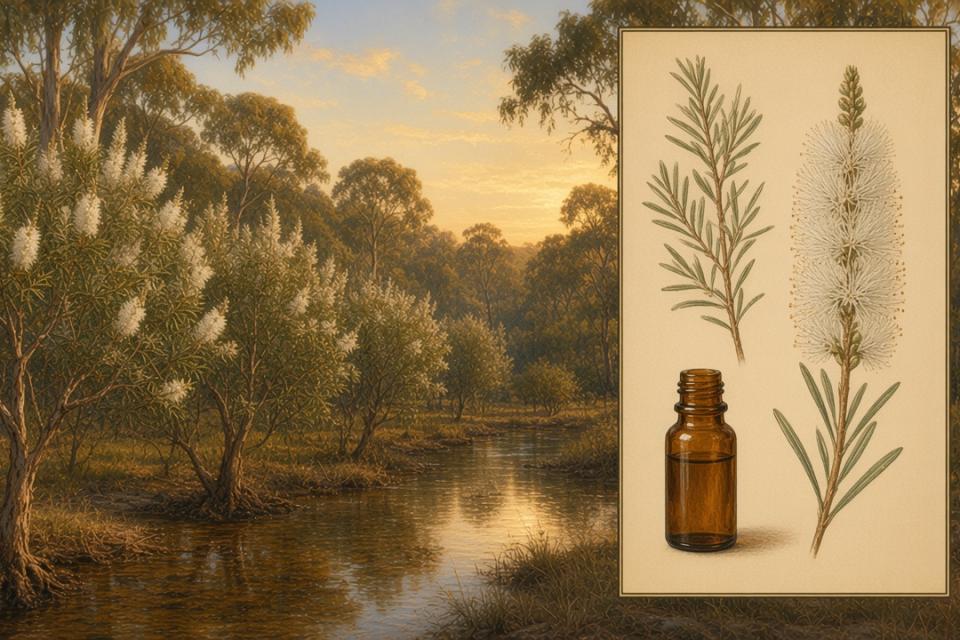
Melaleuca alternifolia (Maiden and Betche) Cheel belongs to Myrtaceae, the myrtle family, alongside eucalyptus, clove, and guava; NCBI Taxonomy files it as taxon 164405. Carson, Hammer, and Riley (Clinical Microbiology Reviews 2006) note that Melaleuca has about 230 species, almost all native to Australia, and that M. alternifolia grows naturally only in low-lying, swampy, subtropical coastal ground around the Clarence and Richmond Rivers of northeastern New South Wales and southern Queensland. Left to grow, it becomes a small tree of about 5–8 m with papery bark and narrow, soft, needle-like leaves. Trees older than three years flower in October and November, the Australian spring, producing loose spikes of white to cream flowers that give the tree a fluffy look.
The name is confusing. EMA explains that tea tree was applied because the leaves were used to make an aromatic tea, and that the name covers more than 150 species of Melaleuca and Leptospermum, including New Zealand’s manuka. Carson and colleagues add that ti tree, an old spelling, is properly a Māori and Samoan name for Cordyline, and that other Melaleuca species give chemically different oils, such as cajuput and niaouli. The European Pharmacopoeia allows tea tree oil from M. alternifolia, M. linariifolia, M. dissitiflora, or other Melaleuca species, provided it meets the chemical standard. Commercial oil comes mainly from plantations in New South Wales, most of them around Lismore, where the plants are harvested by coppicing: cut close to the ground and left to regrow.
The oil is steam-distilled from the leaves and terminal branchlets, with a yield of about 1–2% of the fresh plant weight. It contains around 100 compounds, mostly monoterpenes and their alcohols. Its main constituent is terpinen-4-ol (PubChem CID 11230, C10H18O), typically about 40%, with γ-terpinene, α-terpinene, and smaller amounts of 1,8-cineole (eucalyptol, CID 2758). The international standard ISO 4730 and the European Pharmacopoeia require at least 30% terpinen-4-ol and no more than 15% 1,8-cineole. Carson and colleagues note that the cineole limit rests partly on an old, unproven belief that cineole irritates skin. Light, heat, and air oxidize the oil, raising peroxides and degradation products that are much stronger skin sensitizers, which is why EMA requires airtight, light-proof storage.
02 Lineage
History
Carson and colleagues describe the earliest recorded use: the Bundjalung people of northern New South Wales inhaled the scent of crushed tea tree leaves to treat coughs and colds, sprinkled crushed leaves on wounds under a poultice, and soaked leaves to make an infusion for sore throats and skin complaints. Aboriginal oral history also tells of healing lakes, lagoons into which tea tree leaves had fallen and slowly decayed. NCCIH similarly notes traditional Aboriginal use of the leaves for wounds, burns, and insect bites. These accounts come from later written records of a much older tradition.
The oil entered medicine through chemistry. In the 1920s Arthur Penfold, a chemist at the Technological Museum in Sydney who was surveying Australian essential oils with commercial potential, published a series of papers testing them against phenol, the antiseptic standard of the day. Carson and colleagues report that he rated tea tree oil 11 times more active than phenol, and a bush industry grew up, cutting wild trees and distilling the oil in makeshift mobile stills. The British Pharmaceutical Codex of 1949 described it as germicidal, for use on boils, ringworm, nail-fold infections, impetigo, thrush, and mouth inflammation, and in veterinary practice for mange (EMA). A popular story says Australian soldiers carried tea tree oil in their kits in the Second World War and that bush cutters were exempt from national service. EMA repeats it, but Carson and colleagues found that the Australian War Memorial could not corroborate it.
Demand faded after the war as antibiotics arrived, then revived in the 1970s with interest in natural products; plantations established in the 1970s and 1980s allowed mechanized, consistent production (Carson, 2006). An international standard for the terpinen-4-ol type of oil followed in 1996, and Bassett and colleagues (Medical Journal of Australia 1990) published one of the first rigorous trials, in acne. EMA’s herbal committee adopted its monograph on 24 November 2014, granting traditional use only. It noted that no tea tree product from the positive trials had been authorized in the EU for at least ten years, the requirement for well-established use, but that the trials reinforced the plausibility of the traditional uses.
03 Chemistry
Active compounds and how it works
Tea tree oil is a broad-spectrum antimicrobial. Carson and colleagues summarize laboratory evidence that its lipophilic terpenes, chiefly terpinen-4-ol, dissolve into the membranes of bacteria and fungi, making them leaky and disrupting their function. It kills Staphylococcus aureus, including MRSA, at concentrations of about 0.25–0.5% in the test tube, along with Candida yeasts, the dermatophyte fungi of athlete’s foot, and the acne bacterium; MSKCC adds activity against Pseudomonas and E. coli. Clinical resistance has not been reported despite a century of use, although one laboratory study induced reduced susceptibility in MRSA.
It also damps some inflammation. Carson and colleagues and MSKCC describe studies in which terpinen-4-ol reduced the production of inflammatory mediators by activated human white blood cells, and in which neat tea tree oil applied to the skin reduced the size of the wheal caused by injected histamine in volunteers. Laboratory studies also report activity against herpes simplex virus and some protozoa (MSKCC), but these findings have not translated into proven treatments.
Two laboratory findings matter for safety. In vitro, tea tree and lavender oils showed mild estrogen-like and anti-androgen effects in human cell lines (Henley, New England Journal of Medicine 2007), although the constituents that penetrate skin did not (Nielsen, Toxicology In Vitro 2008). And EMA cites a study in which tea tree oil antagonized the antibacterial effect of ciprofloxacin and the antifungal effect of amphotericin B in the laboratory, which led its authors to advise caution when combining tea tree with antimicrobial drugs.
04 In practice
Common uses
Acne: Bassett and colleagues (Medical Journal of Australia 1990) randomized 124 people with mild to moderate acne to 5% tea tree oil gel or 5% benzoyl peroxide lotion in a single-blind trial. Both reduced inflamed and non-inflamed lesions, but tea tree worked more slowly, and Carson and colleagues note that benzoyl peroxide reduced inflamed lesions significantly more. Side effects were less frequent with tea tree (27 of 61 patients, against 50 of 63), with less dryness, scaling, and itching. In Iran, Enshaieh and colleagues (Indian Journal of Dermatology, Venereology and Leprology 2007) found a 5% gel better than placebo over 45 days in 60 patients. Cochrane’s review of complementary therapies for acne (Cao, 2015) rated that single trial as low-quality evidence of benefit, and Kairey and colleagues (Frontiers in Pharmacology 2023), reviewing 46 trials of tea tree oil, concluded that more evidence is needed for acne.
Athlete’s foot and nails: Satchell and colleagues (Australasian Journal of Dermatology 2002) randomized 158 people with interdigital tinea pedis to 25% or 50% tea tree oil solution or placebo, applied twice daily for four weeks. A marked clinical response occurred in 72% and 68% of the two tea tree groups against 39% on placebo, and fungal cure in 64% on 50% oil against 31% on placebo; four patients on tea tree (3.8%) developed moderate to severe dermatitis. An earlier trial of a 10% cream improved symptoms but not fungal cure (EMA). For toenail fungus, Buck and colleagues (Journal of Family Practice 1994) compared neat tea tree oil with 1% clotrimazole solution twice daily for six months in 117 patients: cultures cleared in 18% and 11%, and nail appearance improved in 60% and 61%, with no significant difference. NCCIH says tea tree may help athlete’s foot but may not work as well as standard treatments, and that nail research is insufficient.
Dandruff: Satchell and colleagues (Journal of the American Academy of Dermatology 2002) randomized 126 people aged 14 and over with mild to moderate dandruff to a 5% tea tree oil shampoo or placebo, used daily for four weeks. Dandruff severity improved by 41% against 11% on placebo, with improvements in itching and greasiness, and no adverse effects were reported. Dandruff is linked to Malassezia yeasts, against which the oil is active.
MRSA decolonization: Dryden and colleagues (Journal of Hospital Infection 2004) compared a five-day tea tree regimen (10% cream and 5% body wash) with a standard regimen of mupirocin nasal ointment, chlorhexidine soap, and silver sulfadiazine cream in 224 hospital patients carrying MRSA. Clearance was 41% with tea tree and 49% with standard care, not significantly different; mupirocin was much better at clearing the nose (78% against 47%), while tea tree was better on skin sites and lesions. In a larger trial in two Northern Irish intensive care units, Blackwood and colleagues (Journal of Antimicrobial Chemotherapy 2013) randomized 391 patients to a 5% tea tree body wash or baby wash; new MRSA colonization was 8.7% and 11.2%, not a significant difference, and the authors concluded tea tree body wash could not be recommended for this purpose.
Other uses: Kairey and colleagues found that mouthwashes with 0.2–0.5% tea tree oil may limit dental plaque and that a 5% gel may help as an add-on to deep cleaning in periodontitis, but most trials were of poor to modest quality. Cochrane’s review of tea tree oil for Demodex blepharitis (Savla, 2020), covering six trials with 562 participants, found the evidence uncertain and suggested lower concentrations to avoid eye irritation. NCCIH says head lice products have been tested only in combination with other ingredients, and that evidence for gum disease, bad breath, and other uses is uncertain.
05 The apothecary
Preparations and traditional use
EU traditional use (EMA/HMPC/320930/2012, adopted 24 November 2014), for adolescents, adults, and older people: for small superficial wounds and insect bites, liquid preparations containing 0.5–10% oil applied one to three times daily, or 0.03–0.07 ml of undiluted oil dabbed on with a cotton swab. For small boils and mild acne, 10% oily or semi-solid preparations one to three times daily, 0.7–1 ml of oil stirred into 100 ml of lukewarm water as a soaked dressing, or undiluted oil on the boil with a cotton swab two or three times daily. For mild athlete’s foot, 10% preparations one to three times daily, a footbath of 0.17–0.33 ml of oil in warm water for 5–10 minutes a day, or undiluted oil on the affected area two or three times daily. See a doctor if wounds have not improved after a week; do not use for boils, acne, or athlete’s foot for more than a month.
Mouth: for minor inflammation of the lining of the mouth, 0.17–0.33 ml of oil mixed in 100 ml of water as a rinse or gargle several times daily, for no more than five days without seeing a doctor; it must not be swallowed (EMA). The clinical trials used a 5% gel for acne, 25–50% solutions for athlete’s foot, neat oil for nails, a 5% shampoo for dandruff, and 5–10% washes and creams for MRSA. EMA does not recommend tea tree products under 12 years of age.
Although EMA permits small amounts of neat oil on tiny areas, diluted products are the safer choice. Carson and colleagues discourage the use of neat oil because irritation depends on concentration, industry data reviewed by EMA show most adverse reports involve undiluted oil, and Kairey and colleagues found side effects were minor except at concentrations of 25% or more. Do not apply neat oil to broken, raw, or large areas of skin. Buy oil that meets ISO 4730, keep it tightly closed in a dark bottle away from heat, and replace old, long-opened bottles. Store all essential oils out of reach of children and pets.
Safety
Before you use tea tree
06 Caution
Side effects
Skin reactions are the common problem. EMA lists stinging, itching, burning, redness, swelling, and allergic contact dermatitis, of unknown frequency, and rare burn-like reactions (fewer than 1 in 1,000). In patch-test studies involving about 9,400 people, an average of 1.6% reacted to tea tree oil (range 0.6–2.4%), possibly an overestimate because some studies used degraded oil (EMA). Severe reactions include blistering, erythema multiforme-like eruptions, and one case of linear IgA disease. Hausen and colleagues (American Journal of Contact Dermatitis 1999) found fresh oil a very mild sensitizer in guinea pigs but oxidized oil three times stronger; oil left on a sunny windowsill developed more than ten times the peroxide level within four days, and sensitized patients reacted to α-terpinene, terpinolene, and ascaridole.
Swallowed, tea tree oil is poisonous. EMA describes central nervous system depression and muscle weakness after accidental ingestion, usually of 10–25 ml in adults, with recovery generally within 36 hours, and one patient was comatose for 12 hours, then semi-conscious for a further 36, after drinking about half a cup. Children are far more vulnerable. Del Beccaro (Veterinary and Human Toxicology 1995) described a 17-month-old who swallowed under 10 ml and became unsteady and drowsy, and Morris and colleagues (Pediatric Emergency Care 2003) reported a 4-year-old who swallowed a small quantity, became ataxic within 30 minutes, then unresponsive, and needed intubation before recovering over about 10 hours. MSKCC also lists disorientation, a widespread rash, and abnormal white blood cell counts after swallowing.
Pets are at real risk. Khan and colleagues (Journal of the American Veterinary Medical Association 2014) reviewed 337 dogs and 106 cats poisoned by 100% tea tree oil reported to the ASPCA Animal Poison Control Center from 2002 to 2012. In 89% of cases the oil had been used deliberately, in amounts from 0.1 to 85 ml, and half the exposures were through the skin alone. Signs began within 2–12 hours and lasted up to three days: drooling, lethargy and depression of the nervous system, weakness of the legs, unsteadiness, and tremors, with young and small cats most severely affected. Carson and colleagues cite three shaved cats given about 120 ml of neat oil on the skin, one of which died.
Hormonal effects remain debated. Henley and colleagues reported three healthy prepubertal boys, aged 4 to 10, who developed breast enlargement (gynecomastia) while using skin products containing lavender and tea tree oils, which resolved when the products were stopped; the authors concluded the oils probably caused it. EMA’s assessment notes that lavender oil was the only ingredient common to all the products and that only one boy’s products also contained tea tree oil, and an EU scientific committee judged a link to tea tree implausible because its hormonally active components do not penetrate skin. Ramsey and colleagues (Journal of Clinical Endocrinology and Metabolism 2019) added cases of breast development in girls and a boy linked to lavender fragrances. Until it is settled, prudence suggests avoiding repeated use of these oils on young children.
07 Caution
Contraindications
Do not use tea tree oil if you have reacted to it before, or if you are allergic to colophony (rosin, found in adhesives, plasters, and some cosmetics), because EMA notes that the two cross-react. Stop at the first sign of a rash. People with sensitive skin, and anyone who has reacted to other essential oils that share constituents, are more likely to become sensitized and should use only diluted products, if at all. Patch testing by a dermatologist can confirm tea tree allergy.
Never swallow tea tree oil or inhale it directly, and never put it in the eyes or ears (EMA). In animal studies, neat oil placed in the middle ear of guinea pigs raised hearing thresholds at high frequencies, while a 2% solution did not (Zhang, Audiology and Neuro-Otology 2000), and a 3% solution caused no hearing loss in chinchillas (Bezdjian, 2014). Because oil in the ear canal can reach the middle ear through a hole in the eardrum or an ear tube, never use tea tree oil or drops containing it in an ear with a known or suspected perforation, discharge, or ventilation tube. If oil gets in an eye, rinse with plenty of water and seek advice if pain or redness persists.
Children and pets: EMA does not recommend use under 12. Any child who swallows tea tree oil needs immediate emergency care, which EMA describes as requiring hospital treatment and breathing support. Do not use tea tree oil on cats or dogs, and keep pets away from freshly treated skin; veterinary products are a separate category.
Pregnancy and breastfeeding: EMA does not recommend tea tree products because safety has not been established, while NCCIH says topical products may be safe in pregnancy and breastfeeding. A conservative approach is to avoid concentrated oil, keep any topical use small and short, and keep oil away from the nipples before feeding.
08 Caution
Drug and herb interactions
EMA reports no known interactions with medicines for topical tea tree oil, and because only small amounts are absorbed through intact skin, interactions with oral drugs are unlikely. The laboratory finding that tea tree oil antagonized ciprofloxacin and amphotericin B (EMA) has not been tested in people, but it is a reason not to substitute or layer tea tree products on infections that are being treated with prescribed antimicrobials without asking the prescriber.
Other skin products are a more practical issue. Combining tea tree oil with other irritant acne treatments, such as benzoyl peroxide, retinoids, or salicylic acid, may add to dryness and irritation, and combining several essential oils increases the chance of sensitization to shared constituents (EMA). Do not mix tea tree oil into prescribed creams or ear and eye drops. In the MRSA trial by Dryden and colleagues, tea tree cream was much less effective than mupirocin at clearing the nose, so it should not replace a prescribed decolonization regimen before surgery.
09 Questions
Frequently Asked Questions
Possibly, for mild to moderate acne. In one trial a 5% gel reduced lesions like 5% benzoyl peroxide, but more slowly and less for inflamed spots, with fewer side effects; another found a 5% gel better than placebo. Cochrane rated the evidence low quality. Use a diluted gel, not neat oil, and see a doctor for severe or scarring acne.
For athlete’s foot, 25–50% solutions beat placebo in a trial of 158 people, but NCCIH notes it may not work as well as standard antifungals. For toenails, neat oil performed similarly to clotrimazole solution after six months, though the fungus cleared in fewer than one in five patients with either treatment. Persistent nail infections usually need medical treatment.
Never swallow it. Ingestion has caused confusion, unsteadiness, and coma, and a 4-year-old needed a breathing tube after swallowing a small amount. EMA allows a diluted rinse or gargle for minor mouth inflammation, for adults and children over 12, provided it is spat out. The same rule applies to eucalyptus oil and other essential oils.
No. A review of 443 poisoned dogs and cats found that most had been given 100% tea tree oil deliberately by their owners. Signs began within hours and included drooling, lethargy, weakness, unsteadiness, and tremors; small and young cats were worst affected. Ask a vet for safe parasite treatments.
EMA says not to use it in the ears. In animal studies neat oil in the middle ear caused some hearing damage. Never use it if you might have a perforated eardrum, ear discharge, or ear tubes (grommets), and see a doctor for ear pain or infection.
Fresh oil is a mild allergen, but oil exposed to air, light, and heat oxidizes into much stronger sensitizers. About 1–2% of people tested react. Use products meeting the ISO 4730 standard, store them airtight in the dark, discard old oil, and stop at the first sign of a rash.
A 2007 report linked breast enlargement in three boys to products containing lavender and tea tree oils, and it resolved when the products were stopped. EMA’s reviewers noted that lavender was the common ingredient and only one boy’s products contained tea tree, and an EU committee judged a tea tree link implausible. The question is not settled, so avoid repeated use of these oils on young children.
EMA does not recommend it in pregnancy or breastfeeding because safety has not been established, while NCCIH says topical products may be safe. Keep any use small, diluted, and short, never swallow it, and keep it off the nipples. Calendula is another traditional topical option for minor skin problems.
10 References
Sources
These references support the history, clinical, and safety claims on this page. They are not an endorsement of any product.
-
European Union herbal monograph on Melaleuca alternifolia (Maiden and Betch) Cheel, M. linariifolia Smith, M. dissitiflora F. Mueller and/or other species of Melaleuca, aetheroleum
European Medicines Agency (EMA/HMPC/320930/2012), 2014
Adopted 24 November 2014: traditional use for small wounds and bites, boils and mild acne, mild athlete’s foot, and mouth inflammation; doses; not under 12, orally, inhaled, or in eyes or ears; ingestion in children is an emergency.
-
Assessment report on Melaleuca alternifolia (Maiden and Betch) Cheel, M. linariifolia Smith, M. dissitiflora F. Mueller and/or other species of Melaleuca, aetheroleum
European Medicines Agency (EMA/HMPC/320932/2012), 2014
History, ISO 4730 composition, trial summaries, patch-test sensitization (mean 1.6%), oxidation, poisoning cases, the gynecomastia reports, and the antimicrobial interaction data.
-
Tea tree oil
National Center for Complementary and Integrative Health (NIH), 2025
Consumer evidence summary (updated April 2025): a small amount of evidence for acne and athlete’s foot; insufficient for nails, lice, and other uses; should not be swallowed; old oil more likely to irritate.
-
Tea Tree Oil
Memorial Sloan Kettering Cancer Center, About Herbs, 2022
Clinical summary (updated May 2022): antimicrobial and anti-inflammatory mechanisms of terpinen-4-ol; contact dermatitis; oral toxicity; contested hormonal effects.
-
Melaleuca alternifolia (Tea Tree) oil: a review of antimicrobial and other medicinal properties
Clinical Microbiology Reviews (PubMed 16418522), 2006
Carson, Hammer, and Riley: Bundjalung use of crushed leaves, Penfold’s 1920s research, the uncorroborated wartime story, ISO 4730, mechanisms, clinical trials, and toxicity.
-
A comparative study of tea-tree oil versus benzoylperoxide in the treatment of acne
Medical Journal of Australia (PubMed 2145499), 1990
Bassett et al.: 124 patients; 5% tea tree gel and 5% benzoyl peroxide both reduced lesions; tea tree slower but with fewer side effects.
-
Complementary therapies for acne vulgaris
Cochrane Database of Systematic Reviews (PubMed 25597924), 2015
Cao et al.: low-quality evidence from a single 60-person trial that 5% tea tree gel reduced total lesion counts and severity compared with placebo.
-
Treatment of interdigital tinea pedis with 25% and 50% tea tree oil solution: a randomized, placebo-controlled, blinded study
Australasian Journal of Dermatology (PubMed 12121393), 2002
Satchell et al.: 158 patients; marked response 68–72% vs 39% on placebo; mycological cure 64% vs 31%; 3.8% developed dermatitis.
-
Comparison of two topical preparations for the treatment of onychomycosis: Melaleuca alternifolia (tea tree) oil and clotrimazole
Journal of Family Practice (PubMed 8195735), 1994
Buck et al.: 117 patients, six months; 100% tea tree oil and 1% clotrimazole comparable (culture cure 18% vs 11%; improvement 60% vs 61%).
-
Treatment of dandruff with 5% tea tree oil shampoo
Journal of the American Academy of Dermatology (PubMed 12451368), 2002
Satchell et al.: 126 patients, four weeks; 41% vs 11% improvement in dandruff severity score; no adverse effects.
-
A randomized, controlled trial of tea tree topical preparations versus a standard topical regimen for the clearance of MRSA colonization
Journal of Hospital Infection (PubMed 15066738), 2004
Dryden et al.: 224 patients; MRSA cleared in 41% with tea tree vs 49% with standard care (not significant); mupirocin better for nasal carriage.
-
Concentrated tea tree oil toxicosis in dogs and cats: 443 cases (2002-2012)
Journal of the American Veterinary Medical Association (PubMed 24344857), 2014
Khan et al.: 337 dogs and 106 cats; 89% intentional use of 100% oil; drooling, CNS depression, paresis, ataxia, tremors; young, small cats at highest risk.
-
Prepubertal gynecomastia linked to lavender and tea tree oils
New England Journal of Medicine (PubMed 17267908), 2007
Henley et al.: three boys with gynecomastia that resolved after stopping lavender- and tea tree-containing products; mild estrogenic and anti-androgenic activity in cell lines.
-
Ingestion of tea tree oil (Melaleuca oil) by a 4-year-old boy
Pediatric Emergency Care (PubMed 12813303), 2003
Morris et al.: a small ingestion caused ataxia within 30 minutes, then unresponsiveness requiring intubation; recovery over about 10 hours.
-
Degradation products of monoterpenes are the sensitizing agents in tea tree oil
American Journal of Contact Dermatitis (PubMed 10357714), 1999
Hausen et al.: fresh oil a very mild sensitizer, oxidized oil three times stronger; peroxides rose more than tenfold in four days; ascaridole and terpinenes as allergens.