
Monograph
Astragalus
Astragalus mongholicus
Updated October 4, 2026
Key points
-
01
Ancient tonic, early evidence
Huang qi has been a Chinese qi tonic for 2,000 years, but NCCIH says there is not enough reliable evidence to know whether it helps any health condition.
-
02
Low-quality add-on trials
Cochrane and other reviews of astragalus for kidney disease, chemotherapy side effects, and heart failure found promising signals in small, low-quality trials.
-
03
Autoimmune and transplant caution
Astragalus may stimulate the immune system. Avoid it with autoimmune disease, and never combine it with transplant drugs such as tacrolimus without your specialist.
-
04
Lithium and other drugs
Merck Manual warns astragalus may raise lithium levels and lower blood sugar with diabetes drugs. It may add to diuretics and blood pressure medicines.
-
05
Telomere claims are unproven
TA-65, purified from astragalus root, changed telomere length in one manufacturer-funded trial. That is a lab marker, not proof of longer or healthier life.
Astragalus root, huang qi in Chinese, is one of the great tonic herbs of traditional Chinese medicine. A 2023 review by Wang and colleagues in Frontiers in Pharmacology notes that it was first recorded in the Shennong Ben Cao Jing, the classic materia medica of the Han dynasty, as a superior-grade herb, and that it has been used for more than 2,000 years in over 200 traditional decoctions. In the West it is sold mainly as an immune supplement, as a remedy for fatigue and colds, and, through a purified compound marketed as TA-65, as an anti-aging product said to protect telomeres.
Clinical research on astragalus is still early. NCCIH says there is not enough reliable scientific evidence to know whether astragalus is useful for any health condition. Cochrane reviews of astragalus for chronic kidney disease, astragalus-based decoctions for chemotherapy side effects, and astragalus to prevent respiratory infections in children found either low-quality trials or no suitable trials at all. Most clinical studies were small, conducted in China, used astragalus as an add-on to conventional treatment, and often tested injections or multi-herb formulas rather than the capsules sold in Western shops.
Astragalus appears to be well tolerated, but its reputation as an immune stimulant creates real cautions. NCCIH advises people with autoimmune diseases to avoid it, and it may interact with immunosuppressant drugs such as those taken after an organ transplant. Merck Manual’s reviewers add lithium and diabetes medicines to the list, and little is known about safety in pregnancy. Never gather wild astragalus: some species in the same genus are the locoweeds that poison livestock. Nothing here is medical advice; anyone with kidney disease, cancer, an autoimmune condition, or a transplant should speak to their specialist before taking astragalus.
In this monograph
01 The plant
Botanical profile
Astragalus is a vast genus in Fabaceae, the pea and bean family, and the name of the medicinal species is a source of confusion. Huang qi is traditionally described as the dried root of Astragalus membranaceus or Astragalus membranaceus var. mongholicus; Cochrane’s 2014 kidney review uses both names, and MSKCC lists both. Plants of the World Online, Kew’s global checklist, now accepts Astragalus mongholicus Bunge, published in 1868, as the correct name for the species and treats A. membranaceus var. mongholicus and A. membranaceus Fisch. ex Bunge as synonyms. NCBI Taxonomy files A. mongholicus as taxon 119829 and lists the variety name as a synonym, while still keeping a separate entry for A. membranaceus. In practice, research labeled with any of these names usually concerns the same medicinal root, but labels and papers will continue to use the older names for years.
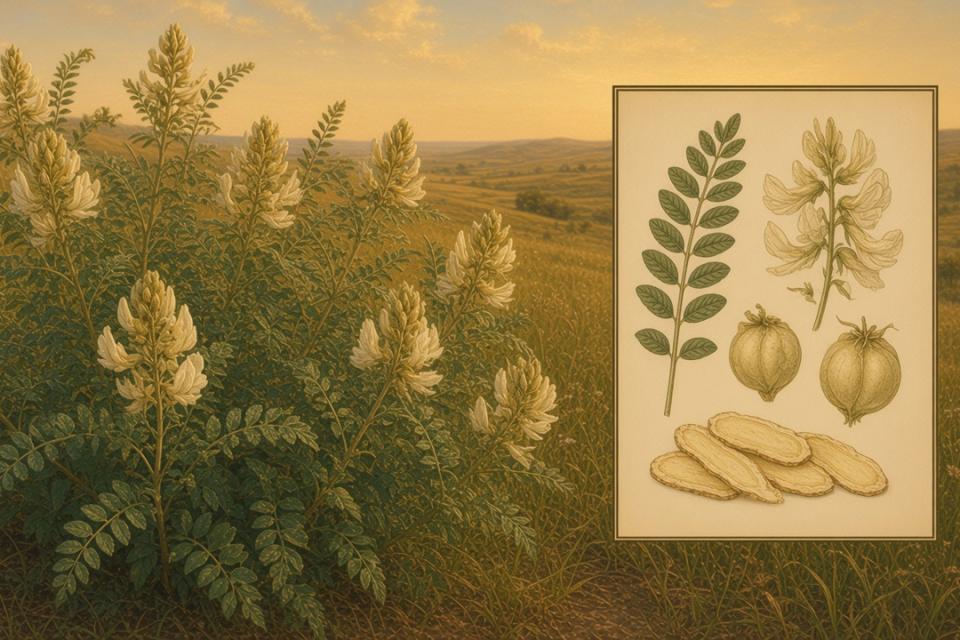
Flora of China describes A. mongholicus as a perennial herb 25–60 cm tall with pinnate leaves 6–15 cm long, each carrying 8–12 pairs of small oval leaflets. Loose spikes of yellow, rarely lilac, pea flowers with a standard petal 13–20 mm long are followed by inflated, papery pods 2–3 cm long hanging on slender stalks. It grows on steppes, meadows, shrubby slopes, and in coniferous forest at 800–2,000 m across northern and western China, and Plants of the World Online gives its native range as Siberia to the Russian Far East, Mongolia, Korea, and northern and western China. Wang and colleagues report that plants flower in June to August, that good-quality roots are harvested after four to five years, and that the name huang qi refers to the root’s yellow color and its standing as a leading tonic. The part used is the long, fibrous root, sold dried and cut into pale yellow slices.
More than 200 compounds have been isolated from astragalus root (Wang). The main groups are triterpenoid saponins called astragalosides, polysaccharides (more than 30 types have been described), and flavonoids, of which isoflavones such as formononetin and calycosin make up about 80%. Astragaloside IV (PubChem CID 13943297) and a calycosin glucoside are used as quality markers in the Chinese Pharmacopoeia. Cycloastragenol (CID 13943286, C30H50O5) is the aglycone of astragaloside IV, the saponin with its sugars removed, and is the basis of telomerase-activator supplements. The genus also has a dark side: Stegelmeier and colleagues (Journal of Natural Toxins 1999) describe locoweed poisoning, a chronic disease in livestock grazing certain Astragalus and Oxytropis species that contain swainsonine. The toxin blocks cellular mannosidases and causes a storage disease with neurological signs, some of them permanent. Medicinal huang qi is not a locoweed, but the genus is too large and varied to identify by eye.
02 Lineage
History
Astragalus belongs to the oldest layer of Chinese herbal medicine. Wang and colleagues trace it to the Shennong Ben Cao Jing, compiled during the Han dynasty, where it was ranked as a superior herb. Zhang Zhongjing’s Golden Chamber (Jin Gui Yao Lue), from the late Eastern Han around AD 200, includes it in eight formulas, among them Huangqi Guizhi Wuwu Tang. Li Shizhen’s Compendium of Materia Medica, completed in the Ming dynasty in the sixteenth century, placed huang qi first among the tonic herbs. Later physicians leaned on it heavily: Li Dongyuan used it repeatedly as a tonic for the spleen and stomach in the thirteenth century, and in Wang Qingren’s Yi Lin Gai Cuo (1830) it is the most abundant ingredient in 11 of 33 prescriptions.
In traditional Chinese medicine terms, astragalus tonifies qi, the body’s vital energy, and is said to secure the exterior, meaning it strengthens the body’s surface against sweating and outside influences. It is also used to promote urination, reduce swelling, and help chronic sores heal (Wang). It is rarely given alone. Classic formulas include Bu Zhong Yi Qi Tang, with ginseng and other herbs, used for digestive weakness and organ prolapse; Danggui Buxue Tang, astragalus with dong quai, for deficiency of both qi and blood; and Yu Ping Feng San, astragalus with two other herbs, a traditional formula for colds, night sweats, and allergic rhinitis. The root is stir-baked with an adjuvant when a tonic effect is wanted and used raw to secure the exterior and promote urination (Wang).
Western interest grew from laboratory work on the immune system. MSKCC cites a 1988 study in which fractionated astragalus reversed immune suppression caused by the chemotherapy drug cyclophosphamide. Astragalus is now widely sold in the US and Europe as a supplement for immunity and fatigue, often in combination products. In China, an injectable form known as Huangqi injection is a patent medicine used for chronic heart failure, tested in dozens of Chinese trials (Fu, PLoS One 2011). In 2000 a small molecule that activates telomerase was identified by screening extracts of traditional Chinese medicines; Bernardes de Jesus and colleagues (Aging Cell 2011) describe this compound, TA-65, as purified from astragalus root. Harley and colleagues (Rejuvenation Research 2011) report that a commercial anti-aging program built around TA-65 was launched in 2007, yet the first blinded, placebo-controlled human trial was not published until 2016 (Salvador).
03 Chemistry
Active compounds and how it works
MSKCC attributes most of astragalus’s activity to its polysaccharides, saponins, and flavonoids, which in laboratory studies have immune-modulating, antioxidant, and anti-inflammatory effects. Astragalus polysaccharides activate macrophages through toll-like receptor 4 and enhance natural killer cell and monocyte activity in vitro. In healthy volunteers, an astragalus root extract raised counts of monocytes, neutrophils, lymphocytes, and platelets and increased circulating cytokines, and some people developed fatigue, malaise, and headache resembling a mild viral illness (MSKCC). That immune activation is the reason for caution in autoimmune disease and with immunosuppressant drugs. Formononetin has estrogen-receptor effects in laboratory studies, and astragalus constituents, including astragaloside IV, show anticoagulant and clot-dissolving activity in the laboratory; whether either matters in people is unknown.
Astragalus has a diuretic reputation, and one human study supports it. Ai and colleagues (Journal of Ethnopharmacology 2008) gave 12 healthy men a single dose of aqueous astragalus extract (0.3 g per kilogram of body weight) and measured their urine. The extract markedly increased sodium excretion over the first four hours, apparently by enhancing the kidney’s response to atrial natriuretic peptide, and astragaloside IV was not the active component. MSKCC cites this as the basis for possible additive effects with diuretics, and Merck Manual separately warns that astragalus may reduce the excretion of lithium.
The telomere story concerns isolated compounds rather than the root. Telomeres are protective caps on chromosomes that shorten as cells divide, and the enzyme telomerase can rebuild them. In mice, TA-65 lengthened critically short telomeres through telomerase and improved some markers of health without significantly increasing overall cancer incidence (Bernardes de Jesus, Aging Cell 2011); a co-author, Calvin Harley, is disclosed as a consultant to the manufacturer in the later human trial. In drug-metabolism terms, MSKCC notes laboratory evidence that astragalus polysaccharides inhibit the P-glycoprotein drug pump, and LiverTox notes possible effects on cytochrome P450 enzymes, both of uncertain clinical relevance.
04 In practice
Common uses
Chronic kidney disease is the best-reviewed use. Zhang and colleagues (Cochrane 2014) included 22 randomized or quasi-randomized studies with 1,323 participants, 241 of them on dialysis, in which astragalus was added to conventional treatment. No study reported the outcomes that matter most, time to dialysis or death. Astragalus reduced 24-hour protein in the urine (by 0.53 g in 10 studies), raised hemoglobin (by about 9.5 g per liter) and serum albumin, and improved creatinine clearance and serum creatinine. The studies were of low quality, and the reviewers concluded that definitive conclusions could not be made. NCCIH describes a 2023 review of 50 studies with 3,423 participants in membranous nephropathy, a kidney disorder, which found improvements in some kidney indicators but cited low quality, small size, and limited geographical range.
Cancer and chemotherapy: McCulloch and colleagues (Journal of Clinical Oncology 2006) pooled 34 randomized studies with 2,815 patients with advanced non-small-cell lung cancer receiving platinum-based chemotherapy with or without astragalus-based Chinese herbal medicine. In 12 studies with 940 patients, the herbal combinations were associated with a lower risk of death at 12 months (risk ratio 0.67) and better tumor response, but the authors stressed that the results needed confirmation in rigorously controlled trials. Taixiang and colleagues (Cochrane 2005) found four low-quality trials of huang qi decoctions given with chemotherapy for colorectal cancer, with less nausea and vomiting and fewer low white cell counts, but no robust demonstration of benefit. MSKCC notes that most studies in this field have poor methodology and that many used injectable astragalus, whose effects may not apply to oral products.
Heart failure: Fu and colleagues (PLoS One 2011) systematically reviewed Huangqi injection for chronic heart failure and found 62 trials, all conducted in China and published in Chinese journals. Their quality was so low, with inclusion criteria often unspecified and only one trial following patients for an adequate period, that the reviewers declined to pool the results. A 2024 meta-analysis by Han and colleagues (Frontiers in Pharmacology) of 19 trials with 1,565 patients with reduced ejection fraction reported that astragalus added to conventional therapy improved ejection fraction by about 6 percentage points and six-minute walking distance by about 68 m, again noting the limited quality of the studies. These outcomes are heart scans, blood markers, and walking tests rather than deaths or hospital admissions.
Colds and immunity: the traditional use of astragalus to ward off colds has almost no rigorous testing. Su and colleagues (Cochrane 2016) screened 6,080 records for placebo-controlled trials of oral astragalus alone to prevent frequent respiratory infections in children and found none; 44 otherwise eligible studies lacked a placebo group. NCCIH describes a 2023 review of 19 small, heterogeneous studies with 1,094 participants suggesting enhanced immune responses, which is not the same as fewer infections. In a placebo-controlled trial in 48 adults with seasonal allergic rhinitis, a supplement containing astragalus reduced runny nose more than placebo but did not improve the other main symptom measures (Matkovic, Phytotherapy Research 2010).
Other claims: NCCIH reports a 2024 review of 20 studies with 953 adults with type 2 diabetes in which astragalus added to metformin lowered fasting glucose and HbA1c more than metformin alone, but most studies were of low quality with risk of bias. For telomeres, Salvador and colleagues (Rejuvenation Research 2016) randomized 117 cytomegalovirus-positive adults aged 53–87 to two doses of TA-65 or placebo for a year. Telomere length rose by 530 base pairs on the low dose and fell by 290 on placebo, while the high dose showed no significant change. The study was funded by the manufacturer, TA Sciences, two authors were employees and three were consultants, and telomere length is a laboratory marker, not evidence of longer or healthier life.
05 The apothecary
Preparations and traditional use
There is no EU herbal monograph for astragalus, and no regulator has set a recommended dose. In traditional Chinese practice, Wang and colleagues cite the Dictionary of Traditional Chinese Medicine for 9–15 g of dried root a day as a decoction, with larger doses of 30–60 g. The root is simmered in water, usually alongside other herbs in a formula chosen by a practitioner; stir-baked root is preferred for tonifying and raw root for securing the exterior, promoting urination, and treating sores. NCCIH says that oral doses of up to 60 g a day for up to four months do not seem to cause adverse effects, but that a thorough safety evaluation has not been done.
Western products include capsules of powdered root, liquid extracts and tinctures, and dry extracts standardized to astragalosides, often astragaloside IV. Many astragalus supplements are multi-ingredient blends, and LiverTox points out that the purity and potency of commercial preparations are not rigorously regulated. TA-65 is a proprietary product sold for telomere support rather than a traditional root preparation, and cycloastragenol is sold separately as a dietary ingredient. Huangqi injection is a hospital medicine in China; trial results for injections should not be assumed to apply to capsules or teas.
Choose a product that names the species and the plant part (root) and comes from a manufacturer that tests identity and contaminants. Do not dig or forage wild astragalus or milkvetch: some members of the genus accumulate swainsonine or other toxins and are hard to tell apart. If you take any prescription medicine, particularly an immunosuppressant, lithium, diabetes or blood pressure treatment, or a blood thinner, discuss astragalus with your doctor or pharmacist before starting it, and tell your cancer team about any herbs during treatment.
Safety
Before you use astragalus
06 Caution
Side effects
Astragalus seems to be well tolerated at usual doses. Merck Manual’s reviewers describe adverse effects as uncommon, mentioning rash, itching, nasal symptoms, and stomach discomfort. In the Cochrane kidney review, six of 22 studies reported no adverse effects and the other 16 did not report on them at all, which is not the same as showing safety. The Cochrane review of huang qi decoctions with chemotherapy found no evidence of harm, but its four trials were small and of low quality.
Effects that follow from its pharmacology have been seen. MSKCC notes fatigue, malaise, headache, and a fall in blood pressure in a study of healthy volunteers, effects that lasted about 24 hours and resembled a mild immune response. The natriuretic effect reported by Ai and colleagues means astragalus can increase sodium and water loss for a few hours after a dose. People already taking blood pressure medicines or diuretics may notice dizziness.
Liver injury does not appear to be a concern. NIH’s LiverTox (last updated in 2019) says astragalus has not been associated with raised liver enzymes or with clinically apparent liver injury. It adds the caveat that astragalus appears in many multi-ingredient products whose contents are not rigorously controlled. Long-term and high-dose safety is less certain. Wang and colleagues note that comprehensive safety and toxicity assessments of astragalus have not been carried out, and that astragaloside showed toxicity to embryos and mothers at high doses in animal studies. Wild-collected or misidentified plants are a separate hazard, because locoweed species of Astragalus and Oxytropis can cause chronic poisoning with lasting neurological damage in grazing animals.
07 Caution
Contraindications
Autoimmune disease: NCCIH says that because astragalus might worsen symptoms of autoimmune diseases, people with these conditions should avoid it. Merck Manual names rheumatoid arthritis and systemic lupus erythematosus as examples, on the reasoning that astragalus may make the immune system more active. The concern rests on pharmacology rather than case reports: in healthy volunteers, an astragalus extract raised immune cell counts and circulating cytokines (MSKCC), exactly the kind of activation that could aggravate an overactive immune system. There is no evidence of benefit in autoimmune disease to set against that risk.
Organ transplants and immunosuppression: people taking drugs to prevent transplant rejection, or to control autoimmune or kidney disease, should not take astragalus without their specialist’s agreement. Merck Manual warns that astragalus may reduce the effectiveness of medicines that suppress the immune system, and a case report found a marked fall in tacrolimus levels in a patient taking a Chinese herbal formula containing astragalus (see interactions). Kidney trials of astragalus were conducted as add-on treatment under medical supervision and do not support self-treatment of kidney disease.
Pregnancy and breastfeeding: NCCIH says little is known about safety in pregnancy or breastfeeding and that some animal research suggests astragalus can be toxic to the fetus during pregnancy. Merck Manual advises against use in pregnancy and breastfeeding, citing animal studies showing toxicity to both mother and fetus, and Wang and colleagues report embryo and maternal toxicity of astragaloside at high doses in animals. Children: the Cochrane review of astragalus to prevent respiratory infections in children found no placebo-controlled trials, so there is no reliable evidence on benefit or safety in children.
Cancer: MSKCC notes that astragalus’s antioxidant and estrogenic activity in laboratory studies could in theory interfere with some chemotherapy drugs or affect hormone-sensitive cancers, although this has not been shown in people, and Merck Manual notes possible interference with immune-suppressing cancer treatments. Use astragalus during cancer treatment only with the knowledge of your oncology team. People with low blood pressure or diabetes treated with glucose-lowering drugs should also take care (see interactions).
08 Caution
Drug and herb interactions
Immunosuppressants are the most important interaction. NCCIH and Merck Manual both warn that astragalus may interact with drugs that suppress the immune system, such as tacrolimus and cyclosporine, which are used after organ transplantation and in some kidney and autoimmune diseases. Yang and colleagues (Journal of Clinical Pharmacy and Therapeutics 2021) described a girl with refractory nephrotic syndrome whose tacrolimus blood level fell by nearly half, without any change in dose, after she started compound Chinese herbal granules; the authors judged astragalus in the formula the most likely cause. MSKCC cites this case. A fall in transplant drug levels can lead to rejection.
Lithium, diuretics, and blood pressure drugs: Merck Manual states that astragalus may decrease the excretion of lithium, raising blood levels and the risk of serious side effects. No case reports are cited and the concern is largely theoretical, but lithium has a narrow safety margin and needs level monitoring if any new product is added. MSKCC notes possible additive effects with diuretics, because of astragalus’s natriuretic effect, and with antihypertensive drugs, because an extract lowered blood pressure in volunteers. Merck Manual also warns that astragalus may cause low blood sugar when combined with diabetes medicines.
Other possible interactions are based on laboratory findings of unknown clinical significance (MSKCC): anticoagulants such as warfarin, because astragalus constituents have anticoagulant activity; hormonal therapies, because of estrogenic constituents; and chemotherapy drugs that are P-glycoprotein substrates, such as doxorubicin, etoposide, and vincristine, because astragalus polysaccharides inhibit that drug pump. LiverTox advises that possible effects on cytochrome P450 enzymes should be considered. If you take any of these medicines, ask your pharmacist before using astragalus.
09 Questions
Frequently Asked Questions
It changes immune markers, but that is not the same as preventing illness. Laboratory and small human studies show astragalus can activate immune cells and raise cytokines, and a 2023 review found enhanced immune responses in small, varied studies. NCCIH says there is not enough reliable evidence to know whether astragalus helps any health condition.
It is a traditional Chinese remedy for warding off colds, but it has hardly been tested properly. A Cochrane review looking for placebo-controlled trials of astragalus to prevent repeated respiratory infections in children found none. Echinacea and elderberry are more often studied for colds, also with mixed results.
Do not take it without your oncology team’s agreement. Low-quality Chinese trials suggest astragalus-based formulas may reduce some chemotherapy side effects, but many used injections or multi-herb decoctions. MSKCC notes laboratory evidence that astragalus could interact with some chemotherapy drugs and hormone-sensitive cancers, and Merck Manual warns it may interfere with immune-suppressing cancer treatments.
A Cochrane review of 22 studies found astragalus added to standard treatment reduced protein in the urine and raised hemoglobin and albumin, but the studies were low quality and none measured dialysis or death. Kidney disease needs specialist care, and astragalus affects sodium excretion and may interact with kidney and transplant drugs.
TA-65 is a telomerase activator purified from astragalus root and sold as a supplement. In a one-year trial funded by its manufacturer, the low dose increased telomere length compared with placebo but the high dose did not. Telomere length is a laboratory marker; there is no evidence that TA-65 makes people live longer or healthier lives.
It is often marketed as an adaptogen, and NCCIH describes it that way, but adaptogen is a theory rather than a proven category. In Chinese medicine it is a qi tonic often combined with ginseng, and Western products sometimes pair it with ashwagandha. None of these combinations has strong clinical evidence.
Avoid it if you have an autoimmune disease, take immunosuppressants such as tacrolimus or cyclosporine after a transplant, or are pregnant or breastfeeding. Check with your doctor first if you take lithium, diabetes or blood pressure medicines, diuretics, blood thinners, or cancer treatment.
No, but they are relatives. Locoweeds are certain Astragalus and Oxytropis species that contain swainsonine, a toxin that causes chronic, sometimes permanent, neurological disease in grazing livestock. Medicinal huang qi is not one of them, but the genus is huge, so never forage wild astragalus or milkvetch.
10 References
Sources
These references support the history, clinical, and safety claims on this page. They are not an endorsement of any product.
-
Astragalus
National Center for Complementary and Integrative Health (NIH), 2025
Consumer evidence summary (updated May 2025): insufficient evidence for any condition; reviews in diabetes, immunity, and membranous nephropathy; up to 60 g a day for four months seems safe; avoid with autoimmune disease; immunosuppressant interaction; pregnancy unknown.
-
Astragalus
Memorial Sloan Kettering Cancer Center, About Herbs, 2023
Clinical summary (updated July 2023): polysaccharide, saponin, and flavonoid mechanisms; chemotherapy meta-analyses limited by poor methods; interactions with immunosuppressants (tacrolimus case), anticoagulants, diuretics, antihypertensives, hormones, and P-glycoprotein substrates.
-
Astragalus
Merck Manual Professional Edition, 2025
Reviewed July 2025: no high-quality evidence for any condition; rash, itching, and stomach upset; avoid in autoimmune disease, pregnancy, and breastfeeding; interactions with immunosuppressants, lithium, and diabetes drugs.
-
Astragalus mongholicus Bunge
Plants of the World Online, Royal Botanic Gardens, Kew, 2026
Accepted name; A. membranaceus and A. membranaceus var. mongholicus listed as synonyms; native range Siberia to the Russian Far East and western and northern China.
-
Astragalus mongholicus
NCBI Taxonomy, National Library of Medicine (NIH), 2026
Taxon 119829; A. membranaceus var. mongholicus listed as a synonym; A. membranaceus retained as a separate entry (taxon 649199).
-
Astragalus mongholicus
Flora of China, Vol. 10 (eFloras), archived by the Internet Archive, 2010
Archived copy (December 2024) of the eFloras page, which is not available over https. Botanical description: pinnate leaves with 8–12 pairs of leaflets, yellow pea flowers, inflated membranous pods 2–3 cm; steppes and slopes at 800–2,000 m in northern and western China.
-
A review of the botany, phytochemistry, traditional uses, pharmacology, toxicology, and quality control of the Astragalus memeranaceus
Frontiers in Pharmacology (PubMed 37680711), 2023
Wang et al.: history from the Shennong Ben Cao Jing; classic formulas; harvesting; more than 200 constituents; Chinese Pharmacopoeia markers; traditional doses of 9–15 g; gaps in toxicology.
-
Astragalus (a traditional Chinese medicine) for treating chronic kidney disease
Cochrane Database of Systematic Reviews (PubMed 25335553), 2014
Zhang et al.: 22 studies, 1,323 participants; less proteinuria and higher hemoglobin and albumin as add-on therapy; no data on dialysis or death; low quality, no definitive conclusions.
-
Astragalus-based Chinese herbs and platinum-based chemotherapy for advanced non-small-cell lung cancer: meta-analysis of randomized trials
Journal of Clinical Oncology (PubMed 16421421), 2006
McCulloch et al.: 34 trials, 2,815 patients; lower 12-month risk of death (RR 0.67, 12 studies) and better tumor response; results need confirmation in rigorous trials.
-
Chinese medical herbs for chemotherapy side effects in colorectal cancer patients
Cochrane Database of Systematic Reviews (PubMed 15674951), 2005
Taixiang et al.: four low-quality trials of huang qi decoctions; less nausea, vomiting, and leukopenia; no robust demonstration of benefit; no evidence of harm.
-
Oral Astragalus (Huang qi) for preventing frequent episodes of acute respiratory tract infection in children
Cochrane Database of Systematic Reviews (PubMed 27905672), 2016
Su et al.: 6,080 records screened; no placebo-controlled trial met inclusion criteria; insufficient evidence on effectiveness or safety in children.
-
Huangqi injection (a traditional Chinese patent medicine) for chronic heart failure: a systematic review
PLoS One (PubMed 21573109), 2011
Fu et al.: 62 trials, all from China; methodological quality too low to pool; no conclusion possible on efficacy or safety.
-
A Natural Product Telomerase Activator Lengthens Telomeres in Humans: A Randomized, Double Blind, and Placebo Controlled Study
Rejuvenation Research (PubMed 26950204), 2016
Salvador et al.: 117 adults aged 53–87 for one year; low-dose TA-65 lengthened telomeres vs placebo, high dose not significant; funded by TA Sciences with employee and consultant authors.
-
The pathogenesis and toxicokinetics of locoweed (Astragalus and Oxytropis spp.) poisoning in livestock
Journal of Natural Toxins (PubMed 10091126), 1999
Stegelmeier et al.: swainsonine in some Astragalus and Oxytropis species inhibits mannosidases, causing chronic neurological disease in livestock, some of it permanent.
-
Cycloastragenol
PubChem, National Library of Medicine (NIH), 2026
CID 13943286, C30H50O5; aglycone of astragaloside IV (CID 13943297), the major saponin of astragalus root; basis of telomerase-activator supplements.