
Monograph
Devil’s Claw
Harpagophytum procumbens
Updated October 4, 2026
Key points
-
01
Root tubers from the Kalahari
The medicine is the dried secondary root tuber, not the hooked fruit. Almost all supply is wild-harvested in Namibia and neighboring countries.
-
02
Modest evidence for back pain
Cochrane found low-quality evidence that extracts giving 50–100 mg harpagoside daily may ease short-term low back pain better than placebo.
-
03
Traditional EU approval
EMA recognizes devil’s claw for minor joint pain and mild digestive complaints on the basis of long use, not proven efficacy, for adults only.
-
04
Avoid with ulcers
Diarrhea and stomach upset are the main side effects. Avoid it with stomach or duodenal ulcers and ask a doctor first if you have gallstones.
-
05
Warfarin and blood pressure
A case of bleeding with warfarin and one of raised blood pressure have been reported. Effects on blood sugar are unpredictable.
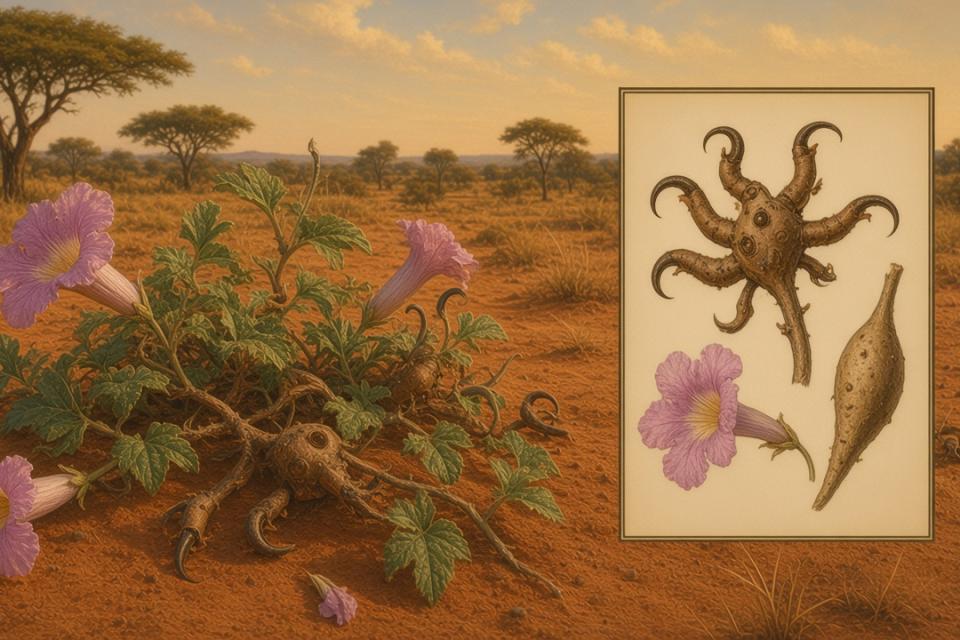
Devil’s claw is a sprawling desert plant of the Kalahari whose woody fruits bristle with hooked arms that snag the feet and fur of passing animals. The part used is not the fruit but the secondary storage tubers that swell on the roots underground. The San, Nama, and other peoples of southern Africa used the root for pain, fever, digestive complaints, and wounds long before it was exported. Since the 1950s it has become a mainstream European remedy for joint and back pain, especially in Germany, and almost all of the supply is still dug from wild plants, mainly in Namibia.
The European Medicines Agency’s herbal committee recognizes devil’s claw root as a traditional herbal medicine for the relief of minor joint pain and for mild digestive problems such as bloating, flatulence, and temporary loss of appetite. That status rests on long use rather than proven efficacy. In a 2014 Cochrane review of herbal medicines for low back pain, Oltean and colleagues judged that extracts standardized to 50 or 100 mg of harpagoside a day may relieve short-term pain better than placebo, but the evidence came from two trials and was rated low quality. Trials in hip and knee osteoarthritis are small and mostly lack a placebo group.
Devil’s claw is generally well tolerated, but its most common side effects are digestive, including diarrhea, and EMA advises against it in people with stomach or duodenal ulcers. People with gallstones should ask a doctor first, and there is a case report of bleeding in a patient taking warfarin. Effects on blood pressure and blood sugar are uncertain, and it is not recommended in pregnancy, while breastfeeding, or for under-18s. Nothing here is medical advice; swollen, red, or hot joints and back pain with fever, weakness, or numbness need a medical assessment, not a herbal remedy.
Featured in
Herbs for Joint Pain and Arthritis Herbs for Inflammation Herbs for Back and Muscle PainIn this monograph
01 The plant
Botanical profile
Harpagophytum procumbens belongs to Pedaliaceae, the sesame family. NCBI Taxonomy lists it as taxon 222879 under the common name Kalahari devil’s claw, with the older synonym Uncaria procumbens. Brendler’s 2021 review in Pharmaceuticals describes two species with five subspecies; the second species, Harpagophytum zeyheri, is also accepted by the European Pharmacopoeia and EMA as a source of devil’s claw root. The genus name comes from the Greek harpagos, a grappling hook, after the fruit (EMA assessment report). Burchell first described the plant in 1822 under the name Uncaria, and the genus Harpagophytum was published in 1840.
SANBI’s PlantZAfrica profile describes a prostrate, sprawling perennial whose annual stems trail across the sand from a deep rootstock, with grayish-green, three- to five-lobed leaves. Trumpet-shaped flowers range from dark velvety red or purple to pink, with a yellowish tube, and appear mainly between November and April. The woody, flattened capsules carry two rows of 12–16 arms tipped with hooked spines that catch in animals’ feet and hair, spreading the seeds; animals sometimes starve when the fruits lodge in their mouths. The plant grows on deep Kalahari sand, and the SANBI Red List notes it is a pioneer that thrives in overgrazed areas. Its range covers Namibia, Botswana, and South Africa, with populations in Angola, Mozambique, Zambia, and Zimbabwe.
The medicine is the secondary root tuber, which branches off the main taproot and, according to the EMA assessment report, contains about twice as much harpagoside as the primary tuber. The tubers are cut and dried. Iridoid glycosides make up 0.5–3% of the dried root, chiefly harpagoside (PubChem CID 5281542), an intensely bitter compound present at 0.8–3.0% in H. procumbens, with smaller amounts of harpagide (CID 93045) and 8-p-coumaroylharpagide. The root also contains acteoside and is about half sugars, mostly stachyose. The European Pharmacopoeia requires at least 1.2% harpagoside in the dried root. Adulteration with the less valuable primary roots, with H. zeyheri, or with unrelated plants has been reported, and a 2015 DNA-barcoding study of supplements sold in the US found that all tested samples contained H. zeyheri, alone in 81% (EMA assessment report).
02 Lineage
History
The peoples of the Kalahari used devil’s claw long before Europeans did. Mncwangi and colleagues (Journal of Ethnopharmacology 2012) describe its traditional use as a general tonic and for arthritis, pain, fever, ulcers, and boils, and the EMA assessment report records its use as a bitter tonic for indigestion, for fever, for cleansing the blood, and for rheumatic and joint pain, with small amounts given to women before childbirth for pain. Brendler identifies the earliest written records as a 1901 account of its use on wounds, which recorded a Nama name for the plant, and a 1907 report in which Samuel Kariko, a Herero man, described its use for cough, diarrhea, constipation, and venereal disease.
Popular accounts credit a German colonial soldier and later farmer at Mariental, Gottreich Hubertus Mehnert, with its discovery. SANBI’s PlantZAfrica says he learned of the plant from San and Nama people and made it known in 1904. A more dramatic version, in which he saw a healer treat a wounded man during the 1904–1908 war against the Herero and Nama, a conflict now recognized as genocide, and his pointer dog led him to the plant, is dismissed by Brendler as implausible and probably a marketing story; the knowledge belonged to the region’s indigenous peoples. Brendler’s account is that the botanist O. H. Volk, interned with Mehnert during the Second World War, took the knowledge back to Germany, that Mehnert trademarked the name Harpago in the early 1950s and began exporting to Germany, and that the first pharmacological study followed in 1958.
In Germany, a devil’s claw tea was registered as a medicine in 1977, Commission E approved the root in 1990, and H. zeyheri was added to the European Pharmacopoeia in 2003 (Brendler). Demand surged around 2000: Stewart and Cole (Journal of Ethnopharmacology 2005) report that exports peaked at 1,018 metric tons in 2002 and that German sales in 2001 were worth about €30 million, with 74% of prescriptions written for rheumatism. Concern about over-harvesting led Germany to propose listing devil’s claw on Appendix II of the Convention on International Trade in Endangered Species (CITES) in 2000; the proposal was withdrawn after objections from Namibia, Botswana, and South Africa, which instead took on monitoring and management of the harvest, and the plant has never been listed. EMA’s herbal committee adopted its first monograph in 2008 and revised it in 2016.
03 Chemistry
Active compounds and how it works
Harpagoside has long been treated as the main active ingredient, and products are standardized to it, but the EMA assessment report concludes that it is unclear whether harpagoside is responsible for the clinical effect. In human white blood cells, Fiebich and colleagues found that a devil’s claw extract inhibited the release of the inflammatory messengers TNF-alpha, interleukin-1 beta, and interleukin-6, while purified harpagoside and harpagide had no effect. Other laboratory studies show that extracts suppress COX-2 and inducible nitric oxide synthase and reduce enzymes that break down cartilage, and that harpagoside inhibits leukotriene formation. Early work found only slight inhibition of prostaglandin synthesis, suggesting that devil’s claw does not work mainly in the way aspirin and ibuprofen do. Mncwangi and colleagues note that isolated constituents are generally less effective than the whole extract.
The bitter iridoids explain the traditional use for poor appetite and indigestion: bitter substances stimulate digestive secretions, and EMA’s ulcer contraindication rests on the root’s stimulation of gastric juice secretion. MSKCC notes that an animal study suggested appetite suppression rather than stimulation, but human data are lacking. Animal studies summarized by EMA found that extracts lowered blood pressure and heart rate and had anti-arrhythmic effects, and that a water extract given by injection lowered blood sugar in rats. A proposed calcium-channel mechanism behind the heart effects was not confirmed in later animal and human studies, and harpagoside content falls by about 10% over three hours in artificial gastric fluid, so laboratory results may not translate to oral use.
04 In practice
Common uses
Low back pain has the most trial evidence. Oltean and colleagues (Cochrane 2014) reviewed 14 trials of herbal medicines with 2,050 participants. For devil’s claw extracts standardized to 50 or 100 mg harpagoside a day, two trials with 315 participants provided low-quality evidence of better short-term pain relief and less use of rescue medication than placebo, and one trial with 88 participants provided very low-quality evidence that it was no worse than rofecoxib. By comparison, the same review rated the evidence for white willow bark and for capsicum cream as moderate quality. The senior author disclosed earlier work as a scientist with a company that sold ingredients covered by the review.
The largest single trial, by Chrubasik and colleagues (European Journal of Anaesthesiology 1999), randomized 197 people with flare-ups of chronic low back pain to 600 mg or 1,200 mg of extract (50 or 100 mg harpagoside) or placebo for four weeks. On the main outcome, the number who were pain-free without the rescue painkiller tramadol for at least five days in the last week, 3 of the placebo group, 6 on the lower dose, and 10 on the higher dose succeeded. The result was statistically significant only with a one-tailed test, and different subgroup analyses gave contradictory pictures of which patients benefited. In a six-week pilot trial in 88 patients, the same group found an extract providing 60 mg harpagoside a day comparable to rofecoxib 12.5 mg, with 10 versus 5 pain-free patients, but the authors stressed that a much larger trial would be needed (Rheumatology 2003).
Osteoarthritis: Chantre and colleagues (Phytomedicine 2000) compared Harpadol capsules, 2,610 mg of powdered root a day containing 57 mg harpagoside, with diacerhein 100 mg in 122 people with knee or hip osteoarthritis for four months. Pain and function improved similarly in both groups, people taking devil’s claw used fewer NSAIDs and other painkillers, and diarrhea was less common (8.1% versus 26.7%). The EMA assessors noted that the trial had no placebo arm, that diacerhein is not a standard reference drug, and that the same trial was published twice. MSKCC summarizes the clinical data for hip and knee osteoarthritis as limited and calls for larger confirmatory studies. A 2003 review cited by EMA found better evidence for products providing at least 50 mg harpagoside a day and warned that results cannot be transferred from one product to another.
Digestive uses: EMA accepts devil’s claw as a traditional bitter for mild digestive complaints such as bloating and flatulence and for temporary loss of appetite, on the basis of long use. MSKCC notes that there is no scientific evidence for gastrointestinal uses. Devil’s claw is also sold for gout, fever, and general inflammation, but these uses have no meaningful clinical support. It is not a quick painkiller: Health Canada’s monograph, quoted in the EMA assessment report, advises at least two to three months of use for osteoarthritis joint pain, while EMA’s own monograph advises seeing a doctor if joint pain persists beyond four weeks of use.
05 The apothecary
Preparations and traditional use
EMA’s monograph sets out the traditional doses for adults. For minor joint pain: a tea made from 4.5 g of cut root steeped in 500 ml of boiling water for 8 hours and drunk in three doses through the day; 435 mg of powdered root three times daily; dry aqueous extract 100–1,200 mg two or three times daily, up to 2,400 mg a day; dry 60% ethanol extract 480 mg twice daily; or tincture (1:5 in 25% ethanol) 0.5–1 ml three times daily. For digestive complaints and loss of appetite the doses are lower: a tea from 1.5 g of root in 250 ml of boiling water divided into three doses, or 100 mg of aqueous extract two or three times daily. EMA does not recommend use under 18.
Because harpagoside is intensely bitter, the tea is an acquired taste, and most products are tablets or capsules of dry extract. The trials that support use for back pain used extracts providing 50–100 mg harpagoside a day, and the Chantre osteoarthritis trial used 2,610 mg of powdered root providing 57 mg; check the label for both the extract amount and its harpagoside content, as products vary widely and results from one product do not necessarily apply to another.
Where available, choose a registered traditional herbal medicine; EMA’s monograph is based on root that meets the European Pharmacopoeia standard, which requires at least 1.2% harpagoside. Products may legitimately contain H. procumbens, H. zeyheri, or both, but substitution with primary roots or unrelated plants has been reported. If you want to support sustainable harvesting, look for products that state their source; Brendler reports that only about 1% of traded devil’s claw carries both organic and Fair for Life certification, with a further 10–15% harvested under good agricultural and collection practice schemes.
Safety
Before you use devil’s claw
06 Caution
Side effects
Digestive upsets are the most common problem. EMA’s monograph lists diarrhea, nausea, vomiting, and abdominal pain, along with headache, dizziness, and allergic skin reactions such as rash, hives, and facial swelling, all of unknown frequency. In the Chantre osteoarthritis trial, 8.1% of people on devil’s claw had diarrhea, fewer than on the comparison drug. In the Chrubasik back pain trial, adverse events were mostly mild digestive symptoms, and in the rofecoxib comparison 13 of the 28 adverse events judged attributable to treatment occurred in the devil’s claw group.
More serious events are rare and mostly from case reports. MSKCC notes reports of stomach ulcers and gastrointestinal bleeding, and an 87-year-old man needed surgery for an intestinal blockage caused by a bezoar, a compacted mass, formed from a herbal preparation containing devil’s claw. A German hospital-based case-control study suggested an increased risk of acute pancreatitis. The German drug regulator BfArM, cited by EMA, lists very rare severe allergic reactions including anaphylactic shock. Long-term safety is incompletely studied: EMA states that adequate tests of reproductive toxicity, genotoxicity, and carcinogenicity have not been performed, although no overdose cases have been reported, and in rats a week of very high oral doses (2 g per kilogram) caused no signs of liver toxicity.
Effects on blood pressure and blood sugar are inconsistent. Animal studies suggested that devil’s claw lowers blood pressure, but Cuspidi and colleagues (Journal of Clinical Hypertension 2015) described moderate high blood pressure in a healthy 62-year-old postmenopausal woman after more than two weeks of taking two 250 mg capsules a day, and EMA’s review found one report of fast heart rate and heart failure in a global safety database. A rat study found lowered blood sugar, yet BfArM notes very rare rises in blood sugar in people. Anyone with high blood pressure, heart disease, or diabetes who starts devil’s claw should monitor their readings.
07 Caution
Contraindications
Stomach and duodenal ulcers: EMA contraindicates devil’s claw in active gastric or duodenal ulcer, because the bitter root stimulates gastric juice secretion. MSKCC notes reports of ulcers and gastrointestinal bleeding with its use. People with a history of ulcers, indigestion, or gastritis, and those already taking NSAIDs, aspirin, or steroids that irritate the stomach, should be cautious. EMA also contraindicates devil’s claw in anyone with a known allergy to the root, given reports of rash, hives, facial swelling, and, very rarely, anaphylaxis.
Gallstones: EMA advises patients with gallstones to consult a doctor before use, a warning taken from a WHO monograph. Swollen, red, or hot joints: EMA warns that joint pain accompanied by swelling, redness, or fever must be examined by a doctor, because it may signal infection, gout, or inflammatory arthritis rather than wear-and-tear pain. Back pain with fever, weight loss, leg weakness, numbness, or loss of bladder control also needs urgent assessment.
Pregnancy, breastfeeding, and children: EMA does not recommend devil’s claw in pregnancy or breastfeeding because of insufficient safety data. Small amounts of the tuber were traditionally given to women approaching childbirth to ease pain, according to the EMA assessment report, but that is not evidence of safety in pregnancy. Extracts stimulated uterine contractions in laboratory studies, and reproductive toxicity has not been adequately tested. It is not recommended for children and adolescents under 18.
Heart disease, blood pressure, and diabetes: given the conflicting animal and human data on blood pressure, heart rhythm, and blood sugar, people with heart disease, hypertension, or diabetes should take devil’s claw only with medical advice and monitoring. People with acute pancreatitis or a history of it should be cautious in the light of the case-control finding reported by MSKCC.
08 Caution
Drug and herb interactions
Warfarin and other anticoagulants: the EMA assessment report notes that devil’s claw inhibits the liver enzyme CYP2C9 in laboratory studies, and CYP2C9 plays a significant role in warfarin metabolism. Clinical evidence is limited to one case report of purpura, bleeding into the skin, in a patient taking devil’s claw with warfarin, rated as a possible interaction. EMA concluded that an interaction has not been conclusively demonstrated, and its monograph lists none, but anyone taking warfarin should avoid devil’s claw or have extra INR checks, and similar caution makes sense with other anticoagulants and antiplatelet drugs.
Other drugs: MSKCC notes that devil’s claw root inhibits several cytochrome P450 enzymes (CYP1A2, 2C8, 2C9, 2C19, 2D6, and 3A4) in the laboratory and modulates the P-glycoprotein drug transporter, but conflicting data suggest these effects may not be clinically relevant. Blood pressure medicines: animal studies predict additive lowering of blood pressure, yet the human case report showed a rise; Stockley’s Herbal Medicines Interactions, cited by EMA, says too little is known to make recommendations.
Diabetes medicines: because devil’s claw lowered blood sugar in rats and very rare rises in blood sugar have been reported in people, its effect in diabetes is unpredictable, and people on glucose-lowering drugs should monitor their levels. Painkillers: devil’s claw is often taken alongside NSAIDs, and both can irritate the stomach. EMA’s monograph lists no confirmed interactions, which reflects a lack of data rather than proof of safety, so tell your doctor or pharmacist if you take it with prescription medicines.
09 Questions
Frequently Asked Questions
The evidence is modest. In a four-month trial in knee and hip osteoarthritis, devil’s claw powder worked about as well as the drug diacerhein, but there was no placebo group. EMA recognizes it only as a traditional remedy for minor joint pain. Turmeric and boswellia are other herbs studied for osteoarthritis.
A Cochrane review found low-quality evidence that extracts providing 50–100 mg harpagoside a day may relieve short-term low back pain better than placebo, based on two trials. The same review rated the evidence for white willow bark as moderate quality. Back pain with fever, numbness, or weakness needs a doctor.
Trials ran for four weeks to four months, and Health Canada’s monograph suggests at least two to three months for osteoarthritis pain. EMA advises seeing a doctor if joint pain continues for more than four weeks of use, or digestive symptoms for more than two weeks.
Ask your doctor or pharmacist first. Both devil’s claw and NSAIDs such as ibuprofen can irritate the stomach. With warfarin, devil’s claw inhibits a key metabolizing enzyme in the laboratory, and one patient developed bleeding into the skin, so avoid the combination or have extra INR checks.
Avoid it with stomach or duodenal ulcers, during pregnancy or breastfeeding, and in under-18s. Talk to a doctor first if you have gallstones, high blood pressure, heart disease, or diabetes, or take warfarin or other prescription medicines.
Almost all devil’s claw is wild-harvested, often by poor rural women, and attempts to cultivate it have not been commercially viable. Harvesting only the secondary tubers lets plants regrow, and South Africa rates the species as Least Concern, but over-harvesting has been a concern. Only a small share of trade is certified organic and fair trade.
The name refers to the woody fruit, which has arms tipped with sharp hooks that cling to animals’ feet and fur. The genus name Harpagophytum means grappling-hook plant. Only the root tubers are used medicinally.
Probably not. In the Cochrane review of herbal medicines for low back pain, cayenne (capsicum) cream or plaster had moderate-quality evidence of benefit for chronic back pain, while devil’s claw taken by mouth had only low-quality evidence. Neither replaces a medical assessment of persistent pain.
10 References
Sources
These references support the history, clinical, and safety claims on this page. They are not an endorsement of any product.
-
European Union herbal monograph on Harpagophytum procumbens DC. and/or Harpagophytum zeyheri Decne., radix
European Medicines Agency (EMA/HMPC/627057/2015), 2016
Adopted 12 July 2016: traditional use for minor joint pain and mild digestive complaints; preparations and doses; contraindicated in gastric or duodenal ulcer; gallstone warning; not for pregnancy or under-18s.
-
Assessment report on Harpagophytum procumbens DC. and/or Harpagophytum zeyheri Decne., radix
European Medicines Agency (EMA/HMPC/627058/2015), 2016
Full review of constituents, adulteration, pharmacology, clinical trials, and safety, including the warfarin case report, blood pressure data, and CYP2C9 inhibition.
-
Devil’s Claw
Memorial Sloan Kettering Cancer Center, About Herbs, 2023
Clinical summary (updated April 2023): limited data for osteoarthritis; ulcers, bleeding, hypertension, bezoar, and pancreatitis reports; CYP and P-glycoprotein effects of uncertain relevance.
-
Harpagophytum procumbens
NCBI Taxonomy, National Library of Medicine (NIH), 2026
Taxon 222879, Kalahari devil’s claw; synonym Uncaria procumbens; family Pedaliaceae.
-
Harpagoside
PubChem, National Library of Medicine (NIH), 2026
CID 5281542, C24H30O11; bitter iridoid glycoside used to standardize devil’s claw root and extracts.
-
From Bush Medicine to Modern Phytopharmaceutical: A Bibliographic Review of Devil’s Claw (Harpagophytum spp.)
Pharmaceuticals (Basel) (PubMed 34451822), 2021
Brendler: taxonomy, earliest written records, critique of the Mehnert discovery story, German introduction, pharmacopoeial history, and trade and certification data.
-
Devil’s Claw-a review of the ethnobotany, phytochemistry and biological activity of Harpagophytum procumbens
Journal of Ethnopharmacology (PubMed 22940241), 2012
Mncwangi et al.: traditional uses, chemistry, H. zeyheri substitution, over-harvesting, and evidence that whole extracts outperform isolated constituents.
-
The commercial harvest of devil’s claw (Harpagophytum spp.) in southern Africa: the devil’s in the details
Journal of Ethnopharmacology (PubMed 16112533), 2005
Stewart and Cole: 1,018 metric tons exported in 2002; German market of about €30 million in 2001; the withdrawn CITES Appendix II proposal; cultivation debate.
-
Harpagophytum procumbens
PlantZAfrica, South African National Biodiversity Institute, 2006
Plant profile: description, flowering, hooked fruits, Kalahari sand habitat, San and Nama knowledge, and harvesting by rural communities.
-
Harpagophytum procumbens
Red List of South African Plants, South African National Biodiversity Institute, 2012
Assessed Least Concern in South Africa (2012); harvesting affects under 2% of the population and most harvested plants regrow; range across seven southern African countries.
-
Herbal medicine for low-back pain
Cochrane Database of Systematic Reviews (PubMed 25536022), 2014
Oltean et al.: 14 trials, 2,050 participants; low-quality evidence that devil’s claw (50 or 100 mg harpagoside) beats placebo for short-term pain; very low-quality comparison with rofecoxib.
-
Effectiveness of Harpagophytum extract WS 1531 in the treatment of exacerbation of low back pain: a randomized, placebo-controlled, double-blind study
European Journal of Anaesthesiology (PubMed 10101629), 1999
Chrubasik et al.: 197 patients, four weeks; 3, 6, and 10 pain-free with placebo, 600 mg, and 1,200 mg extract; significant only on a one-tailed test.
-
A randomized double-blind pilot study comparing Doloteffin and Vioxx in the treatment of low back pain
Rheumatology (Oxford) (PubMed 12509627), 2003
Chrubasik et al.: 88 patients, six weeks; extract with 60 mg harpagoside daily versus rofecoxib 12.5 mg; no significant differences; larger trials needed.
-
Efficacy and tolerance of Harpagophytum procumbens versus diacerhein in treatment of osteoarthritis
Phytomedicine (PubMed 11185727), 2000
Chantre et al.: 122 patients with knee or hip osteoarthritis, four months; similar efficacy to diacerhein, less NSAID use, and less diarrhea; no placebo arm.
-
Systemic Hypertension Induced by Harpagophytum procumbens (devil’s claw): A Case Report
Journal of Clinical Hypertension (PubMed 26094951), 2015
Cuspidi et al.: moderate hypertension in a healthy postmenopausal woman after more than two weeks of a devil’s claw product, contrary to animal data.