Monograph
Hibiscus
Hibiscus sabdariffa
Updated October 8, 2026
Key points
-
01
Roselle calyx, not garden hibiscus
The tea is made from the fleshy red calyces of roselle (Hibiscus sabdariffa), not ornamental hibiscus flowers. Botanists renamed it Sabdariffa gossypiifolia in 2025.
-
02
A modest blood pressure drop
Pooled trials suggest systolic pressure about 7 mmHg lower than placebo, mostly in people with raised readings. Most trials are small, short, and inconsistent.
-
03
Cochrane is not yet convinced
Cochrane’s 2021 review found only one eligible placebo-controlled trial in hypertension and rated the evidence insufficient and of very low certainty.
-
04
Little effect on cholesterol or weight
NCCIH says hibiscus has not been found effective for cholesterol, and a 2024 meta-analysis of six trials found no benefit for weight loss.
-
05
Watch for drug interactions
In small studies hibiscus drinks cut simvastatin exposure by about a third and chloroquine by about 70%. Tell your prescriber if you take warfarin or blood pressure drugs.
The hibiscus in a cup of tart, ruby-red tea is not the showy garden shrub. It is roselle, Hibiscus sabdariffa, a tropical African annual in the mallow family, and the part used is the calyx: the fleshy red cup of sepals that swells around the seed pod after the pale yellow flower fades. Dried calyces make one of the world’s most widely shared drinks, known as bissap or zobo in West Africa, karkadé in Sudan and Egypt, agua de Jamaica in Mexico, and sorrel in the Caribbean, where it is a Christmas tradition. Cochrane calls it sour tea or red tea. Roselle is also grown for fiber, and in 2025 botanists moved it into a separate genus as Sabdariffa gossypiifolia, although research and product labels still use the old name.
Blood pressure is the main modern use, and the evidence is genuine but modest and of uneven quality. In a well-run US trial, McKay and colleagues (Journal of Nutrition 2010) found that three cups a day for six weeks lowered systolic pressure by 7.2 mmHg, against 1.3 mmHg with a placebo drink, in 65 adults with mildly raised readings. A 2022 meta-analysis of 17 trials found systolic pressure about 7 mmHg lower than with placebo, with the largest effects in people whose pressure was highest. Yet Cochrane’s 2021 review, applying strict criteria, found only one eligible placebo-controlled trial in people with hypertension and judged the evidence insufficient. Most trials are small, last a few weeks, and carry a real risk of bias. For cholesterol, NCCIH says hibiscus has been studied but not found effective.
As a drink, hibiscus has a good safety record in trials, but it is pharmacologically active. It may add to blood pressure medicines, it reduced exposure to simvastatin by about a third in six volunteers, it sharply cut absorption of the antimalarial chloroquine in a Sudanese study, and a 2026 case report describes a markedly raised INR in a woman on warfarin. There are no human safety data in pregnancy, and animal studies raise concerns about effects on offspring. Nothing here is medical advice; high blood pressure needs a diagnosis and proven treatment, and hibiscus tea should never quietly replace a prescribed medicine.
Featured in
Herbs for Heart and CirculationIn this monograph
01 The plant
Botanical profile
Hibiscus sabdariffa L. belongs to Malvaceae, the mallow family, and NCBI Taxonomy files it as taxon 183260. Linnaeus named it in Species Plantarum in 1753, giving its habitat as India, but the conserved type specimen is cultivated material from George Clifford’s garden at Hartekamp in Holland. In 2025 Barrett and colleagues (Australian Systematic Botany), noting that Hibiscus as traditionally defined is grossly polyphyletic, reinstated the genus Sabdariffa for the 117 species of Hibiscus section Furcaria. Because ‘Sabdariffa sabdariffa’ would break the naming rules, roselle had to take the next available epithet, from Philip Miller’s 1768 Hibiscus gossypiifolius, and is now Sabdariffa gossypiifolia; its relatives kenaf and false roselle moved with it. The authors acknowledge that the new name has very little recognition among users of the plant, and research and product labels still use Hibiscus sabdariffa. Roselle should not be confused with the ornamental Hibiscus rosa-sinensis or Hibiscus syriacus, the flowers most people picture as hibiscus (JSTOR Daily); research on roselle calyces does not apply to them.
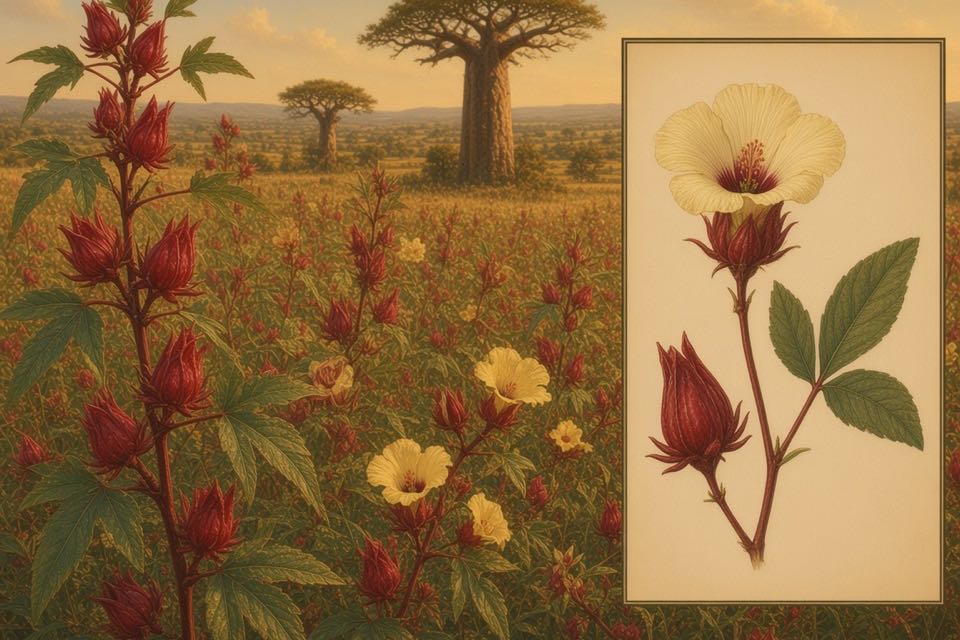
Floras collected by World Flora Online describe roselle as an erect annual herb, usually 0.5–2 m tall, with sturdy, often purplish or reddish stems. The leaves are variable: those low on the stem are simple and ovate, while upper leaves are deeply divided into three to five, sometimes seven, narrow toothed lobes. Flowers grow singly in the leaf axils, pale yellow with a dark red or purplish-brown center, roughly 3–7 cm across. Beneath each sits an epicalyx of about 7 to 12 narrow bracts, often red, and a five-lobed calyx that keeps growing after flowering, becoming thick, fleshy, and deep red, up to about 3.5 cm long, around an egg-shaped, usually hairy capsule of kidney-shaped seeds. Britannica notes that roselle is technically perennial but grown as an annual from seed, is very sensitive to frost, and needs about 25 cm of rain a month in the growing season. Food crops are widely spaced, short, and branched, and their calyces are picked when plump and fleshy.
World Flora Online gives the native range as tropical Africa, from Ghana and Nigeria east to Chad and Sudan and south to Gabon and the Congo basin, and Barrett and colleagues infer a tropical African origin, with every other population spread by people. Britannica calls it probably native to West Africa and describes a fiber form, variety altissima, sown densely to grow 3–5 m tall; its retted stalks yield a lustrous fiber, used with jute for sacking and twine, and the Dutch East Indies began large plantings in the 1920s to make sugar sacks. The calyx chemistry explains the color and sourness. Da-Costa-Rocha and colleagues (Food Chemistry 2014) single out the anthocyanins delphinidin-3-sambubioside (PubChem CID 10196837, C26H29O16+) and cyanidin-3-sambubioside, organic acids including hydroxycitric acid and hibiscus acid, and phenolic acids such as protocatechuic acid. Hopkins and colleagues (Fitoterapia 2013) add citric and malic acids. Amounts in a cup are small: the tea in the McKay trial supplied about 7 mg of anthocyanins per serving.
02 Lineage
History
Roselle’s story begins in tropical Africa, where it remains an everyday food and drink. JSTOR Daily lists some of its African names for the beverage, including bissap, wonjo, foléré, dabileni, tsobo, zobo, and sobolo, and Mahmoud and colleagues (Journal of Antimicrobial Chemotherapy 1994) describe karkadi as one of three common Sudanese drinks. Hopkins and colleagues found it consumed as a beverage in Nigeria and other West African countries, Egypt, Iran, India, Thailand, Taiwan, Mexico, and the United States, and recorded folk use against high blood pressure in Egypt, Jordan, and Trinidad and Tobago and against high cholesterol in Jordan, Greece, Brazil, and Trinidad. Intriguingly, ethnomedical studies in Jordan and Iraq recorded its use for low blood pressure, and in Iraq, Greece, and Brazil for obesity, a reminder that folk traditions do not always point the same way. World Flora Online notes that the leaves are edible too, and the fiber form has long been woven into sacking alongside jute.
Britannica says roselle was known in the West Indies early in the sixteenth century and was growing in Asia by the seventeenth. JSTOR Daily notes that it is widely assumed to have reached the Caribbean from Africa and that its migration is closely tied to the Atlantic slave trade, which brought about 10.7 million people to the Americas between 1526 and 1867. Drawing on Judith Carney and Richard Rosomoff’s In the Shadow of Slavery, it describes how enslaved people kept African knowledge alive in provision gardens, known as conucos, kunukus, or ground provisions, where hibiscus became a staple drink plant, called sorrel or agua de Jamaica in the Americas. Carney (African Ethnobotany in the Americas, 2013) notes the English name guinea sorrel, from the slave traders’ term for Africa, and the Brazilian dish arroz de cuxá, rice with sorrel, whose name comes from the Mandinka of West Africa. Barrett and colleagues, citing a 1911 account, credit Sloane’s 1707 natural history of Jamaica with the first record of roselle eaten as food there.
Today roselle is a festive and commercial drink across the Atlantic world. NPR reports that Caribbean sorrel, steeped with ginger and spices, sweetened, and sometimes spiked with rum or wine, became a Christmas drink partly because the plant used to be available only at that time of year. Food historian Adrian Miller calls African American ‘red drink’ a nod to ancestral red drinks that crossed the Atlantic, and says Christmas sorrel has been gaining a foothold in the United States since at least the 1930s, with newspaper references to it being sold on New York streets to Caribbean immigrants. In Mexico, Ojeda and colleagues (Journal of Ethnopharmacology 2010) describe hibiscus beverages as widely used as a diuretic and for digestive complaints, liver disease, fever, high cholesterol, and hypertension, and researchers at the Mexican Social Security Institute ran the trials comparing hibiscus with captopril and lisinopril. Carney also notes that roselle is the plant that gives Red Zinger tea its color.
03 Chemistry
Active compounds and how it works
Several mechanisms have been proposed for the blood pressure effect, none fully proven in people. The first is a mild diuretic action. Herrera-Arellano and colleagues (Phytomedicine 2004) observed increased sodium excretion in people drinking hibiscus infusion, and in their 2007 trial serum chloride rose, sodium tended to fall, and potassium did not change. Hopkins and colleagues found that hibiscus extracts acted as diuretics in animal studies but in most cases did not significantly change electrolytes, and note that this profile has been compared with potassium-sparing diuretics such as spironolactone. A diuretic effect would also explain why interactions with the diuretic hydrochlorothiazide have been studied.
The second proposal is inhibition of angiotensin-converting enzyme (ACE), the target of drugs such as captopril and lisinopril. In the 2007 trial, plasma ACE activity fell from about 44 to 30 units in people taking a hibiscus extract. Ojeda and colleagues isolated delphinidin-3-sambubioside and cyanidin-3-sambubioside from hibiscus calyces and showed that they inhibit ACE in the test tube by competing with its substrate, with IC50 values of 84.5 and 68.4 µg/mL, similar to related plant flavonoids; test-tube activity does not show that the same happens in the body. Hopkins and colleagues also list relaxation of blood vessels through endothelial pathways and blocking of calcium entry into vessel muscle in laboratory studies. Whether enough anthocyanin reaches the bloodstream is unclear: McKay and colleagues detected none in the urine within an hour of drinking their tea (Hopkins).
For cholesterol and blood sugar the mechanisms are laboratory findings. Hopkins and colleagues describe inhibition of HMG-CoA reductase, the enzyme blocked by statins, and antioxidant protection of LDL cholesterol from oxidation, as well as reduced fat-cell development in cell studies, and they note that hibiscus acid has been proposed to inhibit triglyceride synthesis. Da-Costa-Rocha and colleagues add inhibition of the carbohydrate-digesting enzymes α-glucosidase and α-amylase. They caution that most evidence comes from extracts that are poorly characterized chemically, and call for trials using defined preparations. Some of its authors were affiliated with two German botanical companies. Laboratory activity is a reason to test a plant, not evidence that it works in people.
04 In practice
Common uses
Blood pressure, placebo-controlled trials: the best-known trial is by McKay and colleagues (Journal of Nutrition 2010) at Tufts University. They randomized 65 adults aged 30 to 70 with prehypertension or mild hypertension, not taking blood pressure medicines, to three 240 ml servings a day of brewed hibiscus tea or a placebo drink for six weeks, in a double-blind design. Systolic pressure fell by 7.2 mmHg with hibiscus and 1.3 mmHg with placebo, a significant difference; diastolic pressure fell by 3.1 and 0.5 mmHg, which was not significantly different, and the change in mean arterial pressure was borderline. People with higher starting pressure responded more. Each serving was brewed from 1.25 g of dried hibiscus (Hopkins). It is a careful study, but it is small, short, and measured readings rather than strokes or heart attacks.
Head-to-head with medicines: Herrera-Arellano and colleagues (Phytomedicine 2004) gave 90 Mexican adults with hypertension either an infusion of 10 g of dried calyx in half a liter of water each morning or captopril 25 mg twice a day for four weeks; 75 completed. With hibiscus, pressure fell from about 139/91 to 124/80 mmHg, with no significant difference from captopril. In their 2007 double-blind trial (Planta Medica), 193 adults took a dried extract supplying 250 mg of anthocyanins or lisinopril 10 mg for four weeks; pressure fell from about 146/98 to 130/86 mmHg on hibiscus, but lisinopril worked significantly better. Wahabi and colleagues (Phytomedicine 2010) reviewed four early trials with 390 patients, including these two, judged all but one short and of poor quality, and found no reliable evidence for treating hypertension. A small four-week trial is not enough to show that a tea can replace a drug.
Pooled evidence points to a modest effect with a large question mark. Serban and colleagues (Journal of Hypertension 2015) combined five trials with 390 participants and found systolic pressure 7.58 mmHg and diastolic 3.53 mmHg lower, using a fixed-effect model that can overstate certainty. Ellis and colleagues (Nutrition Reviews 2022) pooled 17 trials: systolic pressure was 7.10 mmHg lower than with placebo (95% confidence interval 1.20 to 13.00 mmHg lower), with extreme heterogeneity (I² of 95%). An umbrella review by Norouzzadeh and colleagues (Complementary Therapies in Medicine 2025) of 26 trials with 1,797 participants found dose-dependent reductions. But Cochrane’s 2021 update by Pattanittum and colleagues, which accepted only placebo or no-treatment comparisons in people with hypertension, found a single eligible trial of 60 people with type 2 diabetes, with no clear effect and very low certainty. Its 2010 version found none.
Cholesterol and blood sugar: Aziz and colleagues (Journal of Ethnopharmacology 2013) found six trials with 474 participants and no significant effect on any blood lipid compared with placebo, black tea, or diet, and NCCIH says hibiscus has been studied for cholesterol but not found effective. Later pooled analyses are more favorable: Ellis and colleagues found LDL cholesterol 6.76 mg/dL lower than with other teas or placebo, a borderline result, and Norouzzadeh and colleagues reported lower total and LDL cholesterol and fasting glucose. In a 12-week Mexican trial of 104 adults (Revista Médica del Instituto Mexicano del Seguro Social 2011), hibiscus extract lowered triglycerides, while pravastatin had the greatest effect on cholesterol. Bule and colleagues (Food Research International 2020) pooled a fall in fasting glucose of only about 4 mg/dL, too small to matter for people with diabetes.
Other uses: for weight, Dilokthornsakul and colleagues (Complementary Therapies in Medicine 2024) pooled six trials with 339 participants and found no meaningful effect on body weight, BMI, or waist size. A meta-analysis of three trials with 178 women with uncomplicated cystitis (Antibiotics 2021) found benefit from a medical device combining xyloglucan, hibiscus, and propolis, but the design cannot show what hibiscus itself contributed. Traditional uses for digestion, fever, and liver complaints have not been tested in good trials. A fair summary is that regular hibiscus tea may lower systolic pressure by a few points in people with raised readings, a modest effect that could be worth having alongside diet and exercise, but not one established well enough to treat hypertension, prevent heart disease, or substitute for medicine.
05 The apothecary
Preparations and traditional use
There is no standardized dose. In the McKay trial, each 240 ml serving was made by steeping 1.25 g of dried hibiscus in boiled water, taken three times a day, an amount the authors described as readily incorporated into the diet. The 2004 Mexican trial used a much stronger infusion, 10 g of dried calyx in half a liter of water once a day, supplying 9.6 mg of anthocyanins, while the 2007 trial used a dried extract providing 250 mg of anthocyanins per dose. Norouzzadeh and colleagues found that effects increased with dose. Trials lasted from two weeks to about three months, so longer-term effects of daily use are not known. Because calyces vary by cultivar, origin, and freshness, two cups of hibiscus tea may contain very different amounts of active compounds.
Hibiscus is sold as whole or cut dried calyces, in tea bags, often blended with other herbs, in bottled drinks, and as capsules and liquid extracts, some standardized to anthocyanins. McKay and colleagues noted that it is an ingredient in many herbal tea blends, so check labels if you are trying to avoid it. Traditional drinks can be strong and sweet. A Caribbean sorrel recipe published by NPR steeps 2 pounds of fresh sorrel with ginger, cinnamon, and allspice for two or three days and adds 1½ to 2 pounds of brown sugar, along with red wine and rum, for 8 cups of drink. The trials used unsweetened tea or capsules, so heavily sugared or alcoholic versions are a different proposition for anyone watching blood pressure or blood sugar.
If you have raised blood pressure and want to try hibiscus tea, agree a plan with your clinician, keep taking any prescribed medicine, and check home readings before and after a few weeks so that any effect, or any fall that is too large, is noticed. Do not take hibiscus capsules or extracts alongside blood pressure medicines without advice. Take chloroquine and other antimalarials with water, not hibiscus drinks. Hopkins and colleagues suggested taking acetaminophen three to four hours before drinking hibiscus, based on a small study showing faster elimination. Give any trial of hibiscus a few weeks: the effects in the McKay trial were measured at six weeks and those in the Mexican trials at four, and a single cup tells you little about your blood pressure.
Safety
Before you use hibiscus
06 Caution
Side effects
In clinical trials hibiscus has been well tolerated. Herrera-Arellano and colleagues reported 100% tolerability in both of their Mexican trials, and the 2007 trial found no abnormal changes in liver or kidney blood tests. Aziz and colleagues concluded that short-term use is well tolerated, Da-Costa-Rocha and colleagues describe an excellent safety and tolerability record, and the 2024 weight-loss meta-analysis found no safety concerns. The 2025 umbrella review by Norouzzadeh and colleagues found a minor rise in the liver enzyme AST, which it judged clinically insignificant, with no increase in adverse events. These reassurances have limits: most trials lasted weeks, enrolled modest numbers, and were not designed to detect rare or long-term harms.
Because hibiscus may lower blood pressure and acts as a mild diuretic, the unwanted effects one would expect are lightheadedness and increased urination, particularly when it is combined with blood pressure drugs. Trials have not reported problematic low blood pressure, but they mostly excluded people already on treatment. In the 2007 trial serum chloride rose and sodium tended to fall without a change in potassium. People who are older, prone to fainting, or taking several blood pressure medicines should stand up slowly and check their readings when they start drinking hibiscus regularly. Very sweet commercial drinks bring their own problems through sugar.
Animal studies show that very large doses can cause harm. Hopkins and colleagues report low acute toxicity, with lethal doses of 2,000 to more than 5,000 mg/kg in rodents, but adverse effects on liver enzymes in animals given 300 mg/kg a day for three months, raised uric acid at extremely high doses, and effects on the testes and sperm counts at 4,600 mg/kg given for months. In a 90-day rat study, Njinga and colleagues (Heliyon 2020) found some toxic effects, including raised urea and creatinine, though liver and kidney tissue looked normal, and advised against prolonged use of the extract. These doses are far beyond a few cups of tea, but they justify caution with concentrated extracts taken for long periods.
07 Caution
Contraindications
Pregnancy and breastfeeding: there are no human safety studies, and the animal evidence is a reason for caution. In rats, Iyare and Adegoke (Nigerian Journal of Physiological Science 2008) linked hibiscus extract in the drinking water during pregnancy to delayed puberty and higher body mass index at puberty in female offspring, associated with raised maternal sodium and corticosterone. De Arruda and colleagues (Drug and Chemical Toxicology 2016) found reduced sperm production in male offspring of rats given 250–500 mg/kg from mid-pregnancy through lactation, and Tobanche Mireles and colleagues (International Journal of Molecular Sciences 2025) reported bone marrow suppression in mothers and genetic damage in newborns after high doses of a hydroalcoholic extract late in pregnancy. These doses far exceed a cup of tea, and the relevance to people is uncertain, but medicinal amounts, capsules, and extracts are best avoided in pregnancy and while breastfeeding. Discuss occasional food amounts with a midwife or doctor.
Low blood pressure and blood pressure treatment: people with low blood pressure, those prone to fainting, and anyone taking several blood pressure medicines should use hibiscus only with medical advice. High blood pressure itself needs proper diagnosis and follow-up, because it usually has no symptoms while raising the risk of stroke, heart attack, and kidney disease, and because proven medicines reduce those risks. A very high reading with chest pain, breathlessness, severe headache, confusion, weakness, or vision changes is an emergency that needs immediate care, not a cup of tea. Hibiscus should never be used to delay starting a recommended medicine.
Kidney and liver disease: the diuretic effect, changes in serum sodium and chloride, and the rat findings on urea and creatinine are reasons for people with significant kidney disease, or on dialysis or fluid restrictions, to talk to their specialist before drinking hibiscus regularly. People with liver disease should avoid concentrated extracts, given the high-dose animal findings and the small rise in AST seen in pooled trials, although ordinary tea has not been linked to liver injury in trials. Children: there is no established medicinal use or dosing in children, and blood pressure problems in children need specialist assessment.
Medicines with a narrow safety margin: people taking warfarin, and those relying on chloroquine for malaria prevention or treatment, should avoid hibiscus drinks or discuss them with their prescriber (see interactions). People on simvastatin or other statins should be aware that hibiscus tea reduced simvastatin levels in a small study; a statin that is absorbed less well may protect the heart less. If you take any regular prescription medicine, tell your pharmacist that you drink hibiscus, including iced teas and blends where it may not be obvious.
08 Caution
Drug and herb interactions
Blood pressure medicines: hibiscus may add to their effect. Ndu and colleagues (Journal of Medical Food 2011) found that hibiscus extract given with hydrochlorothiazide increased urine output in rats and, in rabbits, raised and prolonged blood levels of the diuretic while slowing its clearance; Hopkins and colleagues concluded that hibiscus should not be used with hydrochlorothiazide. In hypertensive rats, Alam and colleagues (Journal of Pharmacy and Pharmacology 2021) found that hibiscus with amlodipine lowered blood pressure more than either alone and increased amlodipine exposure by about half. Hibiscus has also been proposed to inhibit ACE, the target of drugs such as lisinopril. There are no human interaction studies with these drugs, so anyone on blood pressure treatment should tell their prescriber and check home readings.
Simvastatin and other drugs: Showande and colleagues (Journal of Clinical Pharmacy and Therapeutics 2017) gave six healthy volunteers a single 40 mg dose of simvastatin with and without a hibiscus beverage. Hibiscus increased clearance by 44.6% and lowered peak levels by 18%, reducing overall exposure by about a third, and the authors advised against combining them until more is known. Mahmoud and colleagues gave healthy men 600 mg of chloroquine with water or with karkadi; exposure to the drug fell by about 70% with hibiscus, and they warned of a likely loss of antimalarial effect. Kolawole and Maduenyi (European Journal of Drug Metabolism and Pharmacokinetics 2004) found that zobo drink taken before acetaminophen sped its elimination in six men, and Fakeye and colleagues (Phytotherapy Research 2007) found reduced urinary excretion of diclofenac after three days of hibiscus beverage. The last two effects were modest and of uncertain importance.
Warfarin: Bani Yaseen and colleagues (Cureus 2026) describe a 59-year-old woman with a mechanical mitral valve, on long-term warfarin, whose INR rose markedly after she had recently been drinking hibiscus tea, with no other clear cause; it returned to normal after hibiscus was stopped, warfarin was paused, and vitamin K was given. A single case cannot prove that hibiscus was responsible, but warfarin has a narrow safety margin, so anyone taking it should avoid starting or stopping regular hibiscus without telling their anticoagulation clinic, and should have an extra INR check if they do. More generally, small studies show that hibiscus can change how the body absorbs or clears several drugs, so it is sensible to keep it apart from medicines and to tell your pharmacist.
09 Questions
Frequently Asked Questions
Probably a little, in people whose blood pressure is raised. In the best-known trial, three cups a day for six weeks lowered systolic pressure by about 7 mmHg compared with about 1 mmHg on a placebo drink, and meta-analyses report similar average effects. But most trials are small and short, results vary widely, and Cochrane’s 2021 review judged the evidence insufficient because almost no trials met its strict standards.
No. Two four-week Mexican trials found hibiscus comparable to captopril but less effective than lisinopril, and reviewers judged such trials too short and low in quality to rely on. Blood pressure medicines have been shown to prevent strokes and heart attacks; hibiscus has not. Other herbs promoted for blood pressure, such as garlic and hawthorn, also have modest or mixed effects. Never stop or reduce a prescribed medicine without your prescriber.
The US trial used three 240 ml cups a day, each brewed from 1.25 g of dried hibiscus. One Mexican trial used a much stronger infusion of 10 g of dried calyx in half a liter of water each morning, and another used capsules standardized to anthocyanins. There is no agreed dose, and the strength of homemade or bought tea varies widely. Sweetened drinks such as Caribbean sorrel can contain a great deal of sugar.
No. Hibiscus tea comes from the fleshy red calyces of roselle, an annual crop plant, not from the large flowers of ornamental shrubs such as Hibiscus rosa-sinensis or Hibiscus syriacus. In 2025 botanists moved roselle into its own genus as Sabdariffa gossypiifolia, partly because the traditional genus Hibiscus lumped together plants that are not closely related. Research on roselle does not apply to garden hibiscus.
Not reliably. A 2013 review of six trials found no significant effect on blood fats, and NCCIH says hibiscus has been studied for cholesterol but not found effective, although some later meta-analyses report a small fall in LDL cholesterol. A 2024 meta-analysis of six trials found no meaningful effect on weight, BMI, or waist size. Proven cholesterol treatments, and fiber such as psyllium, have far stronger evidence.
It has not been studied in pregnant women. Rat studies have linked hibiscus extract during pregnancy to delayed puberty in female offspring, reduced sperm production in male offspring, and, at high doses of an alcohol-based extract, genetic damage in newborns. The doses were far higher than a cup of tea, but capsules, extracts, and medicinal amounts are best avoided in pregnancy and breastfeeding. Ask your midwife or doctor about occasional drinks.
It can. In small human studies, hibiscus drinks reduced exposure to simvastatin by about a third and to the antimalarial chloroquine by about 70%, and sped the elimination of acetaminophen. Animal studies suggest added effects with hydrochlorothiazide and amlodipine, and a 2026 case report describes a markedly raised INR in a woman on warfarin. Tell your prescriber or pharmacist if you drink hibiscus regularly.
They are all drinks made from roselle calyces. Bissap and zobo are West African names, karkadé is drunk in Sudan and Egypt, agua de Jamaica is the Mexican name, and sorrel is the Caribbean version, often spiced with ginger and cinnamon and served at Christmas. Historians link the plant’s spread to the Americas with the Atlantic slave trade and the gardens of enslaved Africans.
10 References
Sources
These references support the history, clinical, and safety claims on this page. They are not an endorsement of any product.
-
Roselle for hypertension in adults
Cochrane Database of Systematic Reviews (PubMed 34837382), 2021
Pattanittum et al.: update of the 2010 review that found no eligible trials; only one placebo-controlled RCT (60 people with type 2 diabetes, eight weeks) qualified; no clear effect on blood pressure; evidence insufficient and of very low certainty.
-
Hibiscus sabdariffa L. tea (tisane) lowers blood pressure in prehypertensive and mildly hypertensive adults
Journal of Nutrition (PubMed 20018807), 2010
McKay et al.: double-blind trial in 65 adults aged 30–70 not on medication; three 240 ml servings a day for six weeks; systolic pressure fell 7.2 vs 1.3 mmHg with placebo; diastolic change not significant.
-
Effectiveness and tolerability of a standardized extract from Hibiscus sabdariffa in patients with mild to moderate hypertension: a controlled and randomized clinical trial
Phytomedicine (PubMed 15330492), 2004
Herrera-Arellano et al.: 90 enrolled, 75 analyzed; 10 g dried calyx infusion daily vs captopril 25 mg twice daily for four weeks; no significant difference in blood pressure; natriuretic effect.
-
Clinical effects produced by a standardized herbal medicinal product of Hibiscus sabdariffa on patients with hypertension. A randomized, double-blind, lisinopril-controlled clinical trial
Planta Medica (PubMed 17315307), 2007
Herrera-Arellano et al.: 193 adults; extract with 250 mg anthocyanins vs lisinopril 10 mg for four weeks; blood pressure fell from 146/98 to 130/86 mmHg but less than with lisinopril; plasma ACE activity reduced.
-
Effect of sour tea (Hibiscus sabdariffa L.) on arterial hypertension: a systematic review and meta-analysis of randomized controlled trials
Journal of Hypertension (PubMed 25875025), 2015
Serban et al.: five RCTs, 390 participants; fixed-effect analysis found systolic pressure 7.58 mmHg and diastolic 3.53 mmHg lower; effects larger with higher baseline pressure.
-
A systematic review and meta-analysis of the effects of Hibiscus sabdariffa on blood pressure and cardiometabolic markers
Nutrition Reviews (PubMed 34927694), 2022
Ellis et al.: 17 chronic trials; systolic pressure 7.10 mmHg lower than placebo with I² of 95%; effects similar to medication; LDL cholesterol 6.76 mg/dL lower than other teas and placebo.
-
Efficacy and safety of Hibiscus sabdariffa in cardiometabolic health: An overview of reviews and updated dose-response meta-analysis
Complementary Therapies in Medicine (PubMed 39870328), 2025
Norouzzadeh et al.: umbrella review of 26 RCTs with 1,797 participants; dose-dependent blood pressure reductions; lower total and LDL cholesterol and fasting glucose; minor, clinically insignificant AST rise.
-
Effects of Hibiscus sabdariffa L. on serum lipids: a systematic review and meta-analysis
Journal of Ethnopharmacology (PubMed 24120746), 2013
Aziz et al.: six studies, 474 participants; no significant effect on total, LDL, or HDL cholesterol or triglycerides compared with placebo, black tea, or diet; well tolerated short term.
-
Cholesterol Management at a Glance
National Center for Complementary and Integrative Health (NIH), 2019
States that Hibiscus sabdariffa has been studied for cholesterol but has not been found effective (last updated April 2019). NCCIH has no dedicated hibiscus fact sheet.
-
Hibiscus sabdariffa L. in the treatment of hypertension and hyperlipidemia: a comprehensive review of animal and human studies
Fitoterapia (PubMed 23333908), 2013
Hopkins et al.: ethnomedical use, chemistry, proposed mechanisms, McKay tea composition, animal toxicity including high-dose liver effects, and hydrochlorothiazide and acetaminophen interactions.
-
Hibiscus sabdariffa L. - a phytochemical and pharmacological review
Food Chemistry (PubMed 25038696), 2014
Da-Costa-Rocha et al.: anthocyanins, hydroxycitric and hibiscus acids, and protocatechuic acid; ACE, α-glucosidase, and α-amylase inhibition; most studies used poorly characterized extracts; excellent safety record.
-
In vivo pharmacodynamic and pharmacokinetic interactions of Hibiscus sabdariffa calyces extracts with simvastatin
Journal of Clinical Pharmacy and Therapeutics (PubMed 28925046), 2017
Showande et al.: in six healthy volunteers, hibiscus beverage increased simvastatin clearance by 44.6% and cut peak levels by 18% (AUC ratio 0.646); co-administration discouraged.
-
Significant reduction in chloroquine bioavailability following coadministration with the Sudanese beverages Aradaib, Karkadi and Lemon
Journal of Antimicrobial Chemotherapy (PubMed 8089046), 1994
Mahmoud et al.: chloroquine 600 mg taken with karkadi gave an AUC of 2.16 vs 7.52 mg·h/L with water; reduced antimalarial efficacy expected.
-
Reinstatement of Sabdariffa and new combinations to support a monophyletic concept of Hibiscus (Malvaceae: Hibisceae)
Australian Systematic Botany, 2025
Barrett et al.: genus Sabdariffa reinstated for Hibiscus section Furcaria; roselle becomes Sabdariffa gossypiifolia; tropical African origin; conserved type from Clifford’s garden; Sloane’s 1707 record of food use in Jamaica.
-
Roselle
Encyclopaedia Britannica, 2026
Probably native to West Africa; known in the West Indies early in the sixteenth century and in Asia by the seventeenth; grown as an annual; fiber variety altissima used with jute for sacking.
-
Plant of the Month: Hibiscus
JSTOR Daily, 2023
Roselle’s widely assumed African origin in the Caribbean, links to the Atlantic slave trade and enslaved people’s provision gardens, and African and American names for the drink.