Monograph
Vervain
Verbena officinalis
Updated October 10, 2026
Key points
-
01
Not lemon verbena
Vervain (Verbena officinalis) is an unscented wild perennial. Lemon verbena (Aloysia citrodora) is a lemon-scented South American shrub with its own EU monograph for stress and sleep.
-
02
One human trial alone
The only trial of vervain alone found that a decoction mouth rinse, added to brushing and flossing, improved gum and plaque scores in 260 people with gingivitis.
-
03
An ingredient of Sinupret
Vervain is one of five herbs in BNO 1016, which beat placebo for acute viral sinusitis in pooled trials of 589 patients. The results belong to the combination.
-
04
Calming claims rest on animals
Sleep and anti-anxiety effects come from mouse and rat studies. No human trial has tested vervain for sleep or anxiety, and Commission E declined to approve it.
-
05
Avoid in pregnancy
High doses harmed fetal development in rats, and traditional sources describe uterine effects. Its milk-boosting reputation is unproven, and breastfeeding safety is unknown.
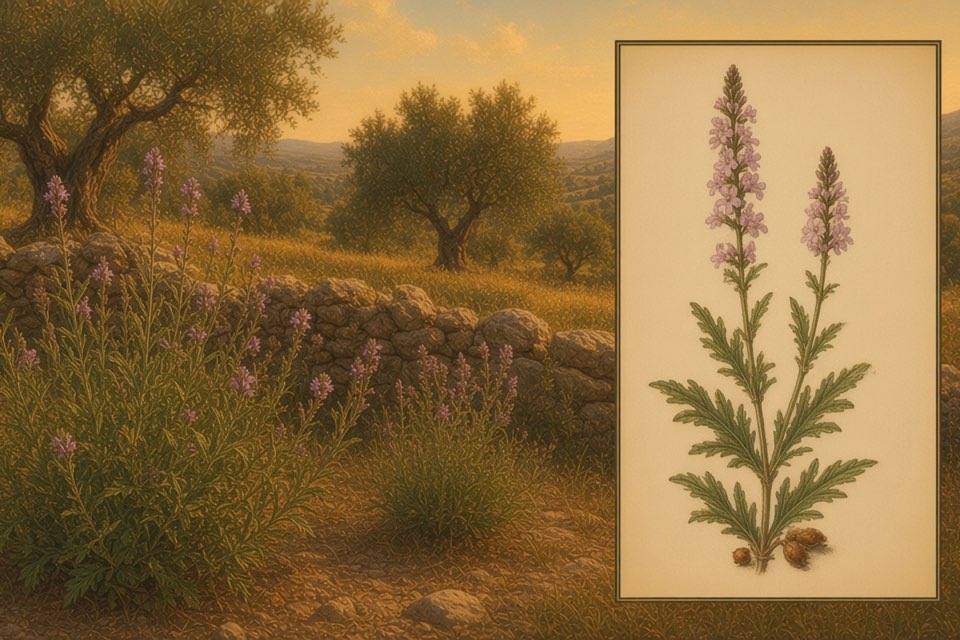
Vervain is a wiry, unscented roadside perennial with an outsized reputation. Verbena officinalis, also called common vervain or simpler’s joy, carries slender spikes of tiny pale lilac flowers above deeply cut leaves, and Kew’s Plants of the World Online gives it a native range stretching from the Old World to Australia. The Roman naturalist Pliny the Elder wrote that no plant enjoyed more renown among the Romans: envoys carried it, the table of Jupiter was cleansed with it, and people in Gaul used it for soothsaying. Later centuries called it herb of grace and tied it to a legend of Calvary. Today the dried flowering herb has a European Pharmacopoeia standard, is listed in the Chinese Pharmacopoeia as ma bian cao, and is one of five herbs in Sinupret, a German herbal combination for sinus infections, including its higher-dose extract BNO 1016. Vervain is not lemon verbena (Aloysia citrodora), a lemon-scented South American shrub whose leaves make a popular tea, and it is not American blue vervain (Verbena hastata), a close relative with its own history.
Evidence for vervain on its own is thin. A 2020 review in Planta Medica by Kubica and colleagues found only one published human trial of a vervain extract: in 260 patients with chronic gingivitis, adding a vervain decoction mouth rinse to brushing and flossing improved gum and plaque scores more than brushing and flossing alone over four weeks. The sedative, anti-anxiety, anticonvulsant, anti-inflammatory, and wound-healing effects often quoted for vervain come from laboratory and animal studies. Germany’s Commission E declined to approve vervain in 1990 because its efficacy was not documented, while allowing that it might contribute to combination products for catarrh of the upper airways. The European Medicines Agency (EMA) has no monograph on vervain at all; its “verbena” monograph covers lemon verbena. The best clinical data that involve vervain belong to Sinupret: in two pooled placebo-controlled trials with 589 patients, the five-herb extract eased acute viral sinusitis somewhat faster than placebo, but that result cannot be credited to vervain alone.
Vervain appears to be well tolerated in ordinary use, though it has never been studied carefully for safety. LactMed, the US government database on medicines in breastfeeding, notes that gastrointestinal and allergic reactions have been reported. Pregnancy is the main concern. Traditional Chinese medicine classes ma bian cao as a herb that “activates blood” and uses it for absent or painful periods, German pharmacognosy handbooks list uterus-contracting and abortive effects, and in a 2019 rat study high doses given during pregnancy lowered fetal weight, increased embryo loss, and delayed bone formation. Vervain is best avoided in pregnancy and, for lack of data, while breastfeeding, despite its old reputation for increasing milk. In a laboratory digestion model, vervain tea also reduced the iron available for absorption. Nothing here is medical advice; sinus symptoms that are severe, worsening, or accompanied by high fever or swelling around the eyes, and gums that keep bleeding, deserve a clinician’s assessment.
Ingredient in
Sinupret (BNO 1016)In this monograph
01 The plant
Botanical profile
Verbena officinalis L. belongs to Verbenaceae, the verbena family, and was first published by Linnaeus in Species Plantarum in 1753. Kew’s Plants of the World Online (POWO) accepts the name, describes the species as a perennial of the temperate biome, and gives its native range as “Old World to Australia”: most of Europe, North Africa, much of Asia from Türkiye to China and Japan, parts of eastern and southern Africa, and Australia. POWO records it as introduced in Great Britain and Ireland, much of the United States, parts of Central and South America, and New Zealand. The German Arzneipflanzenlexikon describes the plant as originally Mediterranean and now spread through temperate zones worldwide, reaching north to central Sweden. Kubica and colleagues (Planta Medica 2020) list the Latin synonyms Verbena sororia D. Don and V. spuria L. and common names including common verbena, simpler’s joy, turkey grass, verveine officinale in French, Eisenkraut in German, kumatsuzura in Japanese, and ma bian cao in Chinese. They note that most Verbena species are American, and that V. officinalis and V. supina are the two found on every continent.
Vervain is an upright, rather sparse plant. Kubica and colleagues describe stems 75 cm to 1 m tall, while the Arzneipflanzenlexikon gives 20 to 60 cm, often woody at the base. The stems are four-angled and rough with stiff hairs, branching toward the top. The leaves are opposite: the lower ones stalked and deeply cut into pinnate lobes, the middle ones three-parted, and the upper ones small, unstalked, and toothed. The European Pharmacopoeia description, quoted by the University of Zurich’s veterinary phytotherapy database, notes bristly hairs along the leaf veins and many small flowers in a loose, elongated spike, each in the axil of a leaf-like bract, with a tubular five-toothed calyx and a pale pink or lilac corolla about twice its length. The corolla is faintly two-lipped, and the fruit is a brown schizocarp that splits into four nutlets; flowering runs from July to September (Arzneipflanzenlexikon). Maud Grieve’s A Modern Herbal (1931) adds that the plant has no perfume and tastes slightly bitter and astringent. It is a ruderal species of sunny fields, stony rubble, roadsides, embankments, and walls.
The medicinal part is the flowering herb. The European Pharmacopoeia, which added a Verbena herb monograph in 2008 (Kubica), defines it as the whole or cut dried aerial parts collected during flowering, with at least 1.5% verbenalin, and warns that a lemon smell indicates adulteration with lemon verbena. The Chinese Pharmacopoeia (2025) defines ma bian cao as the dried aerial parts cut in June to August, with at least 0.50% hastatoside plus verbenalin. The Zurich database summarizes the chemistry: iridoid glycosides at 0.2–3%, chiefly verbenalin (also called cornin, C17H24O10), hastatoside (C17H24O11), and dihydrocornin; about 0.8% caffeoyl phenylethanoid glycosides, mainly verbascoside (also called acteoside), isoverbascoside, and martynoside; and flavonoid glycosides of luteolin, apigenin, and acacetin. There are only traces of essential oil, whose composition varies widely with origin; Italian plants were rich in citral and isobornyl formate (Kubica). Hastatoside was first described in 1979 from both V. officinalis and American blue vervain, V. hastata. Commercial vervain comes from wild collection in southeastern Europe (Arzneipflanzenlexikon).
02 Lineage
History
Vervain was a sacred plant in Rome. In his Natural History, Pliny the Elder wrote that no plant enjoyed a more extended renown among the Romans than hierabotane, the “holy plant,” also called peristereon and, more generally, verbenaca. In John Bostock and H. T. Riley’s 1855 translation, he describes it being borne by envoys treating with the enemy, used to cleanse the table of Jupiter, and used to purify houses; the translators identified one of his two varieties as Verbena officinalis. Pliny reported that people in the Gallic provinces used it for soothsaying, and he mocked the magicians who claimed that rubbing oneself with it won one’s desires, kept away fevers, and made friends, and who insisted it be gathered at the rising of the Dog Star, unseen by sun or moon, after a circle was traced around it with iron. More practically, he noted that it was bruised in wine for snakebites. The Arzneipflanzenlexikon explains that the Romans used the word verbena for branches carried in religious ceremonies, and that Romans and Gauls believed the plant protected against wounds from iron weapons, a belief echoed in its German name, Eisenkraut, “iron herb.”
Medieval and folk traditions built on that reputation. In her Physica, the medieval abbess Hildegard of Bingen described ysena as more cold than warm and used it externally: boiled in water and laid warm over a linen cloth on festering wounds and ulcers, renewed until the putrefaction cleared, and warmed and bound over a swollen throat until the swelling went down. Grieve (1931) recorded the names herb of grace, herbe sacrée, and herba veneris, and a derivation of vervain from the Celtic ferfaen, “to drive away a stone,” for its use in bladder complaints. She wrote that the druids included it in their lustral water, that ambassadors used it in making leagues, and that it was worn around the neck against headaches and snakebites, all of which she linked to the legend that it was found on Mount Calvary and staunched the wounds of the crucified Christ, so that it was crossed and blessed with a verse when gathered. Grieve said it had been recommended in upwards of thirty complaints, including intermittent fevers, ulcers, eye inflammation, and pleurisy, as a poultice for headache and rheumatism, and as a promoter of breast milk. Her druid claims are not referenced, and Pliny spoke only of Gaul.
Later history split between continents and systems. King’s American Dispensatory (1898) used the name vervain for the root of the native American Verbena hastata, a tonic, emetic, and expectorant, and described the European V. officinalis as having similar but weaker properties. Kubica and colleagues note vervain monographs in older British and German pharmacopoeias, the Chinese Pharmacopoeia since 1995, the Pharmacopoeia of the American Institute of Homeopathy in 1897, and the European Pharmacopoeia since 2008. Germany’s Commission E published a negative monograph on 1 February 1990, and the Zurich database recorded no ESCOP, WHO, or EMA monograph as of 2019; EMA’s current list of assessed herbal substances includes lemon verbena leaf but not vervain. Vervain is also one of Edward Bach’s flower remedies, which the Bach Centre describes for perfectionists with fixed principles who find it hard to switch off. US food regulations list “Vervain, European” as a natural flavoring permitted in alcoholic beverages only.
03 Chemistry
Active compounds and how it works
Vervain’s reputation as a calming herb has been tested only in animals. Makino and colleagues (Sleep and Biological Rhythms 2009), as summarized by Kubica, gave rats a water extract of vervain through a stomach tube and found that non-rapid eye movement (NREM) sleep increased by 25.7% over the following 12 hours. Hastatoside and verbenalin given alone, at high doses, at first shortened NREM sleep and then lengthened it in the early morning hours, while verbascoside had no effect, and the rats showed agitation and diarrhea for up to two hours. In mice, Khan and colleagues (Frontiers in Pharmacology 2016) found that a crude extract at 50–300 mg/kg increased time spent in the open arms of an elevated maze and in the lit side of a light-dark box, behavior read as reduced anxiety, and shortened the onset and lengthened the duration of sleep induced by the barbiturate thiopental; at 100–500 mg/kg it delayed drug-induced seizures. Rashidian and colleagues (2017) found that the anticonvulsant effect was reversed by flumazenil and naloxone, pointing to benzodiazepine and opioid receptors (Kubica). These doses dwarf a cup of tea, and no human trial has tested them.
Anti-inflammatory effects are also an animal and laboratory story. Speroni and colleagues (Planta Medica 2007) gave rats three different vervain extracts by mouth and found that all reduced paw swelling caused by carrageenan, protected the stomach lining from alcohol damage, and, applied as gels, sped the healing of small skin wounds; a supercritical carbon dioxide extract was the most active for swelling and wounds. Calvo (Journal of Ethnopharmacology 2006) found that creams containing 1–3% of a vervain extract reduced paw swelling in rats, with the 3% cream similar to piroxicam gel three hours after the injury, and had a pain-relieving effect weaker than methyl salicylate ointment. Kubica and colleagues summarize laboratory studies in which vervain extracts inhibited a range of bacteria, including methicillin-resistant Staphylococcus aureus, and in which a fraction rich in verbascoside showed the strongest antioxidant activity. These findings make a mouth rinse for inflamed gums plausible, but the gingivitis trial did not measure how the decoction worked, and Commission E considered vervain’s effect on mucus, which it described as secretolytic, the most plausible contribution it could make to combination products.
Some laboratory findings bear on safety rather than benefit. The Zurich database cites German handbooks that list uterus-contracting, abortive, emmenagogue (period-inducing), and antithyrotropic effects for vervain, without human data, and Kubica and colleagues note that vervain has been investigated in China as a possible herb to end early pregnancy, in a laboratory study of cells from the pregnant uterine lining. In Fateh and colleagues’ 2019 prenatal study in rats, described under contraindications, high doses harmed fetal development. A water extract was mutagenic in two strains of the Ames bacterial test, with or without metabolic activation, but did not increase chromosome damage in the bone marrow of rats given up to 2,000 mg/kg for three days (Fateh and colleagues, Journal of Ethnopharmacology 2019). Finally, the polyphenols that dominate vervain’s chemistry bind iron: in a laboratory model of digestion, Zaida and colleagues (Annals of Nutrition and Metabolism 2006) found that vervain tea reduced the availability of iron, an effect that added vitamin C counteracted.
04 In practice
Common uses
Gingivitis is the only use tested in a human trial of vervain alone. Grawish and colleagues (Quintessence International 2016) randomized 260 patients with chronic generalized gingivitis into two groups of 130. Both groups were told to brush and floss, and the test group also rinsed with a vervain decoction; Kubica and colleagues describe the regimen as 10 ml twice a day, 30 minutes after brushing, across five dental centers. Gum inflammation, measured by the Gingival Index, and plaque, measured by the Plaque Index, improved in both groups by day 14 and day 28, but significantly more in the vervain group at both points (P < .001), and no adverse effects were reported. The trial is labeled double-blind, yet the abstract describes no placebo rinse for the control group, so the extra rinsing itself may have contributed. It is a single trial of a home-style decoction, it has not been independently repeated, and it lasted four weeks. Vervain has a traditional reputation for mouth and throat inflammation, but no trials in sore throat or in oral mucositis, the mouth sores caused by cancer treatment, were found in the research for this monograph.
Sinusitis is where vervain has its largest audience, as one-fifth of a combination. BNO 1016, a higher-dose member of the Sinupret family of products, is a dry extract of gentian root, primula (cowslip) flower, sorrel herb, elder flower, and verbena herb in the ratio 1:3:3:3:3. Jund and colleagues (Acta Oto-Laryngologica 2015) pooled two similar placebo-controlled trials in acute viral rhinosinusitis, known as ARhiSi-1 and ARhiSi-2, with 589 patients taking 160 mg three times daily or placebo for 15 days. Both groups started at about 10 points on an investigator-rated major symptom score, and at the end of treatment the score was 1.16 points lower with BNO 1016 (2.47 versus 3.63; p < 0.0001), and patient-rated quality of life was also better (p = 0.0015). The original Sinupret tablets and drops (BNO 101) have the same five ingredients at a lower dose. The Arzneipflanzenlexikon notes that the combination is licensed in Germany for acute sinus inflammation in adolescents from 12 and adults. These results belong to the product: there is no trial of vervain alone for sinusitis, and Commission E judged vervain’s efficacy in respiratory disease undocumented.
Sleep, stress, and low mood are the uses most often claimed for vervain today. Kubica and colleagues list depression, insomnia, stress, anxiety, nervous exhaustion, and headache among its traditional uses, and the animal studies described above are consistent with a mild sedative effect. But no human trial of vervain alone for sleep or anxiety was found, and no regulator recognizes such a use. Some of the confusion comes from lemon verbena, a different plant that EMA does accept as a traditional herbal medicine for mild symptoms of mental stress and to aid sleep. Vervain also appears in multi-herb products: in a 1993 trial by Weizman and colleagues (Journal of Pediatrics), a tea of chamomile, vervain, licorice, fennel, and balm mint eliminated colic in 19 of 33 infants, against 9 of 35 given a placebo drink, but the trial cannot show what vervain added. The Bach flower remedy called Vervain is a separate tradition; a systematic review by Thaler and colleagues (BMC Complementary and Alternative Medicine 2009) found no benefit of Bach flower remedies over placebo in four randomized trials for examination anxiety and ADHD.
Other traditional uses are long-standing but unproven. Kubica and colleagues record vervain in European, North American, and Chinese folk medicine for colds, fever, cough and bronchitis, urinary stones and infections, menstrual disorders, stimulating milk flow, colic, jaundice, diarrhea, and intestinal worms, and externally for slow-healing wounds, bites, and gum inflammation. The Chinese Pharmacopoeia uses traditional Chinese medicine terms, describing ma bian cao as bitter and cool, acting to activate blood and dispel stasis, clear toxins, promote urination, reduce jaundice, and check malaria, and lists it for abdominal masses, painful or absent periods, sore throat, abscesses, edema, jaundice, and malaria. LactMed calls vervain a purported galactagogue, or milk booster, with no scientifically valid clinical trials to support the use. Laboratory work on nerve cells and cancer cell lines has attracted attention, but Kubica and colleagues caution that such studies are still a long way from use in human treatment, and conclude that folk uses such as diuretic, fever-reducing, expectorant, and digestive effects still demand scientific confirmation.
05 The apothecary
Preparations and traditional use
Because no European monograph exists, there is no officially assessed dose of vervain on its own. The Arzneipflanzenlexikon lists the forms sold in Germany: cut herb for tea, powdered herb and dry extracts in tablets, and water-alcohol extracts in syrups and drops. Its tea method is to pour about 150 ml of boiling water over 1.5 g of the herb, strain after 10 minutes, and drink a cup three times a day, though the same source advises against using vervain alone because its efficacy and side effects are not adequately documented. The Chinese Pharmacopoeia gives 5–10 g of the cut herb as a decoction. Old Western doses are historical curiosities rather than guidance: Grieve gave half to one drachm of fluid extract, or 2 ounces of herb boiled in a quart of water and drunk over a day for diarrhea. In the gingivitis trial, patients rinsed with 10 ml of decoction twice a day after brushing (Kubica), but the published abstract does not state how strong the decoction was, so there is no validated home recipe.
Sinupret products are a different matter, with fixed doses tested in trials. In the pooled BNO 1016 trials, patients took 160 mg of the five-herb dry extract three times a day for 15 days. Formulations and brand names differ between countries, so anyone looking for the tested product should check that the label names BNO 1016 or lists gentian root, primula flower, sorrel herb, elder flower, and verbena herb. Vervain also turns up in many multi-herb teas and calming blends, usually without a stated dose. The Bach flower remedy Vervain is made and used within Edward Bach’s own system, which the Bach Centre describes in emotional terms, and it is not a substitute for, or a dose of, vervain tea. In the United States, the federal food regulations permit European vervain as a natural flavoring only in alcoholic beverages, and Kubica and colleagues note that vervain oil and extracts are also used in cosmetics and perfumes.
Buying vervain means checking the botanical name. “Verbena” on a label may mean lemon verbena, Aloysia citrodora, which EMA lists as verveine odorante in French and verbena odorosa in Italian, and whose leaves are widely used for tea; the European Pharmacopoeia treats a lemon smell in vervain as a sign of this mix-up, and the Zurich database notes that confusion between the two is possible. Blue vervain, Verbena hastata, is a North American species with its own herbal history. Look for Verbena officinalis, herb or aerial parts, ideally of pharmacopoeial quality. Keep use short, avoid it entirely in pregnancy, take vervain tea between rather than with iron-rich meals or iron supplements, and do not give it to babies or young children without a pediatrician’s advice. A sinus infection that is getting worse, or gums that bleed persistently, needs a clinician or dentist rather than a stronger tea.
Safety
Before you use vervain
06 Caution
Side effects
Reported side effects of vervain are few, but so are careful studies. Commission E, in rejecting vervain, judged that no risks were to be expected from it, according to the Arzneipflanzenlexikon, which lists rare digestive complaints, noted with the combination product. LactMed states that vervain is well tolerated but that gastrointestinal and allergic reactions have been reported. In the gingivitis trial of 260 patients, no adverse effects were reported over four weeks of twice-daily rinsing. The Chinese Pharmacopoeia, as transcribed by Antpedia, advises caution in people whom traditional Chinese medicine describes as having a “cold, deficient” spleen and stomach. In rats given high doses of its iridoids, Makino and colleagues observed agitation and diarrhea for up to two hours. Long-term human use has never been studied.
The best human safety data come from Sinupret, where vervain is one of five herbs. Jund and colleagues reported safety separately for each of the two trials, which included 450 and 385 patients; the first tested two daily doses of BNO 1016, 240 mg and 480 mg, and the second tested 480 mg. In the ARhiSi-1 trial, adverse events occurred in 26 of 300 patients (8.7%) taking BNO 1016 and 7 of 150 (4.7%) on placebo; in ARhiSi-2, in 19 of 194 (9.8%) on BNO 1016 and 27 of 191 (14.1%) on placebo. Most were mild to moderate, and no serious adverse events were reported in either trial (Jund and colleagues 2015). These figures describe the whole extract, not vervain, and the other ingredients, gentian, primula, sorrel, and elder flower, each have their own profiles.
Animal and laboratory safety tests give a mixed picture. Single doses of 3 and 5 g/kg of extract caused no deaths in rodents, only reduced activity (Khan and colleagues, as summarized by Kubica), and Rashidian and colleagues saw no deaths or visible adverse effects at 2 g/kg. On the other hand, a water extract of the leaves was mutagenic in the Ames bacterial test, though it did not damage chromosomes in rat bone marrow (Fateh and colleagues 2019), and high doses during pregnancy harmed fetal development in rats. Vervain’s polyphenols reduced iron availability in a laboratory digestion model, and Kubica and colleagues cite the herbalists Mills and Bone, who list vervain among herbs whose phenylpropanoids may interfere with absorption of non-heme iron, the form found in plant foods. For most adults drinking an occasional cup, these signals are reassuring on acute toxicity but are a reason not to take vervain in large amounts or for long periods.
07 Caution
Contraindications
Pregnancy: avoid vervain. Fateh and colleagues (Chemico-Biological Interactions 2019) tested a vervain extract in 50 pregnant rats under an OECD guideline, giving 500 to 3,000 mg/kg daily from day 6 to day 20 of pregnancy. At 2,000 and 3,000 mg/kg, mothers gained less weight, fetuses weighed less, losses before and after implantation were more frequent, and some fetuses showed incomplete bone formation in the skull, breastbone, and foot; the authors concluded that vervain is not safe in pregnancy. These are very high animal doses, but they fit other signals: the German handbooks cited by the Zurich database list uterus-contracting and abortive effects, traditional Chinese medicine uses ma bian cao to activate blood for absent periods, the 2025 Chinese Pharmacopoeia as transcribed by Antpedia advises caution in pregnancy, and the Arzneipflanzenlexikon advises against use. People trying to conceive may also prefer to avoid it.
Breastfeeding, babies, and children: vervain has a long reputation for increasing breast milk, and Grieve’s herbal of 1931 already called it a good galactogogue, but LactMed found no scientifically valid trials, no data on whether its components pass into milk, and no data on safety for nursing mothers or infants, and it warns that milk-boosting herbs should never replace evaluation of the factors that affect milk supply. The Arzneipflanzenlexikon advises against use while breastfeeding. A 1993 colic trial used a multi-herb tea containing vervain, but that does not establish that vervain alone is safe for infants, and no safety data exist for children. The Sinupret combination is licensed in Germany for adolescents from 12 and adults.
Allergy, low iron, and when not to self-treat: anyone who has reacted to vervain should not use it again, and LactMed notes that allergic reactions have been reported. EMA contraindicates lemon verbena in people hypersensitive to plants of the Verbenaceae family, to which vervain also belongs; no equivalent official statement exists for vervain, but the same caution is sensible. People with iron-deficiency anemia, and vegetarians and vegans who rely on plant iron, may want to avoid drinking vervain with meals, as Kubica and colleagues suggest. Vervain is not a treatment for anxiety disorders, depression, or chronic insomnia, which need proper care, and persistent bleeding gums, loose teeth, or gum pain need a dentist. Sinus symptoms that are severe, keep worsening, or come with high fever, swelling or redness around the eyes, or confusion need prompt medical attention.
08 Caution
Drug and herb interactions
No interactions between vervain and medicines have been documented in people, and the Arzneipflanzenlexikon lists none known. That reflects a lack of study rather than proof of safety. The theoretical concern most relevant to everyday use is sedation: in mice, vervain extract lengthened sleep induced by thiopental, and its anticonvulsant effect appeared to involve the benzodiazepine binding site (Khan and colleagues; Rashidian and colleagues, cited by Kubica). People taking benzodiazepines, sleeping pills, opioids, sedating antihistamines, or other calming herbs such as valerian or passionflower, or drinking alcohol, should be cautious about adding concentrated vervain extracts, and should not drive if they feel drowsy. If a “verbena” tea turns out to be lemon verbena, EMA notes that it may impair the ability to drive and use machines, though it reports no drug interactions for that plant either.
Iron and other minerals: Zaida and colleagues found that vervain infusion reduced iron availability in a laboratory model of digestion, while adding vitamin C counteracted the effect, and Kubica and colleagues cite Mills and Bone’s warning about non-heme iron absorption. Anyone taking iron supplements, or being treated for anemia, can take vervain tea apart from iron doses and iron-rich meals, or alongside a source of vitamin C. The Zurich database, citing a veterinary herbal reference, lists possible interactions with anticoagulants and with iron; the anticoagulant warning is not explained or backed by case reports, but people taking warfarin or similar drugs may wish to mention regular vervain use to their prescriber.
Combination products and hormones: Sinupret contains gentian, primula, sorrel, and elder flower as well as vervain, and Chinese formulas often combine ma bian cao with other herbs, so a pharmacist should check every ingredient against your medicines. Because German handbooks list antithyrotropic effects for vervain, without human confirmation, people taking thyroid medicines may want to mention regular use to their doctor. Its traditional uterine effects are another reason to avoid combining it with fertility treatment without advice. Tinctures, drops, and syrups may contain alcohol, which matters for people avoiding alcohol or taking medicines that should not be combined with it. Tell your surgeon, dentist, and pharmacist about any herbal products you use.
09 Questions
Frequently Asked Questions
No. Vervain is Verbena officinalis, an unscented, slightly bitter wild perennial. Lemon verbena is Aloysia citrodora, a lemon-scented shrub from South America whose European names, such as verveine odorante in French and verbena odorosa in Italian, overlap with vervain’s. EMA accepts lemon verbena leaf tea as a traditional remedy for mild stress, sleep, and bloating, but has no monograph on vervain. The European Pharmacopoeia treats a lemon smell in vervain as a sign of a mix-up. If you want a lemon-scented calming tea with European traditional-use status, lemon balm is another option.
They are close relatives in the same genus but different species. Blue vervain, Verbena hastata, is native to North America; King’s American Dispensatory (1898) used its root as a tonic, emetic, and expectorant and described European vervain, Verbena officinalis, as similar but weaker. Both contain the iridoid hastatoside, which was first described from the two species together. The European Pharmacopoeia, the Chinese Pharmacopoeia, and Sinupret all use Verbena officinalis, so check the Latin name on any product.
It has not been tested in people. In rats, a vervain extract increased deep (NREM) sleep, and in mice it lengthened drug-induced sleep and reduced anxiety-like behavior, but those doses were far higher than a cup of tea, and no regulator recognizes vervain as a sleep aid. Herbs with more human evidence or European traditional-use status include valerian, passionflower, and lemon balm. Insomnia lasting more than a few weeks deserves a medical review.
Vervain, as verbena herb, makes up three of the thirteen parts of the Sinupret extracts, including the higher-dose BNO 1016, alongside gentian root, cowslip (primula) flower, sorrel herb, and elder flower. In two pooled placebo-controlled trials with 589 patients with acute viral sinusitis, the extract improved symptom scores and quality of life somewhat more than placebo over 15 days. Germany’s Commission E suggested vervain’s effect on mucus might contribute to such combinations, but no trial has tested vervain alone for sinusitis, so the benefit belongs to the product.
Possibly, but the evidence is one trial. In 260 patients with chronic gingivitis, rinsing with a vervain decoction twice a day on top of brushing and flossing improved gum and plaque scores more than brushing and flossing alone over four weeks, with no side effects reported; the control group had no placebo rinse. For mouth sores from cancer treatment, a 2020 review found good evidence for chamomile, sage, calendula, and thyme, not vervain. Bleeding gums that persist need a dentist.
It is best avoided in pregnancy. In a 2019 study in pregnant rats, high doses lowered fetal weight, increased embryo loss, and delayed bone formation, German handbooks list uterus-contracting and abortive effects, and the Chinese Pharmacopoeia advises caution. Vervain has a long reputation for increasing breast milk, but LactMed found no valid trials and no data on its passage into milk or on infant safety, so it is not recommended while breastfeeding either. A lactation specialist can help with concerns about milk supply.
Vervain is one of Edward Bach’s flower remedies, which the Bach Centre recommends for enthusiastic perfectionists with fixed principles who find it hard to switch off and relax. It belongs to Bach’s own system and is not a dose of vervain tea or extract. A systematic review of Bach flower remedies found four randomized trials, for examination anxiety and ADHD, and no benefit over placebo. The reviewers judged Bach remedies probably safe, but anxiety that disrupts daily life needs proper assessment and care.
Pliny the Elder called it hierabotane, the “holy plant,” and wrote that Roman envoys carried it, Jupiter’s table was cleansed with it, and houses were purified with it, while people in Gaul used it for soothsaying. The name verbena itself referred to sacred branches carried in Roman ceremonies. Christian legend held that vervain grew on Calvary and staunched the wounds of Christ, so it was blessed when gathered, and the herbalist Maud Grieve recorded its old name, herb of grace. These stories explain its fame; they are not evidence that it heals.
10 References
Sources
These references support the history, clinical, and safety claims on this page. They are not an endorsement of any product.
-
Verbena officinalis (Common Vervain) – A Review on the Investigations of This Medicinally Important Plant Species
Planta Medica (PubMed 32937665), 2020
Kubica et al.: synonyms and common names; botany; iridoids, phenylpropanoid glycosides, and essential oil; European Pharmacopoeia since 2008 and Chinese Pharmacopoeia since 1995; traditional uses; animal and laboratory pharmacology; only one human trial (gingivitis); safety, pregnancy, and iron notes.
-
Verbena officinalis L.
Plants of the World Online, Royal Botanic Gardens, Kew, 2026
Accepted name, first published in Species Plantarum (1753); perennial of the temperate biome; native range Old World to Australia; introduced in Great Britain, Ireland, the United States, and elsewhere.
-
Phytoarznei / Arzneidroge: Verbenae herba
CliniPharm/CliniTox, Institute of Veterinary Pharmacology and Toxicology, University of Zurich, 2020
European Pharmacopoeia 10 definition (at least 1.5% verbenalin; lemon smell indicates Aloysia citriodora); iridoid and phenylethanoid glycoside content; handbook-listed uterine and antithyrotropic effects; Commission E monograph of 1 February 1990; no ESCOP, WHO, or HMPC monograph as of 2019.
-
Eisenkraut – Gewöhnliches Eisenkraut – Verbena officinalis L.
Arzneipflanzenlexikon, Kooperation Phytopharmaka, 2026
Botany and Roman lore; Commission E negative (null) monograph with a possible secretolytic contribution to combinations; licensed five-herb sinus combination; tea preparation; not recommended alone or in pregnancy and breastfeeding; rare digestive complaints.
-
European Union herbal monograph on Aloysia citrodora Paláu (syn. Aloysia triphylla (L’Hér.) Kuntze; Verbena triphylla L’Hér.; Lippia citriodora Kunth), folium
European Medicines Agency (EMA/HMPC/376770/2019), 2021
Lemon verbena, a different plant: traditional use for mild stress, sleep, and mild digestive complaints; contraindicated with hypersensitivity to Verbenaceae plants; national names such as verveine odorante.
-
Verbenae Herba (Mabiancao), Pharmacopoeia of the People’s Republic of China 2025, Volume I
Chinese Pharmacopoeia Commission, via Antpedia transcription, 2025
Dried aerial parts harvested June to August; at least 0.50% hastatoside plus verbenalin; traditional actions and indications; 5–10 g as a decoction; caution in pregnancy.
-
Herbal drug BNO 1016 is safe and effective in the treatment of acute viral rhinosinusitis
Acta Oto-Laryngologica (PubMed 25496178), 2015
Jund et al.: gentian, primula, sorrel, elder, and verbena in a 1:3:3:3:3 dry extract; pooled ARhiSi-1 and ARhiSi-2 trials, 589 patients, 160 mg three times daily for 15 days; symptom score difference 1.16 points; adverse event rates by trial.
-
Short-term effects of Verbena officinalis Linn decoction on patients suffering from chronic generalized gingivitis: Double-blind randomized controlled multicenter clinical trial
Quintessence International (PubMed 26824082), 2016
Grawish et al.: 260 patients; vervain decoction rinse plus brushing and flossing versus brushing and flossing; better Gingival and Plaque Index scores at 14 and 28 days; no adverse effects reported.
-
Prenatal developmental toxicity evaluation of Verbena officinalis during gestation period in female Sprague-Dawley rats
Chemico-Biological Interactions (PubMed 30807743), 2019
Fateh et al.: 50 pregnant rats given 500–3,000 mg/kg on days 6–20; reduced maternal weight gain, lower fetal weight, more implantation losses, and incomplete ossification at 2,000 and 3,000 mg/kg.
-
Vervain
Drugs and Lactation Database (LactMed), National Institute of Child Health and Human Development (PubMed 30000912), 2006
Purported galactagogue without valid clinical trials; no data on excretion into milk or infant safety; well tolerated, but gastrointestinal and allergic reactions reported.
-
Iron availability and consumption of tea, vervain and mint during weaning in Morocco
Annals of Nutrition and Metabolism (PubMed 16508250), 2006
Zaida et al.: in an in vitro digestion model, tea and vervain infusions reduced iron availability and vitamin C counteracted the effect.
-
The Natural History, Book XXV, Chapter 59: Hierabotane, peristereon, or verbenaca
Pliny the Elder, translated by John Bostock and H. T. Riley, via Perseus Digital Library, 1855
Holy plant of the Romans: carried by envoys, used to cleanse the table of Jupiter and purify houses; Gallic soothsaying; magicians’ gathering rituals; bruised in wine for snakebites.
-
Bach Flower Remedies for psychological problems and pain: a systematic review
BMC Complementary and Alternative Medicine (PubMed 19470153), 2009
Thaler et al.: four randomized trials, three in examination anxiety and one in ADHD, showed no benefit over placebo; remedies judged probably safe; evidence low or very low quality.
-
Vervain (A Modern Herbal)
Maud Grieve, A Modern Herbal, via Botanical.com, 1931
Herb of grace, herbe sacrée, and herba veneris; ferfaen etymology; druid, ambassador, and Calvary legends; no perfume, bitter and astringent; folk uses and historical doses; blue vervain as a separate species.
-
21 CFR 172.510: Natural flavoring substances and natural substances used in conjunction with flavors
Electronic Code of Federal Regulations, U.S. Food and Drug Administration, 2026
Lists Vervain, European (Verbena officinalis) as a natural flavoring limited to alcoholic beverages; lemon verbena is listed separately as Lippia citriodora.
-
Vervain
The Bach Centre, 2026
Describes the Bach flower remedy Vervain for perfectionists with fixed principles who find it hard to relax, quoting Bach’s The Twelve Healers and Other Remedies.