
Monograph
Bitter Candytuft
Iberis amara
Updated October 10, 2026
Key points
-
01
Known through Iberogast
Bitter candytuft is the lead ingredient of STW 5 (Iberogast Classic, nine herbs) and STW 5-II (Iberogast Advance, six herbs). It is not assessed by EMA on its own.
-
02
The combination has trials
Three pooled placebo trials (273 people) favored STW 5 for functional dyspepsia, but Cochrane rated the overall evidence very low certainty because results varied widely.
-
03
Alone, it did not beat placebo
In a 208-patient IBS trial, both Iberogast formulas beat placebo after four weeks, but a bitter candytuft single-herb extract did not.
-
04
Liver warning is for Classic
Iberogast Classic contains greater celandine and carries liver warnings, with liver failure reported. Advance has no celandine and lists only allergic reactions.
-
05
Not a homemade remedy
The plant contains toxic, bitter cucurbitacins and has no tested single-herb dose. The drops also contain 240 mg of alcohol per 20-drop dose.
Bitter candytuft (Iberis amara) is a small, white-flowered annual of the mustard family that grows on bare chalk slopes and in arable fields of western Europe. Its leaves are intensely bitter, which is what amara means, and gardeners know its relatives as candytufts. Almost everything known about it medicinally comes from a single product. An extract of the fresh whole flowering plant, roots included, is the first-listed ingredient of STW 5, sold by Bayer as Iberogast, a German liquid for functional dyspepsia (recurring indigestion without a visible cause) and irritable bowel syndrome (IBS). Iberogast Classic combines bitter candytuft with eight other herbs: angelica root, chamomile flower, caraway fruit, milk thistle fruit, lemon balm leaf, peppermint leaf, licorice root, and greater celandine. Iberogast Advance, known in research as STW 5-II, keeps bitter candytuft, chamomile, caraway, lemon balm, peppermint, and licorice and drops the other three, including celandine. In both, bitter candytuft extract makes up 15 ml of every 100 ml, according to Bayer’s mandatory product text. The European Medicines Agency (EMA) has never assessed the herb on its own.
The combination has genuine trial evidence; the herb alone has very little. Melzer and colleagues (Alimentary Pharmacology and Therapeutics 2004) pooled three placebo-controlled trials of STW 5 in functional dyspepsia: 138 people on the drops did better than 135 on placebo on their most bothersome symptom (odds ratio 0.22), with similar rates of side effects. A 2023 Cochrane review counted five placebo-controlled trials with 814 participants and concluded that STW 5 may moderately improve dyspepsia, but rated the certainty very low because results varied so much between trials. Germany’s 2026 neurogastroenterology guideline nonetheless counts STW 5 and STW 5-II among first-line treatments for functional dyspepsia. Bitter candytuft by itself has been tested once in people: in a four-arm IBS trial of 208 patients, Madisch and colleagues (2004) found that both Iberogast formulas beat placebo after four weeks, but a bitter candytuft single-herb extract did not. A smaller 2001 trial hinted that leaving bitter candytuft out of the formula slowed the response. The results on this page belong to the products, not to the plant.
Safety depends mostly on which product is meant. In 2018 Germany’s Federal Institute for Drugs and Medical Devices (BfArM) pressed Bayer to add liver warnings to Iberogast after reports of liver injury, including a case of liver failure with transplantation that ended in death; it acted under its procedure for medicines containing greater celandine, and the Classic label now rules the product out in liver disease, pregnancy, and breastfeeding. In 2021 EMA’s safety committee judged a causal link between the nine-herb product and liver injury at least a reasonable possibility. Iberogast Advance contains no celandine, and its label lists only allergic reactions. Both contain 240 mg of alcohol in each 20-drop dose. There are no safety data for the raw plant, whose cucurbitacins are toxic, so it is not a candidate for homemade teas or tinctures. Nothing here is medical advice; indigestion that is no better after a week, as both leaflets advise, or that comes with vomiting blood, black stools, trouble swallowing, unintended weight loss, or yellowing of the skin or eyes needs a doctor.
Ingredient in
Iberogast (STW 5)In this monograph
01 The plant
Botanical profile
Iberis amara L. was named by Linnaeus in Species Plantarum in 1753 and is the accepted name in Kew’s Plants of the World Online (POWO), which places it in Brassicaceae, the mustard and cabbage family, and gives its native range as western Europe to north-western Italy: Belgium, France, Germany, Great Britain, Italy, Spain, and Switzerland. The World Flora Online, drawing on the same Kew checklist, lists it as introduced in parts of eastern Europe, Asia, North and South America, and New Zealand, and Flora Mesoamericana describes it as cultivated and occasionally naturalized worldwide. Gerhard Madaus’s German textbook of 1938 gives the older synonyms Thlaspi amarum Crantz, Biauricula amara Bubani, and Crucifera iberis Krause. English names include wild candytuft, the name used by the Botanical Society of Britain and Ireland (BSBI), annual or rocket candytuft, clown’s mustard, and sciatica cress, while German has Bittere Schleifenblume and Bauernsenf, farmer’s mustard. The German herbal-medicine association Kooperation Phytopharmaka explains that Schleifenblume, bow flower, refers to the unequal petals, two small ones side by side and two large ones opposite, which suggest a ribbon bow. The garden annual I. umbellata and the evergreen perennial I. sempervirens are separate species, and BSBI notes that I. umbellata leaves lack the bitter taste.
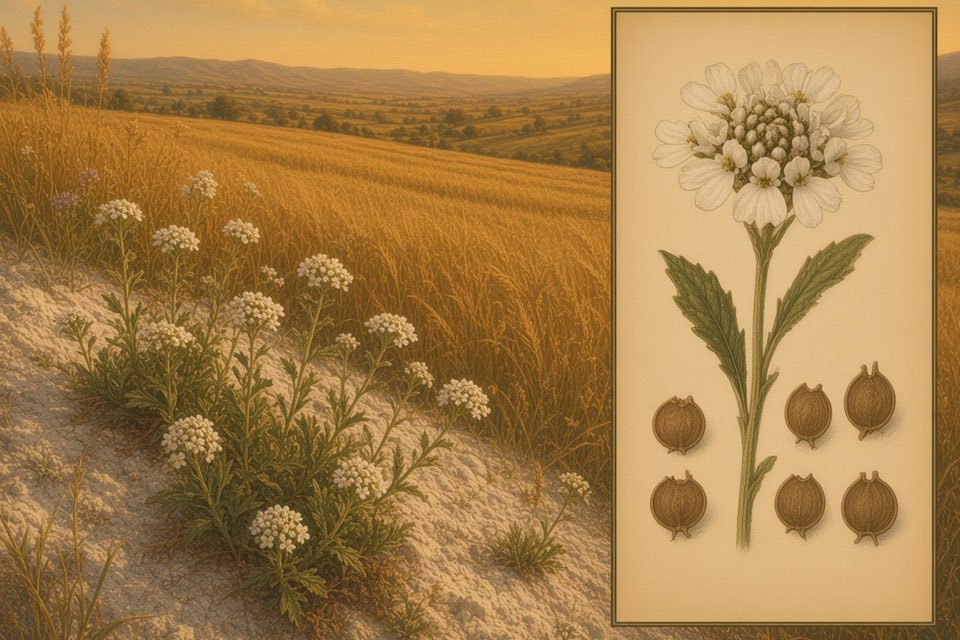
It is an upright annual, rarely biennial, up to about 40 cm tall. BSBI’s species account by Peter Stroh describes more or less hairless leaves that widen toward a blunt tip, up to 6 cm long with two to four tooth-like lobes on each side, and very bitter to taste. The stems branch above into a crowded, flat-topped cluster of flowers that lengthens as the fruits form. The outer flowers of each cluster are much larger than the inner ones, and each flower is lopsided, with two large outer petals, white or sometimes lilac, and two much smaller inner ones. Busch and colleagues (BMC Plant Biology 2014) note that most of the mustard family has symmetrical flowers and only six genera have this one-sided form, and they linked the small inner petals of I. amara to stronger activity of a gene called IaTCP1. The fruits are flat, nearly circular pods 4–6 mm across, narrowly winged, notched at the tip, and topped by a persistent style. BSBI reports that the plant is largely self-incompatible and relies on insects for cross-pollination, flowers from May to as late as November depending on when the seed germinated, ripens its fruit about six weeks after pollination, and then dies.
In Britain, BSBI describes wild candytuft as an early colonist of bare chalk kept open by rabbits, grazing, frost, or ploughing, on warm south-facing banks, tracks, old chalk pits, and arable field edges, with a native range centered on the chalk of southern central England. It is listed as Vulnerable on the Great Britain Red List and has declined substantially since 1970, as myxomatosis cut rabbit numbers and downland was ploughed or became overgrown. Its bitterness is a defense: BSBI notes that rabbits find it unpalatable, and Huang and colleagues (Journal of Chemical Ecology 1993) found that its cucurbitacin glucosides deter the small white butterfly (Pieris rapae) from laying eggs on it. Madaus recorded it in fields and vineyards of south-western and western Germany, favoring limestone and dolomite. The medicinal raw material differs from older traditions, which used the seeds. For STW 5, the fresh or frozen whole plant, above-ground and underground parts together, is harvested between the start of flowering and full bloom; the Kooperation Phytopharmaka says the commercial supply comes from cultivated plants and that quality standards for the fresh plant (Iberis amara recens) are set in the German Drug Codex (DAC). Reichling and Saller (2002) specify the whole, blooming fresh plant with clear seed formation.
02 Lineage
History
Bitter candytuft’s early history is tangled with that of cress. Madaus’s Lehrbuch der Biologischen Heilmittel (1938) relates that Galen explained the name iberis by a physician who cured a friend with the plant in Iberia, and that Pliny reported a book by Servilius Damocrates praising iberis after it healed a fellow physician’s lung complaint. Dioscorides recommended the root as a poultice for sciatica. Madaus adds, however, that Galen and many later writers treated iberis and lepidion, garden cress (Lepidium sativum), as the same plant until the sixteenth-century botanists Anguillara and Dodoens showed that they differed, so it is uncertain which plant the ancient authors meant. Later European writers clearly used Iberis on the skin. Madaus cites Matthiolus’s herbal of 1626, which recommended it externally for gout and sciatica because it reddens and blisters the skin. John Hill’s Family Herbal (1812), under the name sciatica cress, advised beating the leaves with a little lard and applying them for sciatica, or hip-gout, repeated as they dried, and called it ‘an approved remedy’ that was strangely neglected. The Dispensatory of the United States (1918) summed up that the plant appears to have been employed by the ancients in rheumatism, gout, and other diseases.
In the nineteenth century the seeds gained a reputation as a heart remedy. The 1918 Dispensatory reported that the seeds were considered the most effective part, that large doses were said to cause giddiness, nausea, and diarrhea, and that doses of one to three grains (0.065–0.2 g) of seed were said to be useful in cardiac hypertrophy, asthma, and bronchitis. Finley Ellingwood’s American Materia Medica (1919), written for Eclectic physicians, claimed that its most direct action was on an enlarged, functionally weak heart, recommended a tincture at five drops, named a bitter principle called lepiden as its constituent, and remarked that the agent had not received the attention it was said to deserve. Homeopaths adopted it for the same purpose: William Boericke’s materia medica (1901) credited the tincture with ‘great efficacy in cardiac diseases,’ listing palpitation, an irregular pulse, and cardiac breathlessness. Madaus recorded that the German Homeopathic Pharmacopoeia (HAB) prepared the tincture from the seeds, that rubs with the tincture or fresh-plant packs on the breastbone were used for angina pectoris, and that internal homeopathic use was rare and of doubtful success. None of these heart claims has been tested in modern trials.
The plant’s modern career is the story of STW 5. Annaházi and colleagues (Neurogastroenterology and Motility 2026) write that the nine-herb product, now Iberogast Classic, has been used clinically for upper digestive disorders for over six decades. It is made by Steigerwald Arzneimittelwerk in Darmstadt, marketed by Bayer Vital, and holds German authorization number 6463148.00.00, and laboratory papers from the 2000s code its bitter candytuft extract as STW 6. The six-herb STW 5-II was tested as a research preparation from about 2001 and has been sold as Iberogast N and as Iberogast Advance. Regulators have never reviewed bitter candytuft by itself: the Kooperation Phytopharmaka notes that neither EMA’s herbal committee nor the European Scientific Cooperative on Phytotherapy (ESCOP) has assessed it and that it has not been registered as a traditional herbal medicinal product, and in EU safety procedures it appears only as one of the extracts in Iberogast. Regulatory attention has centered on greater celandine instead. BfArM restricted oral celandine medicines in 2008; Bayer, which had contested the liver warnings in court, added them to Iberogast in 2018; and in 2021 EMA’s Pharmacovigilance Risk Assessment Committee (PRAC) asked for liver warnings on the product across the EU.
03 Chemistry
Active compounds and how it works
Bitter candytuft’s chemistry combines two defense systems. The Kooperation Phytopharmaka lists glucosinolates (mustard oil glycosides), bitter cucurbitacins, flavonols, amines, and, in the seeds, fatty oil. Glucosinolates are sulfur compounds that release pungent mustard oils when the plant is damaged, the source of the bite in mustard and cress. Huang and colleagues found sinigrin to be the most abundant glucosinolate in their plants and glucoiberin, named after the genus, a minor one; Jaki and colleagues (Journal of Natural Products 2002) characterized glucoiberin from I. amara as a reference standard and called it a prototype lead constituent. Cucurbitacins are intensely bitter, highly oxygenated triterpenes best known from bitter gourds and squashes. Gmelin isolated cucurbitacins J and K from the plant in 1963, and Huang’s group identified glucosides of cucurbitacins I and E as the compounds that deter egg-laying small whites. Dong and colleagues (Molecular Biology and Evolution 2021) identified the plant’s own enzymes for making them, including a cucurbitadienol synthase and two cytochrome P450 enzymes, and concluded that cucurbitacin production evolved independently in Iberis and in the gourd family. The fresh-plant extract also contains flavonoids, including a kaempferol glycoside first described from it by Kroll and colleagues (Die Pharmazie 2009). Madaus noted in 1938 that the homeopathic tincture contained little mustard oil unless the plant material was first left to ferment with myrosinase, the plant enzyme that releases it.
In laboratory tissue, bitter candytuft behaves differently from most of its partners in STW 5. Ammon and colleagues (Phytomedicine 2006) found that peppermint, chamomile, and licorice extracts relaxed strips of guinea pig small intestine contracted with acetylcholine or histamine, while the Iberis extract did not; instead it raised the resting tone of the muscle and made slack, atonic segments contract. STW 5 as a whole relaxed contracted segments and toned up relaxed ones, which the authors called a dual action and proposed as one reason the product might help both cramping and sluggish symptoms. In strips of guinea pig stomach, Schemann and colleagues (Phytomedicine 2006) found that STW 5 relaxed the upper stomach but stimulated the lower stomach, or antrum; bitter candytuft extract increased muscle activity in both regions, while angelica, chamomile, and licorice supplied the relaxing effect in the upper stomach. In mouse intestine, Sibaev and colleagues (Phytomedicine 2006) found that bitter candytuft increased the frequency and size of the electrical slow waves that pace contractions, while angelica and chamomile blocked them. These are animal tissue experiments at concentrations chosen by the investigators, and none shows what happens in a human gut after a 20-drop dose.
Other experiments point in several directions. In rats, extracts of bitter candytuft and each of the other STW 5 herbs reduced stomach ulcers caused by indometacin, lowered acid output, and raised mucus and prostaglandin E2, with the combined formulas working best (Khayyal and colleagues, Arzneimittel-Forschung 2001). In test-tube reactions, the Iberis extract, coded STW 6, scavenged reactive oxygen species and slowed fat oxidation (Schempp and colleagues, Arzneimittel-Forschung 2003). In rats with experimental arthritis, an Iberis extract reduced paw swelling and inflammatory messengers such as tumor necrosis factor-α and interleukin-1β (Khayyal and colleagues, Planta Medica 2015), and Weidner and colleagues (PLOS One 2016) found that it slowed the growth of colon cancer cells in culture and of human colon tumors grafted into mice. Not every result flatters the herb. In human esophageal cells, Ulrich-Merzenich and colleagues (Phytomedicine 2019) found that the bitter candytuft extract strongly stimulated release of interleukin-8, an inflammatory signal, whereas STW 5 as a whole suppressed it, an effect they credited to the other ingredients. None of these findings has been tested in people, and the arthritis and cancer results in particular are not reasons to take the herb.
04 In practice
Common uses
Bitter candytuft has no established use on its own. The only controlled human data come from two trials of the Iberogast family. In the IBS trial by Madisch, Holtmann, Plein, and Hotz (Alimentary Pharmacology and Therapeutics 2004), 53 of the 208 patients took a bitter candytuft single-herb extract for four weeks, and their abdominal pain and IBS symptom scores did not differ significantly from those of the 52 on placebo (p = 0.15 and p = 0.12), while both combination products did. A 2002 German profile by Reichling and Saller described clear differences from placebo in IBS patients with diarrhea or alternating bowel habits, but the full published trial did not show an overall benefit. The other clue is indirect. In a 60-patient functional dyspepsia trial, Madisch and colleagues (Zeitschrift für Gastroenterologie 2001) compared STW 5, a research version without bitter candytuft, and placebo for four weeks; both herbal versions beat placebo, but a solid improvement came sooner with the complete formula (p = 0.023), and the authors concluded that bitter candytuft appeared to have an additive effect. With about 20 patients per group, that is a hint rather than proof. The Kooperation Phytopharmaka states that the efficacy and side effects of the fresh plant used alone are not sufficiently documented and that such use is therefore not recommended.
Functional dyspepsia is where STW 5 has the most data. In Melzer and colleagues’ 2004 meta-analysis, six randomized trials were identified, and the raw data of three placebo-controlled trials were pooled: the drops eased the most bothersome symptom more than placebo (odds ratio 0.22, 95% confidence interval 0.11–0.47), and a fourth trial found no significant difference between STW 5 and the prokinetic drug cisapride. Von Arnim and colleagues (American Journal of Gastroenterology 2007) then treated 315 patients with 20 drops three times a day or placebo for eight weeks; a validated gastrointestinal symptom score improved by 6.9 points with STW 5 and 5.9 with placebo, which the authors reported as evidence of efficacy. In the cisapride trial by Rösch and colleagues (2002), 186 patients were randomized, and both STW 5 and STW 5-II met the test for non-inferiority to the drug over four weeks. Cochrane’s 2023 review of non-Chinese herbal medicines (Báez and colleagues) found that STW 5 may moderately improve global symptoms over 28 to 56 days (mean difference −2.64 points; five trials, 814 participants) but rated the evidence very low certainty because of large differences between trials, rated a possible increase in the improvement rate as low certainty, and found that it may provide little or no benefit over other treatments.
The six-herb Iberogast Advance (STW 5-II) has its own trials. Madisch and colleagues (Digestion 2004) randomized 120 people with functional dyspepsia and found a significantly greater fall in symptom scores than with placebo during the first four weeks. In the largest trial, Vinson and colleagues (JGH Open 2024) gave 272 patients STW 5-II or placebo for eight weeks: 61.2% responded on the herbal product versus 45.1% on placebo (p = 0.008), although the average symptom score improvement narrowly missed significance (7.9 versus 6.7 points, p = 0.07). Andresen and colleagues (Digestion 2024) found four randomized trials with 613 patients, pooled the two suitable for an individual-patient analysis, and reported improvements in total symptoms and in fullness, early satiety, and upper abdominal pain at four and eight weeks, with no difference in treatment-related or severe side effects. The Storr and colleagues guideline from the German Society for Neurogastroenterology and Motility (2026) counts STW 5, STW 5-II, and peppermint oil with caraway oil as first-line options for functional dyspepsia, while describing the evidence as coming from various small randomized trials, mostly from German-speaking countries. The Cochrane authors, for their part, concluded that more high-quality trials of herbal medicines are needed, especially in people with common gut conditions occurring together.
For IBS, the same 2004 trial by Madisch and colleagues is the main evidence. After a standardized diagnostic work-up, 208 patients were randomly assigned to STW 5 (51), STW 5-II (52), the bitter candytuft extract (53), or placebo (52), and 203 completed four weeks. Both combinations reduced total abdominal pain scores and IBS symptom scores significantly more than placebo, while the candytuft extract did not. Bayer’s leaflet for Iberogast Advance states that its efficacy and tolerability were shown in one IBS trial lasting four weeks and one functional dyspepsia trial lasting eight weeks, and that repeat courses after symptoms return and long-term treatment have not been studied. In Germany, Iberogast Classic is licensed for functional and motility-related stomach and bowel disorders such as functional dyspepsia and IBS and as supportive treatment of gastritis symptoms, and Advance for functional dyspepsia and IBS. None of this tells us what bitter candytuft does by itself; where the herb was isolated, it failed, and where it was removed, the small difference favored keeping it.
05 The apothecary
Preparations and traditional use
Bitter candytuft reaches people almost entirely as Iberogast drops. Bayer’s mandatory product text gives the composition per 100 ml. Both versions contain 15.0 ml of an extract of fresh whole bitter candytuft plant (drug-to-extract ratio 1:1.5–2.5, made with 50% ethanol). Iberogast Classic adds extracts, all made with 30% ethanol, of chamomile flower (20.0 ml), angelica root, caraway fruit, milk thistle fruit, lemon balm leaf, greater celandine herb, and licorice root (10.0 ml each), and peppermint leaf (5.0 ml). Iberogast Advance adds chamomile flower (30.0 ml), caraway fruit (20.0 ml), lemon balm leaf (15.0 ml), peppermint leaf (10.0 ml), and licorice root (10.0 ml). Annaházi and colleagues describe the result as about 31% alcohol, and both leaflets state that each 20-drop dose contains 240 mg of ethanol, which they compare with less than 7 ml of beer or 3 ml of wine. The Kooperation Phytopharmaka mentions 50% hydroalcoholic extracts of the fresh plant as drops or in combinations, but gives no dose for the single herb, and no single-herb product has been tested in a trial.
The labeled doses differ slightly. For Iberogast Classic, the leaflet advises 20 drops three times a day for adults and adolescents from 13, 15 drops for children aged 6 to 12, and 10 drops for children aged 3 to 5, taken before or with meals in a little liquid, and sets no fixed limit on how long it can be used. For Iberogast Advance, adults and adolescents from 12 take 20 drops three times a day before or with meals in a little liquid, preferably water, and it is not recommended under 12. Both bottles should be shaken before use and held at a 45-degree angle when counting drops. Both leaflets ask people taking the product for the first time to see a doctor if symptoms have not improved after one week, to rule out an underlying disease, and to see a doctor whenever symptoms worsen or new ones appear. Opened bottles keep for four to eight weeks depending on size, as printed on the leaflet.
Practical points: check which Iberogast you have, because the two versions look similar; the leaflets describe a green cap for Classic and a purple cap for Advance, and only Classic contains greater celandine and carries liver warnings. Do not make your own bitter candytuft tea or tincture. There is no tested dose, the plant’s cucurbitacins are toxic, and the Kooperation Phytopharmaka notes that the finished products are dosed so that no significant amounts of cucurbitacins pass through the gut wall, which cannot be assumed for a homemade preparation. Homeopathic Iberis preparations, traditionally made from the seeds, are a different product with no evidence for heart or digestive use. Wild plants should be left alone as well: wild candytuft is Vulnerable in Great Britain, and BSBI notes that it can be confused with garden candytufts that escape into the wild. Products sold outside Germany under similar names may differ, so read the ingredient list.
Safety
Before you use bitter candytuft
06 Caution
Side effects
In clinical trials, STW 5 and STW 5-II have caused about as many side effects as placebo. Melzer and colleagues found adverse events similar with STW 5 and placebo and no serious ones. Cochrane’s 2023 review found little to no difference in adverse events between STW 5 and placebo (risk ratio 0.92; four trials, 786 participants; low certainty), and Andresen and colleagues found no difference in treatment-related or severe adverse events between STW 5-II and placebo across their four trials. Ottillinger and colleagues (Wiener Medizinische Wochenschrift 2013), reviewing 12 clinical trials of STW 5 since 1990, reported an incidence of adverse drug reactions of 0.04% across various tolerability studies and said the worldwide spontaneous reporting system confirmed that profile. Trials of a few hundred people over four to eight weeks cannot detect rare reactions, and the liver reports described below came from case reports and spontaneous reporting rather than from trials.
The leaflets list allergy as the main expected side effect. Iberogast Classic lists very rare hypersensitivity reactions, in fewer than 1 in 10,000 people treated, such as skin rash, itching, and breathing difficulty. Iberogast Advance lists the same reactions with a frequency that cannot be estimated, and advises stopping the product and seeing a doctor if any side effect appears. Breathing difficulty after a dose needs urgent care. Bitter candytuft is a relative of mustard, cabbage, and cress, and it shares their glucosinolates, the mustard oil glycosides; whether people with mustard allergy react to it has not been studied, so they may wish to ask a pharmacist before trying either product. The leaflets say the alcohol in a recommended dose has no perceptible effects, but its presence matters for some people, as described under contraindications.
Liver injury is the serious concern, and it has been tied to the celandine-containing Classic. BfArM reported in September 2018 that new reports of liver damage linked to Iberogast included a second case of liver failure with transplantation, which ended in death, and the Classic leaflet now lists liver damage of unknown frequency, from raised liver enzymes and drug-related jaundice to hepatitis and liver failure. Published case reports describe severe liver toxicity leading to transplantation (Sáez-González and colleagues, American Journal of Gastroenterology 2016) and acute liver failure in which re-exposure and a laboratory test supported a causal link (Gerhardt and colleagues, American Journal of Gastroenterology 2019). EMA’s PRAC concluded in 2021 that, given literature reports and spontaneous reports with close timing, improvement on stopping, or recurrence on restarting, a causal relationship between Iberogast and drug-induced liver injury is at least a reasonable possibility. Yellowing of the skin or eyes, dark urine, pale stools, or pain in the upper abdomen while taking it means stopping at once and seeing a doctor. The Advance leaflet lists no liver reactions; even so, any of those signs while taking a herbal product deserves prompt medical attention.
For bitter candytuft alone the data are thin and mostly from animals. Reichling and Saller (2002) summarized toxicology studies in cell lines, rats, and mice in which the fresh-plant extract at therapeutically relevant doses showed no cytotoxic or acute toxic effects and no sign of genotoxic or mutagenic potential. The Kooperation Phytopharmaka lists no known side effects of the finished products but stresses that cucurbitacins are toxic. Historical sources describe what larger amounts of the plant can do. The 1918 Dispensatory said large doses of the seeds were reported to cause giddiness, nausea, and diarrhea, and Madaus noted that the plant’s sulfur-containing oil is irritant, which is why Matthiolus used it to redden and blister the skin over painful joints. Fresh plant juice on the skin may therefore irritate, and the plant should not be eaten.
07 Caution
Contraindications
Iberogast Classic must not be taken by people who have or have had liver disease, or who take medicines whose leaflets list liver damage as a side effect, according to its leaflet and the BfArM-ordered label changes. It must not be taken in pregnancy or while breastfeeding, a contraindication BfArM introduced in 2018, and it is contraindicated under age 3 because experience is insufficient. The leaflet also asks that children under 6 with abdominal pain always see a doctor. Anyone allergic to any of its nine herbal ingredients, which include plants of the daisy family (chamomile, milk thistle) and the carrot family (angelica, caraway), should avoid it. If you have ever had abnormal liver tests, unexplained jaundice, or a liver reaction to another herbal product, choose another option and discuss it with your doctor.
Iberogast Advance has fewer formal restrictions, although its leaflet notes that long-term use has not been studied. Its only listed contraindication is allergy to its active ingredients. Use under 12 is not recommended because it has not been adequately studied, and any child under 12 with functional stomach or bowel symptoms should see a doctor. The leaflet adds that in adolescents aged 12 to 18, such symptoms can have psychological causes and may point to an eating disorder that needs medical care. For pregnancy and breastfeeding, it says the available data give no indication of concern but that it should be taken only after consulting a doctor. People with chamomile or other daisy-family allergy should be cautious with both versions, since chamomile is one of the main ingredients.
Bitter candytuft itself should not be used as a home remedy by anyone. There is no tested dose, no human safety data for the single herb, and no regulatory monograph to guide its use, and the Kooperation Phytopharmaka recommends against using the fresh plant alone. Its cucurbitacins are toxic, and older texts record giddiness, nausea, and diarrhea from large doses of seed. That applies with extra force in pregnancy, while breastfeeding, and in children. People who must avoid alcohol completely, including those recovering from alcohol dependence, should know that three daily doses of either Iberogast supply about 720 mg of ethanol, and the Classic leaflet notes that the alcohol content should be considered after an overdose.
When not to self-treat: functional dyspepsia and IBS are diagnoses made after other causes have been considered. The National Institute of Diabetes and Digestive and Kidney Diseases (NIDDK) advises seeing a doctor right away for indigestion with pain in the chest, jaw, neck, or arm, difficult or painful swallowing, frequent or bloody vomiting, severe and constant abdominal pain, long-lasting bloating or swelling, shortness of breath, weight loss without trying, yellowing of the eyes or skin, or black, tarlike stools. Both Iberogast leaflets advise seeing a doctor if symptoms have not improved after a week of first use, worsen, or change. Chest pain or breathlessness, which old herbals treated with Iberis, needs emergency care, not a herb.
08 Caution
Drug and herb interactions
Medicines that can harm the liver: the Classic leaflet forbids taking Iberogast Classic alongside medicines whose package leaflets list liver damage as a side effect, a rule introduced by BfArM in 2018 and extended across the EU after EMA’s 2021 review. Many prescription and over-the-counter medicines carry such warnings, so if you take any regular medicine, ask a pharmacist to check its leaflet before starting Classic. The same caution applies to herbal and dietary supplements with liver warnings of their own, including other products containing greater celandine, and to heavy alcohol use, which adds its own strain on the liver. Doubling up on liver-active products also makes it harder to tell which one caused a problem if liver tests become abnormal.
Other medicines: the Classic leaflet states that no interactions are known, and the Advance leaflet states that none emerged in its efficacy trials. That is not the same as proof that none exist, since the trials were not designed to look for them. Both products contain licorice root extract, and the licorice monograph on this site explains why large or long-term amounts of glycyrrhizin can raise blood pressure and lower potassium; the sources reviewed here did not measure glycyrrhizin in Iberogast, so people taking diuretics, digoxin, or blood pressure medicines may want to mention it to their prescriber. Peppermint and caraway also appear in other digestive products, and taking Iberogast together with peppermint oil capsules or another multi-herb digestive remedy has not been studied.
Alcohol and bitter candytuft itself: each 20-drop dose of either product contains 240 mg of ethanol, which the leaflets describe as having no perceptible effects at the recommended dose, but people taking medicines that react badly with alcohol, or who avoid alcohol for medical or religious reasons, should take the amount into account. There are no interaction data at all for bitter candytuft used alone, and the Kooperation Phytopharmaka lists none. Before surgery, an endoscopy, or any investigation of abnormal liver tests, tell your care team about any Iberogast product, naming the version, because the celandine in Classic is relevant to liver assessments and the alcohol content may matter in some settings.
09 Questions
Frequently Asked Questions
Today it is used almost only as an ingredient of Iberogast (STW 5 and STW 5-II), German drops licensed for functional dyspepsia and irritable bowel syndrome. Older herbals applied the leaves to the skin for sciatica and gout, and nineteenth- and early twentieth-century Eclectic and homeopathic doctors gave seed and tincture preparations for heart complaints, but none of those uses has been tested. The only trial of bitter candytuft on its own, in IBS, found it no better than placebo. Its reputation therefore rests on the combination products, whose results cannot be credited to this one herb.
It is one of several candytufts, and they are not interchangeable. Iberis amara is an annual with white, sometimes lilac, lopsided flowers and very bitter leaves. Gardeners also grow I. umbellata, an annual whose leaves are not bitter, and I. sempervirens, an evergreen perennial, and both sometimes escape into the wild. Only fresh I. amara is used in Iberogast. In Britain, wild candytuft is a scarce plant of chalk downland listed as Vulnerable, so it should not be picked, and none of these candytufts should be eaten or made into tea.
For functional dyspepsia, probably modestly. A 2004 meta-analysis of three placebo-controlled trials (273 people) found STW 5 eased the most bothersome symptom more than placebo, and later trials of the six-herb STW 5-II found more responders than placebo over eight weeks. A 2023 Cochrane review agreed it may help but rated the evidence very low certainty, and German guidelines list it as a first-line option. For IBS, one 208-patient trial found both versions better than placebo. Other options with trial support include peppermint oil with caraway oil and peppermint oil capsules for IBS.
Classic (STW 5) contains nine herbal extracts: bitter candytuft, angelica root, chamomile, caraway, milk thistle, lemon balm, peppermint, licorice, and greater celandine. Advance (STW 5-II) keeps six of them, with more chamomile, caraway, lemon balm, and peppermint, and drops angelica, milk thistle, and celandine. Classic carries liver warnings and is not for pregnancy, breastfeeding, or liver disease, while Advance lists only allergy. Classic is labeled from age 3, Advance from 12.
Iberogast Classic has been linked to liver injury, including liver failure needing transplantation and a death reported to Germany’s BfArM in 2018, and in 2021 EMA’s safety committee judged a causal link at least a reasonable possibility. Regulators handled it under rules for medicines containing greater celandine, a herb long suspected of causing liver damage. Classic is contraindicated in past or present liver disease and with medicines that can harm the liver. Advance contains no celandine and lists no liver reactions. On any version, stop and see a doctor for yellow skin or eyes, dark urine, pale stools, or upper abdominal pain.
It is not recommended. There is no tested dose or safety data for the single herb, the plant contains toxic cucurbitacins, and a German herbal-medicine association advises against using the fresh plant alone because its efficacy and side effects are not sufficiently documented. When a single-herb extract was tested in IBS, it did not beat placebo. If you want a bitter digestive tea with a European regulatory monograph behind it, gentian, dandelion, or artichoke leaf are better documented, each with its own cautions.
Iberogast Classic must not be used in pregnancy or while breastfeeding, a restriction added in Germany in 2018 alongside its liver warnings, and it is not for children under 3. Children aged 3 to 12 have lower labeled doses, and under-6s with tummy pain should always see a doctor. Iberogast Advance is not recommended under 12, and in pregnancy or breastfeeding its leaflet says to use it only after talking to a doctor. Both contain alcohol, 240 mg in each 20-drop dose, which is worth weighing in pregnancy and for children. Gentle options such as chamomile tea have their own cautions.
Classic bitters such as gentian work, in EMA’s account, by stimulating the taste nerves and increasing stomach and bile secretions, and gentian root has a European monograph for temporary loss of appetite and mild indigestion. Bitter candytuft tastes bitter because of cucurbitacins, toxic triterpenes it makes to deter insects, and it also contains mustard-like glucosinolates. In the laboratory its extract raised gut muscle tone rather than relaxing it, the opposite of peppermint and chamomile. It has no European monograph and is used medicinally almost only inside tested combination products.
10 References
Sources
These references support the history, clinical, and safety claims on this page. They are not an endorsement of any product.
-
Iberis amara L.
Plants of the World Online, Royal Botanic Gardens, Kew, 2026
Accepted name in Brassicaceae; annual of the temperate biome; native range western Europe to north-western Italy (Belgium, France, Germany, Great Britain, Italy, Spain, Switzerland).
-
Iberis amara L., Wild Candytuft (species account)
Botanical Society of Britain and Ireland (Stroh), 2017
Leaf, flower, and fruit description; confusion with I. umbellata and I. sempervirens; bare chalk habitat; self-incompatible and insect-pollinated; cucurbitacin defenses; decline since 1970 and threats.
-
Iberogast® Produkte Pflichttexte für Endverbrauchende
Bayer Vital GmbH, 2023
Mandatory product texts (status 09/2023): full composition of Iberogast Classic (nine extracts) and Advance (six extracts), indications, contraindications, liver warnings for Classic, and 240 mg ethanol per 20 drops.
-
Gebrauchsinformation: Iberogast® ADVANCE
Bayer Vital GmbH, via PatientenInfo-Service, 2023
Patient leaflet: 20 drops three times daily from age 12; not recommended under 12; pregnancy only after consulting a doctor; efficacy shown in a 4-week IBS trial and an 8-week dyspepsia trial; long-term use not studied.
-
Meta-analysis: phytotherapy of functional dyspepsia with the herbal drug preparation STW 5 (Iberogast)
Alimentary Pharmacology and Therapeutics (PubMed 15606389), 2004
Melzer et al.: three placebo-controlled trials pooled (138 STW 5, 135 placebo); odds ratio 0.22 (95% CI 0.11–0.47) for the most bothersome symptom; no difference from cisapride; adverse events similar to placebo.
-
Non-Chinese herbal medicines for functional dyspepsia
Cochrane Database of Systematic Reviews (PubMed 37323050), 2023
Báez et al.: STW 5 may moderately improve global dyspepsia symptoms versus placebo (MD −2.64; 5 trials, 814 participants; very low certainty); little or no difference in adverse events (RR 0.92; low certainty).
-
Treatment of irritable bowel syndrome with herbal preparations: results of a double-blind, randomized, placebo-controlled, multi-centre trial
Alimentary Pharmacology and Therapeutics (PubMed 14984373), 2004
Madisch et al.: 208 IBS patients; STW 5 and STW 5-II beat placebo on abdominal pain and IBS symptom scores at 4 weeks; the bitter candytuft mono-extract did not (p = 0.1473 and 0.1207).
-
A plant extract and its modified preparation in functional dyspepsia. Results of a double-blind placebo controlled comparative study
Zeitschrift für Gastroenterologie (PubMed 11505331), 2001
Madisch et al. (German): 60 patients; STW 5 and a version without bitter candytuft both beat placebo, but solid improvement came earlier with the complete formula (p = 0.023); authors suggest an additive effect of bitter candytuft.
-
Efficacy and Safety of STW 5-II for Functional Dyspepsia Treatment: A Patient Data-Based Meta-Analysis
Digestion (PubMed 38246134), 2024
Andresen et al.: four randomized trials (613 patients), two pooled for efficacy; improvements in total symptoms, fullness, early satiety, and epigastric pain at 4 and 8 weeks; no difference in treatment-related or severe adverse events.
-
S1 Guideline of the German Society for Neurogastroenterology and Motility (DGNM) on Functional Dyspepsia (FD), a Disorder of Gut-Brain Interaction (DGBI) [English Language Edition]
Gastroenterology Research and Practice (PubMed 42095009), 2026
Storr et al.: STW 5/STW 5-II and peppermint oil with caraway oil considered first-line therapies for functional dyspepsia; evidence described as various small randomized trials, mostly from German-speaking countries.
-
Spasmolytic and tonic effect of Iberogast (STW 5) in intestinal smooth muscle
Phytomedicine (PubMed 16978852), 2006
Ammon et al.: in guinea pig ileum, peppermint, chamomile, and licorice extracts were spasmolytic, while Iberis amara extract raised resting tone and contraction of atonic segments; STW 5 showed a dual action.
-
An Independent Evolutionary Origin for Insect Deterrent Cucurbitacins in Iberis amara
Molecular Biology and Evolution (PubMed 34264303), 2021
Dong et al.: identified cucurbitadienol synthase and two cytochrome P450s for cucurbitacin biosynthesis in I. amara; the pathway evolved convergently rather than from the gourd-family route.
-
Schöllkrauthaltige Arzneimittel zur innerlichen Anwendung
Bundesinstitut für Arzneimittel und Medizinprodukte (BfArM), 2018
Risk procedure for oral celandine medicines: 2008 restrictions; September 2018 liver warnings, liver-disease contraindication, and pregnancy and breastfeeding contraindication imposed on Iberogast after a second fatal case of liver failure with transplantation.
-
Scientific conclusions and grounds for the variation to the terms of the marketing authorisation(s): ethanol extracts of Iberis amara and eight other herbs (PSUSA/00010800/202011)
European Medicines Agency, PRAC and CMDh, 2021
PRAC judged a causal relationship between Iberogast and drug-induced liver injury at least a reasonable possibility; EU-wide contraindication in liver disease and warnings on liver injury signs adopted July 2021.
-
Bitter Candytuft
Kooperation Phytopharmaka, Medicinal Plant Lexicon, undated (accessed 2026)
Common names and bow-shaped petals; fresh whole plant harvested from flowering to full bloom; constituents; DAC quality standard; not reviewed by HMPC or ESCOP; single-herb use not recommended; cucurbitacins toxic.
-
Iberis amara. Bittere Schleifenblume, Bauernsenf. Cruciferae. (Lehrbuch der Biologischen Heilmittel)
Madaus, via Henriette’s Herbal Homepage, 1938
Synonyms and folk names; Galen and Pliny stories; confusion with Lepidium; Matthiolus’s external use for gout and sciatica; homeopathic heart indications; HAB tincture from seeds; mustard oil released by myrosinase.