Monograph
Angelica
Angelica archangelica
Updated October 10, 2026
Key points
-
01
Not dong quai
Garden angelica (Angelica archangelica) is a Nordic food and digestive herb. Dong quai (Angelica sinensis) is a Chinese relative with different uses and safety concerns.
-
02
Traditional, untested alone
Commission E approved angelica root for poor appetite and mild indigestion in 1990, but ESCOP found no clinical trials of angelica root on its own.
-
03
An Iberogast Classic ingredient
Angelica is one of nine extracts in Iberogast Classic, which beat placebo for functional dyspepsia. Those results belong to the product, and Iberogast Advance omits angelica.
-
04
Sun-sensitizing furanocoumarins
Angelica contains furanocoumarins that make skin react to UV light. Avoid sunbathing and sunbeds while taking it, and handle the fresh plant with gloves.
-
05
EMA flagged safety concerns
EMA has no angelica monograph and lists the root among herbs with safety concerns. Avoid medicinal use in pregnancy and childhood, and never forage look-alike hemlocks.
Angelica is the great aromatic herb of the far north. Garden angelica, Angelica archangelica, is a tall member of the carrot family (Apiaceae) that Kew’s Plants of the World Online lists as native from Greenland and Iceland across northern Europe to western Siberia, and its thick root, ridged fruits (usually called seeds), and hollow stems have been used as food, flavoring, and medicine for centuries. Many people eat it without knowing: candied angelica stems are a traditional confection, and Kew notes that its roots and seeds flavor the liqueurs Bénédictine and Chartreuse. In medicine, Germany’s Commission E approved angelica root in 1990 for loss of appetite and mild digestive complaints such as mild cramping, a feeling of fullness, and wind. This page is not about dong quai. Dong quai is Angelica sinensis, a Chinese relative that a 2014 review describes as used mostly for menopausal symptoms, menstrual disorders, high blood pressure, and allergies; its uses and safety record are different, and the European Medicines Agency (EMA) assessed it separately and declined to adopt a monograph in 2013.
The evidence for angelica on its own is thin. The European Scientific Cooperative on Phytotherapy (ESCOP), whose 2021 monograph still lists digestive complaints and bronchitis as indications, states that no clinical data were available for single-herb angelica root products. Angelica’s best-known modern role is as one of nine plant extracts in Iberogast Classic, a herbal drop also known as STW 5. A 2004 meta-analysis of three placebo-controlled trials with 273 patients found the full mixture better than placebo for functional dyspepsia, but those results belong to the product, not to angelica, and the newer Iberogast Advance leaves angelica out. A leaf extract sold as SagaPro has two small trials for urinary symptoms: in 69 men who got up at night to urinate it did no better than placebo overall, and a 2025 pilot in 143 adults with overactive bladder reported fewer daytime trips to the toilet. No trial has tested angelica root tea for indigestion.
Safety centers on furanocoumarins, compounds that make skin react to ultraviolet (UV) light. Commission E advised avoiding prolonged sunbathing and intense UV radiation while taking angelica root, and a 2007 EMA reflection paper concluded that angelica’s furanocoumarins pose potential health risks, recommending that products containing meaningful amounts not be used by children or in pregnancy. In 2014 EMA’s herbal committee placed angelica root on a short list of herbal substances with safety concerns, alongside calamus, kava, and ephedra, for which it considered a European monograph unlikely, so there is no EU-endorsed traditional use. The sap of the fresh plant can also cause sun-triggered blistering rashes, and foragers must never confuse angelica with its deadly relatives, the water hemlocks. Nothing here is medical advice; indigestion that lasts more than two weeks or comes with weight loss, vomiting, or black stools needs a doctor’s assessment, and anyone who may have eaten a hemlock needs emergency care right away.
Ingredient in
Iberogast (STW 5)In this monograph
01 The plant
Botanical profile
Angelica archangelica L. belongs to Apiaceae (Umbelliferae), the carrot or parsley family, alongside fennel, caraway, lovage, celery, and the poisonous hemlocks, and was first published by Linnaeus in Species Plantarum in 1753 (Kew’s Plants of the World Online). Mrs Grieve’s A Modern Herbal (1931) calls it garden angelica and lists the older name Archangelica officinalis, which still appears on some labels. Sarker and Nahar (Current Medicinal Chemistry 2004) count more than 60 medicinal species in the genus Angelica, among them A. sinensis (dong quai), A. dahurica, A. gigas, and the North American A. atropurpurea, so the bare word “angelica” on a product says little. Kew’s distribution data list the species as native from Greenland and Iceland through the Faroe Islands, Scandinavia, Britain, Germany, Poland, and the Baltic states to European Russia, western Siberia, and the North Caucasus, and as introduced in places such as Ireland and Belgium. Two subspecies are recognized: subsp. archangelica, which Teixidor-Toneu and colleagues (Journal of Ethnobiology 2020) describe along mountain streams, meadows, and willow thickets in Scandinavia, the Faroes, Iceland, and Greenland, and subsp. litoralis, a mainly coastal plant that Kew says has a sharper, more pungent smell and harder stems. Pharmakobotanik’s list of synonyms adds older German folk names such as Heiliggeistwurz (“Holy Ghost root”) and Engelbrustwurz.
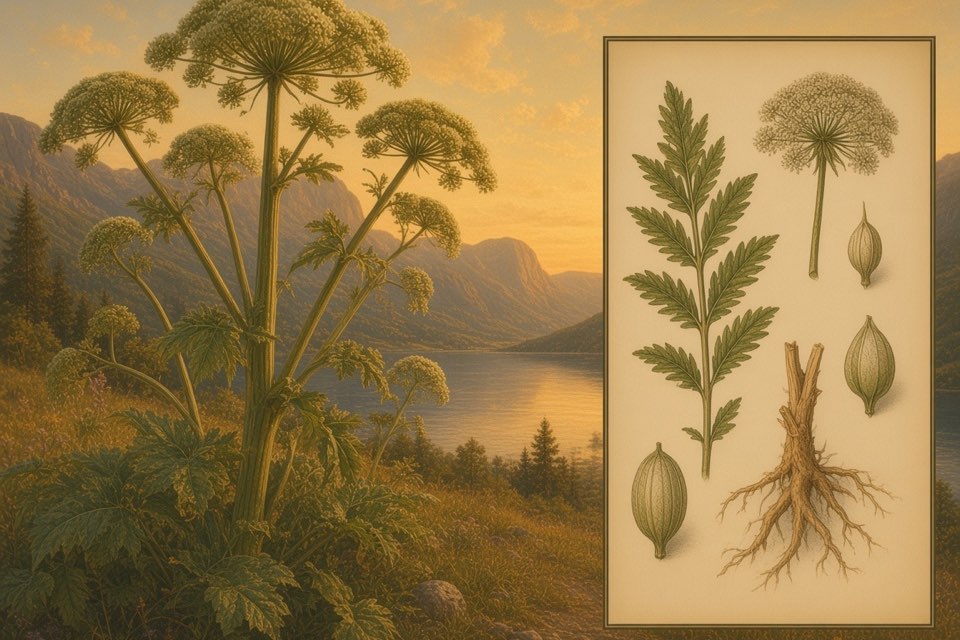
Angelica grows fast and dies young. Kew describes an aromatic herb up to 2 m tall with a thick taproot and bright green, hollow stems sometimes tinged purple; leaves up to 70 cm long, divided two or three times into toothed leaflets, with broad sheathing bases; and globe-shaped umbels 10–14 cm across made of tiny white or greenish flowers about 4 mm wide. The fruits are straw-colored, prominently ridged schizocarps up to 9 mm long. Pharmakobotanik, a German pharmacognosy teaching site, adds that plants can reach 3 m, that the root is a short, stout rhizome with many side roots, that the leaf teeth end in small white points, and that plants live two to four years and die after flowering once, from June to August. Grieve noted that cutting off the flower heads prolongs its life. Its look-alikes are dangerous. The USDA Forest Service warns that water hemlock (Cicuta), which has been called the most poisonous plant in the north temperate zone, has leaflet veins that fork, with one branch ending in the notch between teeth, and chambered lower stems and upper roots. Ontario’s weed guide, describing the related purple angelica, notes that angelica’s veins run to the tips of the teeth and its umbels are globe-shaped rather than flat.
The medicinal part is the dried rhizome and roots, and the European Pharmacopoeia requires at least 2.0 ml of essential oil per kilogram; Pharmakobotanik says the commercial drug comes almost entirely from cultivation, mainly in Poland and the Netherlands. It puts the oil at about 0.35–1% of the root, dominated by monoterpenes: α-pinene (about 14–31%), β-phellandrene (13–28%), and α-phellandrene (2–14%), with musky macrocyclic lactones such as pentadecanolide largely responsible for the smell. Composition varies with origin: root oil from Italy was led by α-pinene (21.3%), δ-3-carene (16.5%), and limonene (16.4%) (Fraternale and colleagues, Journal of Medicinal Food 2014). The root also holds more than 20 furanocoumarins, including angelicin, archangelicin, bergapten, isoimperatorin, and xanthotoxin, plus the prenylated coumarins osthenol and osthole and the simple coumarin umbelliferone. EMA confirms that linear furanocoumarins (psoralen, xanthotoxin, and bergapten) and the angular angelicin are all detectable, and notes that fungal infection can raise the coumarin content of roots 20- to 200-fold. The fruits are richer still: samples from 64 Icelandic sites averaged 22.5 mg of furanocoumarins per gram, mostly imperatorin (Sigurdsson and colleagues, Zeitschrift für Naturforschung C 2012).
02 Lineage
History
Angelica is one of the few plants the Nordic peoples cultivated in the Middle Ages. Teixidor-Toneu and colleagues trace the Old Norse name hvǫnn into every North Germanic language and into Inuit, with a Sámi name of proto-Norse origin. An Icelandic law from about 1150–1175 set a penalty for stealing angelica, and later laws in Iceland and Norway, up to the eighteenth century, protected the hvanngarðr, the angelica garden, as the farmer’s property. A late-fifteenth-century Icelandic document treats harvested angelica as church property and a way for farmers to pay the church, and Norway has some 720 place names built on kvann, the plant’s modern Norwegian name. In Ólafs saga Tryggvasonar, preserved in a fourteenth-century text, the king takes an angelica stalk from a man near a church and gives it to his wife, Queen Thyra. Genetic studies show a spread from Norway to the Faroes and Iceland that fits Viking-age voyages, though the geneticists themselves credited birds. The authors add that the Greeks and Romans did not know the plant, that it is absent from classical materia medica, and that it probably reached the rest of Europe in medieval times through traveling Scandinavian monks.
For centuries the stems were a prized summer treat. Linnaeus recorded that the Sámi ate peeled stems eagerly, a seventeenth-century source called them the Sámi’s “delightful snacks and summer fruits,” and Rautio and colleagues describe Sámi harvesters tending wild stands selectively and spreading the plant to new areas (all cited by Teixidor-Toneu). The Ammassalik Inuit of east Greenland valued it highly, with children dipping stems in powdered sugar, and in the Faroe Islands it was served as a dessert with cream or thick sour milk; in Iceland and the Faroes the stems were the only sweet food available before trading posts brought sugar in the seventeenth century. Grieve adds that Icelanders ate stems and roots raw with butter, that Finns baked the stems in hot ashes, and that Norwegians made bread from the roots. Growers around Voss in western Norway selected a variety with almost solid leaf stalks and about 50% more sugar, which Kew records as the cultivar ‘Vossakvann’, and since 2014 the KVANN Norwegian Seed Savers have been reselecting it. Kew records angelica as a vegetable in Greenland and the Faroes today, but Teixidor-Toneu and colleagues note that it has largely vanished from Nordic diets, partly replaced by rhubarb.
The name comes from Christian folklore laid over older beliefs. Grieve records that across northern Europe angelica was trusted to protect against contagion and to cure “every conceivable malady,” that one legend had an angel reveal it in a dream as a cure for the plague, and that another tied it to the feast of St Michael the Archangel (May 8, old style), making it a guard against evil spirits and witchcraft; it was also called “the Root of the Holy Ghost.” Scandinavian households laid it in doorways so its strong smell would stop infections spreading, and in Iceland its fragrance was said to keep away the smell of death (Teixidor-Toneu). John Parkinson put it in the forefront of all medicinal plants in 1629, and by Grieve’s day the root was official in the Swiss, Austrian, and German pharmacopoeias. Its flavor built an industry too. Kew credits the town of Niort in western France with the art of candying the stems, and Grieve describes gin distillers using angelica with or in place of juniper, and its use in vermouth and Chartreuse. Germany’s Commission E approved the root for digestive complaints in 1990, but in 2014 EMA’s herbal committee set it aside as unlikely ever to receive a European monograph.
03 Chemistry
Active compounds and how it works
No one has shown how, or whether, angelica root eases indigestion in people. Its taste is aromatic at first, then sharp and bitter (Pharmakobotanik), and an Austrian Swedish bitters leaflet describes it as a bitter, oil-rich herb that stimulates the stomach and appetite and mildly relieves cramping. Pharmakobotanik notes that the essential oil had antispasmodic effects in animal experiments. ESCOP’s 2021 summary lists spasmolytic, calcium-blocking, anti-inflammatory, antimicrobial, antiviral, and cytotoxic activity in laboratory studies, and effects on the digestive tract, liver protection, inflammation, pain, sedation, anxiety, and seizures in animals. A 2021 review by Kaur and Bhatti (Phytotherapy Research) credits such effects mainly to coumarins and the volatile oil. Fraternale and colleagues found that Italian root oil inhibited Clostridium difficile and Clostridium perfringens at 0.25% in the test tube, while affecting beneficial bifidobacteria and lactobacilli only at concentrations above 4%. None of this has been confirmed in human studies of angelica alone. For Iberogast Classic, the manufacturer describes angelica, milk thistle, and greater celandine as the three extracts that strengthen its effect on gut movement, but no human trial has separated angelica’s contribution from that of the other eight herbs.
Angelica’s furanocoumarins are the main reason for caution. EMA’s reflection paper explains that linear furanocoumarins such as xanthotoxin (8-methoxypsoralen, or 8-MOP) and bergapten (5-methoxypsoralen, or 5-MOP) become toxic when activated by ultraviolet A light, causing acute skin reactions with itching, pigmentation, and redness, which appeared at 8-MOP blood levels of about 30–50 ng/ml. The same chemistry is used on purpose in PUVA, a psoriasis treatment that combines oral 8-MOP, typically about 30 mg a dose, with UVA light, and EMA cites data showing that PUVA patients had roughly a 6- to 12-fold higher risk of squamous cell skin cancer after 8 to 10 years. The International Agency for Research on Cancer classes 8-MOP plus UV radiation as carcinogenic to humans and 5-MOP as probably carcinogenic, while evidence for angelicin is limited, and EMA adds that angular furanocoumarins such as angelicin may be less phototoxic than linear ones. Because toxicology data on angelica’s own furanocoumarin mixtures are almost entirely lacking, EMA used 8-MOP and 5-MOP as worst-case models.
To put herbal products in context, EMA compared them with food, since ordinary vegetables, fruits, and spices supply furanocoumarins every day: national assessments estimated an average intake of about 1.45 mg a day, with peaks up to 14 mg, close to the 14–15 mg at which phototoxic reactions may be expected with UV exposure. EMA proposed that up to 15 µg of total furanocoumarins a day from a herbal medicine poses no unacceptable risk; that up to 1.5 mg a day would not add significantly to overall risk but should carry a UV warning and be contraindicated in children and pregnancy; and that products above 1.5 mg need a full benefit-risk assessment. It also notes that furanocoumarins affect the cytochrome system, the liver enzymes that process many drugs. For the leaf supplement SagaPro, Kowal and colleagues (Die Pharmazie 2017) measured 158 µg per tablet of isoquercitrin, the flavonoid proposed as its active ingredient, and judged that dose highly unlikely to affect nocturia or anything else, so how the leaf extract might work remains unexplained. They also found about 280 µg of xanthotoxin per tablet, well above EMA’s no-concern level, though below its 1.5 mg threshold.
04 In practice
Common uses
Indigestion and poor appetite are angelica root’s traditional uses. Commission E approved it in 1990 for loss of appetite and digestive discomfort such as mild spasms of the stomach and intestines, a feeling of fullness, and flatulence, and ESCOP’s 2021 monograph lists dyspeptic complaints including mild cramping, sluggish digestion, wind, fullness, and loss of appetite, as well as bronchitis. Those listings rest on tradition and laboratory work: ESCOP states that no clinical data were available for single-herb angelica root products. Europe’s current regulator has gone the other way. EMA has no monograph on angelica root, and in a 2014 statement, revised in 2015, its herbal committee listed Angelica archangelica root among herbal substances that are toxic, contain toxic constituents, or pose serious safety concerns, and for which it judged a positive benefit-risk outcome unlikely. It added that use of these substances outside the medicinal legal framework “is not recommended and should be evaluated critically.” German folk uses, including cough and bronchitis (hence the old name Brustwurz, “breast root”), menstrual complaints, and nervous sleeplessness, have never been shown to work (Pharmakobotanik).
Iberogast Classic is where most people meet medicinal angelica. Sold by Bayer, it is an alcoholic drop combining extracts of nine plants: bitter candytuft (Iberis amara), angelica root, chamomile flower, caraway fruit, milk thistle fruit, lemon balm leaf, peppermint leaf, greater celandine, and licorice root, with angelica extract making up 10 ml of every 100 ml. In Germany it is licensed for functional and motility-related stomach and bowel disorders such as functional dyspepsia and irritable bowel syndrome (IBS), and as supportive treatment for gastritis. Melzer and colleagues (Alimentary Pharmacology and Therapeutics 2004) reanalyzed raw data from three placebo-controlled trials of STW 5 in functional dyspepsia: among 273 patients, the product beat placebo on the most bothersome symptom (odds ratio 0.22), a fourth trial found no difference from the prokinetic drug cisapride, and adverse events were similar to placebo. These results belong to the nine-herb product, not to angelica. Bayer’s newer Iberogast Advance contains six extracts and leaves out angelica, milk thistle, and greater celandine, yet it is licensed for the same functional dyspepsia and IBS uses.
Angelica root is also a common ingredient of Swedish bitters, alcoholic herbal tonics taken before or after meals, and in Austria several are registered medicines whose leaflets are published by the national medicines agency. Original Schwedenbitter Riviera combines extracts of 13 herbs, including angelica root and calamus; Gründberger Schwedenbitter lists angelica root with calamus, wormwood, myrrh, and camphor; and Apotheker Bauer’s also contains angelica root. Bauer’s leaflet describes angelica as a bitter, aromatic herb that stimulates the stomach and appetite. Gründberger’s warns that the angelica root it contains can make the skin more sensitive to light and, with UV exposure, cause skin inflammation, and that long-term use of its calamus can cause seizures or kidney damage; calamus root sits on the same EMA safety list as angelica root. As with Iberogast, any effect of these blends cannot be credited to angelica. The root and fruit also flavor bitter liqueurs and spirits, from Boonekamp, Bénédictine, and Chartreuse to gin (Pharmakobotanik), a food use rather than a medicine.
The leaf, not the root, has been tested for urinary symptoms, in two trials of SagaPro, an Icelandic food supplement made from angelica leaf. Sigurdsson and colleagues (Scandinavian Journal of Urology 2013) randomized 69 men aged 45 or older who got up at least twice a night to urinate to SagaPro or placebo for eight weeks. Night-time voids fell in the study population, with no significant difference between groups; only in a subgroup with reduced night-time bladder capacity did SagaPro look better, which the authors said warranted further study. In a 2025 pilot trial (López-Seoane and colleagues, Food Science and Nutrition), 143 adults in Spain with overactive bladder took SagaPro, 200 mg of leaf extract a day, or placebo for six weeks. The supplement group had fewer daytime voids, a better storage-symptom score, and better quality of life, while the improvement in night-time urination was not statistically significant. That trial was funded through a European Commission grant to the manufacturer and analyzed only participants who completed the protocol. Independent, larger trials are needed before angelica leaf can be called an option for bladder symptoms.
Other human data are scattered. Kudoh and colleagues (Journal of Alzheimer’s Disease Reports 2020) randomized 56 older Japanese adults with mild cognitive impairment to Feru-guard, a supplement supplying 200 mg of ferulic acid and 40 mg of angelica extract a day, or placebo. Among the 47 analyzed, scores on two cognitive tests were better with the supplement at 24 weeks, but the trial was cut short by a change in Japanese law, and angelica was the minor ingredient. Rodent studies have reported anti-anxiety and anticonvulsant effects of angelica extracts and root oil, and laboratory studies report antimicrobial and cytotoxic effects (Kaur and Bhatti), none of them tested in people. Taken together, angelica root has no clinical evidence of its own for any condition, a supporting role in one well-studied combination product, and a far longer history as food and flavoring than as a proven medicine. People looking for a digestive herb with better-studied options, or with an EU-endorsed traditional use, have several to choose from.
05 The apothecary
Preparations and traditional use
Commission E’s 1990 monograph gives an average daily dose of 4.5 g of the cut root, 1.5–3 g of a 1:1 fluid extract, 1.5 g of a 1:5 tincture, or equivalent preparations, taken by mouth. Pharmakobotanik describes the usual German tea: pour about 150 ml of boiling water over one teaspoon (2–4 g) of angelica root, strain after about ten minutes, and drink a cup, moderately warm, several times a day, half an hour before meals; a short decoction also works. Grieve’s older recipe used an ounce of bruised root to a pint of boiling water, taken two tablespoons at a time three or four times a day. Medicinal root should meet the European Pharmacopoeia standard and name Angelica archangelica on the label, because other Angelica species, including dong quai, are sold under similar names. None of these doses has been tested in a clinical trial, and because EMA has not endorsed any traditional use, there is no official limit on how long to take it. Short courses are the prudent choice, avoid strong sun or sunbeds while taking it, and digestive symptoms that last more than two weeks deserve a doctor’s review rather than more tea.
Commission E also listed 10–20 drops of angelica essential oil a day, but that dates from 1990, before EMA’s furanocoumarin assessment, and essential oils are concentrated enough that they should not be swallowed without professional advice. Most medicinal angelica today comes in combinations. Iberogast Classic contains 240 mg of alcohol per 20 drops, is not for children under 3, and must not be used in pregnancy, while breastfeeding, or with liver disease. Gründberger Schwedenbitter contains 40% alcohol by volume, up to 1.8 g of alcohol per 5 ml dose, and its leaflet warns that it can trigger a spasm of the larynx in babies and toddlers up to 2 years old. SagaPro was tested at 200 mg of leaf extract a day. Because strengths and plant parts vary so much, check the label for the species, the part used (root, leaf, or fruit), and the amount, and be cautious about combining several products that contain angelica or other furanocoumarin-rich herbs.
As food, angelica is permitted and familiar. US regulations list angelica, angelica root, and angelica seed among spices and natural flavorings generally recognized as safe (GRAS), and angelica root, seed, and stem among GRAS essential oils and natural extractives (21 CFR 182.10 and 182.20). Most candied angelica sold for confectionery comes from France (Kew), and Grieve gives recipes for candying the stems at home. Fresh stems can be cooked with rhubarb, and Kew notes that young flower heads are eaten in omelets or grilled. If you grow angelica, wear gloves and long sleeves when cutting or peeling stems in sunny weather and wash any sap off your skin, because the plant is phototoxic. Never gather wild angelica unless you are certain of its identity: water hemlocks grow on wet ground such as ditches and stream banks, all their parts are toxic, and tasting is not a safe test.
Safety
Before you use angelica
06 Caution
Side effects
Phototoxic skin reactions are the characteristic risk. Commission E warned that angelica root’s furanocoumarins sensitize the skin to light and that later UV exposure can lead to skin inflammation, and EMA describes the acute reactions furanocoumarins cause under UVA light as itching, pigmentation, and redness. Contact with the fresh plant matters as much as swallowing it. Grosu Dumitrescu and colleagues (Life 2024) list Angelica archangelica among the carrot-family plants that cause phytophotodermatitis, a rash where sap-wetted skin meets sunlight that ranges from mild redness to severe blistering and peeling, is usually painful or burning rather than itchy, and can leave brown marks for months. They note that angelica’s phototoxic compounds are higher after flowering and that such compounds rise when plants are infected by pathogens. We found no published case series of angelica-specific reactions, so how often they occur is unknown, but the risk applies to gardeners, foragers, and cooks peeling stems on a sunny day.
Longer-term risks are uncertain rather than proven. EMA found that toxicology data on angelica’s own furanocoumarin mixtures are almost entirely lacking, and it had to judge them by comparison with the drugs 8-MOP and 5-MOP, whose combination with UV light is linked to skin cancer. That is why it set a cautious no-concern level of 15 µg of furanocoumarins a day and asked for warnings and contraindications above it. Products differ widely. Kowal and colleagues measured about 280 µg of xanthotoxin in each SagaPro tablet, and Icelandic angelica fruits averaged 22.5 mg of furanocoumarins per gram on a simple sum, although not all of these compounds are equally phototoxic. Root content varies with origin and can climb steeply if the root is infected by fungi (EMA). In the clinical trials that have been run, short-term tolerance was good: the 2013 SagaPro trial reported the product to be safe, and in the STW 5 meta-analysis adverse events were similar to placebo, with no serious events.
Combination products bring their own side effects. Iberogast Classic’s product information lists very rare allergic reactions and reports of liver damage. In September 2018 the German Medical Association’s drug commission (AkdÄ) relayed a notice from Germany’s medicines regulator, the Federal Institute for Drugs and Medical Devices (BfArM): after new reports of liver damage with Iberogast, including a case of liver failure with a liver transplant that ended in death, liver-toxicity warnings and a contraindication in pregnancy and breastfeeding had to be added. The notice points to greater celandine, long suspected of damaging the liver, not angelica, and Iberogast Advance contains neither. Swedish bitters add alcohol, and some contain calamus, whose long-term use Gründberger’s leaflet links to seizures and kidney damage. Anyone who develops yellowing of the skin or eyes, dark urine, or pale stools while taking a combination product should stop it and see a doctor.
Misidentification is the gravest danger linked to angelica, even though it is not caused by angelica itself. The USDA Forest Service warns that water hemlock’s toxin, cicutoxin, can cause delirium, nausea, abdominal pain, vomiting, and seizures within 60 minutes of ingestion, frequently leading to death, and that the poison is especially virulent in the roots. The same page notes that spotted or poison hemlock (Conium maculatum), the hemlock that killed Socrates, is a separate carrot-family plant. Water hemlocks have tall stems, umbels of small white flowers, and finely divided leaves, and Ontario’s weed guide warns that angelicas can be confused with toxic members of the carrot family. Buy angelica from a reputable grower or supplier, or grow it from labeled seed, rather than digging wild roots.
07 Caution
Contraindications
Pregnancy and breastfeeding: EMA’s reflection paper recommends that herbal products supplying meaningful amounts of furanocoumarins be contraindicated in pregnant women and children because of the uncertainties, and Iberogast Classic must not be taken in pregnancy or while breastfeeding. Grieve recorded angelica root infusion as an emmenagogue, a herb used to bring on menstruation, which is another reason to avoid medicinal doses in pregnancy. We found no safety data on angelica in breastfeeding. Candied angelica in a slice of cake or a little in a spirit is a food amount, not a medicinal dose, but pregnant and breastfeeding women should avoid angelica teas, tinctures, supplements, and essential oil. Alcohol-based products such as Swedish bitters are unsuitable in pregnancy because of their alcohol alone. Labels matter here too, because dong quai, the Chinese relative often marketed for menstrual and menopausal complaints, may also be sold simply as “angelica.”
Children: EMA’s furanocoumarin framework contraindicates such products in children, Iberogast Classic is not for children under 3, and Iberogast Advance is not recommended under 12. Alcohol-based tinctures, drops, and Swedish bitters are unsuitable for children in any case, and Gründberger’s leaflet warns of dangerous spasm of the larynx in babies and toddlers. Gründberger Schwedenbitter also contains camphor and calamus, and Iberogast Classic contains 240 mg of alcohol in every 20 drops. EMA’s 2007 paper singled out children because toxicity data on angelica’s furanocoumarin mixtures are almost entirely lacking, and the same caution applies to letting children handle or chew fresh stems on sunny days. A child with recurring tummy pain, poor appetite, or weight loss needs a pediatric assessment rather than a herbal bitter.
Sun sensitivity and skin conditions: Commission E advises avoiding prolonged sunbathing and intense UV radiation during treatment, and EMA asks for a warning about UV exposure. People who burn easily, who use sunbeds, who have a light-sensitive skin condition, who are having PUVA or other light therapy, or who have been told to minimize sun exposure because of skin cancer risk should avoid medicinal angelica and handle the fresh plant with gloves. Liver disease and alcohol: Iberogast Classic is contraindicated with current or past liver disease and with other medicines that can damage the liver, because of its greater celandine, and alcohol-based angelica products are unsuitable for anyone avoiding alcohol, including people with alcohol dependence or liver disease.
When not to self-treat: angelica is meant, at most, for mild and occasional indigestion. Indigestion that lasts more than two weeks, new persistent symptoms in later life, trouble swallowing, repeated vomiting, vomiting blood, black or bloody stools, weight loss without trying, or yellowing of the skin or eyes all need a doctor’s assessment. Chest pain, or pain spreading to the jaw, neck, or arm, can be a heart problem rather than indigestion and needs emergency care. Anyone who may have eaten a wild plant mistaken for angelica, or who develops vomiting, confusion, or seizures after foraging, needs emergency care or a poison control center at once; water hemlock poisoning can begin within an hour. If possible, bring a sample or photo of the plant.
08 Caution
Drug and herb interactions
Photosensitizing treatments: no interaction studies exist, but angelica’s furanocoumarins add to any other source of light sensitivity. EMA notes that exposure from herbal medicines adds to what people already get from foods, and asks for a warning about UV light as a co-factor. People taking methoxsalen (8-MOP) or having PUVA therapy should avoid medicinal angelica entirely, because it supplies related compounds, and anyone taking a medicine whose label warns about sun sensitivity should ask a pharmacist before using angelica products. Combining several furanocoumarin-containing herbal products, or taking them before sunbathing or using a sunbed, is best avoided. EMA judged that up to 1.5 mg of furanocoumarins a day from a herbal product would not add significantly to the risk people already carry from food, but we found no study of such amounts taken together with photosensitizing medicines, and product labels rarely state furanocoumarin content.
Blood thinners and other drug metabolism: Commission E listed no known interactions, and we found no case report linking garden angelica to bleeding or a raised INR, a measure of how slowly blood clots. The warfarin case reports usually quoted for angelica involve dong quai. Ge and colleagues (Evidence-Based Complementary and Alternative Medicine 2014) describe a woman whose INR and prothrombin time doubled after four weeks of dong quai with warfarin, and another case with an INR of 10. They note that plain coumarin has no anticoagulant properties of its own, although herbs containing coumarins are sometimes assumed to behave like warfarin. For garden angelica the interaction is theoretical: its coumarins and EMA’s note that furanocoumarins affect the liver’s drug-metabolizing cytochrome system are reasons for care, not evidence of harm. Anyone taking warfarin or another anticoagulant should tell the prescriber before starting medicinal angelica and report unusual bruising or bleeding.
Combination products carry every ingredient’s interactions. Iberogast Classic must not be taken with other medicines that can damage the liver, and each of its other eight herbs brings its own cautions. Swedish bitters contain substantial alcohol, which matters for anyone taking sedatives, sleeping pills, or medicines that should not be mixed with alcohol, and some also contain calamus and camphor. We found no studies of SagaPro taken alongside prescription bladder or prostate medicines, and both of its trials were short, lasting six to eight weeks. Because angelica turns up in digestive drops, bitters, teas, liqueurs, and supplements, tell your pharmacist about all of them, and check labels for angelica root, leaf, or fruit before stacking products.
09 Questions
Frequently Asked Questions
No. Garden angelica is Angelica archangelica, a northern European and Arctic plant used as a digestive bitter and a flavoring for candied stems, gin, and liqueurs. Dong quai is Angelica sinensis, a Chinese species used mostly for menstrual and menopausal complaints in traditional Chinese medicine, with its own case reports of interactions with warfarin. They share a genus but not their uses, chemistry, or safety record, so evidence and warnings for one should not be applied to the other. Check the Latin name on any product labeled “angelica.”
It is a traditional remedy, not a proven one. Germany’s Commission E approved angelica root in 1990 for loss of appetite, mild cramping, fullness, and wind, but ESCOP found no clinical trials of angelica root alone, and EMA has declined to write a monograph because of safety concerns. For bloating and cramping, related carrot-family herbs such as fennel and caraway, or peppermint and chamomile, have their own pages covering evidence and safety. Indigestion that persists beyond two weeks needs a doctor’s check.
Angelica root is one of nine extracts in Iberogast Classic (STW 5), alongside bitter candytuft, chamomile, caraway, milk thistle, lemon balm, peppermint, greater celandine, and licorice. A 2004 meta-analysis of three placebo-controlled trials in 273 people found the full product helped functional dyspepsia, but no study has isolated angelica’s share. The newer Iberogast Advance leaves out angelica, milk thistle, and celandine. Classic carries liver warnings linked to its celandine.
Yes, it can. Angelica contains furanocoumarins, the same family of compounds used with UV light in PUVA therapy for psoriasis. Commission E advised avoiding prolonged sunbathing and intense UV while taking angelica root, and sap from the fresh plant on skin followed by sunlight can cause phytophotodermatitis, a painful, burn-like rash that may blister and leave brown marks for months. Wear gloves and long sleeves when cutting angelica, wash off sap promptly, and see a doctor for a blistering rash.
Medicinal angelica is best avoided in pregnancy and while breastfeeding. EMA’s furanocoumarin assessment recommends contraindicating such herbal products in pregnancy and childhood, Iberogast Classic must not be used in pregnancy or breastfeeding, and old herbals record angelica root as a herb to bring on menstruation. A little candied angelica on a cake is a food amount, not a medicine. If you want help with pregnancy nausea, see our ginger page and discuss any remedy with your midwife or doctor first.
The evidence is weak. In an eight-week trial of 69 men, the angelica leaf supplement SagaPro did not reduce night-time urination more than placebo overall, and a 2025 pilot in 143 adults with overactive bladder found fewer daytime trips to the toilet but no significant change at night. Waking repeatedly to urinate has many possible causes worth having checked by a doctor. For prostate-related urinary symptoms, see our pages on pumpkin seed and saw palmetto.
Only if you are completely certain of the plant, and most people should not try. Angelica grows in the same wet places as water hemlock, one of the most poisonous plants in the north temperate zone, whose toxin can cause seizures and death within hours. Clues such as globe-shaped umbels, leaf veins ending at the tips of the teeth rather than in the notches, and the chambered lower stem and roots of water hemlock help experts, but none is foolproof for beginners. Grow angelica from labeled seed instead, wear gloves when harvesting, and call emergency services or poison control at once if a wild umbellifer has been eaten by mistake.
Angelica root is strongly aromatic, with musky notes from compounds called macrocyclic lactones, and Grieve recorded that gin distillers used it with or in place of juniper; Kew notes that its roots and seeds flavor Bénédictine and Chartreuse. US regulations list angelica root, seed, and stem as generally recognized as safe flavorings, and drinks and candied stems are food uses rather than medicinal doses. The cautions on this page apply to medicinal doses, concentrated extracts, and handling the fresh plant in sunlight. Other bitter herbs, such as gentian, have their own pages, and the alcohol itself deserves moderation.
10 References
Sources
These references support the history, clinical, and safety claims on this page. They are not an endorsement of any product.
-
Reflection paper on the risks associated with furocoumarins contained in preparations of Angelica archangelica L.
European Medicines Agency (EMEA/HMPC/317913/2006), 2007
Linear and angular furanocoumarins in angelica; UVA phototoxicity and PUVA cancer data; dietary intake of about 1.45 mg a day; no-concern level of 15 µg a day; up to 1.5 mg with UV warning and contraindication in children and pregnancy; fungal infection raises root coumarins 20–200-fold.
-
Public statement on prioritisation for assessment of herbal substances associated with safety concerns (Rev. 1)
European Medicines Agency (EMA/HMPC/682247/2013 Rev. 1), 2015
Annex lists Angelica archangelica root with calamus, greater celandine, lily of the valley, ephedra, kava, and rauwolfia as substances with serious safety concerns for which a positive assessment outcome is considered unlikely; use outside the medicinal framework is not recommended.
-
Angelica root (Angelicae radix)
German Commission E monograph, via the American Botanical Council (HerbalGram), 1990
Approved for loss of appetite, mild gastrointestinal spasms, fullness, and flatulence; daily dose 4.5 g root, 1.5–3 g fluid extract, 1.5 g tincture, or 10–20 drops essential oil; furanocoumarins sensitize skin to light, so avoid prolonged sunbathing and intense UV.
-
Angelicae radix (Angelica root)
European Scientific Cooperative on Phytotherapy (ESCOP), 2021
Published summary: indications for dyspeptic complaints and bronchitis; laboratory and animal activities; no clinical data available for single-herb angelica root products; safety data come from trials of herbal combinations.
-
Angelica archangelica L.
Royal Botanic Gardens, Kew, Plants of the World Online, 2026
Accepted name, published by Linnaeus in 1753; native range Greenland and Europe to western Siberia; description of stems, leaves, umbels, and fruits; subsp. litoralis; candied stems from Niort; Nordic food use and the ‘Vossakvann’ cultivar; Bénédictine and Chartreuse.
-
Sweetness Beyond Desserts: The Cultural, Symbolic, and Botanical History of Angelica (Angelica archangelica) in the Nordic Region
Journal of Ethnobiology (Teixidor-Toneu, Kjesrud, and Kool), via the Natural History Museum, University of Oslo, 2020
Old Norse names and laws on angelica theft and gardens; Sámi, Faroese, Icelandic, and Greenlandic food use; Voss variety with more sugar; Viking-age spread; use against infection; decline in modern Nordic diets.
-
Angelica (A Modern Herbal)
Mrs M. Grieve, A Modern Herbal, via Botanical.com, 1931
Archangel and plague legends; Root of the Holy Ghost; Parkinson’s praise in 1629; biennial habit; use by gin distillers and in vermouth and Chartreuse; Nordic food use; candying recipes; emmenagogue use.
-
Angelicae radix – Angelikawurzel
Pharmakobotanik.de (German pharmacognosy teaching resource), 2011
Plant description and German synonyms; European Pharmacopoeia minimum of 2.0 ml/kg essential oil; oil composition (α-pinene, β- and α-phellandrene, macrocyclic lactones); more than 20 furanocoumarins plus osthole; Commission E use, tea preparation, and photosensitivity warning; liqueur and gin use.
-
Meta-analysis: phytotherapy of functional dyspepsia with the herbal drug preparation STW 5 (Iberogast)
Alimentary Pharmacology and Therapeutics (PubMed 15606389), 2004
Melzer et al.: three placebo-controlled trials pooled (STW 5 n = 138, placebo n = 135); odds ratio 0.22 for the most bothersome symptom; no difference from cisapride in a fourth trial; adverse events similar to placebo. Results apply to the nine-herb product.
-
Iberogast Produkte: Pflichttexte (mandatory product information)
Bayer Vital GmbH, 2023
Composition of Iberogast Classic (nine extracts, including angelica root 10 ml per 100 ml) and Iberogast Advance (six extracts, no angelica); indications; Classic contraindicated with liver disease, under 3, and in pregnancy and breastfeeding; liver damage reported.
-
Drug Safety Mail 2018-52: Schöllkraut-haltige Arzneimittel, Hinweise zur Lebertoxizität
Arzneimittelkommission der deutschen Ärzteschaft (AkdÄ), 2018
Relays a BfArM notice: new reports of liver damage with Iberogast, including liver failure with transplantation that ended fatally, led to liver warnings and a pregnancy and breastfeeding contraindication; greater celandine has long been suspected of causing liver damage.
-
A parallel, randomized, double-blind, placebo-controlled study to investigate the effect of SagaPro on nocturia in men
Scandinavian Journal of Urology (PubMed 23323790), 2013
Sigurdsson et al.: 69 men aged 45 or older, eight weeks; no significant difference from placebo in nocturnal voids overall; benefit only in a subgroup with reduced nocturnal bladder capacity; product judged safe.
-
Effects of Angelica archangelica Extract on Overactive Bladder: A Pilot Randomized Controlled Trial
Food Science and Nutrition (PubMed 41368330), 2025
López-Seoane et al.: 143 adults, SagaPro 200 mg leaf extract daily or placebo for six weeks; fewer daytime voids, better storage subscore and quality of life; nocturia change not significant (p = 0.069); per-protocol analysis; manufacturer co-funded.
-
Investigations on the constituents of SagaPro tablets, a food supplement manufactured from Angelica archangelica leaf
Die Pharmazie (PubMed 29441889), 2017
Kowal et al.: 158 µg isoquercitrin per tablet, a dose highly unlikely to affect nocturia; about 280 µg xanthotoxin and 2 µg imperatorin per tablet.
-
New Insights Concerning Phytophotodermatitis Induced by Phototoxic Plants
Life (PubMed 39202761), 2024
Grosu Dumitrescu et al.: lists Angelica archangelica among phototoxic Apiaceae; angelica’s phototoxic compounds higher after flowering; rash ranges from redness to blistering, is often painful, and can leave pigmentation for months.
-
21 CFR 182.20 Essential oils, oleoresins (solvent-free), and natural extractives (including distillates)
U.S. Electronic Code of Federal Regulations (eCFR), 2026
Lists angelica root, seed, and stem (Angelica archangelica) as generally recognized as safe; the neighboring section 182.10 lists angelica, angelica root, and angelica seed among GRAS spices and natural flavorings.