Monograph
Lovage
Levisticum officinale
Updated October 10, 2026
Key points
-
01
A traditional flushing tea
EMA accepts lovage root tea to increase urine and flush the urinary tract in minor complaints, based on long use. There are no clinical trials of lovage alone.
-
02
Canephron N is a combination
In 659 women, centaury, lovage, and rosemary tablets passed a lenient non-inferiority test against fosfomycin, but more women needed antibiotics and more had kidney infections.
-
03
Maggikraut, but not in Maggi
Lovage smells like Maggi seasoning, which contains no lovage. Phthalides such as ligustilide, plus sotolone, give the plant its savory, celery-like aroma.
-
04
Sunlight and skin
Lovage contains furanocoumarins. Handling the plant in strong sun has caused blistering rashes, and older handbooks advise avoiding intense sun during prolonged use.
-
05
Who should avoid it
Not with carrot-family allergy, in pregnancy, breastfeeding, or under 18; older references also rule out kidney inflammation and fluid retention from heart or kidney failure.
Lovage is a tall, celery-scented perennial of the carrot family (Apiaceae) that has been grown in European gardens for well over a thousand years. Its glossy leaves season soups and stews, its hollow young stems were once candied like angelica, and its thick, fleshy root is the part used in medicine. Kew’s Plants of the World Online (POWO) gives its native range as southern Iran to Afghanistan, although it is now naturalized across Europe and North America. In German-speaking countries it is nicknamed Maggikraut because it smells like Maggi seasoning, yet Maggi’s ingredient list contains no lovage at all; the European Medicines Agency (EMA) notes that one of the plant’s aroma compounds, sotolone, has a smell described as like hydrolyzed vegetable protein, which is what Maggi is made from. EMA accepts lovage root as a traditional herbal medicine, taken as a tea “to increase the amount of urine to achieve flushing of the urinary tract as an adjuvant in minor urinary complaints,” the same modest, tradition-based standing it gives nettle leaf, dandelion, and burdock.
There are no clinical trials of lovage on its own. EMA’s assessors found none, and judged that lovage root could not qualify for well-established use. What does exist is research on a combination. Canephron N, also known by its code BNO 1045, is a coated tablet made by the German company Bionorica that contains 18 mg each of powdered centaury herb, lovage root, and rosemary leaf. In a trial of 659 women with uncomplicated bladder infections (Wagenlehner and colleagues, Urologia Internationalis 2018), 83.5% of those given Canephron N needed no additional antibiotics, against 89.8% of those given a single dose of the antibiotic fosfomycin. That passed the trial’s test of being “non-inferior,” but only because the margin was set at 15% rather than the 10% usually applied; symptoms eased faster with the antibiotic, and five women on the herbal tablets developed a kidney infection, against one on fosfomycin. These results belong to the three-herb product, which supplies only about 108 mg of lovage root a day, and cannot be credited to lovage alone.
Lovage is a familiar food plant, and EMA lists no known side effects or drug interactions for the tea. It is contraindicated in anyone allergic to lovage, to other plants of the carrot family, or to anethole. EMA does not recommend it under 18 or during pregnancy and breastfeeding, limits use to two to four weeks, and asks people to see a doctor if fever, painful urination, spasms, or blood in the urine appear. The root contains furanocoumarins, compounds that make skin more sensitive to sunlight, and handling the fresh plant in strong sun has caused blistering rashes. Older German references, including the Commission E monograph, also rule out flushing therapy with kidney inflammation or impaired kidney function, and in fluid retention caused by heart or kidney failure. Nothing here is medical advice. A suspected bladder infection deserves a call to a doctor, and an urgent one if there is fever, back or side pain, or blood in the urine, if you are pregnant, or if the symptoms are in a man or a child.
In this monograph
01 The plant
Botanical profile
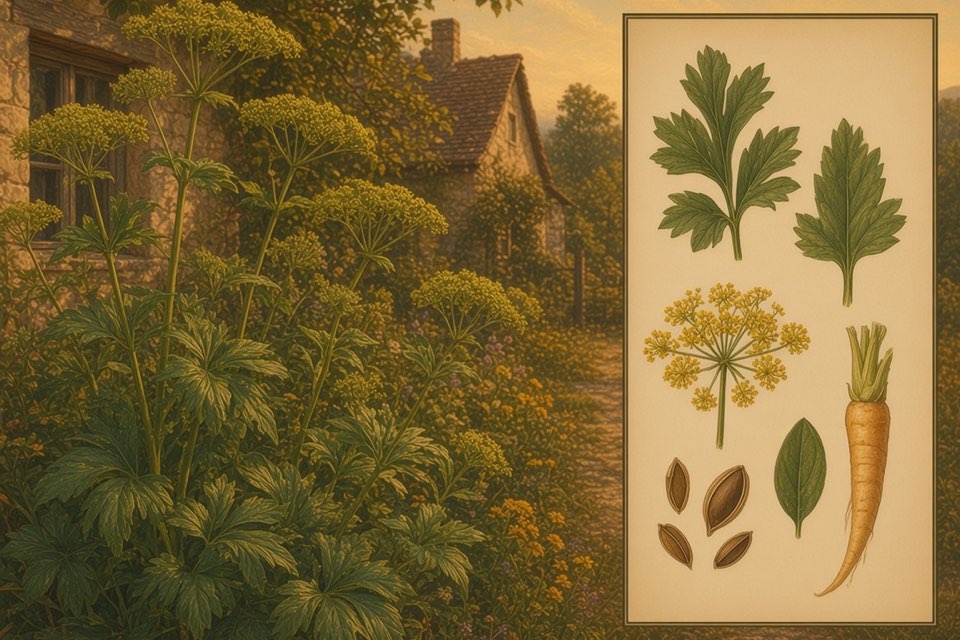
Levisticum officinale W.D.J.Koch belongs to Apiaceae (Umbelliferae), the family of carrot, celery, parsley, fennel, and angelica. Maud Grieve’s A Modern Herbal (1931) lists the older Linnaean name Ligusticum levisticum and the English names Old English lovage, Italian lovage, and Cornish lovage. Kew’s Plants of the World Online records it as a perennial of the temperate biome, native from southern Iran to Afghanistan. That is not where most readers will meet it. The Botanical Society of Britain and Ireland (BSBI) describes it as native to Iran and Afghanistan but widely naturalized in Europe, North America, and elsewhere through its use as a herb; in Britain and Ireland it is a neophyte, a plant introduced by people, that was being grown in gardens by medieval times and was first recorded in the wild in 1836, at Kells in County Meath. Older books placed its origin closer to home: Grieve believed it was native to the mountains of southern France, northern Greece, and the Balkans, a view modern checklists no longer support.
Lovage is a stout, clump-forming plant. Grieve describes a thick, fleshy, carrot-shaped root 5 or 6 inches long, greyish brown outside and whitish within, with a strong aromatic smell and taste. Hollow, channelled stems rise 3 or 4 feet or more, and the large, dark green, shining leaves are divided into narrow wedge-shaped segments, not unlike those of a coarse celery, giving off a scent reminiscent of both angelica and celery when bruised. In June and July the branched stem tips carry flat umbels of yellow flowers like those of fennel or parsnip, followed by small, very aromatic, yellowish-brown fruits, elliptical and curved, with three prominent winged ribs. It is easy to grow from seed or by dividing the roots in rich, moist, well-drained soil and sun (Grieve), and BSBI finds it naturalized on rough ground and by walls, paths, and roadsides. Several unrelated or distant plants have also been called lovage, including Scotch or sea lovage (Ligusticum scoticum), black lovage or Alexanders (Smyrnium olusatrum), and water lovage (a species of Oenanthe), so the Latin name matters on a label.
The root’s chemistry explains its smell. EMA’s assessment report puts the volatile oil at 0.6% to 1% of the root, of which up to 70% is alkylphthalides, mainly responsible for the characteristic odor; about 20 phthalides have been isolated, making up 64% to 80% of the oil, with (Z)-ligustilide described as the lead compound and 3-butylidenephthalide another major one. The oil also contains monoterpenes such as β-phellandrene and pinene, and the root holds sotolone, a flavor compound with a smell likened to hydrolyzed vegetable protein or curry. Coumarins include umbelliferone, coumarin itself, and the furanocoumarins bergapten and psoralen, with total coumarins estimated at 3.2%, along with the polyacetylene falcarindiol (0.14% to 0.2%) and phenolic acids. Olennikov (Metabolites 2022) identified 25 compounds in fresh roots, chiefly coumarins such as apterin, xanthotoxin, isopimpinellin, and pimpinellin, at 1.7 to 2.9 mg/g in fresh roots and 15 to 24 mg/g in dried commercial root. Medicinal root must meet European Pharmacopoeia monograph 1233, updated in 2021 (EMA). Oil content depends on husbandry: leaving the leaves on the plant until autumn raised it from 0.52% to 0.85% in one study (EMA).
02 Lineage
History
Lovage carries a place name. EMA’s assessment report notes that Dioscorides described it as ligusticon in Greek, ligusticum in Latin, a plant of the Alpine region of Liguria in Italy, and Merriam-Webster traces the English word through Middle English lovache and Anglo-French luvasche to Late Latin levisticum, an alteration of Latin ligusticum, “Ligurian”; its first known use in English dates to the fourteenth century. In the ninth century the Capitulare de villis, a decree on the running of the Carolingian imperial estates, listed it among the plants every estate garden should grow (EMA). Its famous seventieth chapter names levisticum alongside rosemary, fennel, celery, and parsley, though a modern botanical index of the list notes that the word could also have meant alpine lovage, Ligusticum mutellina (biozac). Medieval and Renaissance writers, including Lonicerus in 1564 and Matthiolus, used lovage mainly to bring on menstruation, to relieve wind, as a diuretic, and for skin ailments, and an eleventh-century treatise attributed to Trotula of the Salerno medical school recommended garden lovage for lightening the skin (EMA).
Its folk reputation was broad but never grand. Grieve wrote that lovage was much used as a drug plant in the fourteenth century, probably more for its pleasant smell than anything else, that it was never an official remedy, and that no extravagant claims were made for it. Old writers recommended an infusion of the root for gravel, jaundice, and urinary troubles, and Culpeper prized the seeds, recommending a decoction for agues and pleurisy and a distilled water as a gargle for quinsy. In the kitchen, the leafstalks were once blanched like celery and the young stems candied like angelica. Grieve also punctured one popular association: the old public-house cordial called “Lovage” was brewed mainly from tansy and a yarrow, Achillea ligustica, and probably owed what virtue it had to them rather than to lovage. A modern myth follows the same pattern. German gardeners call lovage Maggikraut, but Nestlé’s ingredient list for Maggi seasoning names biologically processed wheat protein, water, flavoring, the flavor enhancers monosodium glutamate and disodium inosinate, salt, and sugar, with no lovage.
Formal medical recognition centered on the urinary tract. EMA’s assessment report cites a German source from 1900 recording its use for inflammatory urinary conditions and kidney stones, and in 1990 Germany’s Commission E endorsed it for irrigation, or flushing, therapy in inflammation of the lower urinary tract and to prevent kidney gravel, at 4 to 8 g a day. The British Herbal Pharmacopoeia of 1983 listed flatulent colic, indigestion, fluid retention, painful or delayed periods, and cystitis. Lovage root teas have been sold in Poland since at least 1967. EMA’s herbal committee adopted a European monograph on 20 November 2012, accepting traditional use only, and a periodic review in 2021 found no new data that justified changing it, noting that no new single-herb lovage products had been authorized in the EU since 2012. Lovage lives on mainly in combinations: EMA records a UK traditional registration for a tablet of lovage root, centaury, and rosemary for minor urinary complaints associated with cystitis in women, and the 2018 trial report states that Canephron N is approved in 28 countries, including Germany and Ukraine. In the United States, lovage is listed among natural flavoring substances permitted in food.
03 Chemistry
Active compounds and how it works
How lovage might increase urine is barely studied. EMA found no data at all on its pharmacology or pharmacokinetics in people. The animal evidence is old and thin: experiments in rabbits and mice in 1937 with an infusion of the root showed a slight increase in urine volume and chloride, while other tests at 0.25 to 1 g of root per animal produced no diuresis (EMA, citing the British Herbal Compendium). Some authors attributed any diuretic effect of the oil to its terpenes. The idea behind “flushing” therapy is to raise the volume of urine passing through the bladder, and the handbooks are explicit that it requires plenty of fluid: Wichtl’s reference text calls abundant fluid intake necessary, and one German compendium asks for at least 2 liters a day (EMA). Since the tea is itself water and is taken with extra drinks, it is hard to separate any effect of the root from the effect of drinking more. EMA concluded that the laboratory data support the traditional use, but added that the therapeutic importance of the plant can be overestimated.
Most laboratory work concerns the phthalides, especially ligustilide and butylidenephthalide, many of them studied as pure compounds or from related plants. EMA summarizes studies in which ligustilide relaxed isolated rat artery rings by blocking calcium entry, butylidenephthalide inhibited contractions of guinea pig intestine, though less potently than the antispasmodic drug papaverine, and ligustilide inhibited spontaneous contractions of isolated rat uterus. Given by stomach tube to mice, ligustilide reduced pain responses, and in monocytes, immune cells, ligustilide and a related phthalide suppressed production of the inflammatory messenger TNF-α. The polyacetylene falcarindiol blocks 5-lipoxygenase, an enzyme in another inflammatory pathway. Whether any of this happens in people drinking the tea is unknown: in rats only about 2.6% of an oral dose of ligustilide was absorbed (EMA). Lovage oil also showed antibacterial activity in test tubes, ranking among the ten most active of 25 essential oils in one screen, and a root extract strengthened the antibiotic ciprofloxacin against drug-resistant Salmonella strains, although the isolated fractions did not (Garvey and colleagues 2011, cited by EMA). None of these effects has been tested in a person with a urinary infection.
Two other findings shape the safety advice. In a 1958 experiment, an extract injected under the skin of rats whose ovaries had been removed produced weak estrogen-like effects, with 1 g of root roughly equal to 8 international units of estradiol, compared with 200 to 300 units for hops (EMA); EMA cites this weak estrogenic activity as a reason for concern in pregnancy. And the root’s furanocoumarins become reactive under ultraviolet light: bergapten and a lovage extract caused mutations in green algae exposed to long-wave ultraviolet light, and EMA notes that furanocoumarins as a class are linked to gene mutations and cancer when activated by light, so it considers sun exposure a concern, while judging that this is not borne out by clinical or pharmacovigilance data for the tea at monograph doses. For Canephron N, the trial report cites laboratory and animal studies of the whole combination suggesting anti-inflammatory, antispasmodic, anti-adhesive, pain-relieving, and diuretic activity, but these were studies of the three-herb mixture, and the contribution of lovage within it is not known.
04 In practice
Common uses
Flushing the urinary tract is lovage root’s one officially recognized medical use, and it rests on tradition rather than proof. EMA’s 2012 monograph accepts the cut root as a herbal tea “to increase the amount of urine to achieve flushing of the urinary tract as an adjuvant in minor urinary complaints,” on the basis that it has been used medicinally for at least 30 years, 15 of them in the European Union. Adjuvant means alongside other measures, not instead of treatment. The assessors found no clinical studies of single-herb lovage preparations, no dose-response studies, and no data in children or older people, so the plant could not qualify for well-established use. The 2021 periodic review identified 24 new publications, none of them clinical trials of lovage, and none justified a revision. Older references cast the net wider: Commission E listed flushing therapy for lower urinary tract inflammation and prevention of kidney gravel, and the British Herbal Compendium added menstrual and digestive complaints. None of these uses has been tested in a trial, and lovage is not a treatment for kidney stones or for an established infection.
The clinical evidence that does exist comes from Canephron N, and it should be read as evidence for that product. Wagenlehner and colleagues (Urologia Internationalis 2018) randomized 659 women aged 18 to 70 with typical symptoms of a new, uncomplicated lower urinary tract infection, in 51 centers in Germany, Ukraine, and Poland, to two Canephron N tablets three times a day for seven days or a single 3 g dose of fosfomycin, with matching placebos so that neither patients nor doctors knew who had which. The main outcome was whether women needed additional antibiotics by about day 38. In the per-protocol analysis, 83.5% on Canephron N and 89.8% on fosfomycin needed none, a difference of 6.3 percentage points (95% confidence interval 0.5 to 12.0 points in favor of fosfomycin); in the broader analysis that kept women with protocol deviations, the gap was 8.3 points. The authors chose a 15% non-inferiority margin, arguing that the two treatments worked in different ways, instead of the 10% usually applied; the result would not have passed the stricter test. Symptom scores fell faster with fosfomycin by day 4, about a quarter of the women had negative urine cultures, and the trial was sponsored by Bionorica, whose employees helped design it and analyze the data.
Safety in that trial deserves attention. Five women on Canephron N (1.5%) developed pyelonephritis, a kidney infection, compared with one (0.3%) on fosfomycin. The difference was not statistically significant, and three of the five cases began on the day of enrollment or the day after, so the authors suggested some infections were already developing; they also called for further study of the risk. Gastrointestinal side effects were less common with the herbal tablets (4.0% versus 6.6%), and no one died or stopped treatment because of a treatment-related adverse event. The same pattern, fewer antibiotics at the cost of more symptoms and more kidney infections, was seen when uva ursi was compared with fosfomycin. For prevention, Germany’s Institute for Quality and Efficiency in Health Care (IQWiG), in a 2022 assessment of herbal remedies for recurrent bladder infections, found only a hint of added benefit from a single study of the lovage, rosemary, and centaury preparation taken with antibiotics compared with antibiotics alone. A 2026 meta-analysis by Ak and colleagues (Neurourology and Urodynamics) pooled 12 studies of Canephron N with 3,821 patients and concluded that it was an effective and safe alternative to antibiotics, but only eight of the studies were randomized and heterogeneity was substantial.
None of the Canephron N research shows that lovage works on its own. The product contains equal amounts of three herbs, and at six tablets a day it supplies about 108 mg of lovage root, roughly 2% to 3% of the 4 to 6 g a day that EMA’s monograph allows as tea. Lovage’s other uses are culinary. The leaves are used as a potherb and celery substitute in soups and stews, the young stems can be candied, and the seeds are used for flavoring (Grieve; Merriam-Webster). US regulations list lovage among natural flavoring substances that may be added to food, and EMA notes that lovage extract has also been used at low levels to flavor some cigarettes. EMA’s assessment report lists Czech combination teas containing lovage root, with herbs such as wormwood, yarrow, and peppermint, for temporary loss of appetite and mild bloating, and older herbals used the root and seeds for colic and wind, but these digestive uses have not been studied. The antibacterial and anti-inflammatory activity seen in test tubes remains a laboratory finding.
05 The apothecary
Preparations and traditional use
EMA’s monograph covers a single preparation: the cut, dried root as a herbal tea. For adults and older people, 2 to 3 g of root is steeped in 150 ml of boiling water as an infusion and drunk twice a day, for a total of 4 to 6 g a day. It should not be used for more than two to four weeks, and a doctor should be consulted if symptoms persist. Older references give similar or higher amounts. Commission E allowed 4 to 8 g a day; Hager’s handbook steeped 1.5 g in 150 ml of hot water for 10 to 15 minutes and recommended drinking it between meals; and Polish teas were made as a decoction of 4 to 5 g in a 200 ml cup of hot water for 15 minutes (EMA). Because the aim is to increase the flow of urine, the handbooks stress drinking plenty of fluid alongside the tea, at least 2 liters a day in one German compendium. EMA does not recommend lovage root for anyone under 18. The leaves used in cooking are a different part of the plant and are not covered by the monograph.
Combination tablets are the form most people encounter. In the Wagenlehner trial, each coated Canephron N tablet contained 18 mg each of powdered centaury herb, lovage root, and rosemary leaf, and women took two tablets three times a day before or after meals for seven days. The UK traditional registration recorded by EMA is for a similar tablet of lovage root, centaury, and rosemary, for women only. Bionorica’s products and their licensed uses differ from country to country, so the label and patient leaflet are the guide to what a particular pack contains and who it is for. Other combination teas and tablets may include lovage alongside herbs such as wormwood, yarrow, peppermint, licorice, or fennel (EMA), each with its own cautions. The trial’s results apply only to the product and dose tested, and they do not tell you what a homemade tea or a different blend will do.
Practical points: buy lovage root from a pharmacy or reputable supplier that names Levisticum officinale root, because several other plants are called lovage. Do not forage for lovage or any similar-looking herb unless you are certain of its identity. In 2021, Michel and colleagues (Der Anaesthesist) described a couple aged 69 and 71 who mistook leaves of monkshood (Aconitum napellus), growing near the herbs in their garden, for lovage; both developed aconitine poisoning with tingling, low blood pressure, slow heart rate, and irregular heartbeats and needed intensive care, though both recovered. If you grow lovage, wear gloves and long sleeves when cutting large amounts in strong sun, since handling the plant has caused blistering rashes. During prolonged use of the root, older handbooks advise avoiding intense sunbathing and ultraviolet light, such as tanning beds (EMA). Stop and see a doctor if symptoms are not clearly better within a few days, or at once if fever, back pain, painful urination, cramps, or blood in the urine appear.
Safety
Before you use lovage
06 Caution
Side effects
Lovage root tea appears to be well tolerated, though it has never been studied on its own in a clinical trial. EMA’s monograph lists no known undesirable effects and no reported cases of overdose, and its assessment report states that no adverse effects had been reported by EU member states. When EMA reviewed the monograph in 2021, a search of the EU and World Health Organization adverse-reaction databases found nothing that would change its view. In the Canephron N trial, adverse event rates were similar for the herbal tablets and fosfomycin, gastrointestinal complaints were less common with the herbal product (4.0% versus 6.6%), and no woman died or stopped treatment because of a treatment-related event; kidney infections were the exception, discussed under uses above. Lovage leaves are eaten as a food, but culinary amounts are small and tell us little about the tea.
Skin reactions are the best-documented problem, and they come mostly from handling the plant or its oil. EMA’s assessment report describes a case reported by Wolf in 1995 in which extensive handling of lovage during harvest in strong sunlight caused itching and redness within a few hours; after 36 hours, blisters had formed on the exposed arms and legs, followed by marked darkening of the skin that was still visible three weeks later. Fresh lovage was found to contain measurable amounts of the furanocoumarins psoralen and 5-methoxypsoralen, which cause this kind of light-triggered reaction, known as phytophotodermatitis. A similar reaction was described after contact with lovage oil, and Lapeere and colleagues (Contact Dermatitis 2013) reported contact dermatitis caused by lovage essential oil in Belgium. One German compendium records individual cases of photodermatosis, a sun-triggered rash, from the root, and the PDR for Herbal Medicines notes a low potential for allergy and possible increased sensitivity to ultraviolet light in fair-skinned people (EMA).
EMA’s assessors weighed these reports against the absence of problems in practice. They concluded that concerns about phototoxicity are not supported by clinical data or pharmacovigilance signals for oral use of the root at monograph doses, but that allergic reactions in people sensitive to the carrot family should be considered, especially with sun exposure. Toxicology data are limited. No studies of reproductive toxicity, genotoxicity, or carcinogenicity have been done on the root, and because of these gaps EMA declined to add lovage to the EU list of traditional herbal substances. Lovage root oil had acute oral lethal doses of 2 to 5 g/kg in rodents, which Tisserand and Balacs judged non-toxic, and a European Food Safety Authority compendium flags coumarin and furanocoumarins in the plant as substances of concern (EMA). On balance, EMA judged that the exposure from lovage root tea most probably does not pose a significant risk to human health.
07 Caution
Contraindications
Allergy: EMA contraindicates lovage root in anyone hypersensitive to lovage, to other plants of the Apiaceae (Umbelliferae) family, or to anethole. The family includes celery, carrot, parsley, fennel, dill, caraway, coriander, and angelica, and anethole is the sweet aroma compound of anise and fennel. Anyone who has reacted to these foods or spices, or to an Apiaceae herb, should avoid lovage tea and lovage-containing combination products. Because the documented skin reactions involved sunlight, people with a history of sun-triggered rashes, or with very fair skin, have extra reason for caution during prolonged use. Anyone allergic to rosemary or to centaury should also avoid Canephron N and similar combinations, since they contain those herbs as well. If a rash, itching, or swelling appears after drinking the tea or handling the plant, stop using it and seek medical advice.
Kidney and heart conditions: the EMA monograph does not list them, but older German references are firm. Germany’s Commission E (1990), as quoted by EMA, says lovage should not be used in acute inflammation of the kidney tissue with impaired kidney function, and that flushing therapy should not be used where fluid retention, or edema, is caused by reduced heart or kidney function. The British Herbal Compendium contraindicates inflammatory disorders of the kidney and edema due to impaired heart or kidney function, and another German compendium adds inflammatory disease of the urinary passages and reduced heart or kidney function generally. It makes sense to follow this advice. Anyone with kidney disease, heart failure, or swelling of the legs or ankles, or anyone whose doctor has told them to limit fluids, should not use lovage or other flushing herbs without medical advice.
Pregnancy, breastfeeding, and children: EMA says safety in pregnancy and breastfeeding has not been established and does not recommend use, citing lovage’s weak estrogen-like activity in rats and the lack of toxicology data. Lovage also appears on lists of plants to avoid in pregnancy because of supposed effects on the womb and its old use to bring on menstruation, though EMA notes that this has been questioned, and that the related plant used in New Mexico as an abortifacient was a different species, Ligusticum porteri. Several older handbooks contraindicate it in pregnancy outright. Urinary infections in pregnancy need prompt medical care in any case. EMA does not recommend lovage root under age 18, because urinary complaints in children and adolescents need medical advice.
When not to self-treat: EMA’s indication is limited to minor urinary complaints, and its monograph tells users to see a doctor if fever, painful urination, spasms, or blood in the urine occur, or if symptoms persist. Signs of a possible kidney infection, such as back or side pain, chills, fever, or vomiting, need prompt medical care. Urinary symptoms in men, in pregnancy, or in children, symptoms that keep coming back, and any blood in the urine also need an assessment rather than a flushing tea. The Canephron N trial, in which more women on the herbal tablets than on the antibiotic developed kidney infections, is a reminder that herbal treatment should not delay testing or antibiotics when they are needed. Lovage should not be used as a substitute for medical care in kidney stones, despite its old reputation for preventing gravel.
08 Caution
Drug and herb interactions
No drug interactions have been reported with lovage root, according to EMA’s monograph. The assessment report does raise a theoretical concern with warfarin and other anticoagulants. Lovage contains coumarin and related compounds, and bergapten and imperatorin, two of its coumarins, have been reported to inhibit platelet aggregation, so EMA sees a theoretical risk of strengthening warfarin’s effect. The coumarin in the plant has no anticoagulant activity itself, but EMA notes that it can be converted by molds into dicoumarol, which does, and that abnormal clotting and bleeding can follow drinking teas made from several coumarin-containing plants. For the same reasons, EMA cites advice that herbal products containing lovage be stopped ahead of surgery. If you take warfarin or another blood thinner, check with your prescriber or anticoagulation clinic before using lovage root, and do not use tea material that is damp or moldy.
Diuretics and fluid balance: no studies have looked at lovage alongside prescription medicines, but its whole purpose is to increase urine, and it is taken with extra fluid. People taking diuretics (water pills), medicines whose levels depend on fluid and salt balance, or treatment for heart failure or kidney disease should ask their prescriber or pharmacist before using it, and older references rule it out where heart or kidney function is reduced. Sun sensitivity: because lovage’s furanocoumarins can make skin more reactive to ultraviolet light, it is sensible to mention lovage to a prescriber if you take other medicines known to increase sun sensitivity or are having light-based skin treatment, though no interaction has been documented.
Antibiotics and combination products: lovage is not a replacement for an antibiotic that has been prescribed for a confirmed or suspected infection. In the prevention study IQWiG assessed, the lovage, rosemary, and centaury preparation was taken together with antibiotics; in the treatment trial, Canephron N was tested instead of an antibiotic, and more women developed kidney infections. Canephron N and similar products also contain rosemary and centaury, so their cautions apply too, and bladder and kidney blends may combine lovage with other herbs, including uva ursi, which has strict limits of its own. Using several flushing teas or blends at once adds up exposure and makes it harder to tell what caused a problem. Tell your doctor and pharmacist about any lovage-containing product you use.
09 Questions
Frequently Asked Questions
Not as a treatment. EMA accepts lovage root tea only as a traditional remedy to increase urine and flush the urinary tract alongside other measures in minor urinary complaints, based on long use rather than trials, and no clinical trial has tested lovage on its own. A combination tablet containing lovage, Canephron N, has been compared with an antibiotic, but more women on the herbal product needed antibiotics later and more developed kidney infections. A suspected bladder infection needs a doctor’s assessment, especially with fever, back pain, or blood in the urine.
Canephron N (BNO 1045) is a coated tablet from the German company Bionorica containing 18 mg each of powdered centaury herb, lovage root, and rosemary leaf. At the trial dose of two tablets three times a day, that is about 108 mg of lovage root daily, roughly 2% to 3% of the 4 to 6 g in EMA’s tea dose. Its trial results, in 659 women with bladder infections, belong to the three-herb product and cannot be credited to lovage alone.
No. Lovage is nicknamed Maggikraut in German because it smells like Maggi seasoning, but Nestlé’s ingredient list names processed wheat protein, water, flavoring, flavor enhancers, salt, and sugar, with no lovage. The resemblance comes from aroma chemistry: EMA notes that sotolone, one of the compounds behind lovage’s intense smell, has an odor described as like hydrolyzed vegetable protein, the savory base of seasonings like Maggi. Lovage leaves can stand in for that flavor in soups and stews.
It is used as one, but the evidence is thin. EMA accepts lovage root tea as a traditional remedy to increase urine, yet it found no human data on how the root acts, and the animal studies, mostly from 1937, showed only a slight increase in urine or none at all. Flushing therapy depends on drinking plenty of fluid, so much of the effect may come from the water itself. Lovage is not a substitute for prescribed diuretics, and people taking them should ask their doctor first.
Yes, mainly from handling the plant. Lovage contains furanocoumarins, compounds that make skin react to sunlight, and one person who handled large amounts during a sunny harvest developed itching, redness, blisters, and lasting dark patches on the arms and legs. Contact dermatitis from lovage essential oil has also been reported. EMA judged that sun sensitivity is not a demonstrated problem with the tea at recommended doses, but older handbooks advise avoiding intense sun during prolonged use. Wear gloves and long sleeves when cutting lovage on bright days.
Medicinal use is not recommended. EMA says safety in pregnancy and breastfeeding has not been established, notes weak estrogen-like effects in rats and missing toxicology data, and does not recommend lovage root then; several older handbooks list pregnancy as a contraindication. Using a few leaves to season food is a different matter from drinking the root tea, but any urinary symptoms in pregnancy should go straight to a midwife or doctor, because infections in pregnancy need prompt treatment. Other flushing herbs such as nettle leaf are also not recommended by EMA in pregnancy.
They share the same modest status. EMA accepts nettle leaf, dandelion, burdock, and lovage root as traditional remedies to increase urine in minor urinary complaints, all based on long use rather than trials. Lovage stands out for its carrot-family allergy contraindication and sun sensitivity, while dandelion and burdock belong to the daisy family. None treats an infection, and none is suitable for people told to restrict fluids. For preventing repeat infections, cranberry has better evidence.
No, but they are relatives. All three belong to the carrot family. Lovage leaves look like those of a coarse celery and are used as a celery substitute, and its young stems were once candied like angelica, whose scent Grieve found in the bruised leaves. Phthalides, the compounds behind lovage’s smell, give characteristic flavors to many carrot-family plants. Several other plants are also called lovage, including Scotch lovage and black lovage, or Alexanders, and one couple poisoned themselves by mistaking monkshood leaves for lovage, so buy from a reputable source and check for Levisticum officinale on the label.
10 References
Sources
These references support the history, clinical, and safety claims on this page. They are not an endorsement of any product.
-
Community herbal monograph on Levisticum officinale Koch, radix
European Medicines Agency (EMA/HMPC/524621/2011), 2012
Adopted 20 November 2012: traditional use of lovage root tea to increase urine and flush the urinary tract as an adjuvant in minor urinary complaints; 2–3 g in 150 ml twice daily (4–6 g a day) for 2–4 weeks; not under 18; contraindicated with Apiaceae or anethole hypersensitivity; not recommended in pregnancy or lactation; no known side effects or interactions.
-
Assessment report on Levisticum officinale Koch, radix
European Medicines Agency (EMA/HMPC/524623/2011), 2012
Phthalide-rich volatile oil, sotolone, coumarins and furanocoumarins; Dioscorides, Capitulare de villis, Commission E (1990) and handbook contraindications for kidney inflammation and cardiac or renal edema; animal diuresis and phthalide pharmacology; phytophotodermatitis case; theoretical warfarin risk; no clinical trials of lovage alone.
-
Addendum to assessment report on Levisticum officinale W.D.J. Koch, radix
European Medicines Agency (EMA/HMPC/500504/2021), 2021
Periodic review adopted 24 November 2021: 24 new references and EudraVigilance and VigiBase data reviewed, none justifying revision; no new single-herb lovage products authorized 2012–2021; new Ph. Eur. monograph 01/2021:1233; aconite mix-up and lovage oil dermatitis reports noted.
-
Levisticum officinale W.D.J.Koch
Plants of the World Online, Royal Botanic Gardens, Kew, 2026
Accepted name in Apiaceae; a perennial of the temperate biome with a native range of southern Iran to Afghanistan.
-
Non-Antibiotic Herbal Therapy (BNO 1045) versus Antibiotic Therapy (Fosfomycin Trometamol) for the Treatment of Acute Lower Uncomplicated Urinary Tract Infections in Women: A Double-Blind, Parallel-Group, Randomized, Multicentre, Non-Inferiority Phase III Trial
Urologia Internationalis (PubMed 30231252), 2018
Wagenlehner et al.: 659 women; Canephron N tablets (18 mg each of centaury, lovage root, and rosemary leaf), two three times daily for 7 days, versus single-dose fosfomycin; 83.5% vs 89.8% needed no additional antibiotics, non-inferior on a 15% margin; pyelonephritis 5 vs 1; sponsored by Bionorica.
-
Bladder infection: Do herbal remedies help with recurrent bladder infection? IQWiG Reports – Commission No. HT20-01
Institute for Quality and Efficiency in Health Care, IQWiG (PubMed 37023241), 2022
German health technology assessment of 15 studies: indication of benefit for cranberry; a hint of added benefit for a lovage root, rosemary leaf, and centaury preparation taken with antibiotics versus antibiotics alone for preventing recurrences, from a single study.
-
The Effect of Canephron N in Preventing Urinary Tract Infection: A Systematic Review and Meta-Analysis
Neurourology and Urodynamics (PubMed 42781758), 2026
Ak et al.: 12 studies (eight randomized) with 3,821 patients; authors conclude Canephron N is an effective and safe alternative to antibiotics, with fewer gastrointestinal events, but heterogeneity was substantial (I² 72% for bacteriuria).
-
Contact dermatitis caused by lovage (Levisticum officinalis) essential oil
Contact Dermatitis (PubMed 23948036), 2013
Lapeere et al.: case report from Belgium of contact dermatitis caused by lovage essential oil, cited in EMA’s 2021 periodic review.
-
Aconitinvergiftung durch eine Verwechslung von Eisenhutblättern mit Liebstöckel (Aconitine poisoning due to confusion of aconite leaves with lovage)
Der Anaesthesist (PubMed 34251482), 2021
Michel et al.: a couple aged 69 and 71 ate garden monkshood leaves mistaken for lovage and developed paresthesia, hypotension, bradycardia, and ventricular arrhythmias requiring intensive care; both recovered.
-
Coumarins of Lovage Roots (Levisticum officinale W.D.J.Koch): LC-MS Profile, Quantification, and Stability during Postharvest Storage
Metabolites (PubMed 36676932), 2022
Olennikov: 25 compounds in fresh roots, chiefly coumarins including apterin, xanthotoxin, isopimpinellin, and pimpinellin; 1.7–2.9 mg/g in fresh roots and 15–24 mg/g in dried commercial root.
-
Lovage (A Modern Herbal)
Maud Grieve, A Modern Herbal (botanical.com), 1931
Synonym Ligusticum levisticum; root, stem, leaf, flower, and fruit description; cultivation; fourteenth-century use, never official; Culpeper’s uses; candied stems; the public-house cordial “Lovage” brewed mainly from tansy and Achillea ligustica; other plants called lovage.
-
Levisticum officinale (Lovage)
Botanical Society of Britain and Ireland, Plant Atlas, 2026
Tall clump-forming perennial naturalized on rough ground and roadsides; native of Iran and Afghanistan; a neophyte in Britain and Ireland, grown in gardens by medieval times and first recorded in the wild in 1836 at Kells, Meath.
-
Pflanzenverzeichnis des Capitulare de villis vel curtis imperii
biozac.de (botanical index of the Capitulare de villis), 2026
Chapter 70 plant list with modern identifications: levisticum as Levisticum officinale (garden lovage) or possibly Ligusticum mutellina (alpine lovage), listed with ros marinum (rosemary), apium (celery), and petresilinum (parsley).
-
§ 172.510 Natural flavoring substances and natural substances used in conjunction with flavors
Electronic Code of Federal Regulations, Title 21 (U.S. FDA), 2026
Lists lovage (Levisticum officinale Koch) among natural flavoring substances that may be safely added to food.
-
MAGGI® Professional Würze 1000g
Nestlé Professional Germany, 2026
Ingredient list for Maggi seasoning: biologically processed vegetable protein (water, wheat proteins, salt), water, flavoring, monosodium glutamate, disodium inosinate, salt, sugar; no lovage.
-
Lovage
Merriam-Webster Dictionary, 2026
Etymology from Middle English lovache and Late Latin levisticum, an alteration of Latin ligusticum (Ligurian); first known use in the 14th century; culinary uses of stalks, leaves, and seeds.